EGCG Safety and Liver Health
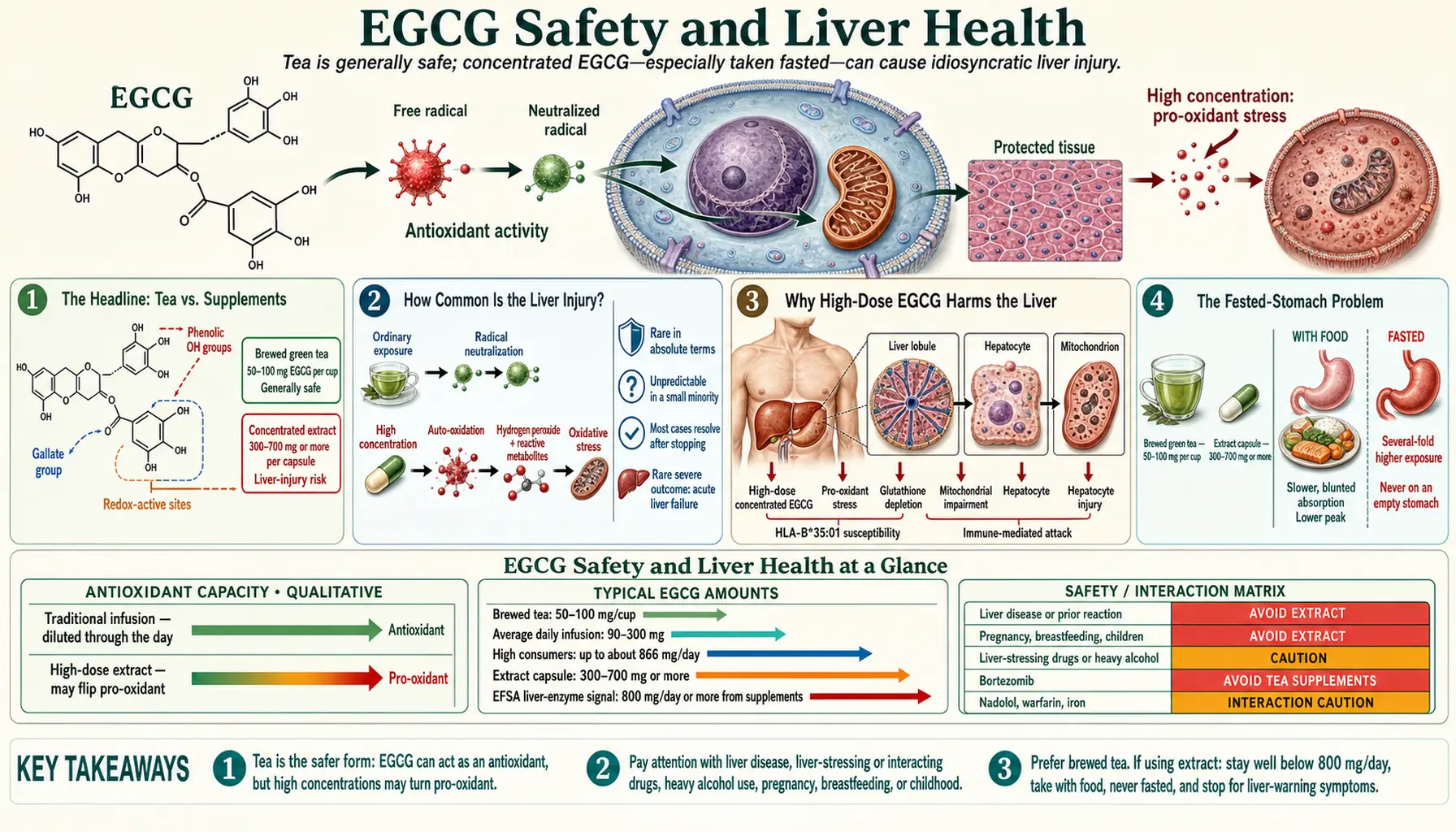
This is the most important page in the EGCG collection, and its message is simple: your cup of green tea is safe, but a high-strength EGCG capsule — especially swallowed on an empty stomach — is not risk-free. Concentrated green tea extracts have caused real liver injury in otherwise healthy people, ranging from silently elevated liver enzymes to, in rare cases, acute liver failure requiring a transplant. This is not fear-mongering; it is the documented conclusion of the U.S. Pharmacopeia, the European Food Safety Authority, and the NIH's drug-injury network. The good news is that the risk is avoidable. This page explains exactly who is at risk, why the fasted-stomach habit is the danger, what the official dose guidance says, and the warning signs that mean stop immediately and call a doctor.
Table of Contents
- The Headline: Tea vs. Supplements
- How Common Is the Liver Injury?
- Why High-Dose EGCG Harms the Liver
- The Fasted-Stomach Problem
- EFSA Guidance and the 800 mg Signal
- USP and LiverTox: Cautionary Labeling
- Warning Signs and What to Do
- Who Should Avoid or Be Cautious
- How to Use EGCG Safely
- Other Safety Considerations
- Key Research Papers
- Connections
- Featured Videos
The Headline: Tea vs. Supplements
The single most important distinction in all of EGCG safety is brewed green tea versus concentrated green tea extract (GTE) supplements.
- Brewed green tea is safe. Even heavy tea-drinking populations — parts of Japan and China where people drink many cups a day for a lifetime — show no signal of tea-caused liver injury. The catechins arrive diluted, with food and throughout the day, and in amounts the liver handles easily. Multiple safety reviews classify traditional green tea infusions as generally safe.
- Concentrated EGCG supplements can injure the liver. Pull the catechins out of the leaf, concentrate them into a capsule delivering many hundreds of milligrams of EGCG in one dose, and swallow it on an empty stomach, and you create the conditions under which idiosyncratic hepatotoxicity has repeatedly been reported.
Why does this matter so much? Because the marketing of "green tea extract" deliberately borrows the safety halo of the beverage while delivering a fundamentally different exposure. The number that separates them is dose: a cup of green tea supplies roughly 50–100 mg of EGCG; a single "fat burner" or "green tea extract" capsule can supply 300–700 mg or more, and stacked doses can push well past the threshold where the liver signal appears.
How Common Is the Liver Injury?
Green tea extract hepatotoxicity is idiosyncratic — it happens unpredictably in a small minority of users, not to everyone who exceeds a dose. That makes it rare in absolute terms but far from negligible given how many people take these products.
- The U.S. Drug-Induced Liver Injury Network (DILIN), described by Navarro and colleagues (2017, Hepatology), found that herbal and dietary supplements account for a growing share of drug-induced liver injury cases in the United States — roughly a fifth of the network's cases — and green tea extract is one of the single most frequently implicated ingredients, often inside multi-ingredient weight-loss products.
- Mazzanti and colleagues (2009) reviewed the published case literature and documented a consistent pattern of hepatocellular injury following green tea extract use, with liver enzymes typically normalizing after the product was stopped, and re-injury on rechallenge in some patients — strong evidence the extract was the cause.
- Most cases resolve fully once the supplement is discontinued, but a small number have progressed to acute liver failure requiring transplantation or resulting in death. That worst-case outcome, however uncommon, is what makes the caution non-negotiable.
Emerging research suggests a genetic susceptibility: people carrying the HLA-B*35:01 immune-system variant appear more prone to green tea extract liver injury, which helps explain why it strikes some users and spares others at the same dose. There is currently no routine test to identify susceptible individuals before the fact.
Why High-Dose EGCG Harms the Liver
The mechanism is not fully settled, but the leading explanations fit together:
- Pro-oxidant stress at high concentration. As explained on the Antioxidant & Cellular Health page, EGCG flips from antioxidant to pro-oxidant at high concentrations, auto-oxidizing to generate hydrogen peroxide and reactive metabolites. The liver, as the organ that concentrates and metabolizes absorbed EGCG, bears the brunt of that oxidative stress.
- Reactive metabolites and mitochondrial injury. High EGCG exposure can deplete hepatocyte glutathione and impair mitochondrial function, a classic pathway to liver-cell death.
- Immune (idiosyncratic) reaction. The HLA-B*35:01 association points to an immune-mediated component in susceptible people, where an EGCG-modified protein is treated as foreign and triggers an immune attack on liver cells.
All three mechanisms are dose-dependent and exposure-dependent — which is precisely why the concentration reached in the blood, driven by dose and by whether the stomach is empty, is the key modifiable risk factor.
The Fasted-Stomach Problem
One of the most actionable findings in EGCG safety is that taking the supplement on an empty stomach dramatically increases how much EGCG enters the bloodstream. Pharmacokinetic studies show that fasting can raise systemic EGCG exposure several-fold compared with taking the same dose with food. Food in the stomach slows and blunts absorption, keeping peak blood concentrations lower.
This creates a dangerous irony. Supplement users are often told to take green tea extract fasted — either to "maximize absorption" for fat-burning or simply as a morning routine before eating. But the fasted state is exactly what produces the high peak EGCG concentrations linked to liver injury. Many of the documented hepatotoxicity cases involved fasted or between-meal dosing of concentrated products. The practical takeaway is unambiguous: if you take any green tea extract, take it with food, never on an empty stomach.
EFSA Guidance and the 800 mg Signal
In 2018 the European Food Safety Authority (EFSA) completed a formal scientific opinion on the safety of green tea catechins, and its conclusions are the clearest official dose guidance available:
- Catechins from traditional green tea infusions, and from reconstituted drinks of equivalent composition, are generally considered safe.
- EGCG taken as a food supplement at doses of 800 mg per day or more was associated with statistically significant elevations in serum ALT (a liver enzyme), signaling liver injury.
- EFSA concluded it could not identify a specific safe dose of EGCG from supplements based on the available data — meaning below 800 mg/day there was not enough evidence to declare a level definitively safe, so caution is warranted across supplemental use.
- For context, average daily EGCG intake from green tea infusions was estimated at roughly 90–300 mg, with high consumers reaching up to about 866 mg — showing that heavy tea drinking can approach the signal threshold, though the beverage's slower absorption keeps peak exposure lower than an equivalent supplement bolus.
The bottom line from EFSA: keep supplemental EGCG well below 800 mg per day, and recognize that the beverage's safety does not transfer automatically to concentrated capsules.
USP and LiverTox: Cautionary Labeling
The United States Pharmacopeia (USP), which sets quality standards for supplements, has reviewed green tea extract safety twice:
- Sarma and colleagues (2008) conducted USP's first systematic review and concluded that green tea extract products should carry a cautionary labeling statement advising consumers to take the product with food and to discontinue use and seek medical care if symptoms of liver trouble appear.
- Oketch-Rabah and colleagues (2020, Toxicology Reports) updated that review comprehensively. It reaffirmed the causal link between green tea extract and hepatotoxicity, emphasized the fasted-state and high-dose risk factors, and supported clear consumer warnings.
The NIH's LiverTox database lists green tea extract among the more common causes of herbal and dietary supplement liver injury, describes the typical hepatocellular injury pattern, and notes the HLA-B*35:01 susceptibility association. These are mainstream, authoritative sources — not fringe warnings — and they converge on the same message: concentrated green tea extract deserves respect and caution.
Warning Signs and What to Do
If you take any green tea extract supplement, learn the symptoms of liver injury and act on them immediately. Stop the supplement and contact a doctor if you develop:
- Yellowing of the skin or the whites of the eyes (jaundice)
- Dark, tea-colored urine
- Pale or clay-colored stools
- Persistent nausea, vomiting, or loss of appetite
- Pain or discomfort in the upper right abdomen (over the liver)
- Unusual fatigue or weakness
- Itchy skin without an obvious rash
Most green tea extract liver injury resolves once the product is stopped, which is why early recognition and prompt discontinuation matter so much. A doctor can confirm with Liver Function Tests (ALT, AST, bilirubin). Do not "push through" these symptoms or assume they are unrelated — and tell the clinician about every supplement you take, because green tea extract is often hidden inside multi-ingredient weight-loss or "detox" blends.
Who Should Avoid or Be Cautious
- People with existing liver disease — anyone with hepatitis, cirrhosis, NAFLD, or elevated baseline liver enzymes should avoid concentrated green tea extract supplements. (Note: ordinary green tea as a beverage has actually been studied as potentially helpful in NAFLD — it is the concentrated extract, not the drink, that is the concern.)
- People taking other liver-stressing medications — combining green tea extract with acetaminophen (paracetamol), statins, methotrexate, isoniazid, or heavy alcohol use adds cumulative liver burden.
- People who drink alcohol heavily.
- Pregnant and breastfeeding women — concentrated EGCG supplements have not been established as safe; stick to ordinary dietary tea in moderation.
- Children.
- Anyone who has previously reacted to a green tea extract product with liver symptoms — never rechallenge.
How to Use EGCG Safely
Putting the guidance together into a practical plan:
- Prefer the beverage. Brewed green tea is the safest source of EGCG by a wide margin and delivers the catechin-plus-caffeine combination that the benefit studies actually used. For most people, three to five cups a day is a sensible, safe intake.
- If you use an extract, keep the EGCG dose moderate — well below the 800 mg/day EFSA signal, and ideally closer to beverage-equivalent amounts.
- Always take extracts with food, never fasted. This is the single most protective habit.
- Don't stack multiple products. Check labels — green tea extract hides in weight-loss, "detox," and pre-workout blends, and doses can add up unknowingly.
- Choose reputable, third-party-tested products if you use them, since supplement labels are not always accurate.
- Know the warning signs above and stop immediately if they appear.
- Consider periodic liver enzyme checks if you use extracts regularly, especially in the first few months.
Other Safety Considerations
Beyond the liver, a few additional points round out EGCG safety:
- Iron absorption — tea catechins bind non-heme (plant) iron and reduce its absorption. People prone to iron deficiency should drink tea between meals rather than with iron-rich meals or iron supplements.
- Caffeine — green tea and many extracts contain caffeine, which can cause jitteriness, insomnia, palpitations, and raised blood pressure in sensitive people or at high stacked doses.
- Drug interactions — EGCG can reduce the effectiveness of the beta-blocker nadolol and the chemotherapy agent bortezomib (EGCG directly inactivates bortezomib, so patients on it should avoid green tea supplements), and vitamin-K-containing green tea products can interfere with the anticoagulant warfarin.
- Stimulant stacking — avoid combining high-dose green tea extract with other stimulant "fat burners," which compounds cardiovascular and liver risk.
- Gastrointestinal upset — concentrated catechins on an empty stomach commonly cause nausea (another reason to take with food).
None of these should obscure the central, reassuring fact: enjoyed as a beverage, green tea is one of the safest and most-studied drinks in the world. The caution on this page is specifically about concentrated, high-dose supplements — a different exposure that deserves a different level of respect.
Key Research Papers
- Oketch-Rabah HA et al. (2020). United States Pharmacopeia (USP) comprehensive review of the hepatotoxicity of green tea extracts. Toxicol Rep. — PubMed
- Mazzanti G et al. (2009). Hepatotoxicity from green tea: a review of the literature and two unpublished cases. Eur J Clin Pharmacol. — PubMed
- Sarma DN et al. (2008). Safety of green tea extracts: a systematic review by the US Pharmacopeia. Drug Saf. — PubMed
- Hu J et al. (2018). The safety of green tea and green tea extract consumption in adults — results of a systematic review. Regul Toxicol Pharmacol. — PubMed
- Navarro VJ et al. (2017). Liver injury from herbal and dietary supplements. Hepatology. — PubMed
- Chow HH et al. (2003). Pharmacokinetics and safety of green tea polyphenols after multiple-dose administration of EGCG and Polyphenon E in healthy individuals. Clin Cancer Res. — PubMed
- Pezeshki A et al. (2016). The effect of green tea extract supplementation on liver enzymes in patients with nonalcoholic fatty liver disease. Int J Prev Med. — PubMed
PubMed Topic Searches
- PubMed: Green tea extract hepatotoxicity
- PubMed: EGCG and liver injury
- PubMed: HLA-B*35:01 susceptibility
- PubMed: EGCG fasted vs fed bioavailability
- PubMed: Green tea catechin safety and dose
External Resources
- LiverTox (NIH) — Green Tea — the authoritative clinical summary of green tea extract liver injury.
- EFSA (2018) — Scientific opinion on the safety of green tea catechins
- NIH NCCIH — Green Tea
Connections
- EGCG Overview
- EGCG Benefits Hub
- EGCG for Metabolism & Weight
- EGCG for Heart & Cholesterol
- EGCG Antioxidant & Cellular Health
- Green Tea
- NAFLD
- Liver Disease
- Liver Function Tests
- Glutathione
- NAC
- Curcumin
- Alpha-Lipoic Acid
- Obesity
- All Antioxidants