Carnosine for Brain Health and Neuroprotection
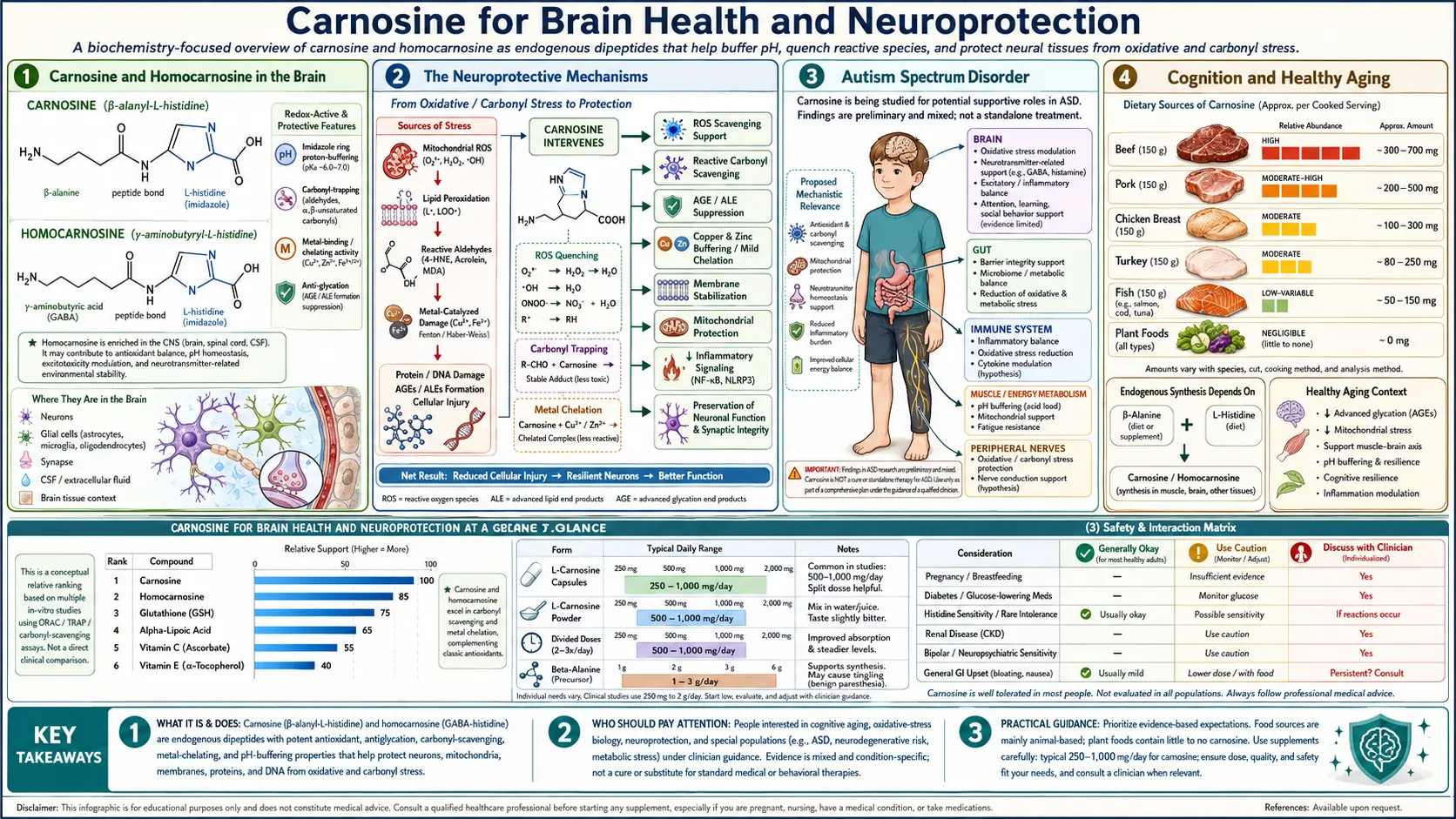
The brain is the second tissue, after muscle, where the body concentrates carnosine — and on paper it looks like an ideal place for a molecule that scavenges free radicals, quenches reactive carbonyls, and buffers the zinc and copper released during nerve signaling. That biochemistry has fueled a large, genuinely interesting research effort into carnosine for autism, age-related cognitive decline, stroke, and neurodegenerative disease. But this is the part of the carnosine story where honesty matters most. The human trials are small, short, sometimes contradictory, and frequently built on top of the same delivery problem that dogs the rest of the field: an enzyme in the blood that takes carnosine apart before it can reach the brain. This page grades the evidence area by area — flagging what is mechanistically plausible, what has weak but real human signals, and what is still only animal data.
Table of Contents
- Carnosine and Homocarnosine in the Brain
- The Neuroprotective Mechanisms
- Autism Spectrum Disorder
- Cognition and Healthy Aging
- Stroke and Cerebral Ischemia
- Neurodegenerative Disease
- The Brain Delivery Problem
- Honest Assessment: Small, Early, Mixed
- Practical Takeaways
- Key Research Papers
- Connections
- Featured Videos
Carnosine and Homocarnosine in the Brain
The brain contains carnosine along with a close relative, homocarnosine (gamma-aminobutyryl-histidine), which is actually the dominant imidazole dipeptide in human brain tissue. Carnosine is found especially in the olfactory system, where it is thought to act as a neurotransmitter or neuromodulator, and in glial cells — the support cells that protect and nourish neurons. This tissue-specific concentration is a hint, just as it is in muscle: the body invests in carnosine chemistry precisely in the places under the heaviest oxidative and metabolic load, and the brain, which burns a fifth of the body's energy and is packed with oxidizable fats, is exactly such a place.
Because carnosine is present natively in neural tissue and appears involved in normal signaling, researchers have long suspected it has protective and regulatory roles beyond simple antioxidant defense. Comprehensive reviews of the field (Schon et al., 2019; Berezhnoy et al., 2019) catalog a wide range of proposed brain functions — antioxidant, anti-glycation, metal-buffering, anti-excitotoxic, and pH-regulating — while consistently noting that the clinical evidence lags well behind the mechanistic enthusiasm.
The Neuroprotective Mechanisms
The case for carnosine in the brain rests on several converging, biologically real mechanisms, most demonstrated in cell and animal models:
- Antioxidant defense. Carnosine scavenges reactive oxygen species and, importantly, the reactive carbonyls produced when the brain's abundant polyunsaturated fats are oxidized — the same anti-carbonyl chemistry described on the Anti-Glycation page. Carnosine has been shown to quench acrolein directly in the central nervous system in an animal model of neuroinflammation.
- Zinc and copper buffering. Neurons release zinc and copper during signaling, and excess free zinc or copper is neurotoxic and can seed protein aggregation. Carnosine chelates both metals, and this zinc-buffering role is a central theme in theories of carnosine and neurodegeneration (Kawahara et al., 2018; Trombley et al., 2000).
- Anti-excitotoxicity. Overstimulation by the neurotransmitter glutamate (excitotoxicity) drives damage in stroke and neurodegeneration; carnosine appears to blunt aspects of this cascade in experimental models.
- Anti-aggregation and anti-glycation. By reducing glycation and carbonylation of proteins, carnosine may interfere with the misfolding and aggregation of proteins such as amyloid-beta — the basis for hypotheses about Alzheimer's disease (Hipkiss, 2007; Preston et al., 1998).
These mechanisms are individually well supported in the laboratory. The open question — true throughout this page — is whether they add up to a measurable benefit in a living human brain, given how little intact carnosine survives to get there.
Autism Spectrum Disorder
Autism is the brain condition most associated with carnosine in the public mind, largely because of a single early trial. In 2002, Michael Chez and colleagues ran a small, 8-week, double-blind, placebo-controlled study of oral L-carnosine in 31 children with autistic spectrum disorders and reported improvements on some standardized behavior and language measures compared with placebo (Chez et al., 2002). The proposed rationale involved carnosine's effects on neurological function and possibly on the temporal and frontal lobes.
That trial launched two decades of interest, but the follow-up evidence is genuinely mixed. Some later randomized studies reported benefits on particular outcome measures — for example a 2020 randomized controlled study by Abraham and colleagues found L-carnosine as an adjunctive therapy improved certain symptom scores in children with autism (Abraham et al., 2020) — while others found no significant effect. A 2021 systematic review and meta-analysis by the same group concluded that L-carnosine might confer some benefit but that the underlying trials were few, small, and of limited quality, so no firm recommendation could be made (Abraham et al., 2021). A broader 2022 network meta-analysis of pharmacological and dietary-supplement treatments for autism placed carnosine among many interventions with weak or uncertain evidence (Siafis et al., 2022).
The honest bottom line: carnosine for autism is an area of legitimate ongoing research with a plausible mechanism and some encouraging small signals, but it is not an established treatment, and families should regard it that way and discuss any use with the child's clinician. See our Autism page for the broader clinical picture.
Cognition and Healthy Aging
Some of the more encouraging human data come from Japan, where the imidazole dipeptides carnosine and anserine (a methylated carnosine relative abundant in poultry and fish) have been tested for age-related cognitive decline. In a randomized controlled trial, Hisatsune and colleagues (2016) found that anserine/carnosine supplementation preserved verbal episodic memory in elderly participants relative to placebo, with brain-imaging correlates. A later trial reported benefits specifically in older adults carrying the APOE4 Alzheimer's-risk gene with mild cognitive impairment (Masuoka et al., 2019). A 2021 systematic review with meta-analysis concluded that carnosine/anserine supplementation showed a possible protective effect against cognitive decline, while again emphasizing the small number and modest size of the trials (Caruso et al., 2021). More recently, a randomized trial reported carnosine improved some cognitive outcomes, with the clearest effect in younger participants (O'Toole et al., 2025).
These are real randomized trials with positive signals, which puts cognition on somewhat firmer footing than most carnosine indications. But the effects are modest, the trials are short, several come from overlapping research groups, and the anserine/carnosine combinations used differ from plain L-carnosine supplements sold elsewhere. It is fair to call cognitive aging the most promising human indication for carnosine chemistry, while stopping well short of calling it proven.
Stroke and Cerebral Ischemia
In animal models of stroke, carnosine looks impressive. Rajanikant and colleagues (2007) showed that carnosine was neuroprotective against permanent focal cerebral ischemia in mice, reducing the size of the brain injury. Multiple subsequent rodent studies have reported that carnosine limits ischemic and reperfusion damage through its combined antioxidant, anti-excitotoxic, anti-inflammatory, and metal-buffering actions, and reviews consistently list stroke among carnosine's most reproducible preclinical successes (Berezhnoy et al., 2019).
The crucial caveat is that this evidence is essentially all preclinical. The history of stroke research is littered with neuroprotective compounds that worked beautifully in rodents and then failed in human trials, because the human brain, the timing of treatment, and the complexity of real strokes differ from tidy animal models. Carnosine for human stroke remains an experimental idea, not a therapy. It is a promising target for properly designed clinical trials, and nothing more than that today.
Neurodegenerative Disease
The neurodegeneration hypothesis ties several carnosine themes together. In Alzheimer's disease, carnosine's ability to inhibit protein glycation, quench carbonyls, and buffer zinc and copper — metals implicated in amyloid aggregation — makes it a theoretically attractive candidate (Hipkiss, 2007; Kawahara et al., 2018). Early cell work showed carnosine and its relatives could protect brain endothelial cells against amyloid-beta toxicity (Preston et al., 1998). In Parkinson's disease, where oxidative stress in the substantia nigra is central, carnosine has shown protective effects in laboratory models, and a 2022 review summarized its antioxidant and neuroprotective actions across neurodegenerative conditions (Solana-Manrique et al., 2022).
A small number of exploratory human studies (for example add-on carnosine in Parkinson's) have reported modest improvements in some measures, but they are pilot-scale and not confirmatory. As with stroke, the mechanism is compelling and the preclinical data are supportive, yet there is no robust human evidence that carnosine prevents or slows Alzheimer's, Parkinson's, or any neurodegenerative disease. See our Alzheimer's Disease and Parkinson's Disease pages for the established clinical picture.
The Brain Delivery Problem
Every brain claim runs into the same wall that limits carnosine elsewhere: serum carnosinase, the blood enzyme that hydrolyzes carnosine within minutes of ingestion, plus the additional barrier of the blood-brain barrier itself. It is genuinely uncertain how much of an oral carnosine dose ever reaches brain tissue intact in humans. Several strategies are being explored to get around this — using anserine (which resists carnosinase somewhat better), designing carnosinase-resistant carnosine analogs and prodrugs, and relying on the brain's own ability to synthesize carnosine from circulating beta-alanine and histidine that cross the barrier.
This delivery uncertainty is a major reason to treat brain trials cautiously. When a study does show benefit, it is not always clear whether the active agent was intact carnosine reaching the brain, the beta-alanine and histidine released from it, or an indirect systemic anti-inflammatory effect. Untangling that is one of the field's central unsolved problems, discussed further on the Sources & Supplements page.
Honest Assessment: Small, Early, Mixed
Pulling the areas together, an evidence-graded summary looks like this:
- Cognitive aging — the strongest human signal, from several small randomized trials of anserine/carnosine, showing modest memory benefit. Promising but unproven.
- Autism — a plausible mechanism and some positive small trials, but the overall evidence is weak and mixed; not an established treatment.
- Stroke and neurodegeneration — robust and reproducible in animals, essentially untested in rigorous human trials. Experimental only.
- The delivery problem — serum carnosinase and the blood-brain barrier cast doubt on how much oral carnosine reaches the brain, complicating interpretation of every positive study.
Carnosine is a legitimately interesting neuroscience molecule and a reasonable subject for continued clinical research. It is not, on current evidence, a proven brain supplement, and the gap between the elegant mechanisms and the thin human data should keep expectations grounded.
Practical Takeaways
- Do not treat carnosine as a proven brain therapy for autism, dementia, stroke recovery, or Parkinson's. The mechanisms are real; the human proof is not there yet.
- If considering it for a specific condition, especially in a child with autism or an older adult with cognitive concerns, involve the treating clinician and view it as experimental, not as a substitute for established care.
- The best-supported brain use — modest memory support in aging — used anserine/carnosine combinations, not necessarily the plain L-carnosine capsules widely sold.
- Dietary intake of carnosine and anserine comes from meat, poultry, and fish; a mixed diet supplies these naturally, as covered on the Sources page.
- Be wary of strong marketing claims about carnosine "protecting the brain" or "preventing dementia" — they run far ahead of the evidence.
Key Research Papers
- Chez MG et al. (2002). Double-blind, placebo-controlled study of L-carnosine supplementation in children with autistic spectrum disorders. J Child Neurol, 17(11):833–837. — PMID 12585724
- Schon M et al. (2019). The potential of carnosine in brain-related disorders: a comprehensive review of current evidence. Nutrients, 11(6):1196. — PMID 31141890
- Berezhnoy DS et al. (2019). Carnosine as an effective neuroprotector in brain pathology and potential neuromodulator in normal conditions. Amino Acids, 51(1):139–150. — PMID 30353356
- Kawahara M, Tanaka KI, Kato-Negishi M (2018). Zinc, carnosine, and neurodegenerative diseases. Nutrients, 10(2):147. — PMID 29382141
- Hisatsune T et al. (2016). Effect of anserine/carnosine supplementation on verbal episodic memory in elderly people. J Alzheimers Dis, 50(1):149–159. — PMID 26682691
- Masuoka N et al. (2019). Effects of anserine/carnosine supplementation on mild cognitive impairment with APOE4. Nutrients, 11(7):1626. — PMID 31319510
- Caruso G et al. (2021). The therapeutic potential of carnosine/anserine supplementation against cognitive decline: a systematic review with meta-analysis. Biomedicines, 9(3):253. — PMID 33806459
- O'Toole TE et al. (2025). Carnosine supplementation improves cognitive outcomes in younger participants of the NEAT trial. Neurotherapeutics. — PMID 39919936
- Rajanikant GK et al. (2007). Carnosine is neuroprotective against permanent focal cerebral ischemia in mice. Stroke, 38(11):3023–3031. — PMID 17916766
- Abraham DA et al. (2020). Effect of L-carnosine as adjunctive therapy in the management of children with autism spectrum disorder: a randomized controlled study. Amino Acids, 52(11-12):1521–1528. — PMID 33170378
- Abraham DA et al. (2021). Effect of L-carnosine in children with autism spectrum disorders: a systematic review and meta-analysis of randomised controlled trials. Amino Acids, 53(4):575–585. — PMID 33704575
- Solana-Manrique C et al. (2022). Antioxidant and neuroprotective effects of carnosine: therapeutic implications in neurodegenerative diseases. Antioxidants (Basel), 11(5):848. — PMID 35624713
- Hipkiss AR (2007). Could carnosine or related structures suppress Alzheimer's disease? J Alzheimers Dis, 11(2):229–240. — PMID 17522447
PubMed Topic Searches
- PubMed: Carnosine and autism
- PubMed: Anserine/carnosine and cognition
- PubMed: Carnosine and cerebral ischemia
- PubMed: Carnosine, zinc, neurodegeneration
- PubMed: Homocarnosine in brain
External Authoritative Resources
- PubChem — Carnosine
- PubChem — Anserine (the methylated relative used in cognition trials)
- MedlinePlus — L-Carnosine
Connections
- Carnosine Benefits Hub
- Carnosine Overview
- Carnosine: Anti-Glycation & Aging
- Carnosine: Sources & Supplements
- Autism
- Alzheimer's Disease
- Parkinson's Disease
- Stroke
- Melatonin (Brain Antioxidant)
- NAC
- L-Theanine
- Glycine
- Histidine
- All Antioxidants
- Carnosine: Muscle & Exercise