Carnosine for Muscle and Exercise Performance
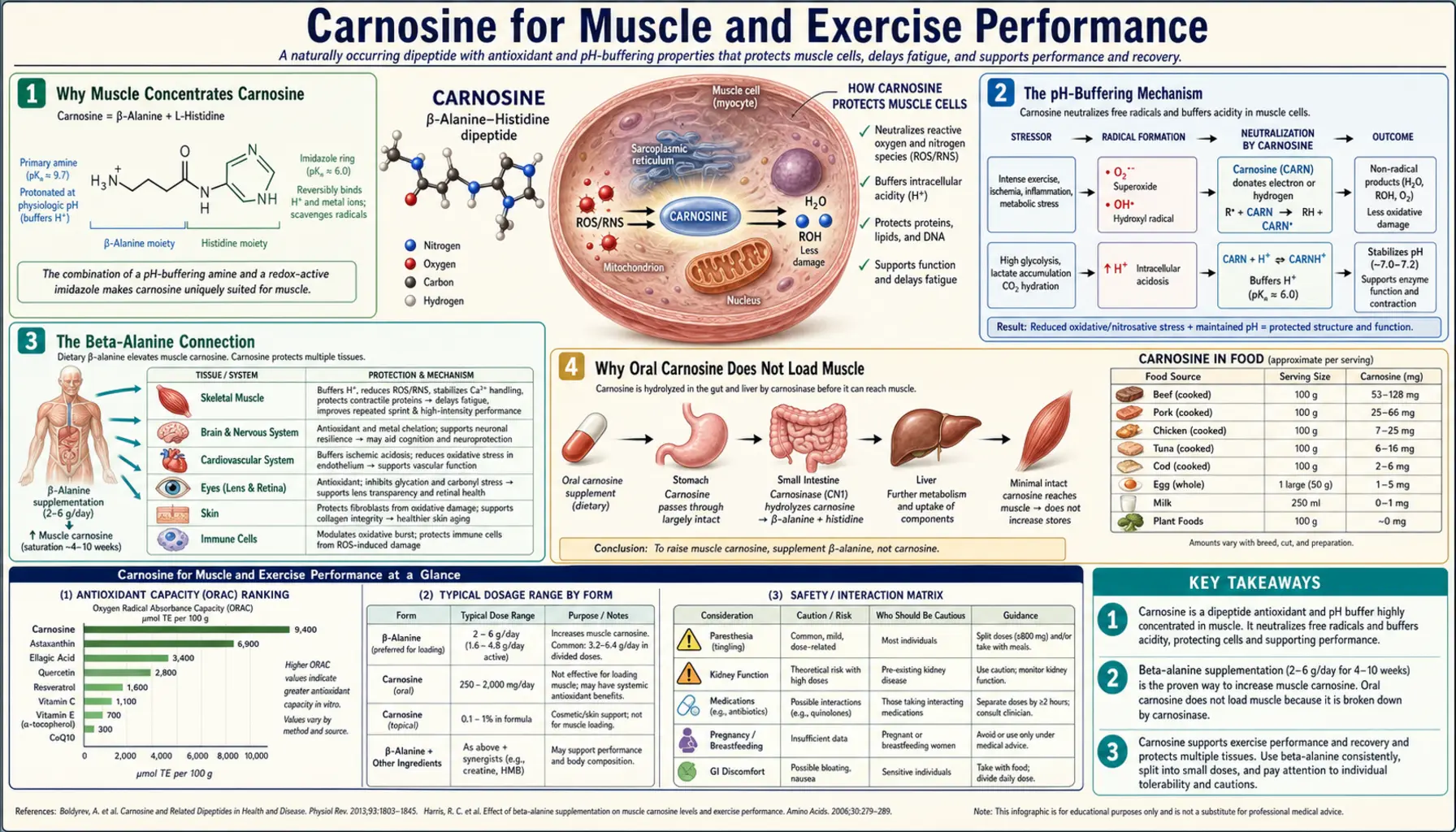
This is the one carnosine benefit that is genuinely well established in humans — but with a twist that trips up almost everyone. Muscle is where the body stockpiles most of its carnosine, using it as an internal pH buffer that soaks up the acid produced during hard, fast exercise. Raising muscle carnosine really does produce a small but reliable performance edge in high-intensity efforts. The twist is that swallowing carnosine barely helps: an enzyme in your blood dismantles it within minutes. The proven way to load muscle carnosine is to supplement its rate-limiting building block, beta-alanine, and let the muscle rebuild carnosine from the inside. This page walks through the buffering mechanism, the beta-alanine evidence base — one of the more rigorously studied topics in sports nutrition — and exactly who does and does not stand to gain.
Table of Contents
- Why Muscle Concentrates Carnosine
- The pH-Buffering Mechanism
- The Beta-Alanine Connection
- Why Oral Carnosine Does Not Load Muscle
- What the Performance Evidence Actually Shows
- Dosing, Loading, and the Tingling Side Effect
- Who Benefits Most
- Safety and Honest Limits
- Practical Takeaways
- Key Research Papers
- Connections
- Featured Videos
Why Muscle Concentrates Carnosine
Skeletal muscle holds the body's largest reserve of carnosine — concentrations reach the low millimolar range, far higher than in most other tissues. The distribution is not uniform: fast-twitch (type II) muscle fibers, the ones recruited for powerful, explosive, short-duration effort, contain substantially more carnosine than slow-twitch (type I) fibers built for endurance. This pattern is a strong clue to carnosine's job. Fast-twitch fibers rely heavily on anaerobic glycolysis — burning glucose without oxygen — during intense effort, and that process floods the cell with acid. Carnosine is positioned exactly where the acid problem is worst.
Across species, muscle carnosine content tracks how much a given animal depends on short bursts of maximal power. Sprinting animals and fast-twitch-dominant muscles carry more; enduring, slow-twitch tissue carries less. Within humans there is wide individual variation driven by fiber-type distribution, sex (men average higher than women), age (levels tend to decline with age), diet (meat-eaters average higher than vegetarians), and training history (Harris et al., 2012). Muscle carnosine can now be measured non-invasively in living people using proton magnetic resonance spectroscopy, which has made this one of the most quantifiable topics in nutritional physiology (Lievens et al., 2021).
The pH-Buffering Mechanism
During high-intensity exercise, muscle cells produce hydrogen ions faster than they can be cleared, and intracellular pH falls — the muscle becomes acidic. This acidosis is one of several factors that impair force production and contribute to the burning, failing sensation of an all-out effort: it interferes with the contractile machinery and with the enzymes of energy metabolism. (The old story that lactic acid itself causes the burn is an oversimplification; the accumulation of hydrogen ions is the more accurate culprit.)
Carnosine buffers this. The imidazole ring on its histidine component has an acid-dissociation constant (pKa) of roughly 6.8 — almost exactly in the middle of the pH range a working muscle passes through as it acidifies. A good buffer works best near its pKa, so carnosine is chemically tuned to absorb hydrogen ions precisely when and where the muscle needs it. Because it sits inside the muscle fiber, carnosine is one of the most important non-bicarbonate intracellular buffers, estimated to account for a meaningful share of a fiber's total buffering capacity, especially in fast-twitch fibers (Matthews et al., 2019). More carnosine means the muscle can tolerate more hydrogen-ion production before pH drops far enough to impair performance — which is the entire mechanistic basis for the ergogenic effect.
The Beta-Alanine Connection
Carnosine is synthesized inside the muscle from two amino acids, beta-alanine and L-histidine, joined by the enzyme carnosine synthase. Histidine is plentiful in muscle, so it is not limiting. Beta-alanine is the rate-limiting ingredient — there is normally not enough free beta-alanine available to push carnosine synthesis to its maximum. This single fact reorganizes the whole practical picture: if you want more muscle carnosine, the effective lever is to supply more beta-alanine, not more carnosine.
The landmark demonstration came from Roger Harris and colleagues in 2006. They showed that oral beta-alanine supplementation is absorbed and drives a substantial, dose-dependent increase in muscle carnosine content in the human vastus lateralis (the large quadriceps muscle), directly tying the precursor to the product (Harris et al., 2006). Subsequent work established the dose-response in detail: chronic beta-alanine supplementation, typically 3.2 to 6.4 grams per day for four to twelve weeks, raises muscle carnosine by roughly 40 to 80 percent, with longer supplementation producing larger gains (Sale et al., 2010; Stellingwerff et al., 2012; Saunders et al., 2017 [24-week study]). After supplementation stops, muscle carnosine washes out slowly, over many weeks, because carnosine turnover in muscle is naturally slow.
For the amino acid itself — its metabolism, food sources, and other roles — see our dedicated Beta-Alanine page.
Why Oral Carnosine Does Not Load Muscle
The obvious question is: why not just take carnosine directly? The answer is an enzyme called serum carnosinase (CN1), which circulates in human blood and rapidly hydrolyzes carnosine back into its two component amino acids. Swallow a dose of carnosine and much of it is dismantled in the bloodstream within minutes, long before it can be delivered intact to muscle. The muscle then has to rebuild carnosine from the resulting beta-alanine and histidine anyway — so, pound for pound, oral carnosine is an inefficient and expensive way to deliver beta-alanine.
Interestingly, humans are unusual here. Many other mammals have little or no serum carnosinase activity, so in those species oral carnosine survives better. This species difference is one reason animal studies of oral carnosine can look more promising than the human reality — a caution that applies across the whole carnosine literature and is examined further on the Sources & Supplements page. For the specific goal of loading muscle carnosine to buffer exercise acidosis, the consensus is clear: beta-alanine is the tool, not oral carnosine.
What the Performance Evidence Actually Shows
Beta-alanine is one of a small handful of sports supplements with genuine, meta-analytic support — but it is important to be precise about the size and shape of the effect, because it is easy to overstate.
A 2012 meta-analysis by Hobson and colleagues, pooling many controlled trials, found a small but statistically significant benefit of beta-alanine on exercise performance, concentrated in exercise lasting between about one and four minutes — the duration window where anaerobic glycolysis and the resulting acidosis are most limiting (Hobson et al., 2012). A larger 2017 systematic review and meta-analysis in the British Journal of Sports Medicine by Saunders and colleagues reached the same conclusion with more data: a real overall effect, modest in magnitude, most reliable for high-intensity exercise of roughly 30 seconds to 10 minutes, and negligible for single very short sprints or for long steady endurance (Saunders et al., 2017).
What this looks like in practice: a rower shaving a small fraction off a 2,000-meter time, a cyclist producing slightly more work in a repeated-sprint test, a lifter squeezing out an extra rep or two before failure in a high-repetition set. The effect is real and reproducible, but it is an edge, not a transformation — the typical improvement is on the order of a couple of percent. The International Society of Sports Nutrition, reviewing the full body of evidence, formally endorsed beta-alanine as an effective ergogenic aid for high-intensity exercise while being explicit about the modest effect size and the specific duration window (Trexler et al., 2015).
Dosing, Loading, and the Tingling Side Effect
The evidence-based protocol is a loading approach rather than a single pre-workout dose — because the benefit comes from chronically elevated muscle carnosine, not from an acute spike:
- Daily dose: roughly 3.2 to 6.4 grams of beta-alanine per day, sustained for at least four weeks and ideally longer; carnosine continues to rise for several weeks of continued intake (Stellingwerff et al., 2012).
- Timing does not matter much. Because you are slowly building a tissue store, the effect depends on total daily intake over weeks, not on taking it right before training.
- The tingling. A single large dose of beta-alanine (above roughly 800 mg to 10 mg per kg of body weight) commonly causes paresthesia — a harmless pins-and-needles or flushing sensation on the skin of the face, neck, and hands, lasting 10–60 minutes. It is caused by beta-alanine activating certain sensory nerve receptors and is not dangerous.
- How to avoid the tingling: split the daily total into smaller doses (for example 4 x 0.8–1.6 g through the day), take it with food, or use a sustained-release formulation, which blunts the blood spike that triggers paresthesia.
Because muscle carnosine washes out slowly after you stop, occasional missed days are inconsequential; consistency over weeks is what counts.
Who Benefits Most
- Athletes in high-intensity, glycolytic events — rowing, 400–1500 m running, sprint cycling, swimming middle distances, combat sports, and repeated-sprint team sports — are the clearest beneficiaries, because their limiting factor is exactly the acidosis carnosine buffers.
- People doing high-repetition resistance training may get a small benefit in sets taken near failure, where local muscle acidosis limits total reps.
- Vegetarians and vegans start with measurably lower baseline muscle carnosine because they consume no dietary beta-alanine from meat, so they often show the largest proportional increase from supplementation (Baguet et al., 2011). This is discussed further on the Sources page.
- Trained muscle may load more. Some evidence suggests already-trained muscle takes up carnosine somewhat more readily than untrained muscle (Bex et al., 2014).
- Endurance-only athletes and single-sprint power athletes get little from it — their events fall outside the duration window where buffering is decisive.
Safety and Honest Limits
Beta-alanine has a reassuring safety record. A systematic risk assessment and meta-analysis by Dolan and colleagues (2019) examined the available human data and found no evidence of harmful effects beyond the transient, benign paresthesia; markers of health and function were unaffected by supplementation across the studied range (Dolan et al., 2019; see also Ko et al., 2014). It is worth noting the honest caveats too: the vast majority of trials are short (weeks to a few months), so very-long-term safety is inferred rather than proven, and beta-alanine can modestly lower muscle taurine in animal models, though this has not translated into a demonstrated human problem.
The performance limits are equally important to state plainly. The benefit is real but small, specific to a particular exercise duration, and it will not compensate for inadequate training, sleep, or overall nutrition. It stacks additively — not synergistically — with other buffering strategies such as sodium bicarbonate. And none of the muscle-buffering evidence supports the broader anti-aging or disease claims sometimes attached to carnosine; those rest on a separate and far weaker evidence base covered on the Anti-Glycation & Aging page.
Practical Takeaways
- Use beta-alanine, not oral carnosine, if your goal is muscle buffering — serum carnosinase dismantles swallowed carnosine before it can help.
- Think loading, not pre-workout. Take 3.2–6.4 g/day for at least four weeks; the benefit comes from a raised tissue store, so daily consistency beats timing.
- Split the dose or use sustained-release to avoid the harmless tingling; take with meals.
- Match it to your event. Expect a small edge in hard efforts of roughly 30 seconds to a few minutes; expect little for pure endurance or single explosive lifts.
- Vegetarians and vegans tend to have the most to gain because their starting muscle carnosine is lower.
- Keep expectations calibrated: a couple of percent is a meaningful margin in competition but not a game-changer for general fitness.
Key Research Papers
- Harris RC et al. (2006). The absorption of orally supplied beta-alanine and its effect on muscle carnosine synthesis in human vastus lateralis. Amino Acids, 30(3):279–289. — PMID 16554972
- Sale C, Saunders B, Harris RC (2010). Effect of beta-alanine supplementation on muscle carnosine concentrations and exercise performance. Amino Acids, 39(2):321–333. — PMID 20091069
- Derave W, Everaert I, Beeckman S, Baguet A (2010). Muscle carnosine metabolism and beta-alanine supplementation in relation to exercise and training. Sports Med, 40(3):247–263. — PMID 20199122
- Hobson RM et al. (2012). Effects of beta-alanine supplementation on exercise performance: a meta-analysis. Amino Acids, 43(1):25–37. — PMID 22270875
- Stellingwerff T, Decombaz J, Harris RC, Boesch C (2012). Optimizing human in vivo dosing and delivery of beta-alanine supplements for muscle carnosine synthesis. Amino Acids, 43(1):57–65. — PMID 22358258
- Trexler ET et al. (2015). International Society of Sports Nutrition position stand: Beta-Alanine. J Int Soc Sports Nutr, 12:30. — PMID 26175657
- Blancquaert L, Everaert I, Derave W (2015). Beta-alanine supplementation, muscle carnosine and exercise performance. Curr Opin Clin Nutr Metab Care, 18(1):63–70. — PMID 25474013
- Saunders B et al. (2017). Beta-alanine supplementation to improve exercise capacity and performance: a systematic review and meta-analysis. Br J Sports Med, 51(8):658–669. — PMID 27797728
- Saunders B et al. (2017). Twenty-four weeks of beta-alanine supplementation on carnosine content, related genes, and exercise. Med Sci Sports Exerc, 49(5):896–906. — PMID 28157726
- Matthews JJ, Artioli GG, Turner MD, Sale C (2019). The physiological roles of carnosine and beta-alanine in exercising human skeletal muscle. Med Sci Sports Exerc, 51(10):2098–2108. — PMID 31083045
- Dolan E et al. (2019). A systematic risk assessment and meta-analysis on the use of oral beta-alanine supplementation. Adv Nutr, 10(3):452–463. — PMID 30980076
- Baguet A et al. (2011). Effects of sprint training combined with vegetarian or mixed diet on muscle carnosine content and buffering capacity. Eur J Appl Physiol, 111(10):2571–2580. — PMID 21373871
PubMed Topic Searches
- PubMed: Beta-alanine, muscle carnosine, performance
- PubMed: Muscle carnosine pH buffering
- PubMed: Beta-alanine meta-analyses
- PubMed: Beta-alanine safety and paresthesia
- PubMed: Vegetarian muscle carnosine
External Authoritative Resources
- NIH Office of Dietary Supplements — Exercise and Athletic Performance (beta-alanine section)
- Journal of the International Society of Sports Nutrition — Beta-Alanine Position Stand (full text)
- PubChem — Beta-Alanine
Connections
- Carnosine Benefits Hub
- Carnosine Overview
- Carnosine: Anti-Glycation & Aging
- Carnosine: Sources & Supplements
- Beta-Alanine (Rate-Limiting Precursor)
- Histidine (Precursor)
- Creatine
- Taurine
- Carnitine
- All Antioxidants
- Beef
- Chicken
- Pork
- Salmon
- Carnosine: Brain & Neuroprotection