Carnosine: Food Sources and Supplements
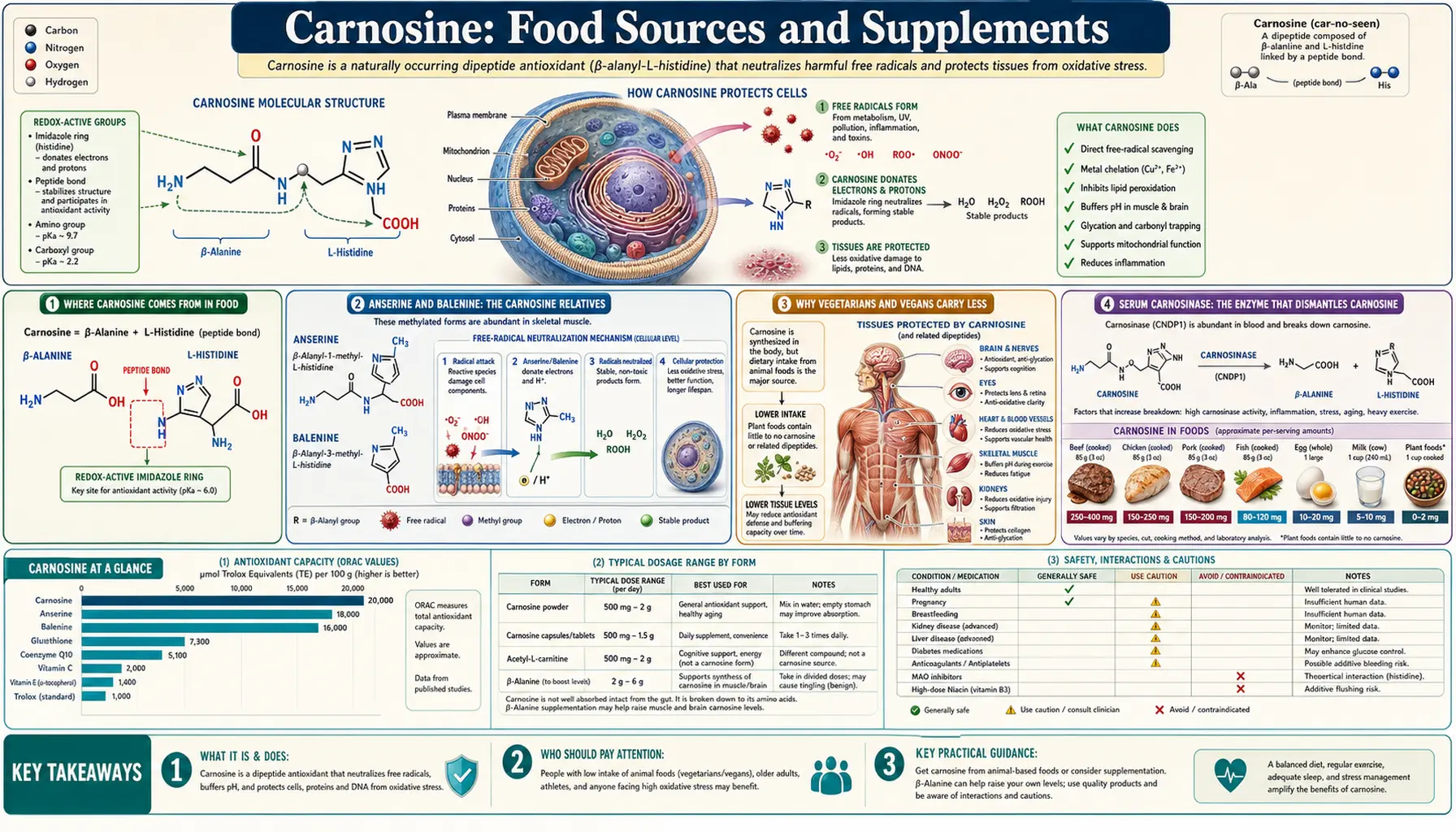
Carnosine is fundamentally an animal-tissue molecule: it is found in meat, poultry, and fish, and essentially not at all in plants — which is why lifelong vegetarians and vegans carry measurably less of it in their muscles. That single fact frames the whole practical discussion. When people ask whether they should supplement carnosine, the honest answer depends on an enzyme most have never heard of: serum carnosinase, which chops swallowed carnosine into pieces in the bloodstream within minutes, and whose activity is set partly by your genes. This page maps where carnosine comes from in the diet, why the body defends against intact carnosine so aggressively, and how that biology decides whether plain L-carnosine, its precursor beta-alanine, or a specialized form like zinc-carnosine is the right tool for a given goal.
Table of Contents
- Where Carnosine Comes From in Food
- Anserine and Balenine: The Carnosine Relatives
- Why Vegetarians and Vegans Carry Less
- Serum Carnosinase: The Enzyme That Dismantles Carnosine
- CNDP1 Genetics: Why It Varies Between People
- Oral Carnosine vs Beta-Alanine
- Supplement Forms on the Shelf
- Safety, Interactions, and Cautions
- Practical Takeaways
- Key Research Papers
- Connections
- Featured Videos
Where Carnosine Comes From in Food
Carnosine is concentrated in the skeletal muscle of animals, so the dietary sources are exactly the muscle meats: beef, pork, poultry, and fish. Red meats such as beef and pork are generally among the richer sources of carnosine specifically, while poultry and fish are richer in its close relative anserine (discussed next). Content varies with the animal, the cut, the muscle's fiber type, and how the food is prepared — because carnosine is water-soluble, some of it leaches into cooking juices and is lost if those juices are discarded.
The single most important dietary fact is what is not a source: plants contain essentially no carnosine, anserine, or balenine. These imidazole dipeptides are synthesized and stored in animal muscle and brain; fruits, vegetables, grains, legumes, nuts, and seeds do not supply them in meaningful amounts. There is also no carnosine in dairy or eggs to speak of. This makes carnosine one of the clearest examples of a bioactive compound that a mixed omnivorous diet delivers and a strict plant-based diet does not — a point that matters for the muscle and, potentially, aging stories covered on the Muscle & Exercise and Anti-Glycation pages. For the individual foods, see our Beef, Chicken, Pork, Salmon, and Tuna pages.
Anserine and Balenine: The Carnosine Relatives
Carnosine belongs to a small family of imidazole dipeptides that share the histidine-based structure but differ slightly:
- Carnosine (beta-alanyl-L-histidine) — the parent compound, richest in mammalian muscle such as beef and pork.
- Anserine (beta-alanyl-1-methyl-L-histidine) — a methylated version abundant in poultry and fish (chicken, turkey, tuna, salmon). The added methyl group makes anserine somewhat more resistant to breakdown by human carnosinase, which is one reason several cognition trials used anserine/carnosine blends rather than plain carnosine (see the Brain page).
- Balenine (also called ophidine, beta-alanyl-3-methyl-L-histidine) — found in certain marine animals; researchers have explored it as a naturally carnosinase-resistant alternative that survives longer in human blood after ingestion (de Jager et al., 2023).
Humans do not just eat these dipeptides; we also make them. Dietary intake, endogenous synthesis from beta-alanine and histidine, and the balance of breakdown enzymes together set tissue levels. Food-composition studies of histidine-dipeptide content in meat confirm the broad pattern — red meat higher in carnosine, poultry higher in anserine — and show that the amounts depend on the animal's diet and muscle type (Kopec et al., 2013).
Why Vegetarians and Vegans Carry Less
Because plants supply no carnosine and no beta-alanine, people who avoid meat depend entirely on the body's own synthesis, which is limited by beta-alanine availability. The measurable result: vegetarians and vegans have lower muscle carnosine on average than omnivores. Everaert and colleagues (2011) documented this in a large human study, finding that vegetarianism, female sex, and older age were each independently associated with reduced muscle carnosine (interestingly, CNDP1 genotype was not a major driver of muscle levels in that analysis).
The effect is real but not catastrophic, and it responds to intervention. A randomized trial found that switching omnivorous women to a vegetarian diet reduced the body's creatine pool but did not substantially disturb carnosine (or carnitine) homeostasis over the study period, suggesting the body compensates to a degree (Blancquaert et al., 2018). And vegetarians who supplement beta-alanine, or who do high-intensity training, can raise muscle carnosine just like omnivores — indeed, because they start lower, they often show the largest proportional gains (Baguet et al., 2011; de Salles Painelli et al., 2018). The practical implication for plant-based athletes is discussed on the Muscle & Exercise page.
Serum Carnosinase: The Enzyme That Dismantles Carnosine
The central character in any discussion of carnosine supplements is serum carnosinase (CN1), a circulating human enzyme that hydrolyzes carnosine into its two amino acids, beta-alanine and histidine. When you swallow carnosine, much of what is absorbed is broken down in the blood within minutes, so relatively little intact carnosine reaches tissues (Bellia et al., 2014). This is why direct oral carnosine is an inefficient way to raise muscle carnosine — the muscle has to rebuild it from the released beta-alanine anyway.
Humans are somewhat unusual in having high serum carnosinase activity; many other mammals have little, which is one reason animal studies of oral carnosine can look more favorable than the human reality. There is, however, a revealing exception: people with genetically low carnosinase activity retain far more intact carnosine after a dose. Everaert and colleagues (2012) showed that low plasma carnosinase activity promotes "carnosinemia" — measurable circulating carnosine — after carnosine ingestion in humans, directly demonstrating that the enzyme, not absorption, is the bottleneck. This has driven interest in carnosinase-resistant approaches: anserine and balenine, chemically modified analogs, and D-carnosine prodrugs designed to survive the enzyme (Orioli et al., 2011), as well as outright carnosinase inhibitors as a drug strategy (Regazzoni, 2024).
CNDP1 Genetics: Why It Varies Between People
How much carnosinase you make is partly written in your DNA. The enzyme is encoded by the CNDP1 gene, and a common variation in a repeated sequence in that gene (a CTG trinucleotide repeat, sometimes called the Mannheim polymorphism) changes how much carnosinase is secreted into the blood: certain genotypes produce less enzyme and therefore leave more carnosine intact (Riedl et al., 2007). This genetic difference is not just academic. It has been linked to the risk of diabetic kidney disease — individuals whose genotype yields lower carnosinase (and thus higher tissue carnosine) appear partly protected from diabetic nephropathy, and carnosinase activity differs between diabetic patients with and without kidney complications (Zhang et al., 2019; Peters et al., 2018).
The upshot is that carnosine biology is genuinely personalized. Two people taking the same oral carnosine dose can end up with very different amounts of intact carnosine in circulation depending on their CNDP1 genotype. This variability helps explain why supplement trials give inconsistent results and why blanket claims about "how much carnosine to take" are unreliable — the same dose is not the same exposure in different people.
Oral Carnosine vs Beta-Alanine
For most people the practical question reduces to a choice between two supplements, and the right answer depends on the goal:
- To raise muscle carnosine for exercise buffering: use beta-alanine. This is the evidence-based, well-studied route. Beta-alanine is the rate-limiting precursor, it is not degraded by serum carnosinase the way carnosine is, and controlled trials confirm it reliably loads muscle carnosine (Harris et al., 2006; Harris et al., 2012). Plain oral carnosine is a more expensive, less efficient way to deliver the same beta-alanine.
- For the anti-glycation and brain hypotheses: the answer is genuinely uncertain. These goals would require intact carnosine in tissues other than muscle, and serum carnosinase makes it unclear how well any oral form achieves that. This is where carnosinase-resistant relatives (anserine, balenine) and analogs are being investigated, and why the evidence on the Anti-Glycation and Brain pages remains preliminary.
In other words, the one goal with a clear supplement answer — muscle performance — is best served by beta-alanine, not by carnosine itself; and the goals where you might specifically want carnosine are the ones where delivery is least certain. That tension is the honest core of the whole carnosine supplement question.
Supplement Forms on the Shelf
Several distinct products get marketed under the carnosine umbrella; they are not interchangeable:
- L-carnosine — the plain dipeptide, sold as capsules or powder. Subject to the serum-carnosinase limitation described above. Commonly marketed for anti-aging and general antioxidant support, claims that outrun the human evidence.
- Beta-alanine — the precursor, and the properly evidence-based choice for muscle carnosine loading and high-intensity exercise. Covered in depth on the Beta-Alanine page. Typical protocol: 3.2–6.4 g/day for at least four weeks; causes harmless skin tingling at large single doses.
- Zinc-carnosine (polaprezinc) — a chelate of zinc and carnosine used mainly for the gut, where it acts locally on the stomach and intestinal lining to support mucosal healing (studied for gastric ulcers and gut-barrier integrity). Because it works topically in the digestive tract, it sidesteps the blood-carnosinase problem, but it is a different application from systemic carnosine and should not be conflated with it.
- Anserine/carnosine blends — used in the Japanese cognition trials; the anserine component resists carnosinase somewhat better than carnosine alone.
Safety, Interactions, and Cautions
- General tolerability. Both dietary carnosine and oral L-carnosine are well tolerated in the amounts studied, with no consistent pattern of serious adverse effects. Carnosine is, after all, a normal component of a meat-containing diet.
- Beta-alanine paresthesia. The main practical side effect in this family comes from beta-alanine, not carnosine: a harmless pins-and-needles tingling after large single doses, avoidable by splitting doses or using sustained-release forms (see the Muscle & Exercise page).
- Blood-sugar handling in diabetes. Because carnosine chemistry intersects with glycation and carnosinase intersects with diabetic kidney disease, people with diabetes considering supplementation should do so with clinician oversight, as an adjunct to — not a replacement for — standard glycemic management.
- Pregnancy and breastfeeding. There is insufficient safety data for supplemental doses; dietary intake from normal food is not a concern, but supplements are best avoided without medical advice.
- Claims to distrust. Be skeptical of L-carnosine products promising to reverse aging, dissolve AGEs, cure autism, or prevent dementia. These extrapolate from laboratory chemistry to human outcomes that have not been demonstrated.
Practical Takeaways
- Food first: a mixed diet with meat, poultry, and fish supplies carnosine and anserine naturally; plants supply none.
- Vegetarians and vegans start with lower muscle carnosine and are the group most likely to benefit from beta-alanine supplementation if performance is the goal.
- For exercise, choose beta-alanine, not oral carnosine — it is cheaper, better evidenced, and not destroyed by serum carnosinase.
- For gut healing, zinc-carnosine (polaprezinc) is a distinct, locally acting product — don't confuse it with systemic carnosine.
- Recognize the delivery problem: serum carnosinase and your CNDP1 genotype mean an oral carnosine dose is not the same exposure in everyone, which is why results and recommendations vary.
- Keep claims in proportion — the muscle-buffering benefit is proven; the anti-aging and brain benefits are hypotheses under study.
Key Research Papers
- Everaert I et al. (2011). Vegetarianism, female gender and increasing age, but not CNDP1 genotype, are associated with reduced muscle carnosine levels in humans. Amino Acids, 40(4):1221–1229. — PMID 20865290
- Everaert I et al. (2012). Low plasma carnosinase activity promotes carnosinemia after carnosine ingestion in humans. Am J Physiol Renal Physiol, 302(12):F1537–F1544. — PMID 22496410
- Bellia F, Vecchio G, Rizzarelli E (2014). Carnosinases, their substrates and diseases. Molecules, 19(2):2299–2329. — PMID 24566305
- Riedl E et al. (2007). A CTG polymorphism in the CNDP1 gene determines the secretion of serum carnosinase in Cos-7 transfected cells. Diabetes, 56(9):2410–2413. — PMID 17601991
- Peters V, Zschocke J, Schmitt CP (2018). Carnosinase, diabetes mellitus and the potential relevance of carnosinase deficiency. J Inherit Metab Dis, 41(1):39–47. — PMID 29027595
- Zhang S et al. (2019). Carnosinase concentration, activity, and CNDP1 genotype in patients with type 2 diabetes with and without nephropathy. Amino Acids, 51(4):611–617. — PMID 30610469
- Harris RC et al. (2012). Determinants of muscle carnosine content. Amino Acids, 43(1):5–12. — PMID 22327512
- Blancquaert L et al. (2018). Changing to a vegetarian diet reduces the body creatine pool in omnivorous women, but appears not to affect carnitine and carnosine homeostasis: a randomised trial. Br J Nutr, 119(7):759–770. — PMID 29569535
- Baguet A et al. (2011). Effects of sprint training combined with vegetarian or mixed diet on muscle carnosine content and buffering capacity. Eur J Appl Physiol, 111(10):2571–2580. — PMID 21373871
- de Salles Painelli V et al. (2018). High-intensity interval training augments muscle carnosine in the absence of dietary beta-alanine intake. Med Sci Sports Exerc, 50(11):2242–2252. — PMID 30334920
- de Jager S et al. (2023). Acute balenine supplementation in humans as a natural carnosinase-resistant alternative to carnosine. Sci Rep, 13(1):6484. — PMID 37081019
- Regazzoni L (2024). State of the art in the development of human serum carnosinase inhibitors. Molecules, 29(11):2488. — PMID 38893364
PubMed Topic Searches
- PubMed: Carnosine dietary content
- PubMed: Serum carnosinase and CNDP1
- PubMed: Vegetarian carnosine and beta-alanine
- PubMed: Carnosine oral bioavailability
- PubMed: Zinc-carnosine (polaprezinc)
External Authoritative Resources
- PubChem — Carnosine
- NCBI Gene — CNDP1 (serum carnosinase)
- MedlinePlus — L-Carnosine
- USDA FoodData Central (nutrient composition of meats and fish)
Connections
- Carnosine Benefits Hub
- Carnosine Overview
- Carnosine: Muscle & Exercise
- Carnosine: Anti-Glycation & Aging
- Carnosine: Brain & Neuroprotection
- Beta-Alanine
- Histidine
- Alanine
- Beef
- Chicken
- Pork
- Salmon
- Tuna
- Diabetes (CNDP1 link)
- All Antioxidants