Graves’ Disease: The Most Common Cause of Hyperthyroidism
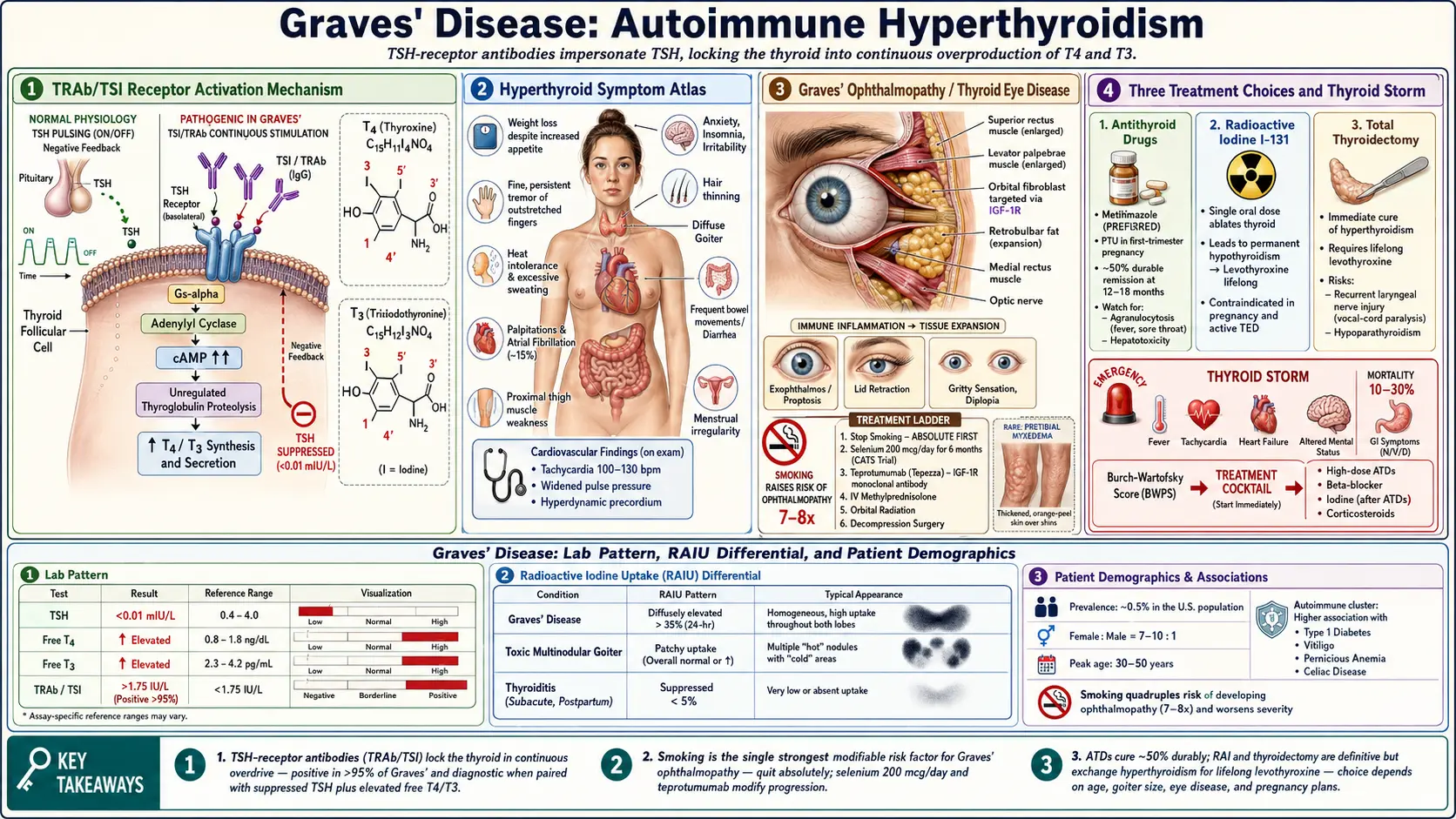
Graves’ disease is an autoimmune disorder in which antibodies called thyroid-stimulating immunoglobulins (TSI), also known as TSH receptor antibodies (TRAb), bind and activate the thyroid-stimulating hormone receptor, leading to unregulated production and secretion of thyroid hormone (PubMed PMID: 30283735). The 2018 European Thyroid Association (ETA) guideline describes it as the most prevalent cause of hyperthyroidism in iodine-replete regions, with 20–30 new cases per 100,000 people a year; it is more common in women, about 3% of women and 0.5% of men develop it during their lifetime, and incidence peaks between ages 30 and 60 (PubMed PMID: 30283735). The U.S. National Institute of Diabetes and Digestive and Kidney Diseases (NIDDK) states that it affects nearly 1 in 100 Americans and causes about 4 out of 5 cases of hyperthyroidism in the United States (NIDDK: Graves’ Disease). Hallmarks include goiter, hyperthyroidism and, in a pooled 40% of people with Graves’ disease in a 2020 meta-analysis of 57 studies, an orbital inflammation known as Graves’ ophthalmopathy or thyroid eye disease (PubMed PMID: 32691849).
Interactive Visualization How Your Thyroid Is Controlled — run the feedback loop Watch TSH drive the thyroid, T4 convert to T3, and the loop feed back — then switch on Hashimoto's, Graves', or iodine deficiency. Launch → Interactive Visualization Autoimmunity: When Defence Turns on You Watch immune cells lose the ability to tell self from invader and attack the body's own tissue — then see how tolerance normally prevents it and why it breaks down. Launch →Table of Contents
What Graves’ Disease Is
The 2018 ETA guideline describes Graves’ disease as a systemic autoimmune disorder in which thyroid antigen-specific T cells infiltrate tissues that carry the TSH receptor, while stimulating autoantibodies activate that receptor; the antibodies raise intracellular cyclic AMP, which releases thyroid hormone and drives growth of the thyroid cells, and the result is thyroid enlargement with unregulated hormone production (PubMed PMID: 30283735). The same guideline reports that about 30% of patients have family members with Graves’ disease or Hashimoto’s thyroiditis, that twin studies attribute 80% of the susceptibility to genes, and that cigarette smoking, high dietary iodine intake, stress and pregnancy also predispose to the disease, while oral contraceptive use appears protective (PubMed PMID: 30283735). NIDDK describes the cause as probably a combination of genes and an outside trigger, such as a virus (NIDDK: Graves’ Disease).
Graves’ disease clusters with other autoimmune disorders. In a UK study of 2,791 people with Graves’ disease, 9.67% had another autoimmune disorder, most often rheumatoid arthritis (3.15%), and relative risks exceeded 10 for pernicious anemia, systemic lupus erythematosus, Addison’s disease, celiac disease and vitiligo (PubMed PMID: 20103030). NIDDK also lists type 1 diabetes and autoimmune gastritis among the associated disorders (NIDDK: Graves’ Disease).
Hyperthyroid Symptoms
Symptoms listed by NIDDK (NIDDK: Graves’ Disease) and by the U.S. National Library of Medicine’s MedlinePlus encyclopedia (MedlinePlus: Graves disease) include:
- Weight loss despite an increased appetite
- Rapid or irregular heartbeat and palpitations. In a Danish registry of 40,628 people diagnosed with hyperthyroidism (of any cause) in hospital, 8.3% were diagnosed with atrial fibrillation or flutter within 30 days of the hyperthyroidism diagnosis; male sex, older age and existing heart disease were associated with higher risk (PubMed PMID: 15302638)
- Shaking hands (tremor)
- Heat intolerance and increased sweating
- Nervousness, irritability, moodiness and problems concentrating
- Trouble sleeping and fatigue
- Muscle weakness, described by MedlinePlus as affecting the hips and shoulders
- Frequent bowel movements; the 2016 Japanese thyroid storm guideline describes diarrhea as the most common gastrointestinal symptom of thyrotoxicosis (PubMed PMID: 27746415)
- Irregular menstrual periods; NIDDK lists problems with the menstrual cycle, fertility and pregnancy among the complications of untreated disease
- Hair loss
- An enlarged thyroid gland (goiter)
- Shortness of breath with activity
- Eye symptoms in Graves’ ophthalmopathy: bulging, gritty or irritated eyes, puffy eyes, light sensitivity, pressure or pain, and blurred or double vision
- Rarely, Graves’ dermopathy (pretibial myxedema): reddish, thick skin with a rough texture, usually on the shins
MedlinePlus notes that older people may instead show a rapid or irregular heartbeat, chest pain, memory loss or decreased concentration, and weakness and fatigue (MedlinePlus: Graves disease).
Graves’ Ophthalmopathy
The 2021 European Group on Graves’ Orbitopathy (EUGOGO) guideline describes Graves’ orbitopathy as the main extrathyroidal manifestation of Graves’ disease (PubMed PMID: 34297684). A 2020 meta-analysis of 57 studies (26,804 patients) found a pooled prevalence of 40% among people with Graves’ disease, ranging from 27% in North American studies to 58% in studies from Oceania (PubMed PMID: 32691849); NIDDK puts it at more than 1 in 3. NIDDK states that the eye symptoms can start before or at the same time as the hyperthyroidism, rarely after Graves’ disease has been treated, that the eye disease can develop even when thyroid function is normal, and that most people have mild symptoms (NIDDK: Graves’ Disease).
Smoking is closely linked to the eye disease: in a 1993 case-control study smoking was associated with an odds ratio of 7.7 for Graves’ ophthalmopathy (versus 1.9 for Graves’ hyperthyroidism without eye disease), and smokers had more severe eye disease (PubMed PMID: 8419666). The 2021 EUGOGO guideline lists smoking, thyroid dysfunction, a high serum TRAb level, radioactive iodine treatment and hypercholesterolemia as risk factors (PubMed PMID: 34297684). The eye disease is covered in detail on the Thyroid Eye Disease page. Treatments described in trials and the 2021 EUGOGO guideline include:
- Risk-factor control and local treatment. For mild, active disease, the guideline states that control of risk factors, local treatments and selenium (in selenium-deficient areas) are usually sufficient (PubMed PMID: 34297684).
- Selenium. In a 2011 EUGOGO randomized, double-blind trial of 159 patients with mild Graves’ orbitopathy, selenium 100 µg twice daily for 6 months, compared with placebo, improved quality of life, reduced eye involvement and slowed progression of the eye disease; the Clinical Activity Score fell in all groups but more with selenium, and exploratory 12-month results were similar. Pentoxifylline, tested in the same trial, did not improve these outcomes and frequently caused gastrointestinal problems, while no adverse events were evident with selenium. The published abstract reports no result for the trial’s secondary diplopia score (PubMed PMID: 21591944). A 2018 review by members of the trial group describes the treatment as a 6-month course of sodium selenite (PubMed PMID: 29933354). The trial studied mild disease only, and the guideline limits its statement on selenium to selenium-deficient areas (PubMed PMID: 34297684).
- Teprotumumab, a monoclonal antibody that inhibits the IGF-1 receptor, was approved in the USA on 21 January 2020 (PubMed PMID: 33865501). In the OPTIC trial of 83 patients with active thyroid eye disease (infusions every 3 weeks for 21 weeks), a proptosis response (a reduction of at least 2 mm) at week 24 occurred in 83% with teprotumumab versus 10% with placebo, an overall response in 78% versus 7%, and a diplopia response in 68% versus 29% (PubMed PMID: 31971679). In a pooled analysis of the two randomized trials (171 patients), the proptosis response was maintained 51 weeks after the final dose in 38 of 57 patients (67%) with follow-up data, and muscle spasm (18%), hearing loss (10%) and hyperglycaemia (8%) were the adverse events with the greatest risk difference from placebo (PubMed PMID: 33865501). The 2021 EUGOGO guideline lists teprotumumab among second-line treatments, having weighed efficacy and safety, costs, drug availability and long-term effectiveness (PubMed PMID: 34297684).
- Intravenous glucocorticoids. For moderate-to-severe, active disease the guideline states that intravenous glucocorticoids are more effective and better tolerated than oral ones, recommends intravenous methylprednisolone combined with mycophenolate as first-line treatment, and describes a cumulative 4.5 g of intravenous methylprednisolone in 12 weekly infusions as the optimal regimen (PubMed PMID: 34297684).
- Other second-line options listed by the guideline are a second course of intravenous methylprednisolone, oral glucocorticoids combined with cyclosporine or azathioprine, orbital radiotherapy combined with glucocorticoids, rituximab and tocilizumab (PubMed PMID: 34297684). The two randomized rituximab trials disagreed: against intravenous methylprednisolone (32 patients), the Clinical Activity Score fell more after rituximab and no disease reactivation occurred after it (PubMed PMID: 25494967), whereas against placebo (25 patients) rituximab offered no additional benefit and carried more moderate or severe adverse events (PubMed PMID: 25343233).
- Sight-threatening disease and surgery. The guideline describes treatment of sight-threatening disease with several high single doses of intravenous methylprednisolone per week and, if it does not respond, urgent orbital decompression; rehabilitative surgery (orbital decompression, squint and eyelid surgery) is described for inactive residual disease (PubMed PMID: 34297684).
Diagnosis
- Thyroid function tests. In overt hyperthyroidism free T4 and free T3 are elevated and TSH is suppressed; in milder hyperthyroidism free T4 can be normal, with only free T3 elevated and TSH undetectable (PubMed PMID: 30283735).
- TSH receptor antibodies (TRAb) or thyroid-stimulating immunoglobulins (TSI). The ETA guideline recommends TRAb measurement as a sensitive and specific tool for diagnosis, before stopping antithyroid drugs, and during pregnancy (PubMed PMID: 30283735). A 2012 meta-analysis of 21 studies reported pooled sensitivities and specificities between 97.1% and 99.2% for second- and third-generation binding assays (PubMed PMID: 22776786).
- Radioactive iodine uptake (RAIU) and scan. MedlinePlus describes higher-than-normal uptake, most commonly from Graves’ disease; toxic nodular goiter and toxic adenoma often give normal uptake concentrated into a few “hot” areas; and lower-than-normal uptake with subacute or silent thyroiditis, iodine overload, excess thyroid hormone intake or amiodarone (MedlinePlus: Radioactive iodine uptake). NIDDK states that in Graves’ disease the iodine shows up throughout the gland (NIDDK: Graves’ Disease). The ETA guideline states that typical ultrasound findings combined with positive TRAb make scintigraphy unnecessary in the vast majority of cases, and suggests it when nodules coexist and before radioactive iodine treatment (PubMed PMID: 30283735).
- Thyroid ultrasound with Doppler. The ETA guideline describes diffuse enlargement and low echogenicity, and increased blood flow (the “thyroid inferno” pattern) in untreated Graves’ disease; flow velocity can distinguish it from subacute thyroiditis and type 2 amiodarone-induced thyrotoxicosis, where flow is reduced (PubMed PMID: 30283735). NIDDK notes that Doppler may be used when a radioactive iodine uptake test is not a good option, such as during pregnancy or breastfeeding (NIDDK: Graves’ Disease).
Three Treatment Options
- Antithyroid drugs (ATDs). Methimazole (and its prodrug carbimazole) and propylthiouracil (PTU) reduce thyroid hormone synthesis. The ETA guideline recommends methimazole for every non-pregnant patient who chooses drug treatment, given for 12–18 months and stopped if TSH and TRAb are normal; it reports maximum remission rates of 50–55% within 12–18 months, with relapse most likely in the first 6–12 months after the drug is stopped (PubMed PMID: 30283735). In a 2013 network meta-analysis (8 studies, 1,402 patients), relapse occurred in 52.7% after antithyroid drugs, 15% after radioactive iodine and 10% after surgery; across 31 cohort studies adverse effects of the drugs occurred in 13% of patients, more often with methimazole (mainly skin reactions), while liver effects were more common with PTU (PubMed PMID: 23824415). The ETA guideline lists rash, urticaria and joint pain (1–5%) as the common side effects, and agranulocytosis in 0.1–1.0%, typically abruptly within 3 months of starting; PTU-associated liver toxicity occurs foremost in children (liver failure in up to 1 in 2,000 exposed children), whereas methimazole liver injury is usually milder and cholestatic (PubMed PMID: 30283735). In the FDA adverse-event reporting system, severe liver injury was reported more often than expected in children given PTU but not methimazole (PubMed PMID: 20427502). The guideline recommends that patients be told to report jaundice, light-colored stools, dark urine, fever, sore throat or cystitis promptly, and notes that routine blood counts are not useful because agranulocytosis begins abruptly (PubMed PMID: 30283735).
- Radioactive iodine (RAI, I-131). Taken by mouth as a capsule or liquid; NIDDK states that more than one treatment may be needed and that almost everyone treated later develops hypothyroidism, treated with daily thyroid hormone (NIDDK: Graves’ Disease). The ETA guideline reports hypothyroidism in 5–50% after the first year, rising by 3–5% a year thereafter, and no evidence of increased thyroid cancer or total cancer mortality after RAI (PubMed PMID: 30283735). It lists pregnancy and breastfeeding as absolute contraindications, recommends postponing conception for at least 6 months after treatment in both men and women, and states that RAI is contraindicated in active, severe orbitopathy (PubMed PMID: 30283735). In a 1998 randomized trial of 443 patients, eye disease developed or worsened in 15% of those given radioiodine alone (persistently in 5%), in no patient given radioiodine followed by a 3-month course of prednisone, and in 3% of those given methimazole (PubMed PMID: 9420337); the ETA guideline reports new or worsening eye disease in 15–33% after RAI and states that preventive glucocorticoids prevent it (PubMed PMID: 30283735).
- Thyroidectomy. The ETA guideline describes total thyroidectomy as the procedure of choice when surgery is selected, with rapid control of hyperthyroidism, no radiation risk and no reported harmful effect on the eye disease, but lifelong levothyroxine afterwards; listed complications are hypoparathyroidism, recurrent laryngeal nerve palsy, wound infection and bleeding, and the guideline recommends a high-volume surgeon and restoring normal thyroid function with antithyroid drugs before the operation (PubMed PMID: 30283735). In questionnaire-based surveys of clinicians, surgery was the first-line choice for newly diagnosed Graves’ hyperthyroidism in 0.9% (American) and 2.1% (European) of cases (PubMed PMID: 30283735).
Choosing Between Treatments
The 2018 ETA guideline (PubMed PMID: 30283735) describes how the options are matched to situations:
- Antithyroid drugs are described as first-line treatment for newly diagnosed Graves’ hyperthyroidism, particularly in younger people, with RAI or thyroidectomy considered for those who prefer them. Relapse after stopping the drugs is most likely with severe hyperthyroidism, large goiters or persistently high TRAb.
- RAI has no absolute indications but is often recommended after side effects of, or relapse after, a course of antithyroid drugs; older people whose hyperthyroidism precipitated atrial fibrillation, heart failure or cardiac ischemic symptoms are described as candidates for definitive therapy, usually RAI. The guideline states RAI is not contraindicated in large goiters.
- Surgery is described as effective when the goiter is large, primary hyperparathyroidism coexists, nodules are suspicious for cancer, the patient wishes to avoid antithyroid drugs and RAI, or RAI is not available.
- With eye disease, the guideline lists antithyroid drugs for moderate-to-severe active and for sight-threatening orbitopathy, and marks RAI and thyroidectomy as not used in those situations; for mild, active orbitopathy all three are listed, with 6 months of selenium alongside antithyroid drugs and steroid prophylaxis with RAI. The 2021 EUGOGO guideline likewise prefers antithyroid drugs for managing the hyperthyroidism in moderate-to-severe and sight-threatening orbitopathy (PubMed PMID: 34297684).
- Pregnancy. The guideline recommends switching from methimazole to PTU when planning pregnancy and in the first trimester, and considering a change back to methimazole if drugs are still needed after 16 weeks; it reports methimazole embryopathy in 2–4% of exposed children, especially with exposure in gestational weeks 6–10, and birth defects at a similar rate but of a less severe spectrum with PTU. Thyroidectomy, when drugs cannot be used, is described in the second trimester. NIDDK likewise notes that PTU is often used in the first 3 months because methimazole can, rarely, harm the fetus (NIDDK: Graves’ Disease).
- Children. The guideline recommends against PTU in children and adolescents and describes long-term methimazole as the mainstay.
Beta-blockers (propranolol, or longer-acting atenolol or bisoprolol) are described by the ETA guideline as useful for adrenergic symptoms such as palpitations and tremor, especially before antithyroid drugs take effect, and the guideline recommends beta-blockade in all suitable patients (PubMed PMID: 30283735). NIDDK notes that they do not stop thyroid hormone production (NIDDK: Graves’ Disease).
Thyroid Storm — A Medical Emergency
Thyroid storm is life-threatening thyrotoxicosis with decompensation of several organs — impaired consciousness, high fever, heart failure, diarrhea and jaundice; the ETA guideline estimates its mortality at 10% and grades it with the Burch–Wartofsky Point Scale (45 points or more consistent with thyroid storm, 25–44 impending) (PubMed PMID: 30283735). In Japanese nationwide surveys of 356 patients, mortality was 11.0% and 9.5% in the two diagnostic grades, and multiple organ failure was the most common cause of death (PubMed PMID: 22690898). The 2016 Japanese guideline describes thyroid storm as often associated with triggering illnesses, with infection the second most common trigger (28%) in the nationwide survey (PubMed PMID: 27746415); NIDDK notes that surgery under general anesthesia can lead to thyroid storm if antithyroid medicines are not taken beforehand (NIDDK: Graves’ Disease), and the ETA guideline describes storm after RAI as extremely rare (PubMed PMID: 30283735). The ETA guideline recommends a multimodal approach — antithyroid drugs, glucocorticoids, beta-blockade, cooling, fluid resuscitation, nutritional and respiratory support, and intensive-care monitoring (PubMed PMID: 30283735) — and the 2016 Japanese guideline recommends inorganic iodide given at the same time as antithyroid drugs (PubMed PMID: 27746415).
Smoking, Iodine, Selenium and Other Factors
- Smoking. In the 1993 case-control study smoking was associated with Graves’ hyperthyroidism (odds ratio 1.9) and especially with Graves’ ophthalmopathy (7.7) (PubMed PMID: 8419666); the ETA guideline lists smoking among factors associated with relapse after antithyroid drugs (PubMed PMID: 30283735), and NIDDK states that smoking makes the eye disease worse (NIDDK: Graves’ Disease).
- Iodine. The ETA guideline lists high dietary iodine intake among factors that predispose to Graves’ disease (PubMed PMID: 30283735). NIDDK states that people with Graves’ disease may be sensitive to too much iodine, that foods with large amounts of iodine — such as kelp, dulse or other seaweeds — and iodine supplements may cause or worsen hyperthyroidism, and that some cough syrups and multivitamins contain iodine (NIDDK: Graves’ Disease). Pharmacological iodide is also used deliberately in specific settings: as potassium iodide for 10 days before thyroidectomy (PubMed PMID: 30283735) and in thyroid storm (PubMed PMID: 27746415).
- Selenium. The trial evidence concerns mild eye disease: 6 months of selenium improved mild Graves’ orbitopathy compared with placebo (PubMed PMID: 21591944); the ETA guideline mentions selenium only for mild, active orbitopathy (PubMed PMID: 30283735), and the 2021 EUGOGO guideline limits its statement to selenium-deficient areas (PubMed PMID: 34297684).
- Stress. The ETA guideline lists stress among predisposing factors (PubMed PMID: 30283735), and NIDDK lists stressful life events, with smoking, among triggers that can make the eye disease return or worsen (NIDDK: Graves’ Disease).
- Bones, heart and weight. The ETA guideline lists weight loss, osteoporosis, fragility fractures, atrial fibrillation, embolic events and cardiovascular dysfunction among the complications of untreated hyperthyroidism (PubMed PMID: 30283735).
Decisions about treatment and supplements belong with a clinician.
Connections
- Endocrinology
- Autoimmunity: When Defence Turns on You — interactive animation
- How Your Thyroid Is Controlled — interactive animation
- Hashimoto's Thyroiditis
- Thyroid Disorders
- Atrial Fibrillation
- Heart Failure
- Diabetes
- Osteoporosis
- Anemia
- Fatigue
- Brain Fog
- Anxiety
- Heart Palpitations
- Selenium
- Iodine
- Vitamin D3
- Thyroid Panel
- Adrenal Fatigue
- Insomnia
- TPO and TgAb Antibodies Explained
- Dry Eye Disease
Key Research Papers
- Kahaly GJ, Bartalena L, Hegedüs L, Leenhardt L, Poppe K, Pearce SH (2018). 2018 European Thyroid Association guideline for the management of Graves’ hyperthyroidism. Eur Thyroid J. 7(4):167–186. — PubMed PMID: 30283735
- Bartalena L, Kahaly GJ, Baldeschi L, et al. (2021). The 2021 European Group on Graves’ orbitopathy (EUGOGO) clinical practice guidelines for the medical management of Graves’ orbitopathy. Eur J Endocrinol. 185(4):G43–G67. — PubMed PMID: 34297684
- Douglas RS, Kahaly GJ, Patel A, et al. (2020). Teprotumumab for the treatment of active thyroid eye disease. N Engl J Med. 382(4):341–352. — PubMed PMID: 31971679
- Kahaly GJ, Douglas RS, Holt RJ, Sile S, Smith TJ (2021). Teprotumumab for patients with active thyroid eye disease: a pooled data analysis, subgroup analyses, and off-treatment follow-up results from two randomised, double-masked, placebo-controlled, multicentre trials. Lancet Diabetes Endocrinol. 9(6):360–372. — PubMed PMID: 33865501
- Marcocci C, Kahaly GJ, Krassas GE, et al. (2011). Selenium and the course of mild Graves’ orbitopathy. N Engl J Med. 364(20):1920–1931. — PubMed PMID: 21591944
- Marinò M, Menconi F, Rotondo Dottore G, Leo M, Marcocci C (2018). Selenium in Graves hyperthyroidism and orbitopathy. Ophthalmic Plast Reconstr Surg. 34(4S Suppl 1):S105–S110. — PubMed PMID: 29933354
- Salvi M, Vannucchi G, Currò N, et al. (2015). Efficacy of B-cell targeted therapy with rituximab in patients with active moderate to severe Graves’ orbitopathy: a randomized controlled study. J Clin Endocrinol Metab. 100(2):422–431. — PubMed PMID: 25494967
- Stan MN, Garrity JA, Carranza Leon BG, et al. (2015). Randomized controlled trial of rituximab in patients with Graves’ orbitopathy. J Clin Endocrinol Metab. 100(2):432–441. — PubMed PMID: 25343233
- Bartalena L, Marcocci C, Bogazzi F, et al. (1998). Relation between therapy for hyperthyroidism and the course of Graves’ ophthalmopathy. N Engl J Med. 338(2):73–78. — PubMed PMID: 9420337
- Prummel MF, Wiersinga WM (1993). Smoking and risk of Graves’ disease. JAMA. 269(4):479–482. — PubMed PMID: 8419666
- Chin YH, Ng CH, Lee MH, et al. (2020). Prevalence of thyroid eye disease in Graves’ disease: a meta-analysis and systematic review. Clin Endocrinol (Oxf). 93(4):363–374. — PubMed PMID: 32691849
- Tozzoli R, Bagnasco M, Giavarina D, Bizzaro N (2012). TSH receptor autoantibody immunoassay in patients with Graves’ disease: improvement of diagnostic accuracy over different generations of methods. Systematic review and meta-analysis. Autoimmun Rev. 12(2):107–113. — PubMed PMID: 22776786
- Sundaresh V, Brito JP, Wang Z, et al. (2013). Comparative effectiveness of therapies for Graves’ hyperthyroidism: a systematic review and network meta-analysis. J Clin Endocrinol Metab. 98(9):3671–3677. — PubMed PMID: 23824415
- Rivkees SA, Szarfman A (2010). Dissimilar hepatotoxicity profiles of propylthiouracil and methimazole in children. J Clin Endocrinol Metab. 95(7):3260–3267. — PubMed PMID: 20427502
- Frost L, Vestergaard P, Mosekilde L (2004). Hyperthyroidism and risk of atrial fibrillation or flutter: a population-based study. Arch Intern Med. 164(15):1675–1678. — PubMed PMID: 15302638
- Boelaert K, Newby PR, Simmonds MJ, et al. (2010). Prevalence and relative risk of other autoimmune diseases in subjects with autoimmune thyroid disease. Am J Med. 123(2):183.e1–9. — PubMed PMID: 20103030
- Akamizu T, Satoh T, Isozaki O, et al. (2012). Diagnostic criteria, clinical features, and incidence of thyroid storm based on nationwide surveys. Thyroid. 22(7):661–679. — PubMed PMID: 22690898
- Satoh T, Isozaki O, Suzuki A, et al. (2016). 2016 Guidelines for the management of thyroid storm from the Japan Thyroid Association and Japan Endocrine Society (first edition). Endocr J. 63(12):1025–1064. — PubMed PMID: 27746415
Agency sources quoted above: NIDDK, Graves’ Disease; MedlinePlus Medical Encyclopedia, Graves disease and Radioactive iodine uptake.
PubMed Topic Searches
Each link opens a live PubMed query — results update as new studies are indexed.
- PubMed: Graves disease
- PubMed: Hyperthyroidism treatment
- PubMed: TSH receptor antibodies
- PubMed: Methimazole hyperthyroidism
- PubMed: Propylthiouracil
- PubMed: Radioactive iodine Graves
- PubMed: Thyroidectomy Graves
- PubMed: Graves ophthalmopathy
- PubMed: Teprotumumab thyroid eye disease
- PubMed: Thyroid storm
- PubMed: Beta blocker thyrotoxicosis
- PubMed: Smoking Graves ophthalmopathy