Glutamic Acid: Food Sources & Daily Intake
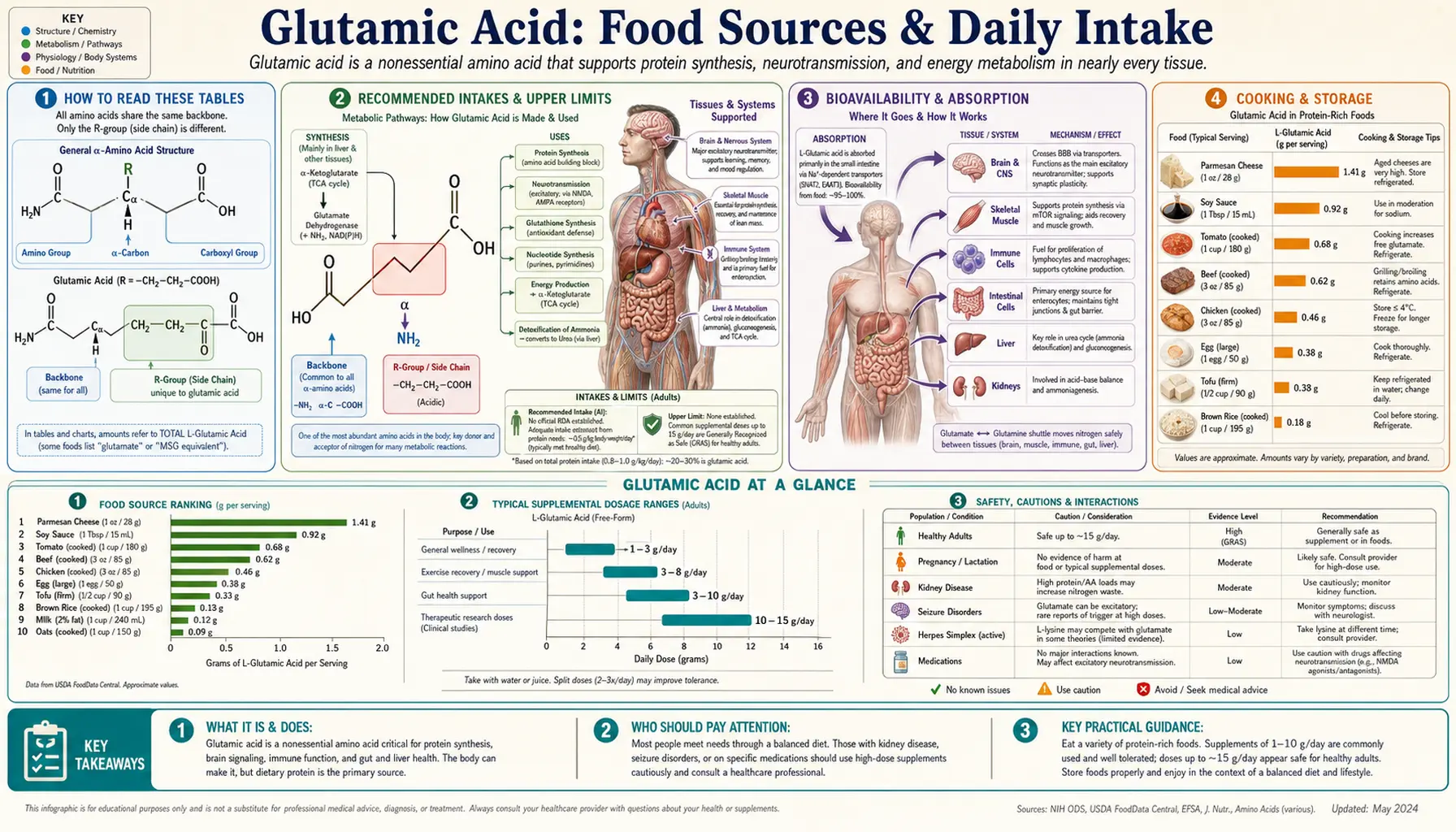
Glutamic acid is the most abundant amino acid in the food we eat and in the human body — roughly a tenth to a fifth of all dietary protein is glutamic acid. It does double duty as glutamate, the brain’s main “go” (excitatory) neurotransmitter and the raw material the body turns into calming GABA. Its free form is also what the tongue tastes as umami, the savory “fifth taste.” In whole foods most glutamic acid is bound inside protein (it has no taste until digestion frees it); aging, fermenting and cooking release some as free glutamate — the same molecule as added MSG, just naturally occurring. The richest sources are aged cheeses, meat and fish, with mushrooms and ripe tomatoes adding extra free glutamate on top. The table below shows grams of glutamic acid per 100 g of food (total, bound + free); there is no FDA Daily Value for individual amino acids, so amounts are absolute.
| Glutamic Acid: Food Sources & Daily Intake | |||||
|---|---|---|---|---|---|
| Rank | Food (serving) | Per 100 g | Glucose | Fructose | Notes |
| 1 | Parmesan Cheese 1 oz / 28 g | 🟢 8.2 g | — | — | Aging releases free glutamate — intensely savory. |
| 2 | Pumpkin Seeds 1 oz / 28 g | 🟢 6.1 g | 0.1 | 0.1 | Top plant source. |
| 3 | Cheddar Cheese 1 oz / 28 g | 🟢 5.7 g | 0 | 0 | |
| 4 | Peanuts 1 oz / 28 g | 🟢 5.4 g | — | — | |
| 5 | Beef Meat 3 oz / 85 g | 🟢 4.6 g | 0 | 0 | |
| 6 | Sunflower Seeds 1 oz / 28 g | 🟢 4.2 g | — | — | |
| 7 | Pork 3 oz / 85 g | 🟢 4.2 g | 0 | 0 | |
| 8 | Chicken Organ Meats 3 oz / 85 g | 🟡 3.9 g | — | — | Nutrient-dense organ meat (giblets). |
| 9 | Salmon 3 oz / 85 g | 🟡 3.9 g | 0 | 0 | |
| 10 | Tuna 3 oz / 85 g | 🟡 3.8 g | 0 | 0 | |
| 11 | Pork Organ Meats 3 oz / 85 g | 🟡 3.0 g | — | — | Nutrient-dense organ meat. |
| 12 | Beef Organ Meats 3 oz / 85 g | 🟡 2.6 g | — | — | Nutrient-dense organ meat. |
| 13 | Chicken Breast 3 oz / 85 g | 🟡 2.1 g | — | — | |
| 14 | Egg 1 large / 50 g | 🟡 1.6 g | — | — | |
| 15 | Chickpeas 1 cup / 164 g | 🟡 1.6 g | — | — | |
| 16 | White Beans 1 cup / 179 g | 🟡 1.5 g | — | — | |
| 17 | Brown Rice 1 cup / 195 g | ⚪ 0.5 g | 0 | 0 | Common staple. |
Table of Contents
- How to Read These Tables
- Recommended Intakes & Upper Limits
- Bioavailability & Absorption
- Cooking & Storage
- Vegetarian & Vegan Sources
- Who Needs to Pay Attention
- Data Sources & References
- Connections
- Featured Videos
How to Read These Tables
- Non-essential amino acid. Your body makes all the glutamic acid it needs, so there is no dietary requirement and deficiency essentially never happens. It is listed here because it is the most abundant amino acid in food and the source of umami flavor — not because you need to seek it out.
- Grams per 100 g, not %DV. There is no FDA Daily Value for individual amino acids, so this table reports the absolute grams per 100 g of food and ranks foods by that. A typical serving is shown beside each food.
- Bound vs free glutamate. Most glutamic acid in whole foods is bound inside protein and has no flavor until digestion releases it. The small free fraction — high in aged cheese, ripe tomatoes, mushrooms and broths — is what you taste as savory umami. This table counts total glutamic acid (bound + free).
Recommended Intakes & Upper Limits
Your personal target depends on age, sex and pregnancy. The Daily Value used for the %DV column above is a single label figure; the table below is the age-specific guidance.
| Reference | Adult value | Notes |
|---|---|---|
| Status | Non-essential (most abundant AA) | The body makes plenty of its own; it is the single most common amino acid in dietary protein and in human tissue. |
| Adult requirement | None set | No recommended intake exists — deficiency does not occur in people eating normal protein. |
| Main roles | Glutamate neurotransmitter, GABA precursor, umami taste | Glutamate is the brain’s chief excitatory signal and the building block of calming GABA; free glutamate gives food its savory flavor. |
| Richest in | Aged cheese, meat, fish, mushrooms, tomatoes | Concentrated proteins lead; mushrooms and ripe tomatoes add free glutamate (umami) on top. |
Bioavailability & Absorption
Glutamic acid from food is very well absorbed, but most of what you eat never reaches the bloodstream intact: the cells lining the gut use dietary glutamate as their primary fuel, burning the great majority of it on the spot. This is why eating glutamate-rich food — or MSG — barely moves blood glutamate levels, and why dietary glutamate does not freely cross into the brain (the brain makes and tightly recycles its own). For nutrition purposes, what matters is simply eating adequate total protein; glutamic acid comes along automatically as the largest single component of it.
Cooking & Storage
This is the one amino acid where cooking does something you can taste. Heat, aging and fermentation break proteins apart and release free glutamate, which is exactly what registers as savory umami — it is why aged Parmesan, slow-simmered broth, roasted meat, sun-ripened tomatoes and fermented sauces taste so rich. The glutamic acid itself is stable and is not destroyed by ordinary cooking; cooking simply unlocks the savory free form. No special handling is needed for nutrition.
Vegetarian & Vegan Sources
Glutamic acid is effortless on a plant-based diet — it is the most abundant amino acid in plant protein too. The strongest plant sources are mushrooms and ripe tomatoes (also loaded with free glutamate for umami), lentils, white beans and chickpeas, peanuts, and pumpkin and sunflower seeds. Savory plant cooking — mushroom or tomato broth, slow-roasted vegetables, fermented foods, nutritional yeast — naturally concentrates free glutamate, giving plant meals the same satisfying depth as meat dishes. No supplementation is ever needed.
Who Needs to Pay Attention
Glutamic-acid deficiency essentially never occurs: the body manufactures it in large amounts, so even people on low-protein diets make plenty. There is no benefit to supplementing it. Some people report sensitivity to added MSG (free glutamate) — headaches or flushing — but controlled, blinded studies have generally failed to confirm a consistent reaction at normal dietary amounts, and naturally glutamate-rich foods such as cheese and tomatoes are not implicated. Anyone who notices a reliable personal trigger can simply avoid it; for everyone else, glutamate in whole food is safe and is the main carrier of savory flavor.
Data Sources & References
- NIH MedlinePlus — Amino acids
- Linus Pauling Institute — protein and amino acids
- PubMed — dietary glutamate metabolism and the gut
- PubMed — monosodium glutamate sensitivity controlled trials
Connections
- All Amino Acids
- Glutamic Acid (Main Page)
- Glutamic Acid Benefits
- Glutamic Acid History
- Glutamine
- Aspartic Acid
- Mushrooms
- Tomatoes