Folate, Cardiovascular Disease & Stroke: What the Trials Found
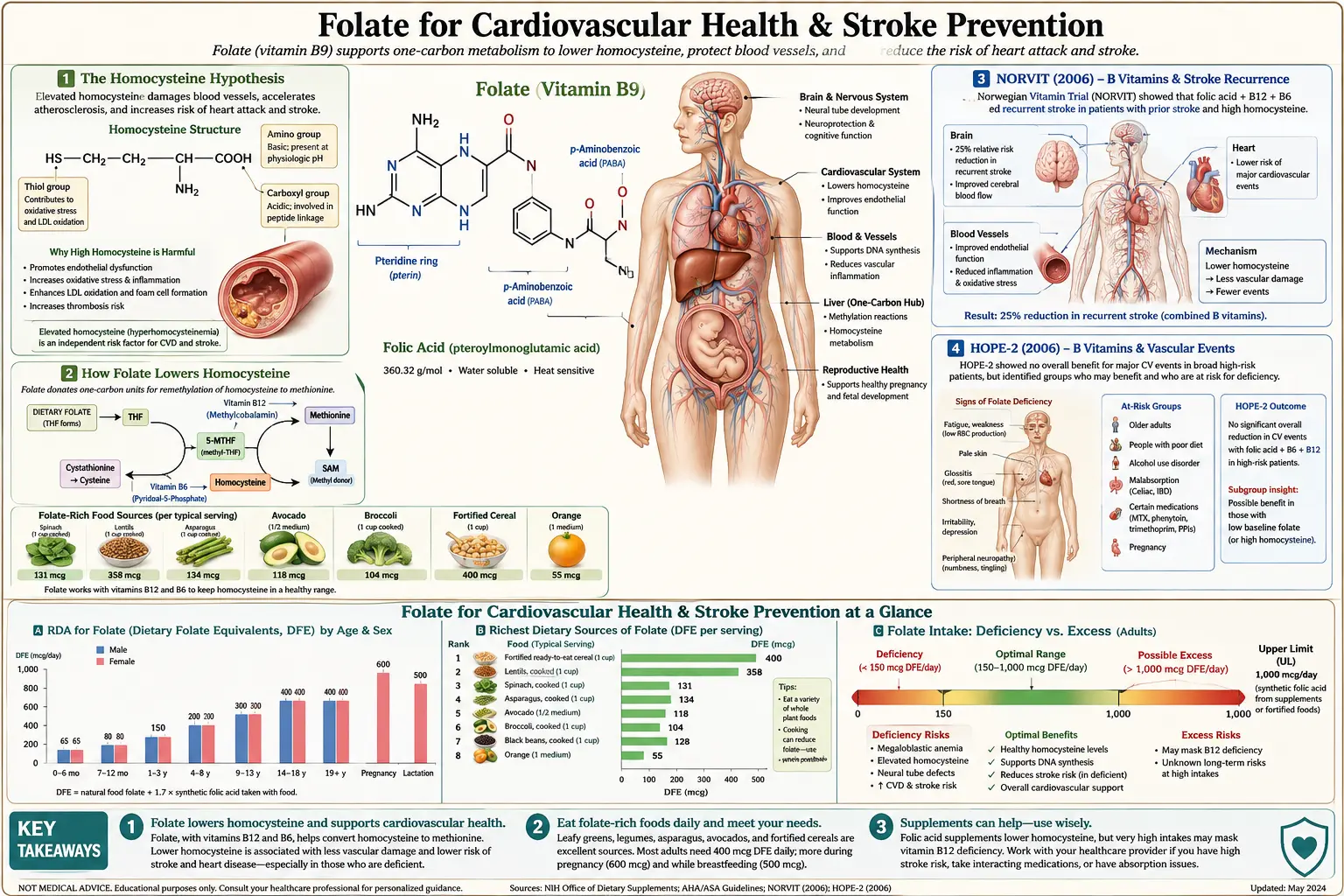
Research on folate and cardiovascular disease has largely tested the “homocysteine hypothesis”: that raised blood homocysteine contributes to arterial disease, and that lowering it with folic acid and other B vitamins would prevent heart attacks and strokes. Large randomized trials (NORVIT, HOPE-2, WENBIT, WAFACS, SEARCH, VITATOPS, VISP) lowered homocysteine but did not reduce major cardiovascular events, and a 2017 Cochrane review found no effect on heart attack or death (Martí-Carvajal 2017). Stroke results differed: the same review found a small reduction in stroke (RR 0.90), and the China Stroke Primary Prevention Trial (CSPPT), in 20,702 adults with high blood pressure, found fewer first strokes with enalapril plus folic acid than with enalapril alone (hazard ratio 0.79) (Huo 2015). Several meta-analyses report the stroke effect mainly in trials run where grain is not fortified with folic acid. This page describes each trial, the stroke meta-analyses, the genetic (Mendelian randomization) studies that ask whether homocysteine is a cause or a marker, and the role of vitamin B12.
Table of Contents
- The Homocysteine Hypothesis
- How Folate Lowers Homocysteine
- NORVIT (2006)
- HOPE-2 (2006)
- SEARCH (2010)
- WAFACS, VITATOPS, VISP & WENBIT
- The Stroke Results Across Trials
- CSPPT — The China Stroke Primary Prevention Trial
- Stroke Meta-Analyses and Fortification
- Folate, Nitric Oxide & Endothelial Function
- Which Groups Showed Effects in the Trials
- Doses Used in the Trials
- Cautions
- Key Research Papers
- Connections
- Featured Videos
The Homocysteine Hypothesis
In 1969 McCully published a description of the vascular pathology of homocysteinemia and its implications for the pathogenesis of arteriosclerosis (McCully 1969; the paper has no abstract in PubMed). The idea that followed — that milder elevations of homocysteine might contribute to ordinary arterial disease, and that lowering homocysteine might prevent it — is referred to on this page as the homocysteine hypothesis.
Observational studies then linked higher homocysteine with more heart disease and stroke:
- Wald and colleagues (2002) pooled 72 MTHFR genetic studies and 20 prospective studies. Per 5 μmol/L higher homocysteine, the odds ratio for ischaemic heart disease was 1.32 (95% CI 1.19-1.45) in the prospective studies and 1.42 in the genetic studies; for stroke it was 1.59 (1.29-1.96) in the prospective studies. The authors interpreted the agreement between the two kinds of study as strong evidence that the association is causal (Wald 2002).
- The Homocysteine Studies Collaboration (2002) analysed individual data from 30 studies with 5,073 heart disease and 1,113 stroke events. Associations were stronger in retrospective studies, where blood was taken after the disease began, than in prospective studies. In the prospective studies, after adjustment, a 25% lower homocysteine (about 3 μmol/L) was associated with an 11% lower risk of ischaemic heart disease and a 19% lower risk of stroke. The authors concluded that homocysteine is at most a modest independent predictor of heart disease and stroke in healthy populations, and that genetic studies and randomized trials would help settle whether it is causal (HSC 2002).
Marker or cause? Genetic (Mendelian randomization) studies
The MTHFR C677T variant raises homocysteine, especially when folate is low, so studies of this variant have been used as an instrumental variable — a “Mendelian randomization” test of whether lifelong higher homocysteine causes disease (Clarke 2012). Their results:
- Coronary heart disease, published studies: a 2002 meta-analysis of 40 case-control studies found 16% higher odds of coronary heart disease with the TT genotype (OR 1.16, 95% CI 1.05-1.28), with heterogeneity between European (OR 1.14) and North American (OR 0.87) populations that the authors suggested might be explained by folate status (Klerk 2002).
- Coronary heart disease, unpublished datasets: in 19 large unpublished datasets (48,175 cases, 67,961 controls), the TT-versus-CC odds ratio was 1.02 (0.98-1.07) overall and 1.01 (0.95-1.07) in unsupplemented low-folate populations, while 86 published studies gave 1.15. The authors concluded that lifelong moderate homocysteine elevation has little or no effect on coronary heart disease and that the published result reflects publication bias or methodological problems (Clarke 2012).
- Stroke and population folate: in 237 genetic datasets, the TT-versus-CC homocysteine difference was 3.12 μmol/L in Asia (low folate) but 0.13 μmol/L in fortified regions (America, Australia, New Zealand), and the stroke odds ratio was 1.68 in Asia versus 1.03 in those regions. In 13 trials (45,549 people) the summary stroke RR was 0.94 (0.85-1.04), close to what the genetic data predicted for populations with similar folate status; the predicted effect in low-folate Asia was larger (RR 0.78), and no trial had then been run exclusively in a low-folate region (Holmes 2011).
- A low-folate population: in the China Kadoorie Biobank (156,253 genotyped adults, 12,240 strokes over 12 years), 21% had the TT genotype (5% to 41% by region). TT carriers had 13% higher odds of any stroke (OR 1.13, 1.09-1.17), more so for intracerebral haemorrhage (1.24) than ischaemic stroke (1.11). The variant was unrelated to ischaemic heart disease (Bennett 2023).
- Many variants, many endpoints: a 2021 Mendelian randomization study found genetically higher homocysteine associated with any stroke (OR 1.11 per standard deviation) and genetically higher folate with lower coronary artery disease and stroke risk; none of these associations persisted after correction for multiple testing, and genetically predicted vitamin B12 showed no association with cardiovascular disease (Yuan 2021).
- Stroke subtype: genetically predicted homocysteine was associated with small vessel stroke (OR 1.34 per standard deviation) but not with large artery or cardioembolic stroke; the authors suggested that any effect of homocysteine lowering on stroke would be confined to small vessel stroke (Larsson 2019).
In summary, the largest genetic datasets found little or no association between the homocysteine-raising variant and coronary heart disease (Clarke 2012), and an association with stroke that was larger in low-folate populations (Holmes 2011; Bennett 2023).
How Folate Lowers Homocysteine
In one-carbon metabolism, a carbon unit is transferred to tetrahydrofolate to form methylene-THF, which can be reduced to methyl-THF (5-MTHF). Methyl-THF methylates homocysteine to form methionine, in a reaction catalysed by a vitamin B12-containing methyltransferase; much of that methionine becomes S-adenosylmethionine (SAM), a universal methyl donor (Selhub 2002). Folate and B12 are therefore both needed for this route back from homocysteine to methionine.
The Homocysteine Lowering Trialists' Collaboration pooled 25 randomized trials with individual data on 2,596 people. Folic acid lowered homocysteine more when homocysteine was higher and folate lower at the start, and more in women than men. Standardized to a starting homocysteine of 12 μmol/L and folate of 12 nmol/L, daily doses of 0.2, 0.4, 0.8, 2.0 and 5.0 mg folic acid lowered homocysteine by 13%, 20%, 23%, 23% and 25%. Vitamin B12 (about 0.4 mg/day) gave a further 7% reduction; vitamin B6 had no significant effect. The authors concluded that doses of 0.8 mg or more are typically needed for the maximal reduction (HLTC 2005).
In a trial of 932 Chinese women, the MTHFR TT genotype was associated with lower folate and higher homocysteine at every folic acid dose, and genotype did not significantly change the response to dose (Crider 2011). CDC states that “your folic acid intake is more important than your MTHFR genotype for determining the amount of folate in your blood.”
The cardiovascular trials then asked whether this reliable lowering of homocysteine translates into fewer heart attacks and strokes.
NORVIT (2006)
The Norwegian Vitamin Trial (NORVIT; Bønaa 2006, New England Journal of Medicine) enrolled 3,749 people within seven days of a heart attack and assigned them, in a two-by-two factorial design, to one of four daily treatments: 0.8 mg folic acid + 0.4 mg vitamin B12 + 40 mg vitamin B6; folic acid + B12; B6 alone; or placebo. The primary end point, over a median of 40 months, was recurrent heart attack, stroke, or sudden death attributed to coronary disease.
Results:
- Folic acid plus B12 lowered mean homocysteine by 27%
- No significant effect of folic acid plus B12 on the primary end point (risk ratio 1.08, 95% CI 0.93-1.25)
- No significant benefit of B6 (relative risk 1.14, 0.98-1.32)
- In the group given all three vitamins, a trend toward higher risk (relative risk 1.22, 95% CI 1.00-1.50, P=0.05)
The authors concluded that B vitamins did not lower the risk of recurrent cardiovascular disease after a heart attack, that a harmful effect from combined treatment was suggested, and that such treatment should therefore not be recommended (Bønaa 2006).
HOPE-2 (2006)
The Heart Outcomes Prevention Evaluation 2 trial (Lonn 2006, NEJM) randomized 5,522 people aged 55 or older with vascular disease or diabetes to 2.5 mg folic acid + 50 mg vitamin B6 + 1 mg vitamin B12 daily or placebo, for an average of five years. The primary outcome was cardiovascular death, heart attack or stroke.
Results:
- Homocysteine fell by 2.4 μmol/L with the vitamins and rose by 0.8 μmol/L with placebo
- No significant reduction in the primary outcome (18.8% vs 19.8%; relative risk 0.95, 95% CI 0.84-1.07), cardiovascular death (0.96) or heart attack (0.98)
- Fewer strokes with the vitamins (relative risk 0.75, 95% CI 0.59-0.97)
- More hospitalizations for unstable angina with the vitamins (relative risk 1.24, 95% CI 1.04-1.49)
The authors concluded that the supplements did not reduce the risk of major cardiovascular events in people with vascular disease (Lonn 2006). The stroke result is one reason later researchers looked at stroke separately.
SEARCH (2010)
The Study of the Effectiveness of Additional Reductions in Cholesterol and Homocysteine (SEARCH; Armitage 2010, JAMA) was a double-blind trial in 12,064 heart-attack survivors in UK hospitals, who took 2 mg folic acid + 1 mg vitamin B12 daily or placebo for 6.7 years.
Results:
- Homocysteine fell by a mean of 3.8 μmol/L (28%)
- No significant reduction in major vascular events (25.5% vs 24.8%; RR 1.04, 95% CI 0.97-1.12)
- No apparent effect on stroke (4.5% vs 4.4%; RR 1.02, 95% CI 0.86-1.21) or on major coronary events (RR 1.05)
- No significant difference in cancer incidence (11.2% vs 10.6%)
The authors concluded that substantial long-term reductions in homocysteine had no beneficial effect on vascular outcomes and were not associated with adverse effects on cancer incidence (Armitage 2010).
WAFACS, VITATOPS, VISP & WENBIT
Other large trials, mostly in people who already had vascular disease or a stroke:
- WAFACS (Albert 2008, JAMA) — 5,442 US women health professionals aged 42 or older with cardiovascular disease or three or more coronary risk factors took 2.5 mg folic acid + 50 mg B6 + 1 mg B12 or placebo for 7.3 years. Homocysteine fell 18.5% relative to placebo in a blood substudy, but the composite of heart attack, stroke, coronary revascularization or cardiovascular death did not differ (RR 1.03, 95% CI 0.90-1.19); stroke RR was 1.14 (0.82-1.57).
- VITATOPS (2010, Lancet Neurology) — 8,164 people with a stroke or transient ischaemic attack in the previous 7 months, in 20 countries, took 2 mg folic acid + 25 mg B6 + 0.5 mg B12 or placebo for a median of 3.4 years. The primary end point was the composite of stroke, heart attack or vascular death: 15% vs 17% (RR 0.91, 95% CI 0.82-1.00, P=0.05). The investigators concluded that the vitamins were safe but did not seem more effective than placebo and that the results did not support their use to prevent recurrent stroke.
- VISP (Toole 2004, JAMA) — 3,680 adults after a nondisabling ischaemic stroke, in the US, Canada and Scotland, took a high-dose formulation (2.5 mg folic acid, 25 mg B6, 0.4 mg B12) or a low-dose one (20 μg folic acid, 200 μg B6, 6 μg B12) for 2 years. Homocysteine fell 2 μmol/L more with the high dose, but there was no treatment effect on any end point; ischaemic stroke within 2 years was 9.2% vs 8.8%.
- WENBIT (Ebbing 2008, JAMA) — 3,096 adults undergoing coronary angiography in western Norway took 0.8 mg folic acid + 0.4 mg B12 + 40 mg B6, folic acid + B12, B6 alone, or placebo. Homocysteine fell 30% with folic acid and B12. The trial was stopped early because of participants' concern after preliminary NORVIT results suggested harm. Over a median of 38 months, folic acid/B12 did not change the composite of death, heart attack, hospitalization for unstable angina and stroke (HR 1.09, 95% CI 0.90-1.32).
An individual-participant meta-analysis of 8 large trials (37,485 people), with an average 25% reduction in homocysteine over a median of 5 years, found no significant effect on major vascular events (rate ratio 1.01), major coronary events (1.03) or stroke (0.96, 95% CI 0.87-1.06), in any subgroup studied, and no significant effect on cancer incidence (1.05) or death from any cause (1.02) (Clarke 2010).
The Stroke Results Across Trials
While the composite cardiovascular outcomes did not improve, stroke results varied between trials:
- HOPE-2: fewer strokes with the vitamins (RR 0.75, 0.59-0.97) (Lonn 2006)
- SEARCH: no apparent effect on stroke (RR 1.02) (Armitage 2010)
- WAFACS: stroke RR 1.14 (0.82-1.57) (Albert 2008)
- VISP: ischaemic stroke 9.2% vs 8.8% (Toole 2004)
- Cochrane review, 10 trials (44,224 people): stroke 4.3% vs 5.1%, RR 0.90 (95% CI 0.82-0.99), rated high-quality evidence; there was no difference in heart attack (RR 1.02) or death from any cause (RR 1.01) (Martí-Carvajal 2017)
Explanations proposed in the research:
- Population folate status — most trials took place in regions with high or increasing population folate, where the genetic data predict little benefit (Holmes 2011). After folic acid fortification of grain was fully implemented in the United States and Canada by 1998, the decline in stroke mortality accelerated in both countries but did not change in England and Wales, where fortification was not required; the authors described this as consistent with the hypothesis that fortification helps reduce stroke deaths. This was an observational, population-level comparison (Yang 2006).
- Stroke subtype — one Mendelian randomization analysis linked genetically higher homocysteine only with small vessel stroke (Larsson 2019).
- Vitamin B12 status and form — see the B12 points in the meta-analysis section below (Zhao 2017; Hsu 2018). Spence's 2016 commentary argues that VISP was affected by fortification in North America, by B12 injections given to patients with low baseline B12, and by harm from the cyanide in cyanocobalamin among participants with impaired kidney function, and that the main causes of elevated homocysteine where food is fortified are kidney failure and metabolic B12 deficiency (Spence 2016). This is the author's interpretation of trial subgroups, not a trial result.
- Statin use — in one meta-analysis, the stroke effect was greater in trials with lower statin use (Huo 2012).
These questions led to a primary prevention trial in a population without folic acid fortification: CSPPT.
CSPPT — The China Stroke Primary Prevention Trial
The China Stroke Primary Prevention Trial (CSPPT; Huo 2015, JAMA) was a randomized, double-blind trial run from 2008 to 2013 in 32 communities in Jiangsu and Anhui provinces, China. The authors described the findings as consistent with benefit from folate among adults with hypertension and low baseline folate levels.
Design
- 20,702 adults with hypertension and no history of stroke or heart attack
- Stratified by MTHFR C677T genotype (CC, CT, TT), then randomized to a single pill of enalapril 10 mg + folic acid 0.8 mg daily, or enalapril 10 mg alone
- Median treatment duration: 4.5 years
- Primary outcome: first stroke
Results
- First stroke: 2.7% with enalapril-folic acid vs 3.4% with enalapril alone (HR 0.79, 95% CI 0.68-0.93)
- First ischaemic stroke: 2.2% vs 2.8% (HR 0.76, 95% CI 0.64-0.91)
- Composite of cardiovascular death, heart attack and stroke: 3.1% vs 3.9% (HR 0.80, 95% CI 0.69-0.92)
- No significant difference in haemorrhagic stroke (HR 0.93, 0.65-1.34), heart attack (HR 1.04, 0.60-1.82) or death from any cause (HR 0.94, 0.81-1.10)
- No significant differences in the frequency of adverse events
The 2017 Cochrane review rated the effect of enalapril plus folic acid on stroke as uncertain because it comes from one mega-trial, and estimated that about 143 people (95% CI 85 to 428) would need treatment for 5.4 years to prevent one stroke (Martí-Carvajal 2017).
Later CSPPT subgroup analyses
- Folate, B12 and MTHFR genotype: median baseline serum folate was 8.1 ng/mL and B12 280.2 pmol/L. Folic acid reduced first ischaemic stroke in participants with both folate and B12 below the median (2.3% vs 3.6%; HR 0.62, 0.46-0.86), particularly in MTHFR 677 CC carriers (HR 0.24). TT homozygotes, by contrast, responded better when both folate and B12 were above the median (HR 0.28) (Qin 2020). These are post-hoc subgroup analyses.
- Platelet count and homocysteine: in 10,789 participants, the subgroup with a low platelet count (lowest quartile) and homocysteine of 15 μmol/L or more had the highest stroke rate on enalapril alone (5.6%), and folic acid reduced stroke in this subgroup by 73% (HR 0.27, 0.11-0.64); there was no significant effect in the low-risk group (high platelet count, homocysteine below 15 μmol/L). The authors wrote that, if confirmed, platelet count and homocysteine could serve as biomarkers (Kong 2018).
Stroke Meta-Analyses and Fortification
Wang and colleagues (Lancet 2007) pooled 8 randomized trials of folic acid that reported stroke. Folic acid reduced stroke risk by 18% (RR 0.82, 95% CI 0.68-1.00, P=0.045). The effect was greater in trials:
- lasting more than 36 months (RR 0.71)
- with a homocysteine reduction of more than 20% (RR 0.77)
- in populations with no or only partly fortified grain (RR 0.75)
- in people with no history of stroke (RR 0.75)
In the corresponding comparison groups the estimates were attenuated and not significant (Wang 2007).
Later meta-analyses, which differ in the trials they include:
- Huo 2012 — overall RR 0.92 (0.86-1.00) across 55,764 people; 0.89 (0.82-0.97) in 10 trials with no or partial fortification; 1.03 (0.88-1.21) in 5 trials in fortified populations. A greater effect was seen in trials with lower statin use, and 0.4-0.8 mg/day appeared adequate compared with larger doses.
- Holmes 2011 — 13 trials, RR 0.94 (0.85-1.04); most trials were in regions with high or increasing population folate.
- Zhao 2017 — 22 trials (82,723 people), RR 0.89 (0.84-0.96). RR 0.78 in low-folate regions (Asia, 2 trials) vs 1.05 in high-folate regions (America); 0.85 in trials without fortification (11 trials) vs 1.05 with fortification (7 trials). Among trials without fortification, a larger effect was seen with a folic acid dose of 0.8 mg or less (0.78) and with low baseline vitamin B12 (<384 pg/mL; 0.78).
- Hsu 2018 — 13 trials (65,812 people) in countries without mandatory fortification: RR 0.85 (0.77-0.95). Folic acid alone or with minimal cyanocobalamin (0.05 mg/day or less) was associated with lower stroke risk (RR 0.75, 0.66-0.86); folic acid with 0.4 mg/day or more of cyanocobalamin was not (RR 0.95, 0.86-1.05).
- Cochrane 2017 — stroke RR 0.90 (0.82-0.99), 10 trials, high-quality evidence; the CSPPT comparison (enalapril plus folic acid vs enalapril) rated uncertain (Martí-Carvajal 2017).
Across these analyses, the stroke reduction appears mainly in trials without folic acid fortification, while trials in fortified populations show little or no effect.
Folate, Nitric Oxide & Endothelial Function
Laboratory and surgical studies by Antoniades and colleagues at Oxford examined 5-MTHF, the circulating form of folate, in blood vessels taken from patients undergoing coronary bypass surgery:
- 5-MTHF in vessels (2006): in vessels from 117 bypass patients, 5-MTHF given ex vivo (61 patients) or by intravenous infusion before the vessels were harvested (56 patients) improved nitric oxide-mediated, endothelium-dependent vessel responses and reduced vascular superoxide. These changes were not explained by direct superoxide scavenging or by changes in plasma homocysteine. Instead, 5-MTHF was a strong peroxynitrite scavenger, increased vascular tetrahydrobiopterin (BH4), and reversed uncoupling of endothelial nitric oxide synthase (eNOS) (Antoniades 2006).
- MTHFR genotype as a model (2009): in 218 bypass patients, MTHFR genotype determined the level of 5-MTHF in the vessel wall, not vascular homocysteine; vascular 5-MTHF was associated with nitric oxide bioavailability and eNOS coupling, while vascular homocysteine was associated only with NADPH-stimulated superoxide. The authors suggested that plasma homocysteine is an indirect marker of 5-MTHF rather than a primary regulator of endothelial function (Antoniades 2009).
These studies measured vessel function in surgical samples, not heart attacks or strokes. The outcome trials on this page all used folic acid; none tested 5-MTHF against folic acid for cardiovascular events.
Riboflavin and blood pressure in MTHFR TT carriers: riboflavin is the cofactor for MTHFR. In a 4-year follow-up of patients with cardiovascular disease, 31 with the TT genotype took riboflavin (1.6 mg/day for 16 weeks) or placebo in a crossover design; riboflavin, given in 2004 and 2008, lowered systolic blood pressure by 9.2 mm Hg and diastolic by 6.0 mm Hg overall. The authors wrote that the findings, if confirmed in the general population, could have important implications for preventing hypertension (Wilson 2012). This is a riboflavin effect, not a folate effect.
Which Groups Showed Effects in the Trials
The trials and analyses above reported effects in some groups and not in others:
- Populations without folic acid fortification — stroke reductions were concentrated in trials without fortification or with partial fortification (Wang 2007; Huo 2012; Zhao 2017; Hsu 2018), and the genetic studies predicted a larger effect in low-folate regions (Holmes 2011).
- Adults with hypertension and no prior stroke or heart attack — the CSPPT population, in which enalapril plus folic acid reduced first stroke compared with enalapril alone (Huo 2015); the Cochrane review rated this comparison uncertain because it rests on one trial (Martí-Carvajal 2017).
- Low folate and B12, or low platelets with high homocysteine — in CSPPT subgroup analyses (Qin 2020; Kong 2018).
- Older adults with mild cognitive impairment (brain atrophy, not stroke) — in VITACOG (271 people over 70), folic acid 0.8 mg, B12 0.5 mg and B6 20 mg for 24 months slowed whole-brain atrophy (0.76% vs 1.08% a year among 168 with MRI; P=0.001), and the atrophy rate was 53% lower with treatment in those with homocysteine above 13 μmol/L (Smith 2010). A later analysis found the benefit only in people with high baseline omega-3 fatty acids (>590 μmol/L: 40% slower atrophy), with no significant effect when omega-3 levels were low (Jernéren 2015).
MTHFR genotype: CSPPT stratified participants by genotype, and its subgroup analyses found different patterns in CC and TT carriers depending on folate and B12 levels (Qin 2020). CDC states that people with an MTHFR gene variant can process all types of folate, including folic acid, that folic acid is the only type of folate shown to help prevent neural tube defects, and that the claim that people with an MTHFR variant should avoid folic acid and take other types of folate, such as 5-MTHF, is not true.
Groups in which trials found no reduction in major cardiovascular events:
- People who had had a heart attack, or who had vascular disease, diabetes or coronary disease — NORVIT, HOPE-2 (composite outcome), SEARCH, WENBIT and WAFACS.
- People who had had a stroke or transient ischaemic attack — VISP, and VITATOPS (borderline composite result, P=0.05).
- Trials in populations with folic acid fortification — pooled stroke RR 1.03 (Huo 2012) and 1.05 (Zhao 2017).
Doses Used in the Trials
Daily doses as reported in each trial (all used folic acid, not methylfolate):
- NORVIT: folic acid 0.8 mg + B12 0.4 mg + B6 40 mg (factorial arms) (Bønaa 2006)
- WENBIT: folic acid 0.8 mg + B12 0.4 mg + B6 40 mg (factorial arms) (Ebbing 2008)
- HOPE-2: folic acid 2.5 mg + B6 50 mg + B12 1 mg (Lonn 2006)
- WAFACS: folic acid 2.5 mg + B6 50 mg + B12 1 mg (Albert 2008)
- SEARCH: folic acid 2 mg + B12 1 mg (Armitage 2010)
- VITATOPS: folic acid 2 mg + B6 25 mg + B12 0.5 mg (VITATOPS 2010)
- VISP: high dose folic acid 2.5 mg + B6 25 mg + B12 0.4 mg vs low dose folic acid 20 μg + B6 200 μg + B12 6 μg (Toole 2004)
- CSPPT: folic acid 0.8 mg combined with enalapril 10 mg in a single pill (Huo 2015)
- VITACOG: folic acid 0.8 mg + B12 0.5 mg + B6 20 mg (Smith 2010)
On dose: homocysteine lowering reached its maximum at about 0.8 mg/day of folic acid, with 0.2 and 0.4 mg giving about 60% and 90% of that effect (HLTC 2005). In stroke meta-analyses, 0.4-0.8 mg/day appeared adequate compared with larger doses (Huo 2012), and among unfortified trials the effect was larger at 0.8 mg or less (Zhao 2017). Testing is described on the Homocysteine lab test page.
Decisions about folate and other B vitamin supplements belong with a clinician.
Cautions
- Vitamin B12 deficiency — the 1992 US Public Health Service recommendation stated that the effects of higher folate intakes are not well known but include complicating the diagnosis of vitamin B12 deficiency, and advised keeping total folate consumption below 1 mg a day except under a physician's supervision (USPHS 1992). The 2015 SOGC guideline states that folic acid supplementation is unlikely to mask B12 deficiency (pernicious anemia) and recommends folic acid in a multivitamin that includes 2.6 μg/day of B12 to address even theoretical concerns (Wilson 2015). In a 4.3-year trial in people with type 2 diabetes on insulin, metformin lowered B12 by 19% compared with placebo and raised the absolute risk of B12 deficiency by 7.2 percentage points (de Jager 2010).
- The NORVIT harm signal — in people who had just had a heart attack, the folic acid + B12 + B6 group showed a trend toward higher cardiovascular risk (RR 1.22, P=0.05), and the authors concluded a harmful effect was suggested (Bønaa 2006). WENBIT was stopped early because of participants' concern about these preliminary results (Ebbing 2008).
- In-stent restenosis — in a trial of 636 patients after coronary stenting, folic acid, B6 and B12 (given intravenously, then daily orally at 1.2 mg folic acid, 48 mg B6 and 60 μg B12 for six months) led to a smaller minimal luminal diameter, a higher restenosis rate (34.5% vs 26.5%, P=0.05) and more repeat target-vessel revascularization (15.8% vs 10.6%) than placebo. The adverse effect was seen in all subgroups except women, people with diabetes and people with homocysteine of 15 μmol/L or more (Lange 2004).
- Blood pressure medicines — CSPPT combined folic acid with enalapril (an ACE inhibitor) in one pill, and found no significant differences in adverse events between groups (Huo 2015).
- Colorectal adenomas and cancer — in people with a history of colorectal adenomas, 1 mg/day of folic acid did not reduce adenomas; at the second follow-up, advanced lesions occurred in 11.6% vs 6.9% (RR 1.67, 1.00-2.80, P=0.05), and folic acid was associated with higher risks of three or more adenomas and of non-colorectal cancers (Cole 2007). In the cardiovascular trials, cancer incidence did not differ significantly (SEARCH, Armitage 2010; Clarke 2010, RR 1.05). Unmetabolized folic acid is covered in the B9 Methylation & Homocysteine article.
Decisions about folate supplements, and about testing, belong with a clinician.
Key Research Papers
- Bønaa KH et al.; NORVIT Trial Investigators (2006). Homocysteine lowering and cardiovascular events after acute myocardial infarction (NORVIT). N Engl J Med 354:1578-88. — PubMed PMID: 16531614
- Lonn E et al.; HOPE 2 Investigators (2006). Homocysteine lowering with folic acid and B vitamins in vascular disease (HOPE-2). N Engl J Med 354:1567-77. — PubMed PMID: 16531613
- SEARCH Collaborative Group; Armitage JM et al. (2010). Effects of homocysteine-lowering with folic acid plus vitamin B12 vs placebo on mortality and major morbidity in myocardial infarction survivors: a randomized trial (SEARCH). JAMA 303:2486-94. — PubMed PMID: 20571015
- Huo Y et al. (2015). Efficacy of folic acid therapy in primary prevention of stroke among adults with hypertension in China: the CSPPT randomized clinical trial. JAMA 313:1325-35. — PubMed PMID: 25771069
- Wang X et al. (2007). Efficacy of folic acid supplementation in stroke prevention: a meta-analysis. Lancet 369:1876-82. — PubMed PMID: 17544768
- Toole JF et al. (2004). Lowering homocysteine in patients with ischemic stroke to prevent recurrent stroke, myocardial infarction, and death: the Vitamin Intervention for Stroke Prevention (VISP) randomized controlled trial. JAMA 291:565-75. — PubMed PMID: 14762035
- VITATOPS Trial Study Group (2010). B vitamins in patients with recent transient ischaemic attack or stroke in the VITAmins TO Prevent Stroke (VITATOPS) trial: a randomised, double-blind, parallel, placebo-controlled trial. Lancet Neurol 9:855-65. — PubMed PMID: 20688574
- Albert CM et al. (2008). Effect of folic acid and B vitamins on risk of cardiovascular events and total mortality among women at high risk for cardiovascular disease: a randomized trial (WAFACS). JAMA 299:2027-36. — PubMed PMID: 18460663
- Antoniades C et al. (2006). 5-Methyltetrahydrofolate rapidly improves endothelial function and decreases superoxide production in human vessels: effects on vascular tetrahydrobiopterin availability and endothelial nitric oxide synthase coupling. Circulation 114:1193-201 (year corrected from 2009: this title is the 2006 paper). — PubMed PMID: 16940192
- Yang Q et al. (2006). Improvement in stroke mortality in Canada and the United States, 1990 to 2002. Circulation 113:1335-43. — PubMed PMID: 16534029
- Homocysteine Lowering Trialists' Collaboration (2005). Dose-dependent effects of folic acid on blood concentrations of homocysteine: a meta-analysis of the randomized trials. Am J Clin Nutr 82:806-12. — PubMed PMID: 16210710
- Wilson CP et al. (2012). Riboflavin offers a targeted strategy for managing hypertension in patients with the MTHFR 677TT genotype: a 4-y follow-up. Am J Clin Nutr 95:766-72. — PubMed PMID: 22277556
- Martí-Carvajal AJ et al. (2017). Homocysteine-lowering interventions for preventing cardiovascular events. Cochrane Database Syst Rev 8:CD006612. — PubMed PMID: 28816346
- Ebbing M et al. (2008). Mortality and cardiovascular events in patients treated with homocysteine-lowering B vitamins after coronary angiography: a randomized controlled trial (WENBIT). JAMA 300:795-804. — PubMed PMID: 18714059
- McCully KS (1969). Vascular pathology of homocysteinemia: implications for the pathogenesis of arteriosclerosis. Am J Pathol 56:111-28. — PubMed PMID: 5792556
- Homocysteine Studies Collaboration (2002). Homocysteine and risk of ischemic heart disease and stroke: a meta-analysis. JAMA 288:2015-22. — PubMed PMID: 12387654
- Wald DS et al. (2002). Homocysteine and cardiovascular disease: evidence on causality from a meta-analysis. BMJ 325:1202. — PubMed PMID: 12446535
- Klerk M et al.; MTHFR Studies Collaboration Group (2002). MTHFR 677C→T polymorphism and risk of coronary heart disease: a meta-analysis. JAMA 288:2023-31. — PubMed PMID: 12387655
- Clarke R et al.; MTHFR Studies Collaborative Group (2012). Homocysteine and coronary heart disease: meta-analysis of MTHFR case-control studies, avoiding publication bias. PLoS Med 9:e1001177. — PubMed PMID: 22363213
- Holmes MV et al. (2011). Effect modification by population dietary folate on the association between MTHFR genotype, homocysteine, and stroke risk: a meta-analysis of genetic studies and randomised trials. Lancet 378:584-94. — PubMed PMID: 21803414
- Bennett DA et al. (2023). MTHFR and risk of stroke and heart disease in a low-folate population: a prospective study of 156 000 Chinese adults. Int J Epidemiol 52:1862-9. — PubMed PMID: 37898918
- Yuan S et al. (2021). Homocysteine, B vitamins, and cardiovascular disease: a Mendelian randomization study. BMC Med 19:97. — PubMed PMID: 33888102
- Larsson SC et al. (2019). Homocysteine and small vessel stroke: a mendelian randomization analysis. Ann Neurol 85:495-501. — PubMed PMID: 30785218
- Selhub J (2002). Folate, vitamin B12 and vitamin B6 and one carbon metabolism. J Nutr Health Aging 6:39-42. — PubMed PMID: 11813080
- Crider KS et al. (2011). MTHFR 677C→T genotype is associated with folate and homocysteine concentrations in a large, population-based, double-blind trial of folic acid supplementation. Am J Clin Nutr 93:1365-72. — PubMed PMID: 21508090
- Clarke R et al.; B-Vitamin Treatment Trialists' Collaboration (2010). Effects of lowering homocysteine levels with B vitamins on cardiovascular disease, cancer, and cause-specific mortality: meta-analysis of 8 randomized trials involving 37 485 individuals. Arch Intern Med 170:1622-31. — PubMed PMID: 20937919
- Huo Y et al. (2012). Efficacy of folic acid supplementation in stroke prevention: new insight from a meta-analysis. Int J Clin Pract 66:544-51. — PubMed PMID: 22607506
- Zhao M et al. (2017). Meta-analysis of folic acid efficacy trials in stroke prevention: insight into effect modifiers. Neurology 88:1830-8. — PubMed PMID: 28404799
- Hsu CY et al. (2018). Folic acid in stroke prevention in countries without mandatory folic acid food fortification: a meta-analysis of randomized controlled trials. J Stroke 20:99-109. — PubMed PMID: 29402063
- Spence JD (2016). Homocysteine lowering for stroke prevention: unravelling the complexity of the evidence. Int J Stroke 11:744-7 (commentary). — PubMed PMID: 27462097
- Qin X et al. (2020). Interaction of serum vitamin B12 and folate with MTHFR genotypes on risk of ischemic stroke. Neurology 94:e1126-36. — PubMed PMID: 31932513
- Kong X et al. (2018). Platelet count affects efficacy of folic acid in preventing first stroke. J Am Coll Cardiol 71:2136-46. — PubMed PMID: 29747834
- Antoniades C et al. (2009). MTHFR 677 C>T polymorphism reveals functional importance for 5-methyltetrahydrofolate, not homocysteine, in regulation of vascular redox state and endothelial function in human atherosclerosis. Circulation 119:2507-15. — PubMed PMID: 19398669
- Smith AD et al. (2010). Homocysteine-lowering by B vitamins slows the rate of accelerated brain atrophy in mild cognitive impairment: a randomized controlled trial (VITACOG). PLoS One 5:e12244. — PubMed PMID: 20838622
- Jernéren F et al. (2015). Brain atrophy in cognitively impaired elderly: the importance of long-chain ω-3 fatty acids and B vitamin status in a randomized controlled trial. Am J Clin Nutr 102:215-21. — PubMed PMID: 25877495
- Lange H et al. (2004). Folate therapy and in-stent restenosis after coronary stenting. N Engl J Med 350:2673-81. — PubMed PMID: 15215483
- Cole BF et al. (2007). Folic acid for the prevention of colorectal adenomas: a randomized clinical trial. JAMA 297:2351-9. — PubMed PMID: 17551129
- US Public Health Service / CDC (1992). Recommendations for the use of folic acid to reduce the number of cases of spina bifida and other neural tube defects. MMWR Recomm Rep 41(RR-14):1-7. — PubMed PMID: 1522835
- Wilson RD et al.; SOGC (2015). Pre-conception folic acid and multivitamin supplementation for the primary and secondary prevention of neural tube defects and other folic acid-sensitive congenital anomalies. J Obstet Gynaecol Can 37:534-52. — PubMed PMID: 26334606
- de Jager J et al. (2010). Long term treatment with metformin in patients with type 2 diabetes and risk of vitamin B-12 deficiency: randomised placebo controlled trial. BMJ 340:c2181. — PubMed PMID: 20488910
- Centers for Disease Control and Prevention. MTHFR Gene Variant and Folic Acid Facts. — CDC
PubMed Topic Searches
Connections
- All Vitamins
- Vitamin B9 Overview
- B9 Benefits Hub
- B9 Pregnancy & Neural Tube
- B9 Methylation & Homocysteine
- B9 Depression & Mental Health
- Vitamin B12
- Vitamin B6
- Vitamin B2 (Riboflavin)
- Choline
- Methionine
- Homocysteine
- Lipid Panel
- Cardiology
- Stroke
- Hypertension
- Alzheimer's Disease
- Oxidative Stress
- Deficiency
- Toxicity
- History
- Sources