Folate / Folic Acid Excess: Symptoms, Causes, and Risks
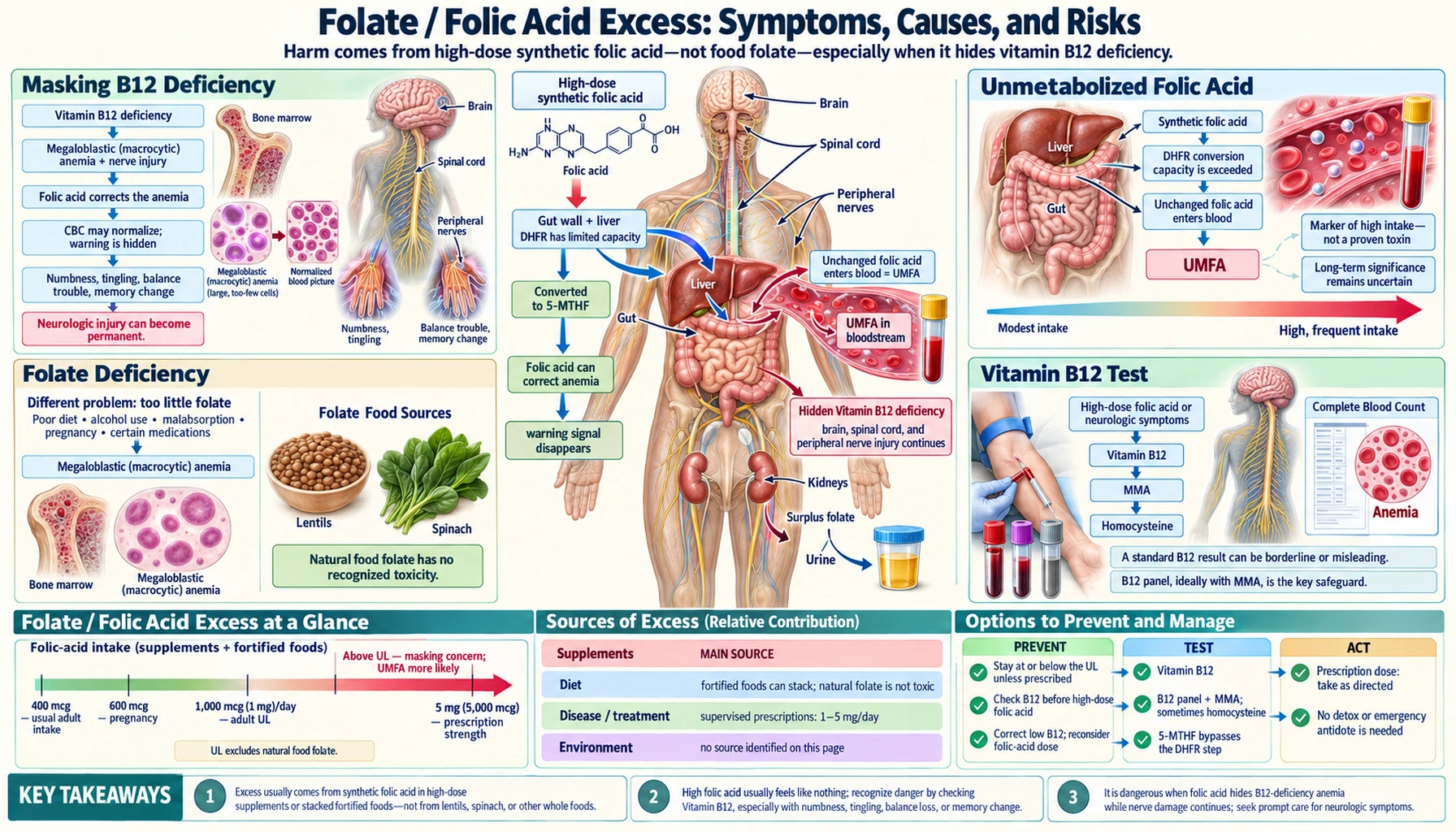
Here is the single most reassuring fact to start with: the folate you get from food cannot poison you. Natural folate — the form in leafy greens, beans, lentils, and liver — has no known toxicity, and there is no reason to fear eating folate-rich foods. The concerns on this page are about something narrower and man-made: high doses of synthetic folic acid, the stable form added to supplements and used to fortify flour and cereals. There are really only two well-documented worries, and neither is a classic "overdose." First, a high folic-acid intake can mask a vitamin B12 deficiency — folic acid can correct the anemia that would otherwise raise the alarm, while the silent nerve damage of B12 deficiency keeps progressing undetected. This concern, together with case reports in which high folic acid seemed to set off or worsen that nerve damage itself, is why the Institute of Medicine set a daily upper limit of 1,000 micrograms of folic acid from supplements and fortified food for adults. Second, at high intakes some folic acid passes into the bloodstream unchanged — so-called unmetabolized folic acid — whose long-term significance is still genuinely uncertain. This hub explains both issues honestly and without alarm, with deep-dive pages on each. The practical point is simple: food folate carries no known risk, and for people taking high-dose folic-acid supplements, the check that matters is vitamin B12 (with methylmalonic acid), which catches a deficiency the folic acid could be hiding.
Symptom Deep-Dive Pages
Masking B12 Deficiency
The most important real risk of high-dose folic acid — how it can correct the anemia of B12 deficiency while the irreversible nerve damage quietly continues, and how it ties to the 1,000 mcg upper limit.
Read the deep dive →Unmetabolized Folic Acid
At high intakes, some synthetic folic acid appears in the blood unprocessed. What unmetabolized folic acid (UMFA) is, why it shows up, what the research does and does not show, and how to keep it low.
Read the deep dive →Table of Contents
- Symptom Deep-Dive Pages
- What "Folate Excess" Really Means
- The Main Concern: Masking B12 Deficiency
- Why It Causes No Symptoms of Its Own
- Unmetabolized Folic Acid: The Second Concern
- Where High Folic-Acid Intake Comes From
- How It Is Detected
- How the Risk Is Managed
- When to Seek Care / Red Flags
- Key Research Papers
- Connections
- Featured Videos
What "Folate Excess" Really Means
It helps to be precise about words, because "folate excess" is easy to misunderstand. Folate is the umbrella term for vitamin B9 in all its forms. The form that occurs naturally in food — in spinach, lentils, beans, asparagus, and liver — is a family of compounds your gut converts as it absorbs them, and your body has no trouble disposing of any surplus. There is no recognized toxicity from food folate, at any intake. You cannot eat too many leafy greens.
Folic acid is different. It is a synthetic, fully oxidized form of B9 that does not occur in nature; it was created because it is cheap, extremely stable, and well absorbed, which makes it ideal for supplements and for fortifying foods like flour, bread, pasta, and breakfast cereal. Because folic acid is so well absorbed and so stable, it is the only form of B9 that can build up to intakes far above what food alone would ever provide — and so it is the only form for which an upper limit and any "excess" concerns exist at all.
That upper limit is worth knowing. The Tolerable Upper Intake Level (UL) for adults, set by the U.S. Institute of Medicine, is 1,000 micrograms (1 mg) per day of folic acid from supplements and fortified foods combined. Several points about this number matter:
- It applies only to synthetic folic acid — the kind in pills and added to food — not to naturally occurring folate from whole foods. Food folate is explicitly excluded from the Tolerable Upper Intake Level.
- The Tolerable Upper Intake Level was set to protect people who are short of vitamin B12. Unlike, say, vitamin A or iron, folic acid does not cause organ damage at these doses. The Institute of Medicine based the 1,000 mcg limit on evidence that excessive folate intake may set off or worsen nerve damage (neuropathy) in people short of vitamin B12 — numerous case reports show nerve problems starting or progressing in B12-deficient people given supplemental folate. It described masking — high folic acid hiding a vitamin B12 deficiency and delaying its diagnosis (the subject of the next section) — as a separate, long-recognized concern.
- The recommended daily intake for most adults is only 400 mcg of dietary folate equivalents (600 mcg in pregnancy), so the Tolerable Upper Intake Level sits well above what people normally need. Reaching 1,000 mcg generally requires supplements, not diet.
So when this page talks about "folate excess," it is really a shorthand for a high intake of synthetic folic acid — from a high-dose supplement, from several fortified products plus a multivitamin, or from a prescription dose. It is not about your dinner. Holding that distinction in mind makes the rest of this topic far less alarming and far more accurate.
The Main Concern: Masking B12 Deficiency
If high-dose folic acid is rarely "toxic" in any direct sense, why is it taken seriously at all? The answer is the one problem that justifies the entire upper limit: folic acid can mask — that is, hide or delay the diagnosis of — a vitamin B12 deficiency. This is not a poisoning. It is a missed diagnosis, and it can have permanent consequences. The full story lives on the Masking B12 Deficiency deep-dive page; here is the essential mechanism.
Folate and vitamin B12 work as a team. Both are needed to make healthy red blood cells, and a shortage of either one produces the same blood-test picture: megaloblastic (macrocytic) anemia, in which red cells come out too large and too few. For decades, that abnormal blood count was the early-warning signal that told doctors to look for a B12 problem — tiredness, pallor, and big red cells prompted the testing that found the deficiency before it could do lasting harm.
Here is the trap. Vitamin B12 deficiency does two separate kinds of damage: it causes the blood problem (the anemia), and it independently causes a nerve problem — numbness, tingling, balance trouble, and, if it advances, irreversible damage to the spinal cord and brain. Giving folic acid can correct the blood problem even when the cause is B12 deficiency, because folate can patch the red-cell-making step on its own. The anemia improves, the blood count normalizes, the person feels less tired — and the early-warning signal disappears. But folic acid does not repair the nerve damage — in the case reports the Institute of Medicine reviewed, it may even have set it off or worsened it — and the damage keeps progressing silently while the most obvious clue has been erased. By the time numb feet or an unsteady gait force the issue, the neurological injury can be advanced and only partly reversible. This sequence is well described in the medical literature, including the New England Journal of Medicine review of B12 deficiency and the Lancet Neurology review of B12, folic acid, and the nervous system.
This risk — the neuropathy of B12 deficiency starting or advancing while folic acid corrects the anemia — is the basis of the 1,000 mcg/day upper limit, and the reason mandatory folic-acid fortification programs were debated so carefully before they were adopted. It is worth being clear-eyed about scale: fortification has prevented thousands of serious birth defects (neural tube defects) and is one of the great public-health successes of the last generation. The masking concern does not undo that benefit. But it does mean that taking high-dose folic acid to "treat tiredness" or a suspected B-vitamin problem, without a B12 check first, carries this risk — especially in the people most likely to be B12-deficient: older adults, vegans and vegetarians, people on long-term metformin or acid-suppressing drugs, and anyone with a digestive condition that impairs absorption.
Why It Causes No Symptoms of Its Own
One of the most common questions is, "What does too much folic acid feel like?" The honest answer is jarring at first: by itself, a high folic-acid intake usually feels like nothing at all. Unlike fat-soluble vitamins such as A and D, which the body stores and which can build up to genuinely toxic levels, B9 is water-soluble. Surplus folate is filtered out by the kidneys and leaves in the urine. There is no recognized "folic acid poisoning syndrome" — no characteristic set of symptoms that high intake reliably produces.
This is exactly why the danger is subtle. The real risks of high folic acid are not things you feel; they are things that happen out of sight:
- The masking effect is, by definition, the absence of a warning. The whole problem is that the symptom that would have appeared (anemia and its tiredness) is prevented. There is no folic-acid symptom to notice — there is a B12 symptom that has been silenced.
- Unmetabolized folic acid in the blood is detectable on a research assay, not by sensation. You cannot feel it; its presence is a laboratory finding whose long-term meaning is still being studied (see the next section).
So this topic breaks the usual pattern of a "toxicity" page. There is no list of folic-acid overdose symptoms to memorize, because high folic acid does not announce itself. Old reports occasionally mention vague complaints such as nausea, bloating, sleep disturbance, or irritability at very high doses, but these are inconsistent, poorly substantiated, and not an established syndrome. The question is not whether there are symptoms of too much folic acid; it is whether a B12 deficiency is hiding underneath a high folic-acid intake. The check that answers it is a blood test for B12, not a symptom checklist.
Unmetabolized Folic Acid: The Second Concern
The second documented issue with high folic-acid intake is the appearance of unmetabolized folic acid (UMFA) in the bloodstream. It has its own deep-dive page, Unmetabolized Folic Acid; here is the gist and an honest read of what the science says.
Normally, the folic acid you swallow is converted in the gut wall and liver into the body's natural circulating form, 5-methyltetrahydrofolate (5-MTHF), before it reaches the general bloodstream. The enzyme that does the first step of this conversion (dihydrofolate reductase, or DHFR) has a limited capacity in humans. When you take in more folic acid than that enzyme can keep up with — from a large supplement dose, or a steady high intake — some folic acid slips through into the blood unchanged. That is UMFA. Researchers can measure it, and studies confirm that the higher and more frequent the folic-acid dose, the more UMFA appears; a noncontrolled trial in 30 healthy adults given 5 mg/day for 90 days (Paniz 2017), for example, found serum UMFA raised in most participants.
What does UMFA mean for health? This is where honesty matters: the long-term significance of UMFA is genuinely uncertain, and it is an area of active research rather than settled fact. Some observational findings have linked higher UMFA to laboratory measures such as reduced natural-killer-cell activity (part of the immune system) in older women, and some analyses have explored associations with cognition in people who also had low B12. But these are associations, often in small studies, and they do not establish that UMFA causes harm at the levels most people reach. Importantly:
- UMFA is a marker of high folic-acid intake, not a proven toxin. Finding it in blood tells you the intake exceeded the body's conversion capacity; it does not, by itself, prove damage is occurring.
- The amounts from a normal fortified diet are small. Concern centers on high-dose supplements and very high cumulative intakes, not on eating bread and cereal.
- Major health authorities have not set a separate limit for UMFA and continue to regard the established benefits of folic acid (especially preventing birth defects) as far outweighing this uncertain concern at typical intakes.
The practical bottom line is moderate and undramatic: there is no need to fear fortified food or a standard 400 mcg supplement, but there is also no benefit to mega-dosing folic acid "just in case." Intakes at or below the 1,000 mcg/day upper limit keep UMFA low and sidestep this uncertainty. A folate supplement in the natural form, 5-MTHF (methylfolate), bypasses the DHFR conversion step, so it produces no UMFA at all — though for most people plain food folate and a modest supplement are perfectly adequate.
Where High Folic-Acid Intake Comes From
Because food folate is not a concern, a genuinely high folic-acid intake almost always comes from synthetic sources. Here is where it adds up.
- High-dose supplements — the main source. Standard multivitamins typically contain 400 mcg of folic acid, well within the limit. But stand-alone folic-acid tablets come in higher strengths, commonly 800 mcg. The Institute of Medicine noted in 1998 that supplements containing 1,000 mcg or more were available only by prescription in the United States and Canada, with smaller doses, usually 400 mcg, sold over the counter; the current U.S. food-additive rule for folic acid (21 CFR 172.345) sets numeric caps only for fortified foods — for example 400 mcg per serving of breakfast cereal — and names no tablet strength. The 5 mg (5,000 mcg) dose is a prescription strength used for specific medical reasons (see below), not a general wellness dose. Taking a high-dose folic-acid pill on top of an already-fortified diet is the usual way people exceed 1,000 mcg.
- Stacking fortified foods plus a multivitamin. In countries with mandatory fortification (including the United States), flour-based foods — bread, pasta, breakfast cereal — carry added folic acid. Many breakfast cereals are heavily fortified, sometimes providing 100–400 mcg per serving. A bowl of fortified cereal, sandwiches, pasta at dinner, and a multivitamin can quietly add up, although for most people the total still stays under the limit.
- Prescription folic acid — deliberate high doses, medically supervised. Doctors prescribe folic acid at high doses (often 1–5 mg/day) for genuine reasons: to support people on the chemotherapy/immune drug methotrexate (which depletes folate and whose side effects folic acid eases), in certain chronic anemias, in some pregnancies at higher risk of neural tube defects, and in kidney dialysis. These are appropriate uses — the point is that they are chosen and monitored, including a check of B12 status, rather than self-prescribed.
- "More is better" thinking. The most avoidable cause is simply assuming that if 400 mcg is good, several times that must be better. For folic acid it is not: above what you need, the extra is excreted or appears as UMFA, with no added benefit and the masking risk if B12 is low.
By contrast, the things that drive a folate deficiency — poor diet, alcohol use, malabsorption, pregnancy, and certain medications — are the mirror image of this list and are covered on the Folate Deficiency hub.
How It Is Detected
Because high folic acid produces no symptoms of its own, there is rarely a "diagnosis of folic-acid excess" in the way one diagnoses, say, iron overload. Instead, the relevant testing is aimed at the two real concerns — making sure a B12 deficiency is not hidden, and, in research settings, measuring folate status itself.
- A serum or red-cell folate test can confirm that folate stores are high (or simply adequate). A high folate level on its own is not treated and is not dangerous; it mostly tells you the supplement or fortified diet is being absorbed. Many labs no longer even routinely test folate in fortified countries because deficiency has become uncommon.
- The far more important test in this setting is for vitamin B12. For anyone taking high-dose folic acid — and especially anyone in a high-risk group for B12 deficiency (older adults, vegans, long-term metformin or acid-blocker users, those with digestive disease) — a B12 check is what catches a hidden deficiency. Because a standard B12 blood level can be borderline or misleading, doctors often add methylmalonic acid (MMA) and sometimes homocysteine, which rise when B12 is truly deficient at the cellular level and can reveal a deficiency a simple B12 level misses. See the Vitamin B12 Test and Homocysteine pages, and the broader blood picture on the Complete Blood Count page.
- Unmetabolized folic acid (UMFA) can be measured, but this is a research assay, not a routine clinical test. You will not typically be offered a UMFA test, and there is no clinical action tied to a UMFA result.
In short, there is no test that "rules out folic-acid toxicity"; for someone taking a lot of folic acid, the test that catches the real risk is a B12 panel, ideally with methylmalonic acid. That is the single most useful piece of bloodwork in this whole topic.
How the Risk Is Managed
Because there is no toxic syndrome to reverse, "treatment" here is really about prevention and good sense rather than emergency care. The steps are low-key and entirely manageable.
- The upper limit. For supplements and fortified foods combined, the Institute of Medicine's adult upper limit is 1,000 mcg/day of folic acid; prescribed doses above it are given for specific medical reasons (below). For most people, a 400 mcg multivitamin (or 600 mcg in pregnancy) plus a normal diet already meets the recommended intake without a high-dose stand-alone tablet.
- A B12 check before, not after. The most important single check is the one that rules out a hidden B12 deficiency before high-dose folic acid is relied on — repeated over time for people who stay on it. This matters most for older adults, vegans and vegetarians, and people on metformin or long-term acid-suppressing medication. When B12 is low, it is usually corrected with B12 itself, and the folic-acid dose is reconsidered.
- Folic acid taken for fatigue or "low energy." Tiredness has countless causes, and B12 deficiency is one that a blood test finds. Taking folic acid to feel better risks exactly the masking it is famous for — the folic acid can blanket the symptom while the cause of the tiredness goes undetected.
- Modest folate supplements, and methylfolate. A standard-dose supplement is harmless for the great majority of people. For those who prefer not to generate UMFA, there is 5-MTHF (methylfolate), the body's natural circulating form, which needs no DHFR conversion step. For most people, though, folate-rich food does the job: see Lentils, Spinach, and the Folate Food Sources page.
- Prescription high-dose folic acid. Doses of 1–5 mg/day for methotrexate, pregnancy risk, dialysis, or a chronic anemia are a deliberate, monitored choice. The safety fact behind the monitoring: in people short of vitamin B12, high-dose folic acid may set off or worsen nerve damage (Institute of Medicine), and the checks that catch a B12 shortage are a B12 blood level with methylmalonic acid.
In short, there is nothing to "detox" and no harm to undo for the vast majority of people. Sensible management comes down to two things: a reasonable dose, and a B12 level that is not quietly low underneath it.
When to Seek Care / Red Flags
Because high folic acid itself does not cause an emergency, the meaningful red flags are the symptoms of a vitamin B12 deficiency that folic acid may have been masking — the deficiency that high folate can hide. In people taking high-dose folic acid (or in a high-risk group for B12 deficiency), the following can signal B12-related nerve damage that needs prompt attention; the check that finds it is a B12 test with methylmalonic acid:
- Numbness, tingling, or "pins and needles" — especially in the hands and feet, often symmetric. This is a classic early sign of B12-related nerve injury.
- Balance problems or an unsteady, clumsy gait — difficulty walking in the dark or on uneven ground, a sense of unsteadiness, or frequent stumbling.
- Memory trouble, confusion, or mood changes — new cognitive fog, difficulty concentrating, or depression, particularly in an older adult.
- A sore, smooth, or burning tongue, or new mouth discomfort.
- Persistent fatigue, weakness, or pallor that improved on folic acid and then returned or never fully resolved — a hint that the underlying cause was never addressed.
The general principle for high folic-acid intake is reassuring but specific: there is no folic-acid overdose to fear, but there is a hidden B12 deficiency to rule out. In someone taking high-dose folic acid, any new neurological symptom — numbness, tingling, balance loss, or memory change — is a warning sign of B12 deficiency, and time matters. Caught early, B12 deficiency is very treatable; caught late, some nerve damage can be permanent. For the full mechanism and what to ask for, see the Masking B12 Deficiency page, the Vitamin B12 overview, and Anemia.
Key Research Papers
- Stabler SP (2013). Vitamin B12 Deficiency. New England Journal of Medicine;368(2):149-160. — DOI: 10.1056/NEJMcp1113996. — doi:10.1056/NEJMcp1113996
- Reynolds E (2006). Vitamin B12, folic acid, and the nervous system. Lancet Neurology;5(11):949-960. — DOI: 10.1016/S1474-4422(06)70598-1. — doi:10.1016/S1474-4422(06)70598-1
- Morris MS, Jacques PF, Rosenberg IH, Selhub J (2007). Folate and vitamin B-12 status in relation to anemia, macrocytosis, and cognitive impairment in older Americans in the age of folic acid fortification. American Journal of Clinical Nutrition;85(1):193-200. — DOI: 10.1093/ajcn/85.1.193. — doi:10.1093/ajcn/85.1.193
- Morris MS, Jacques PF, Rosenberg IH, Selhub J (2010). Circulating unmetabolized folic acid and 5-methyltetrahydrofolate in relation to anemia, macrocytosis, and cognitive test performance in American seniors. American Journal of Clinical Nutrition;91(6):1733-1744. — DOI: 10.3945/ajcn.2009.28671. — doi:10.3945/ajcn.2009.28671
- Selhub J, Rosenberg IH (2016). Excessive folic acid intake and relation to adverse health outcome. Biochimie;126:71-78. — DOI: 10.1016/j.biochi.2016.04.010. — doi:10.1016/j.biochi.2016.04.010
- Troen AM, Mitchell B, Sorensen B, et al. (2006). Unmetabolized Folic Acid in Plasma Is Associated with Reduced Natural Killer Cell Cytotoxicity among Postmenopausal Women. Journal of Nutrition;136(1):189-194. — DOI: 10.1093/jn/136.1.189. — doi:10.1093/jn/136.1.189
- Sweeney MR, McPartlin J, Scott J (2007). Folic acid fortification and public health: report on threshold doses above which unmetabolised folic acid appear in serum. BMC Public Health;7:41. — DOI: 10.1186/1471-2458-7-41. — doi:10.1186/1471-2458-7-41
- Paniz C, Bertinato JF, Lucena MR, et al. (2017). A Daily Dose of 5 mg Folic Acid for 90 Days Is Associated with Increased Serum Unmetabolized Folic Acid and Reduced Natural Killer Cell Cytotoxicity in Healthy Brazilian Adults. Journal of Nutrition;147(9):1677-1685. — DOI: 10.3945/jn.117.247445. — doi:10.3945/jn.117.247445
- Ebbing M, Bønaa KH, Nygård O, et al. (2009). Cancer Incidence and Mortality After Treatment With Folic Acid and Vitamin B12. JAMA;302(19):2119-2126. — DOI: 10.1001/jama.2009.1622. — doi:10.1001/jama.2009.1622
- Honein MA, Paulozzi LJ, Mathews TJ, Erickson JD, Wong LY (2001). Impact of Folic Acid Fortification of the US Food Supply on the Occurrence of Neural Tube Defects. JAMA;285(23):2981-2986. — DOI: 10.1001/jama.285.23.2981. — doi:10.1001/jama.285.23.2981
- Devalia V, Hamilton MS, Molloy AM (2014). Guidelines for the diagnosis and treatment of cobalamin and folate disorders. British Journal of Haematology;166(4):496-513. — DOI: 10.1111/bjh.12959. — doi:10.1111/bjh.12959
- National Institutes of Health, Office of Dietary Supplements (2022). Folate — Health Professional Fact Sheet (Tolerable Upper Intake Levels; masking of B12 deficiency). — NIH ODS Folate Fact Sheet