Microplastics in Food and Water: Exposure and Health Research
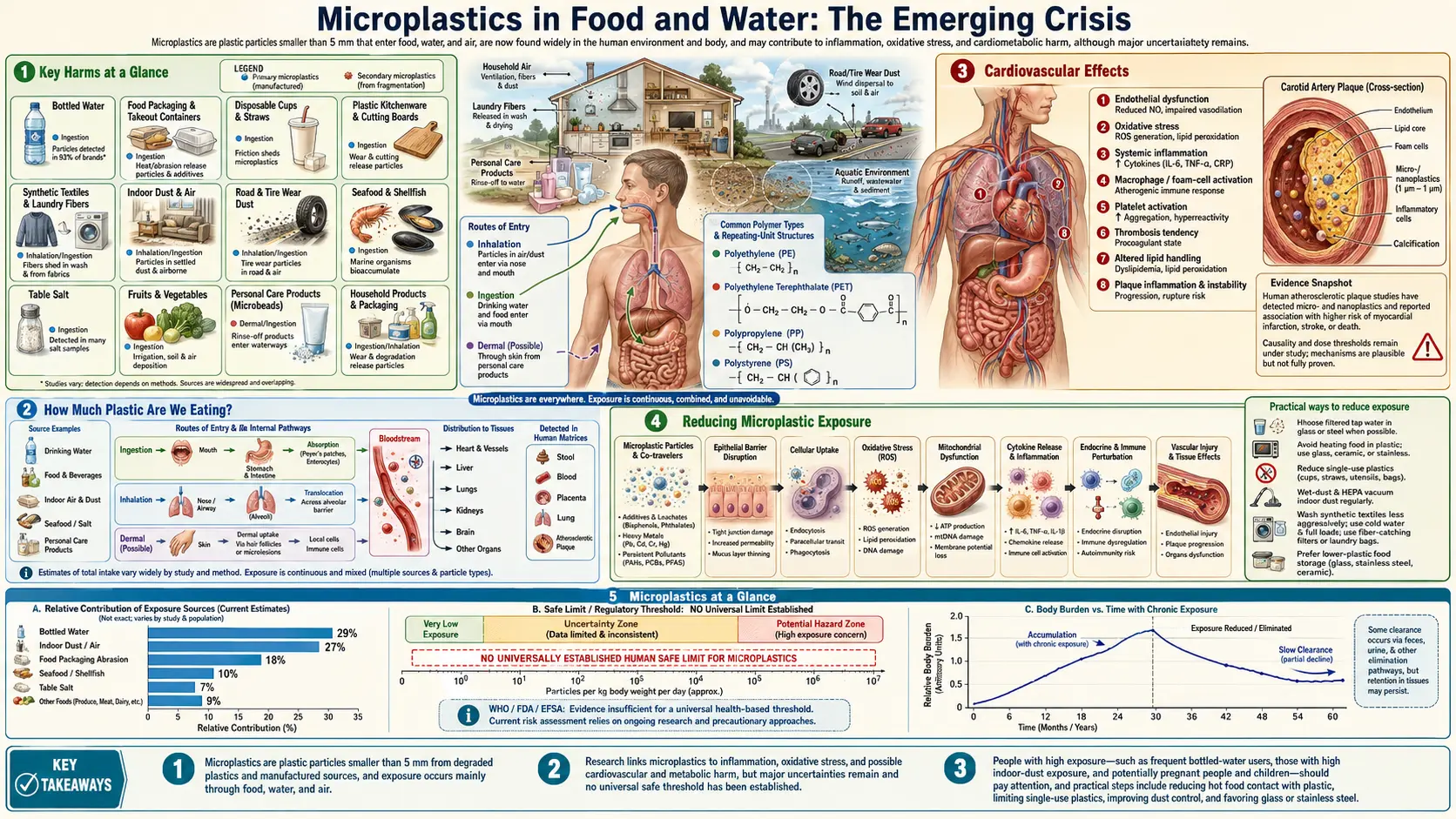
Microplastics are plastic particles smaller than 5 millimetres and larger than 1 micrometre; nanoplastics are smaller still, in the 1–1,000 nanometre range (Kutlar Joss 2026). They are described in the research as ubiquitous environmental contaminants, and studies have measured them in bottled water, salt, seafood, fruit and vegetables, and indoor and outdoor air. Human biomonitoring studies have reported plastic particles in blood (Leslie 2022), placenta (Ragusa 2021), breast milk (Ragusa 2022), testis (Hu 2024), carotid artery plaque (Marfella 2024), and liver, kidney and brain tissue from autopsies (Nihart 2025).
How much plastic people take in is uncertain. A 2021 analysis from the University of Newcastle, Australia, estimated that people may ingest 0.1–5 g of microplastics a week on global average (Senathirajah 2021); the upper end of that range is the basis of the widely repeated “credit card a week” comparison. A 2022 reanalysis concluded that the calculation overestimates the ingested mass by several orders of magnitude (Pletz 2022), and a 2021 lifetime exposure model put median adult intake at 883 particles and 583 nanograms a day (Mohamed Nor 2021). Animal and cell studies describe effects on the gut, brain and reproductive organs, and one observational study linked plastics in artery plaque to later heart attack, stroke and death (Marfella 2024). What typical human exposure means for health is still being studied (Leslie 2022; Broggiato 2026).
Table of Contents
- Key Findings at a Glance
- What Are Microplastics?
- Sources of Microplastic Exposure Through Food and Water
- How Much Plastic Are We Eating?
- Nanoplastics and the Brain
- Gut Effects
- Endocrine Disruption
- Cardiovascular Findings
- Reproductive Findings
- Bottled Water vs. Tap Water
- What Studies Report About Everyday Sources
- Key Research Papers
- Connections
- Featured Videos
Key Findings at a Glance
- Intake estimates differ widely — 0.1–5 g a week in one analysis (Senathirajah 2021), a median of 583 ng a day for adults in a lifetime exposure model (Mohamed Nor 2021); a 2022 reanalysis concluded the gram-level figure is an overestimate by several orders of magnitude (Pletz 2022).
- Detected in human blood, placenta, breast milk, testis and brain tissue — small human studies and autopsy series (see below).
- Plaque plastics and cardiovascular events — in a 2024 observational NEJM study, patients whose carotid plaque contained micro- and nanoplastics had a higher risk of heart attack, stroke or death (hazard ratio 4.53) over about 34 months (Marfella 2024).
- Gut barrier effects in mice — polystyrene microplastic reduced intestinal mucus secretion and damaged barrier function in mice (Jin 2019); people with inflammatory bowel disease had more microplastics in stool than healthy people (Yan 2022).
- Estrogenic chemicals — almost all commercial plastic products sampled in one study leached chemicals with estrogenic activity in a cell assay (Yang 2011).
- Reproductive findings — microplastics were measured in all 23 human testes in one study (Hu 2024); mouse studies report reduced fertility after nanoplastic exposure (Zeng 2023).
- Bottled water: about 240,000 particles per litre — a 2024 Columbia University study using stimulated Raman scattering microscopy, about 90% of them nanoplastics (Qian 2024).
- Plastic teabags — one plastic teabag steeped at 95 °C released about 11.6 billion microplastics and 3.1 billion nanoplastics into a cup (Hernandez 2019).
- Brain — in mice, orally given nanometre-sized polystyrene particles reached the brain within 2 hours (Kopatz 2023); autopsy brain tissue contained plastics, mostly polyethylene (Nihart 2025).
What Are Microplastics?
- Definition: Microplastics are defined as plastic particles smaller than 5 mm and larger than 1 micrometre; nanoplastics are in the 1–1,000 nm range (Kutlar Joss 2026)
- Primary microplastics: Sources described as primary include microbeads, microfibres, paints and pharmaceutical additives (Yadav P 2025). Washing synthetic clothing releases fibres: a study using domestic washing machines estimated that over 700,000 fibres could be released from an average 6 kg wash load of acrylic fabric, and polyester-cotton blend shed significantly fewer fibres than polyester or acrylic (Napper 2016)
- Secondary microplastics: These result from the degradation of larger plastic products (Yadav P 2025). In a simulation of bottled water stored in a vehicle, prolonged sunlight and heat accelerated the breakdown of PET bottles (Hu J 2025)
- Composition: Microplastics are primarily composed of polymers such as polyethylene, polypropylene and polystyrene, together with additives that enhance their performance (Bora 2024). Polypropylene was the most common polymer in bottled-water particles (54%) (Mason 2018); polyethylene predominated in autopsy tissues (Nihart 2025)
- Chemical carriers: Microplastics adsorb environmental chemicals such as persistent organic pollutants and heavy metals (Bora 2024). A lifetime exposure model that included chemical sorption concluded that the contribution of ingested microplastics to total chemical intake from food is small (Mohamed Nor 2021)
Sources of Microplastic Exposure Through Food and Water
- Bottled water: A 2018 study of 259 bottles from 11 brands bought in nine countries found some sign of microplastic contamination in 93%, with an average of 10.4 particles larger than 100 µm per litre and 325 per litre when particles of 6.5–100 µm were included (the smaller particles were identified by dye, not confirmed spectroscopically) (Mason 2018). A 2024 study estimated about 2.4 × 10⁵ micro- and nanoplastic particles per litre of bottled water (Qian 2024)
- Tap water: In one exposure estimate, people meeting their recommended water intake only from bottled water might ingest an additional 90,000 microplastics a year, compared with 4,000 for those drinking only tap water (Cox 2019)
- Salt: Of 39 salt brands tested, microplastic content ranged from 0–1,674 particles per kg in sea salts (excluding one outlier of 13,629), 0–148 in rock salt and 28–462 in lake salt; sea salts produced in Asian countries and regions had relatively high levels, and in unrefined sea salts the levels correlated with plastic emissions from rivers and with reported microplastic levels in the surrounding seawater (Kim 2018)
- Seafood: In commercially important fish, particle numbers were significantly higher than controls in the gills and digestive tissues but not in the edible flesh; in scallops, which are eaten whole, Patagonian samples had significantly more particles while Scottish samples did not differ from controls (Akoueson 2020)
- Honey: A 2013 study found coloured fibres and fragments in all 19 honey samples it examined (fibres 40–660 per kg) and in commercial sugars; the authors described them as non-pollen particulates of tentatively environmental or processing origin (Liebezeit 2013)
- Tea bags: Plastic teabags made of nylon and PET released billions of micro- and nanoplastic particles into a single cup at brewing temperature (Hernandez 2019)
- Fruits and vegetables: An Italian study detected micro- and nanoplastics in edible fruit and vegetables, with apples the most contaminated fruit and carrots the most contaminated vegetable; the authors hypothesized uptake and translocation through the plants' biological systems (Oliveri Conti 2020)
- Food containers and preparation: Microwave heating caused the highest release of particles from plastic containers in one study (Hussain 2023), polypropylene infant feeding bottles released microplastics during formula preparation (Li D 2020), and chopping on plastic cutting boards released microplastics (Yadav H 2023) — details below
How Much Plastic Are We Eating?
- The 0.1–5 g a week estimate: Using data from 59 publications, a University of Newcastle team estimated that humans may ingest 0.1–5 g of microplastics weekly on global average, describing it as the first attempt to turn microplastic counts into a mass (Senathirajah 2021). This range underlies the “credit card a week” comparison (Pletz 2022)
- Critique of that estimate: A 2022 reanalysis raised serious issues with how the estimate combined data and obtained particle sizes, concluded that it overestimates ingested mass by several orders of magnitude, and argued that ingested mass is a rather irrelevant factor for toxic effects (Pletz 2022)
- Lifetime exposure model: A 2021 probabilistic model estimated median intake of microplastics (1–5,000 µm) at 553 particles (184 ng) a day for children and 883 particles (583 ng) a day for adults, with simulated stool concentrations agreeing with measured data (Mohamed Nor 2021)
- Particle counts in the American diet: Covering about 15% of Americans' caloric intake, one analysis estimated annual consumption at 39,000–52,000 particles depending on age and sex, rising to 74,000–121,000 when inhalation was included; the authors note large variation and consider these likely underestimates (Cox 2019)
- Inhalation: A review cites calculations of 1,200 inhaled particles a year in remote locations to over 1.5 million a year in highly polluted urban areas, with indoor exposure generally exceeding outdoor (Kutlar Joss 2026)
- Trend over time: In autopsy samples, time of death (2016 versus 2024) was a significant factor, with plastic concentrations higher in later samples of both liver and brain (Nihart 2025)
Nanoplastics and the Brain
- Size matters in mice: When mice were given polystyrene particles of 9.55, 1.14 and 0.293 µm by mouth, nanometre-sized particles — but not the larger ones — reached the brain within 2 hours. Computer simulations suggested that the coating of molecules around a particle affects passage: cholesterol enhanced uptake into the membrane, while a protein model inhibited it (Kopatz 2023)
- Gut-to-brain signalling in mice: In mice fed nanoplastics of about 500 nm, the particles activated gut macrophages through lysosomal damage; the resulting interleukin-1 signalling was linked to microglial activation in the brain and a decline in cognitive and short-term memory (Yang Q 2023)
- Human autopsy tissue: A 2025 study detected micro- and nanoplastics in decedent human kidney, liver and brain, mainly polyethylene. Brain tissue held a higher proportion of polyethylene than liver or kidney, and electron microscopy showed mostly nanoscale shard-like fragments. Concentrations were not influenced by age, sex, race/ethnicity or cause of death (Nihart 2025)
- Dementia cohort: The same study observed even greater accumulation in decedent brains with a documented dementia diagnosis, with deposits in cerebrovascular walls and immune cells. The authors call for research on routes of exposure, uptake and clearance, and potential health consequences (Nihart 2025). An author correction (2025) removed duplicated supplementary figure panels, corrected scale bars, added a sample preparation step and clarified a supplementary data table
- Cellular uptake: In a cell study, polystyrene nanoplastics penetrated human ovarian granulosa-like cells (Zeng 2023)
Gut Effects
- Barrier and microbiota in mice: Male mice exposed to 5 µm polystyrene microplastic for six weeks had reduced intestinal mucus secretion, damaged intestinal barrier function, altered gut microbiota (including a significant fall in Actinobacteria and changes in 15 genera) and metabolic disorders (Jin 2019)
- Inflammatory signalling in mice: Nanoplastics activated gut macrophages more strongly than microplastics and reprogrammed them to produce interleukin-1 (Yang Q 2023)
- Review findings: A 2024 review describes microplastics accumulating in the gastrointestinal tract and disrupting the gut microbiome, a disruption it links to gastrointestinal disorders, systemic inflammation and chronic disease (Bora 2024)
- Chemicals carried on particles: A lifetime exposure model found that the contribution of ingested microplastics to total chemical intake is small (Mohamed Nor 2021)
- IBD connection: Stool from people with inflammatory bowel disease contained more microplastics (41.8 items per gram dry mass) than stool from healthy people (28.0), and concentration correlated with disease severity. The authors state that exposure may be related to the disease process or that IBD may increase retention of microplastics (Yan 2022)
Endocrine Disruption
- Estrogenic chemicals from plastic products: Using a sensitive MCF-7 cell proliferation assay, a 2011 study found that almost all commercially available plastic products sampled leached chemicals with detectable estrogenic activity, including products advertised as BPA-free; in some cases BPA-free products released more estrogenic activity than BPA-containing ones (Yang 2011). Several authors disclosed employment by, or stock in, companies with financial interests in this research
- Additives and adsorbed chemicals: Microplastics contain performance additives and adsorb persistent organic pollutants and heavy metals (Bora 2024). BPA and phthalates are covered on their own pages in this section
- The “Trojan horse” question: The idea that particles deliver concentrated chemical doses is tested by modelling: a lifetime exposure model concluded that microplastics contribute little to total chemical intake (Mohamed Nor 2021)
Cardiovascular Findings
- Blood: A 2022 study described as the first to report plastic particles in human blood measured particles of 700 nm and larger in whole blood from 22 healthy volunteers; PET, polyethylene and styrene polymers were the most widely encountered, and the mean of the summed quantifiable concentration was 1.6 µg/mL. The authors state that whether this exposure is a public health risk remains to be determined (Leslie 2022)
- Arterial plaques: A 2024 prospective, multicentre observational study in the New England Journal of Medicine analysed plaque removed from patients having carotid endarterectomy for asymptomatic carotid artery disease. Of 257 patients who completed a mean follow-up of 33.7 months, 150 (58.4%) had polyethylene in their plaque and 31 (12.1%) also had polyvinyl chloride. Patients with micro- and nanoplastics in the plaque had a higher risk of the composite of heart attack, stroke or death from any cause than those without (hazard ratio 4.53; 95% CI 2.00–10.27) (Marfella 2024)
- Study design: The study was observational and its background notes that direct evidence that the preclinical risk extends to humans had been lacking; it also measured inflammatory biomarkers in the plaque (Marfella 2024)
Reproductive Findings
- Testicular tissue: A 2024 study found microplastics in all 47 dog and 23 human testes it analysed, with mean totals of 122.63 µg/g in dogs and 328.44 µg/g in humans, polyethylene dominant; PVC and PET levels correlated negatively with normalized testis weight (Hu 2024). The study drew a published comment and an author response in the same journal
- Sperm: A 2026 review reports that micro- and nanoplastics have been identified in testicular tissue and semen, and that animal studies report decreased sperm count and quality (Broggiato 2026)
- Ovarian effects in mice: In female mice, 1 mg a day of polystyrene nanoplastics decreased fertility, disturbed ovarian function and increased ovarian apoptosis (Zeng 2023); the 2026 review also cites mouse studies of reduced oocyte quality and pregnancy rates, and detection in human follicular fluid (Broggiato 2026)
- Placenta: In six placentas from physiological pregnancies, 12 microplastic fragments of 5–10 µm were found in four — five on the fetal side, four on the maternal side and three in the membranes (Ragusa 2021). Research reviewed in 2026 has also reported micro- and nanoplastics in fetal meconium and amniotic fluid (Broggiato 2026)
- Breast milk: Microplastics, mostly polyethylene, PVC and polypropylene of 2–12 µm, were found in 26 of 34 breast milk samples; no significant relationship was found with the mothers' age, use of plastic-containing personal care products, or consumption of seafood or plastic-packaged food and drinks (Ragusa 2022)
- Interpreting the animal data: The 2026 review notes that many laboratory models use unrealistically high doses of pristine polymers without environmental additives, which may limit their relevance to real-world exposure (Broggiato 2026)
Bottled Water vs. Tap Water
- Where bottled-water particles come from: Polypropylene, the most common polymer found, matches a common bottle-cap plastic, and the data suggested contamination comes at least partly from the packaging or bottling process (Mason 2018)
- Heat and sunlight: In a simulation of PET bottled water stored in a vehicle, prolonged sunlight and heat accelerated PET degradation, producing up to 10.03 ppm microplastics within 28 days (Hu J 2025)
- Nanoplastic discovery: A Columbia University team developed a stimulated Raman scattering microscopy method able to detect single nanoplastics below 100 nm. Applied to bottled water, it estimated about 2.4 ± 1.3 × 10⁵ particles per litre, about 90% of them nanoplastics — orders of magnitude more than the microplastic abundance reported earlier in bottled water (Qian 2024)
- Bottled versus tap: One exposure estimate put the extra intake from drinking only bottled water at about 90,000 microplastics a year, against 4,000 for only tap water (Cox 2019)
What Studies Report About Everyday Sources
Most of the figures below are laboratory release measurements; intake figures in them are model estimates based on the authors' assumptions.
- Heating food in plastic: Microwave heating caused the highest release of micro- and nanoplastics into food simulants compared with refrigeration or room-temperature storage; some containers released as many as 4.22 million microplastic and 2.11 billion nanoplastic particles from one square centimetre within 3 minutes of microwaving. Storage for over six months also released millions to billions of particles (Hussain 2023)
- Infant feeding bottles: Polypropylene feeding bottles released up to 16,200,000 microplastic particles per litre during formula preparation; sterilization and high-temperature water significantly increased release, and estimated infant exposure across 48 regions ranged from 14,600 to 4,550,000 particles per day (Li D 2020)
- Tea bags: Steeping a single plastic teabag at 95 °C released about 11.6 billion microplastics and 3.1 billion nanoplastics into a cup, matched to the bags' nylon and PET; the authors report these levels as several orders of magnitude higher than plastic loads reported in other foods (Hernandez 2019). The study drew a published comment and an author response in 2020
- Cutting boards: Chopping released microplastics from both polypropylene and polyethylene boards; based on their assumptions, the authors estimated annual exposure of 7.4–50.7 g from a polyethylene board and 49.5 g from a polypropylene board. The polyethylene particles did not affect mouse fibroblast viability over 72 hours (Yadav H 2023)
- Water source: Bottled-only drinkers were estimated to ingest about 90,000 more microplastics a year, versus 4,000 for tap-only drinkers (Cox 2019)
- Salt type: Measured ranges were 0–1,674 particles per kg in sea salts, 0–148 in rock salt and 28–462 in lake salt (Kim 2018)
- Laundry: Acrylic and polyester fabrics shed significantly more fibres in washing than a polyester-cotton blend (Napper 2016)
- Indoor air: A review reports that indoor airborne microplastic exposure generally exceeds outdoor exposure, with tyre wear, textile fibres and degrading plastics among the major sources of airborne microplastics (Kutlar Joss 2026)
Key Research Papers
Key peer-reviewed research and authoritative sources underpinning the claims on this page. Links resolve to DOI, PubMed, or the issuing agency.
- Mason SA, Welch VG, Neratko J. Synthetic polymer contamination in bottled water. Front Chem. 2018;6:407. — doi:10.3389/fchem.2018.00407
- Qian N, Gao X, Lang X, et al. Rapid single-particle chemical imaging of nanoplastics by SRS microscopy. Proc Natl Acad Sci USA. 2024;121(3):e2300582121. — doi:10.1073/pnas.2300582121
- Marfella R, Prattichizzo F, Sardu C, et al. Microplastics and nanoplastics in atheromas and cardiovascular events. N Engl J Med. 2024;390(10):900-910. — doi:10.1056/NEJMoa2309822
- Leslie HA, van Velzen MJM, Brandsma SH, Vethaak AD, Garcia-Vallejo JJ, Lamoree MH. Discovery and quantification of plastic particle pollution in human blood. Environ Int. 2022;163:107199. — doi:10.1016/j.envint.2022.107199
- Ragusa A, Svelato A, Santacroce C, et al. Plasticenta: first evidence of microplastics in human placenta. Environ Int. 2021;146:106274. — doi:10.1016/j.envint.2020.106274
- Ragusa A, Notarstefano V, Svelato A, et al. Raman microspectroscopy detection and characterisation of microplastics in human breastmilk. Polymers. 2022;14(13):2700. — doi:10.3390/polym14132700
- Nihart AJ, Garcia MA, El Hayek E, et al. Bioaccumulation of microplastics in decedent human brains. Nat Med. 2025;31:1114-1119. — doi:10.1038/s41591-024-03453-1
- Hernandez LM, Xu EG, Larsson HCE, Tahara R, Maisuria VB, Tufenkji N. Plastic teabags release billions of microparticles and nanoparticles into tea. Environ Sci Technol. 2019;53(21):12300-12310. — doi:10.1021/acs.est.9b02540
- Cox KD, Covernton GA, Davies HL, Dower JF, Juanes F, Dudas SE. Human consumption of microplastics. Environ Sci Technol. 2019;53(12):7068-7074. — doi:10.1021/acs.est.9b01517
- Senathirajah K, Attwood S, Bhagwat G, Carbery M, Wilson S, Palanisami T. Estimation of the mass of microplastics ingested — a pivotal first step towards human health risk assessment. J Hazard Mater. 2021;404(Pt B):124004. — doi:10.1016/j.jhazmat.2020.124004
- Zeng L, Zhou C, Xu W, et al. The ovarian-related effects of polystyrene nanoplastics on human ovarian granulosa cells and female mice. Ecotoxicol Environ Saf. 2023;257:114941. — doi:10.1016/j.ecoenv.2023.114941
- Jin Y, Lu L, Tu W, Luo T, Fu Z. Impacts of polystyrene microplastic on the gut barrier, microbiota and metabolism of mice. Sci Total Environ. 2019;649:308-317. — doi:10.1016/j.scitotenv.2018.08.353
- Mohamed Nor NH, Kooi M, Diepens NJ, Koelmans AA. Lifetime accumulation of microplastic in children and adults. Environ Sci Technol. 2021;55(8):5084-5096. — doi:10.1021/acs.est.0c07384
- Pletz M. Ingested microplastics: do humans eat one credit card per week? J Hazard Mater Lett. 2022;3:100071. — doi:10.1016/j.hazl.2022.100071
- Hu CJ, Garcia MA, Nihart A, et al. Microplastic presence in dog and human testis and its potential association with sperm count and weights of testis and epididymis. Toxicol Sci. 2024;200(2):235-240. — doi:10.1093/toxsci/kfae060
- Yan Z, Liu Y, Zhang T, Zhang F, Ren H, Zhang Y. Analysis of microplastics in human feces reveals a correlation between fecal microplastics and inflammatory bowel disease status. Environ Sci Technol. 2022;56(1):414-421. — doi:10.1021/acs.est.1c03924
- Kim JS, Lee HJ, Kim SK, Kim HJ. Global pattern of microplastics (MPs) in commercial food-grade salts: sea salt as an indicator of seawater MP pollution. Environ Sci Technol. 2018;52(21):12819-12828. — doi:10.1021/acs.est.8b04180
- Akoueson F, Sheldon LM, Danopoulos E, et al. A preliminary analysis of microplastics in edible versus non-edible tissues from seafood samples. Environ Pollut. 2020;263(Pt A):114452. — doi:10.1016/j.envpol.2020.114452
- Liebezeit G, Liebezeit E. Non-pollen particulates in honey and sugar. Food Addit Contam Part A. 2013;30(12):2136-2140. — doi:10.1080/19440049.2013.843025
- Oliveri Conti G, Ferrante M, Banni M, et al. Micro- and nano-plastics in edible fruit and vegetables. The first diet risks assessment for the general population. Environ Res. 2020;187:109677. — doi:10.1016/j.envres.2020.109677
- Hussain KA, Romanova S, Okur I, et al. Assessing the release of microplastics and nanoplastics from plastic containers and reusable food pouches: implications for human health. Environ Sci Technol. 2023;57(26):9782-9792. — doi:10.1021/acs.est.3c01942
- Li D, Shi Y, Yang L, et al. Microplastic release from the degradation of polypropylene feeding bottles during infant formula preparation. Nat Food. 2020;1(11):746-754. — doi:10.1038/s43016-020-00171-y
- Yadav H, Khan MRH, Quadir M, et al. Cutting boards: an overlooked source of microplastics in human food? Environ Sci Technol. 2023;57(22):8225-8235. — doi:10.1021/acs.est.3c00924
- Kopatz V, Wen K, Kovács T, et al. Micro- and nanoplastics breach the blood-brain barrier (BBB): biomolecular corona's role revealed. Nanomaterials. 2023;13(8):1404. — doi:10.3390/nano13081404
- Yang Q, Dai H, Cheng Y, et al. Oral feeding of nanoplastics affects brain function of mice by inducing macrophage IL-1 signal in the intestine. Cell Rep. 2023;42(4):112346. — doi:10.1016/j.celrep.2023.112346
- Yang CZ, Yaniger SI, Jordan VC, Klein DJ, Bittner GD. Most plastic products release estrogenic chemicals: a potential health problem that can be solved. Environ Health Perspect. 2011;119(7):989-996. — doi:10.1289/ehp.1003220
- Napper IE, Thompson RC. Release of synthetic microplastic plastic fibres from domestic washing machines: effects of fabric type and washing conditions. Mar Pollut Bull. 2016;112(1-2):39-45. — doi:10.1016/j.marpolbul.2016.09.025
- Hu J, Wu Y, Wang J, et al. Unraveling microplastics release in bottled water under in-vehicle conditions using carbon quantum dots. J Hazard Mater. 2025;496:139200. — doi:10.1016/j.jhazmat.2025.139200
- Broggiato M, Pezzana S, Scaccabarozzi C, et al. Plastic pollution in human reproduction: should we worry? Reprod Biomed Online. 2026;52(3):105343. — doi:10.1016/j.rbmo.2025.105343
- Kutlar Joss M, Probst-Hensch N. Microplastics in the air and potential health risks — a narrative review. Swiss Med Wkly. 2026;156:4935. — doi:10.57187/4935
- Bora SS, Gogoi R, Sharma MR, et al. Microplastics and human health: unveiling the gut microbiome disruption and chronic disease risks. Front Cell Infect Microbiol. 2024;14:1492759. — doi:10.3389/fcimb.2024.1492759
- Yadav P, Kumar A, Ram K, et al. Microbial degradation of microplastics: effectiveness, challenges, and sustainable solutions. Curr Res Microb Sci. 2025;9:100495. — doi:10.1016/j.crmicr.2025.100495
- PubMed — search for recent research