Glyphosate: The World's Most Widely Used Herbicide
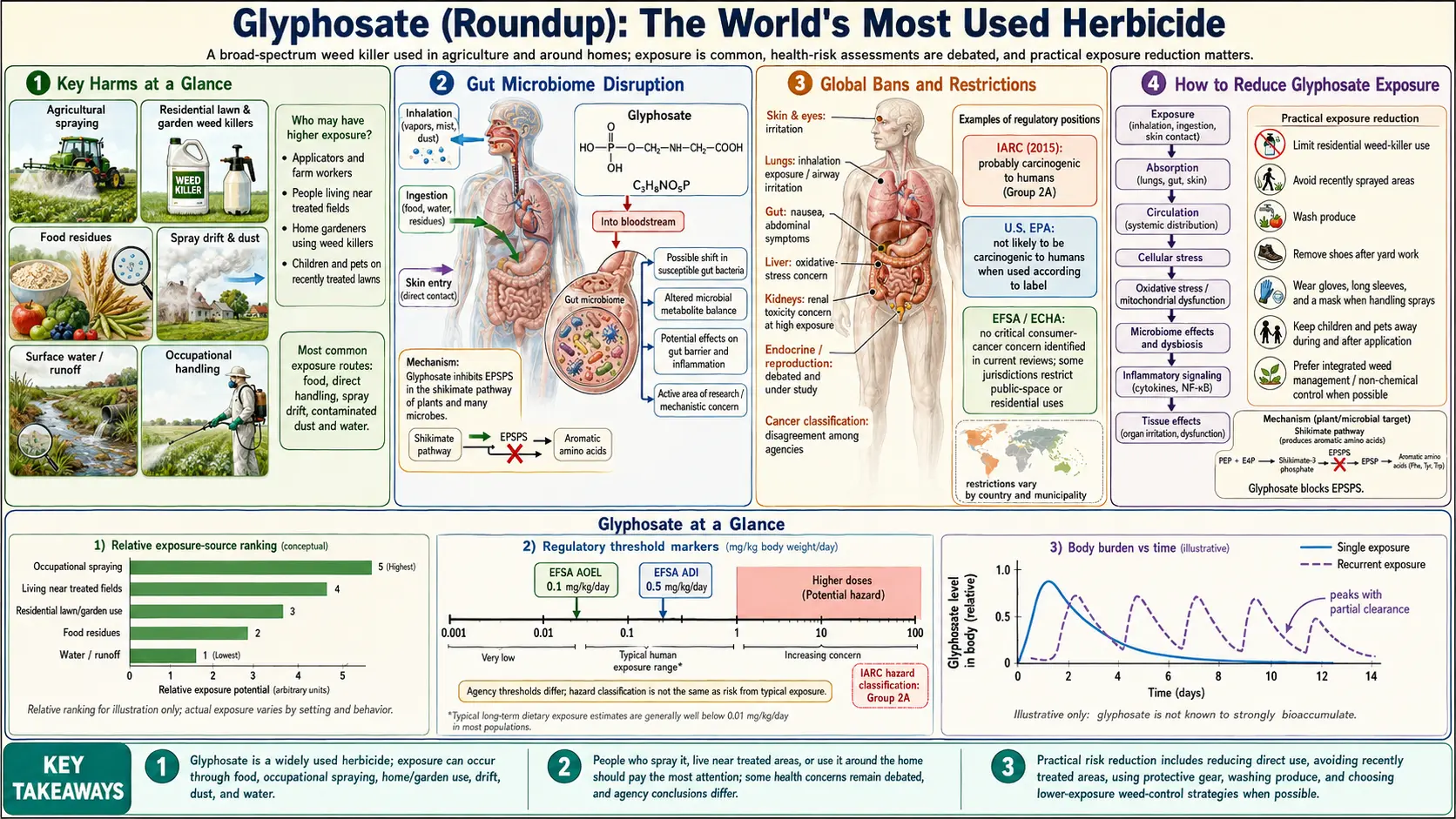
Glyphosate is a broad-spectrum systemic herbicide, and published reviews describe it as the most widely used herbicide in the world. It was introduced commercially in 1974. A 2016 analysis of use data estimated that 8.6 billion kilograms had been applied worldwide by 2014, about 1.6 billion kilograms of it in the United States, and that global use rose almost 15-fold after genetically engineered glyphosate-tolerant crops were introduced in 1996 (Benbrook 2016). Its safety is contested: the World Health Organization's cancer agency (IARC) classified it as "probably carcinogenic to humans" in 2015, while the US Environmental Protection Agency (EPA) and European regulators concluded that it is not likely to be, or unlikely to be, a human carcinogen. This page sets out what each agency and the main studies report, including where they disagree.
Table of Contents
- Key Findings at a Glance
- History and Scale of Use
- Cancer Classifications: IARC, EPA, EFSA
- Non-Hodgkin Lymphoma Lawsuits
- Gut Microbiome Research
- Where Glyphosate Is Found
- Glyphosate-Tolerant Crops and Resistant Weeds
- Bans and Restrictions
- Mineral Chelation Claims
- The Seralini Study and Scientific Controversy
- Endocrine and Formulation Research
- What Studies Report About Differences in Exposure
- Key Research Papers
- Connections
- Featured Videos
Key Findings at a Glance
- IARC Group 2A (March 2015) — "probably carcinogenic to humans," based on "limited" evidence of cancer in humans, "sufficient" evidence in experimental animals and "strong" evidence of genotoxicity. IARC describes this as a hazard classification, not an estimate of risk at a given exposure.
- EPA and EFSA disagree with IARC — EPA concluded in 2017 that glyphosate is "not likely to be carcinogenic to humans"; EFSA concluded in 2015 that it is "unlikely to pose a carcinogenic hazard to humans." In 2022 a US federal appeals court vacated the human-health portion of EPA's 2020 interim decision, finding the cancer conclusion not supported by substantial evidence.
- Non-Hodgkin lymphoma: studies differ — the large Agricultural Health Study cohort found no association overall (2018); a 2019 meta-analysis using the highest-exposure groups reported a 41% higher risk (meta-RR 1.41, 95% CI 1.13–1.75).
- Shikimate pathway in microbes — glyphosate blocks the EPSPS enzyme, which plants and some microorganisms use. Laboratory, bee and rat studies report effects on gut bacteria; human data are lacking.
- Formulations — cell studies report commercial formulations to be more toxic than glyphosate alone, and reviewers note that risk assessment focuses almost exclusively on the active ingredient.
- Transgenerational effects in rats — one rat study reported disease in the grand-offspring and great-grand-offspring of exposed females, with negligible effects in the exposed generation and their offspring.
- Residues — studies have measured glyphosate in genetically engineered soybeans, honey and human urine; a study of 41 breast-milk samples detected none.
- Resistant weeds — 38 weed species in 37 countries had evolved glyphosate resistance by a 2018 review.
- Bans — a 2023 policy study described Sri Lanka as the first and only country to adopt and implement a complete ban (2015), later reversed; the EU renewed glyphosate's approval until 15 December 2033.
History and Scale of Use
- 1974 – Market launch: Glyphosate was introduced commercially in 1974 and became the dominant herbicide worldwide (Duke and Powles 2008)
- 1996 – Glyphosate-tolerant crops: The first glyphosate-tolerant (genetically engineered) crop, soybean, was introduced in the United States in 1996 (Heap and Duke 2018). By 2008, almost 90% of transgenic crops grown worldwide were glyphosate resistant (Duke and Powles 2008)
- Generic production: After glyphosate became a generic compound, its cost dropped sharply (Duke and Powles 2008)
- Scale of use: An estimated 8.6 billion kilograms had been applied globally by 2014; two-thirds of the US total for 1974–2014 was sprayed in the last 10 of those years (72% globally), and in 2014 enough was sprayed to apply about 1.0 kg per hectare on every hectare of US cropland. Genetically engineered herbicide-tolerant crops accounted for about 56% of global use (Benbrook 2016)
Cancer Classifications: IARC, EPA, EFSA
- IARC Group 2A (2015): In March 2015 the International Agency for Research on Cancer classified glyphosate as "probably carcinogenic to humans" (Group 2A). IARC states the classification rests on "limited" evidence of cancer in humans (from real-world exposures, mainly to formulated products), "sufficient" evidence of cancer in experimental animals (from studies of pure glyphosate) and "strong" evidence of genotoxicity for both pure glyphosate and its formulations. The full evaluation appears in IARC Monographs Volume 112
- Non-Hodgkin lymphoma in the IARC review: IARC reports that studies of people exposed to different formulations in different regions found increases in the same cancer, non-Hodgkin lymphoma, and that its Working Group's combined analysis of all available studies showed a statistically significant association
- Hazard, not risk: IARC describes its evaluation as a hazard classification that "indicates the strength of evidence that glyphosate can cause cancer"; the probability of cancer depends on the type and extent of exposure. IARC also states that many regulatory agencies rely primarily on industry toxicology data that are not public, while IARC uses only publicly available data
- US EPA: EPA states that its 2017 assessment concluded glyphosate is "not likely to be carcinogenic to humans," and that its 2020 interim registration review decision found no human health risks when glyphosate is used as directed
- 2022 court ruling: In June 2022 the US Court of Appeals for the Ninth Circuit held that EPA's "not likely to be carcinogenic" conclusion was in tension with its own analysis and its 2005 Cancer Guidelines (EPA had said the association with non-Hodgkin lymphoma could not be determined) and was not supported by substantial evidence. The court vacated the human-health portion of the interim decision and remanded it. EPA withdrew the interim decision in September 2022 and states it expects to complete an updated cancer and human-health assessment in late 2026
- EFSA (2015 and 2023): After considering IARC's findings, the European Food Safety Authority concluded in 2015 that glyphosate "is unlikely to pose a carcinogenic hazard to humans." In July 2023 EFSA reported no critical areas of concern, noting that the European Chemicals Agency had found in 2022 that glyphosate did not meet the criteria for classification as carcinogenic, mutagenic or reprotoxic; EFSA listed data gaps, including the consumer dietary risk assessment, one impurity, risks to aquatic plants and the toxicity of one formulation component
- Documents from litigation: A 2018 analysis of 141 documents released in US litigation reported ghostwriting of articles sponsored by the herbicide's original manufacturer, interference in peer review and behind-the-scenes influence on a retraction (McHenry 2018)
Non-Hodgkin Lymphoma Lawsuits
- Scale: According to a 2021 federal appeals court opinion, thousands of people with cancer had sued the herbicide's original manufacturer in state and federal courts since 2015
- Johnson case (California): A school district grounds integrated pest manager who developed non-Hodgkin lymphoma was awarded about $39.3 million in compensatory and $250 million in punitive damages by a jury. In 2020 the California Court of Appeal reduced the compensatory award to $10,253,209.32 and the punitive award to the same amount
- Hardeman case (federal): In the first federal bellwether trial, the jury awarded about $5.27 million in compensatory and $75 million in punitive damages; the district court reduced the punitive award to $20 million. In 2021 the Ninth Circuit affirmed the judgment, finding substantial evidence of malice under California law and holding the reduced award constitutional
- Pilliod case (California): A married couple who both developed non-Hodgkin lymphoma were awarded over $37 million and over $18 million in compensatory damages and $1 billion each in punitive damages. The trial court reduced the totals to about $56 million and about $31 million, and the Court of Appeal affirmed in 2021
- Verdicts and science: These are legal findings on liability in individual cases; they are separate from the scientific and regulatory assessments described above, which continue to disagree
Gut Microbiome Research
- Shikimate pathway: Glyphosate targets 5-enolpyruvylshikimate-3-phosphate synthase (EPSPS), an enzyme of the shikimate pathway found in plants and some microorganisms. Glyphosate is the only herbicide that targets EPSPS (Duke and Powles 2008)
- Poultry bacteria (laboratory): A 2013 in vitro study of poultry gut bacteria reported that Salmonella and Clostridium species were highly resistant to glyphosate, while most beneficial species tested, including Enterococcus, Bifidobacterium adolescentis and Lactobacillus, were moderately to highly susceptible (Shehata 2013)
- Honey bees: Bees exposed to glyphosate at concentrations documented in the environment had lower abundances of dominant gut bacteria and higher mortality after exposure to an opportunistic pathogen (Motta 2018)
- Rats: In a 90-day rat study, glyphosate and a commercial formulation caused build-up of shikimic acid in the cecum, suggesting inhibition of the shikimate pathway in gut bacteria; the changed gut metabolites were not seen in blood, which the authors interpreted as limited consequences for body chemistry (Mesnage 2021)
- Antiparasitic patent: A US patent assigned to the herbicide's original manufacturer (US 7,771,736, granted 2010) claims the use of glyphosate combined with oxalic acid to treat infections by pathogens that contain EPSPS, such as the parasites that cause malaria and toxoplasmosis
- Disease hypothesis: A 2013 hypothesis paper argued that glyphosate's effects on gut-bacterial amino acid synthesis and on cytochrome P450 enzymes contribute to many Western diseases (Samsel and Seneff 2013); it presents an argument rather than new experimental data, and human studies testing it are lacking
Where Glyphosate Is Found
- Pre-harvest use on grains: EFSA's 2015 review covered foliar spraying for desiccation of cereals and oilseeds before harvest as a representative use, and a 2016 consensus statement described pre-harvest desiccant use as a newer use pattern. The EU's 2023 renewal does not permit desiccation uses
- Soybeans: In 31 soybean batches from Iowa, genetically engineered glyphosate-tolerant soy contained glyphosate and its breakdown product AMPA (means of 3.3 and 5.7 mg/kg); conventional and organic batches contained neither (Bøhn 2014)
- Honey: On the Hawaiian island of Kaua'i, glyphosate was detected in 27% of 59 hive honey samples and 33% of 15 store-bought samples, with higher occurrence near agriculture (Berg 2018)
- Breast milk: A study of 41 milk samples from lactating women in Idaho and Washington detected neither glyphosate nor AMPA (assay limit 1 µg/L); three of its co-authors were employees of the herbicide's original manufacturer (McGuire 2016)
- Water and air: A 2016 consensus statement concluded that glyphosate-based herbicides often contaminate drinking water sources, precipitation and air, especially in agricultural regions (Myers 2016)
- Human urine: A 2019 review of 19 studies found average urinary levels of 0.26–73.5 µg/L in occupationally exposed people and 0.16–7.6 µg/L in the general population, and noted that data on human exposure are scarce (Gillezeau 2019)
Glyphosate-Tolerant Crops and Resistant Weeds
- Engineered tolerance: Glyphosate-tolerant crops are genetically engineered to survive glyphosate, so it can be sprayed over the growing crop. A 2016 consensus statement reports that regulators increased residue tolerance levels in maize, oilseeds (soybeans and canola), alfalfa and related livestock feeds to accommodate these uses (Myers 2016)
- Rising use: Global glyphosate use rose almost 15-fold after these crops were introduced in 1996, and herbicide-tolerant crops accounted for about 56% of global use by 2014 (Benbrook 2016)
- Resistant weeds: Glyphosate resistance first appeared in a weed in Australia in 1996. By the 2018 review, 38 weed species had evolved resistance across 37 countries, 34 crops and six non-crop situations, with resistant weeds in glyphosate-tolerant cropping systems dominating the area affected (Heap and Duke 2018)
- Industry response: The same review reports that industry developed crop traits for resistance to other herbicides, and warns that over-reliance on these traits will lead to weeds resistant to several herbicides (Heap and Duke 2018)
Bans and Restrictions
- Sri Lanka: A 2023 policy study describes Sri Lanka as the first and so far only country to adopt and implement a complete glyphosate ban, in June 2015, after a local scientist linked glyphosate to an epidemic of chronic kidney disease of unknown origin. The ban was partly reversed in 2018 and fully revoked in 2022; the study reports that the scientific community did not corroborate the kidney-disease link (Dorlach 2023)
- Austria, France and Germany: The same study reports that these EU member states announced plans to restrict glyphosate nationally but that none had officially adopted or implemented a full ban including agricultural uses (Dorlach 2023)
- Thailand, El Salvador, Colombia: The study reports that Thailand planned a full ban from December 2019 but reversed it after interventions by the herbicide's manufacturer and the US government; that a 2013 Salvadoran law covering glyphosate was never signed or implemented; and that Colombia's aerial spraying of coca fields with glyphosate was halted after the 2015 IARC classification (Dorlach 2023)
- European Union: Glyphosate is approved in the EU until 15 December 2033 under Implementing Regulation (EU) 2023/2660. Uses for desiccation to control the timing of harvest are not permitted, and member states may add further conditions and restrictions
Mineral Chelation Claims
- The chelation patent: A 1964 US patent (US 3,160,632) held by a chemical company covers a family of aminomethylenephosphinic acids, listing chelating agents among their uses; it describes a glycine-methylenephosphinic acid that chelated calcium. The patent does not name glyphosate, although it is often cited as glyphosate's chelation patent
- Crop mineral content: A 2012 greenhouse and field study found that glyphosate at recommended rates had no effect on calcium, magnesium, manganese, zinc, iron, copper or other minerals in the leaves or seeds of glyphosate-tolerant soybeans, and no effect on yield; the authors note conflicting claims that reduced manganese is linked to crop disease (Duke 2012)
- Human health: No study measuring mineral status in people in relation to glyphosate exposure was found for this page; claims that dietary residues deplete minerals in the human body remain unverified
The Seralini Study and Scientific Controversy
- 2012 study: French molecular biologist Gilles-Eric Seralini and colleagues published a 2-year feeding study in rats given herbicide-tolerant genetically modified maize, low levels of a glyphosate-based herbicide formulation in drinking water, or both. The authors reported more kidney and liver pathology, earlier deaths in females and more large tumors in the treated groups than in controls; in the republished version they state that the study was a chronic-toxicity study and was not designed as a carcinogenicity study
- Retraction: Food and Chemical Toxicology retracted the 2012 paper in 2013 (retraction notice published January 2014, PMID 24490213), so the 2012 report is no longer part of the published record in that journal. The authors disputed the retraction
- Republication: The study was republished in the journal Environmental Sciences Europe in 2014. An editor's note on the republication states that it implies no appraisal of the paper's content and aims to enable scientific transparency and a discussion of its methodological controversies. The findings above therefore rest on a study that was retracted by its first journal and republished by a second, and remain disputed
- Disputed retraction: A 2018 analysis of documents released in US litigation reported behind-the-scenes influence by the herbicide's original manufacturer on a retraction (McHenry 2018)
- Authors' conclusion: The authors concluded that 2-year feeding trials are needed to evaluate the safety of genetically modified foods and pesticides in their full commercial formulations
Endocrine and Formulation Research
- Estrogen receptors (cells): Pure glyphosate stimulated the growth of hormone-dependent human breast cancer cells (T47D) at 10-12 to 10-6 M, through estrogen receptors, but not hormone-independent cells; this was a cell-culture study, and the authors called for animal studies (Thongprakaisang 2013)
- Aromatase (cells): In human placental cells, glyphosate was toxic within 18 hours at concentrations lower than those of agricultural use, the commercial formulation was always more toxic than glyphosate alone, and the formulation disrupted aromatase, the enzyme that makes estrogen (Richard 2005)
- Review of low-dose effects: A 2015 review by the same research group concluded that a coherent body of evidence indicates that glyphosate-based herbicides could be toxic below the regulatory lowest-observed-adverse-effect level for chronic effects, possibly through endocrine disruption and oxidative stress (Mesnage 2015)
- Formulations and risk assessment: A 2018 review states that pesticide risk assessment in the EU and US focuses almost exclusively on the active ingredient, that adjuvants have no acceptable daily intake and are not included in dietary risk assessment, and that studies sometimes name glyphosate when testing a full formulation (Mesnage and Antoniou 2018)
- Transgenerational effects (rats): In a study from Michael Skinner's laboratory at Washington State University, transient exposure of pregnant rats had negligible effects on the exposed generation and their offspring, but grand-offspring and great-grand-offspring showed more prostate, kidney and ovarian disease, obesity and birth abnormalities, with sperm DNA-methylation changes (Kubsad 2019)
What Studies Report About Differences in Exposure
- Organic diet intervention: In 16 people from four US families, mean urinary glyphosate fell 70.93% and AMPA 76.71% within six days of switching from a non-organic to an organic diet (Fagan 2020); one author was affiliated with an environmental advocacy organization
- A contrasting finding: A 2016 study of 40 lactating women found no difference in urinary glyphosate or AMPA between women eating organic and conventionally grown foods, or between women living on farms and in urban or suburban areas (McGuire 2016)
- Crop type: Glyphosate residues were found in genetically engineered glyphosate-tolerant soybeans but not in conventional or organic soybeans in one Iowa study (Bøhn 2014)
- Occupation: Reported urinary levels are higher in people exposed through their work than in the general population (Gillezeau 2019), and the cancer studies above concern mainly people exposed through farming and herbicide application
- Decisions about personal exposure and health concerns belong with a clinician.
Key Research Papers
Key peer-reviewed research and authoritative sources underpinning the claims on this page. Links resolve to DOI, PubMed, or the issuing agency.
- International Agency for Research on Cancer. Some Organophosphate Insecticides and Herbicides (includes glyphosate, evaluated March 2015). IARC Monographs on the Evaluation of Carcinogenic Risks to Humans, Vol. 112. Lyon: IARC; 2017. publications.iarc.fr
- Zhang L, Rana I, Shaffer RM, Taioli E, Sheppard L. Exposure to glyphosate-based herbicides and risk for non-Hodgkin lymphoma: a meta-analysis and supporting evidence. Mutat Res Rev Mutat Res. 2019;781:186-206. — doi:10.1016/j.mrrev.2019.02.001
- Myers JP, Antoniou MN, Blumberg B, et al. Concerns over use of glyphosate-based herbicides and risks associated with exposures: a consensus statement. Environ Health. 2016;15:19. — doi:10.1186/s12940-016-0117-0
- Mesnage R, Defarge N, Spiroux de Vendomois J, Seralini GE. Potential toxic effects of glyphosate and its commercial formulations below regulatory limits. Food Chem Toxicol. 2015;84:133-153. — doi:10.1016/j.fct.2015.08.012
- Samsel A, Seneff S. Glyphosate's suppression of cytochrome P450 enzymes and amino acid biosynthesis by the gut microbiome: pathways to modern diseases. Entropy. 2013;15(4):1416-1463. — doi:10.3390/e15041416
- Kubsad D, Nilsson EE, King SE, Sadler-Riggleman I, Beck D, Skinner MK. Assessment of glyphosate induced epigenetic transgenerational inheritance of pathologies and sperm epimutations. Sci Rep. 2019;9:6372. — doi:10.1038/s41598-019-42860-0
- Seralini GE, Clair E, Mesnage R, et al. Long term toxicity of a Roundup herbicide and a Roundup-tolerant genetically modified maize. Food Chem Toxicol. 2012;50(11):4221-4231. — doi:10.1016/j.fct.2012.08.005 — Retracted (retraction notice: PubMed PMID: 24490213); republished 2014: doi:10.1186/s12302-014-0014-5
- Seralini GE, Clair E, Mesnage R, et al. Republished study: long-term toxicity of a Roundup herbicide and a Roundup-tolerant genetically modified maize. Environ Sci Eur. 2014;26:14. — doi:10.1186/s12302-014-0014-5
- Mesnage R, Antoniou MN. Ignoring adjuvant toxicity falsifies the safety profile of commercial pesticides. Front Public Health. 2018;5:361. — doi:10.3389/fpubh.2017.00361
- Benbrook CM. Trends in glyphosate herbicide use in the United States and globally. Environ Sci Eur. 2016;28:3. — doi:10.1186/s12302-016-0070-0
- Thongprakaisang S, Thiantanawat A, Rangkadilok N, Suriyo T, Satayavivad J. Glyphosate induces human breast cancer cells growth via estrogen receptors. Food Chem Toxicol. 2013;59:129-136. — doi:10.1016/j.fct.2013.05.057
- Van Bruggen AHC, He MM, Shin K, et al. Environmental and health effects of the herbicide glyphosate. Sci Total Environ. 2018;616-617:255-268. — doi:10.1016/j.scitotenv.2017.10.309
- Guyton KZ, Loomis D, Grosse Y, et al. Carcinogenicity of tetrachlorvinphos, parathion, malathion, diazinon, and glyphosate. Lancet Oncol. 2015;16(5):490-491. — PubMed PMID: 25801782
- International Agency for Research on Cancer. Q&A on Glyphosate. Lyon: IARC; 1 March 2016. — iarc.who.int
- Andreotti G, Koutros S, Hofmann JN, et al. Glyphosate use and cancer incidence in the Agricultural Health Study. J Natl Cancer Inst. 2018;110(5):509-516. — PubMed PMID: 29136183
- US Environmental Protection Agency. Glyphosate (registration review timeline, cancer conclusion, interim decision withdrawal). — epa.gov
- US Court of Appeals for the Ninth Circuit. Natural Resources Defense Council v. US Environmental Protection Agency, Nos. 20-70787 and 20-70801. Filed June 17, 2022. — ca9.uscourts.gov
- European Food Safety Authority. Conclusion on the peer review of the pesticide risk assessment of the active substance glyphosate. EFSA J. 2015;13(11):4302. — doi:10.2903/j.efsa.2015.4302
- European Food Safety Authority. Peer review of the pesticide risk assessment of the active substance glyphosate. EFSA J. 2023;21(7):8164. — doi:10.2903/j.efsa.2023.8164
- European Food Safety Authority. Glyphosate: no critical areas of concern; data gaps identified. News release, 6 July 2023. — efsa.europa.eu
- European Commission. Renewal of the approval of glyphosate (Implementing Regulation (EU) 2023/2660). — food.ec.europa.eu
- McHenry LB. The Monsanto Papers: poisoning the scientific well. Int J Risk Saf Med. 2018;29(3-4):193-205. — PubMed PMID: 29843257
- US Court of Appeals for the Ninth Circuit. Hardeman v. Monsanto Co., Nos. 19-16636 and 19-16708. Filed May 14, 2021. — ca9.uscourts.gov
- Court of Appeal of the State of California, First Appellate District. Johnson v. Monsanto Co., A155940, A156706. Filed July 20, 2020. — courts.ca.gov
- Court of Appeal of the State of California, First Appellate District. Pilliod v. Monsanto Co., A158228. Filed August 9, 2021. — courts.ca.gov
- Duke SO, Powles SB. Glyphosate: a once-in-a-century herbicide. Pest Manag Sci. 2008;64(4):319-325. — PubMed PMID: 18273882
- Heap I, Duke SO. Overview of glyphosate-resistant weeds worldwide. Pest Manag Sci. 2018;74(5):1040-1049. — PubMed PMID: 29024306
- Shehata AA, Schrödl W, Aldin AA, Hafez HM, Krüger M. The effect of glyphosate on potential pathogens and beneficial members of poultry microbiota in vitro. Curr Microbiol. 2013;66(4):350-358. — PubMed PMID: 23224412
- Motta EVS, Raymann K, Moran NA. Glyphosate perturbs the gut microbiota of honey bees. Proc Natl Acad Sci U S A. 2018;115(41):10305-10310. — PubMed PMID: 30249635
- Mesnage R, Teixeira M, Mandrioli D, et al. Use of shotgun metagenomics and metabolomics to evaluate the impact of glyphosate or Roundup MON 52276 on the gut microbiota and serum metabolome of Sprague-Dawley rats. Environ Health Perspect. 2021;129(1):17005. — PubMed PMID: 33502259
- US Patent 7,771,736 B2. Glyphosate formulations and their use for the inhibition of 5-enolpyruvylshikimate-3-phosphate synthase. Granted August 10, 2010. — patents.google.com
- US Patent 3,160,632. Toy ADF, Uhing EH. Aminomethylenephosphinic acids, salts thereof, and process for their production. Granted December 8, 1964. — patents.google.com
- Bøhn T, Cuhra M, Traavik T, et al. Compositional differences in soybeans on the market: glyphosate accumulates in Roundup Ready GM soybeans. Food Chem. 2014;153:207-215. — PubMed PMID: 24491722
- Berg CJ, King HP, Delenstarr G, et al. Glyphosate residue concentrations in honey attributed through geospatial analysis to proximity of large-scale agriculture and transfer off-site by bees. PLoS One. 2018;13(7):e0198876. — PubMed PMID: 29995880
- McGuire MK, McGuire MA, Price WJ, et al. Glyphosate and aminomethylphosphonic acid are not detectable in human milk. Am J Clin Nutr. 2016;103(5):1285-1290. — PubMed PMID: 27030536
- Gillezeau C, van Gerwen M, Shaffer RM, et al. The evidence of human exposure to glyphosate: a review. Environ Health. 2019;18(1):2. — PubMed PMID: 30612564
- Fagan J, Bohlen L, Patton S, Klein K. Organic diet intervention significantly reduces urinary glyphosate levels in U.S. children and adults. Environ Res. 2020;189:109898. — PubMed PMID: 32797996
- Dorlach T, Gunasekara S. The politics of glyphosate regulation: lessons from Sri Lanka's short-lived ban. Global Health. 2023;19(1):84. — PubMed PMID: 37957659
- Duke SO, Reddy KN, Bu K, Cizdziel JV. Effects of glyphosate on the mineral content of glyphosate-resistant soybeans (Glycine max). J Agric Food Chem. 2012;60(27):6764-6771. — PubMed PMID: 22708739
- Richard S, Moslemi S, Sipahutar H, Benachour N, Seralini GE. Differential effects of glyphosate and roundup on human placental cells and aromatase. Environ Health Perspect. 2005;113(6):716-720. — PubMed PMID: 15929894
- PubMed — search for recent research
Connections
- All Toxins
- Pesticides
- Lymphoma
- Manganese
- Zinc
- Gut Healing
- Banned Additives
- Detox Protocols
- Glyphosate and Copper Chelation
- Morley Robbins
- Ractopamine
- rBGH
- Irritable Bowel Syndrome
- Thyroid Disorders
- Cancer
- Iron
- Heavy Metals
- Food Additives
- Household Chemicals
- Glyphosate — canonical topic hub for the same herbicide, gathering exposure routes, cancer classification and mitigation in one place.