Infertility
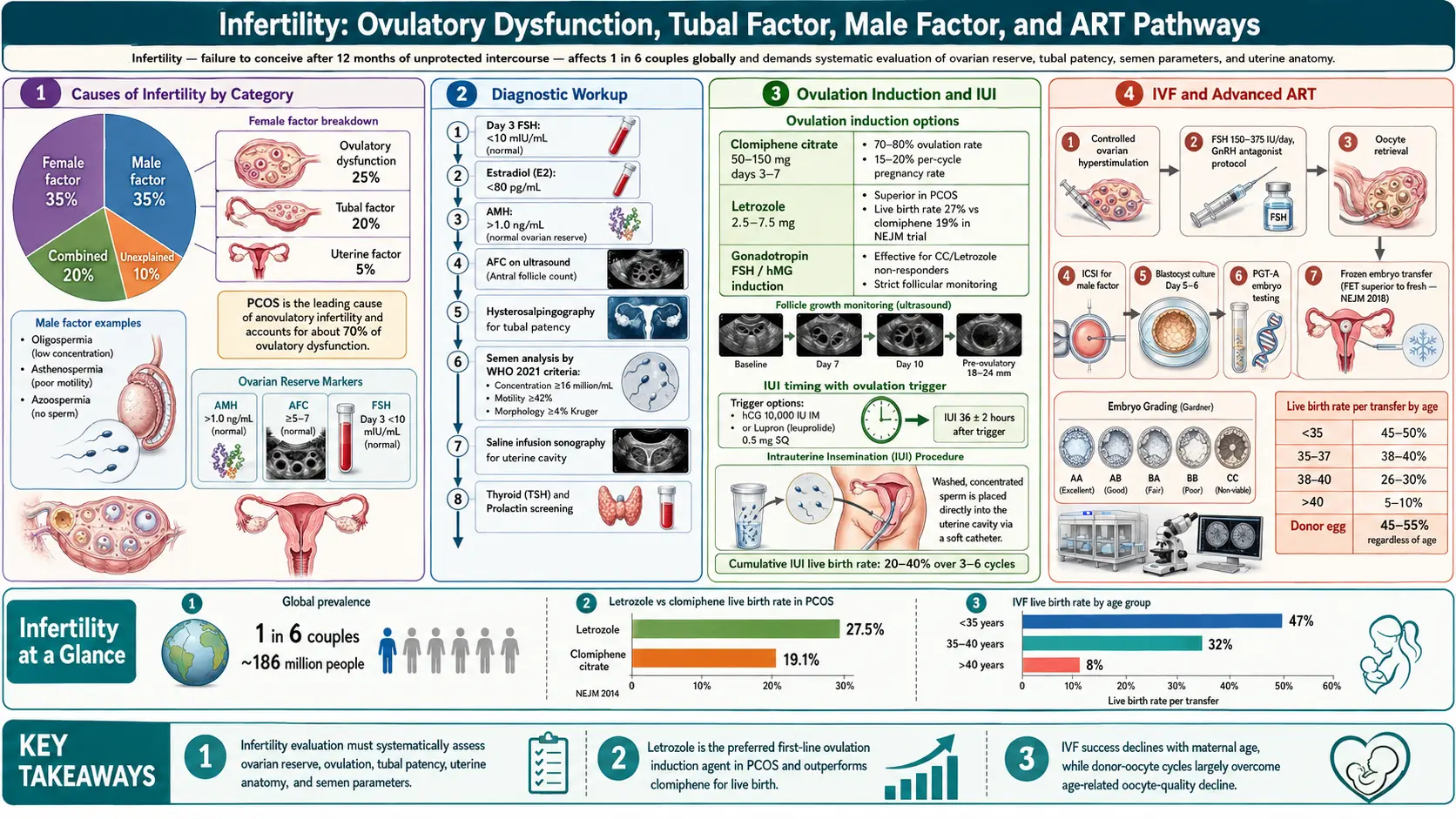
How Infertility Is Defined
Infertility is the inability to conceive after 12 months or more of regular, unprotected sexual intercourse. It can affect both men and women and may result from various factors related to reproductive health and general well-being. Infertility can be primary (never having conceived) or secondary (difficulty conceiving after having had a successful pregnancy).
In 2023 the American Society for Reproductive Medicine published a new committee opinion, “Definition of infertility,” which replaces its 2020 document “Definitions of infertility and recurrent pregnancy loss.”
Common Causes of Infertility
1. Female Infertility
- Ovulation disorders: Conditions such as polycystic ovary syndrome (PCOS), hypothalamic dysfunction, and premature ovarian failure (now usually called primary ovarian insufficiency, POI). A 2026 review in the Journal of Internal Medicine uses the new name for polycystic ovary syndrome, polyendocrine metabolic ovarian syndrome (PMOS), introduced in 2026 to reflect a shift toward seeing it as a lifelong hormone (endocrine) and metabolic disorder. The review gives its frequency as 10–13% of women of reproductive age and reports insulin resistance in 75% of lean and 95% of overweight women with the condition.
- Fallopian tube damage or blockage: Often due to pelvic inflammatory disease or previous surgeries.
- Endometriosis: Uterine tissue growing outside the uterus can interfere with fertility.
- Uterine or cervical abnormalities: Such as polyps, fibroids, or congenital malformations.
- Age: Fertility declines with age, especially after 35.
2. Male Infertility
- Low sperm count or poor sperm quality: Reduced number of sperm or motility issues.
- Hormonal imbalances: Such as low testosterone levels.
- Varicocele: Enlarged veins in the scrotum that can affect sperm production.
- Infections: Such as sexually transmitted infections (STIs) or mumps.
- Genetic disorders: Conditions like Klinefelter syndrome.
Risk Factors
- Age: Women over 35 and men over 40 may face higher risks of infertility.
- Smoking: Reduces fertility in both men and women and increases the risk of miscarriage.
- Alcohol and substance use: Can negatively impact sperm and egg quality.
- Being overweight or underweight: Can disrupt hormone levels and ovulation.
- Exposure to toxins: Such as pesticides, heavy metals, and radiation.
- Chronic conditions: Such as diabetes, thyroid disorders, and autoimmune diseases.
Diagnosis
- Medical history and physical examination: To assess overall health and identify potential risk factors.
- Ovulation tests: To confirm if and when ovulation occurs.
- Hormone tests: To check levels of reproductive hormones such as follicle-stimulating hormone (FSH), luteinizing hormone (LH), and progesterone.
- Imaging tests: Ultrasound and hysterosalpingography (HSG) to check the uterus and fallopian tubes.
- Semen analysis: To evaluate sperm count, motility, and morphology.
- Genetic testing: May be recommended to identify underlying genetic conditions.
Treatment Options
- Medications:
- Clomiphene citrate: Stimulates ovulation.
- Letrozole: An aromatase-inhibitor pill used to bring on ovulation since about 2001. In a 2014 trial of 750 women with polycystic ovary syndrome, 27.5% had a live birth with letrozole vs 19.1% with clomiphene, and ovulation occurred in 61.7% vs 48.3% of treatment cycles. A 2022 Cochrane review (41 trials, 6,522 women) found more live births with letrozole than with clomiphene-type drugs (odds ratio 1.72, high-certainty evidence), with ovarian hyperstimulation syndrome equally rare in both groups (0.5%).
- Gonadotropins: Hormonal injections to trigger ovulation.
- Metformin: For women with polycystic ovary syndrome to improve insulin resistance and ovulation.
- Surgical procedures:
- Laparoscopic surgery: To remove endometrial tissue, fibroids, or correct blockages.
- Varicocele repair: Surgery to correct enlarged veins in the scrotum.
- Assisted reproductive technologies (ART):
- In vitro fertilization (IVF): Eggs are fertilized outside the body and the resulting embryo is then transferred into the uterus, where it may implant.
- Intrauterine insemination (IUI): Sperm is directly placed into the uterus during ovulation.
- Intracytoplasmic sperm injection (ICSI): A single sperm is injected into an egg, often used in IVF for severe male infertility.
- Donor options:
- Egg or sperm donation: For individuals with significant egg or sperm quality issues.
- Surrogacy: An option when a woman cannot carry a pregnancy to term.
Prevention and Management Strategies
- Everyday habits: Diet, physical activity and sleep are the lifestyle factors most often discussed in fertility care.
- Alcohol and smoking: Smoking reduces fertility in both men and women and increases the risk of miscarriage; alcohol can affect sperm and egg quality (see Risk Factors).
- Stress: Relaxation techniques and emotional support are commonly used to cope with the stress of trying to conceive.
- Regular check-ups: Monitoring of reproductive health, especially while trying to conceive.
- Sexually transmitted infections (STIs): Some infections can lead to infertility, for example through pelvic inflammatory disease, which can damage the fallopian tubes; safer-sex practices such as condoms lower the risk of infection.
Complications of Infertility
- Emotional and psychological stress: Infertility can cause feelings of frustration, guilt, and depression.
- Relationship strain: The stress of infertility can affect relationships with partners and family members.
- Financial burden: Treatments such as IVF and ART can be costly and may not be covered by insurance.
Key Research Papers
- Steptoe PC, Edwards RG. Birth after the reimplantation of a human embryo. The Lancet. 1978;312(8085):366. — doi:10.1016/S0140-6736(78)92957-4
- Vander Borght M, Wyns C. Fertility and infertility: definition and epidemiology. Clinical Biochemistry. 2018;62:2-10. — doi:10.1016/j.clinbiochem.2018.03.012
- Practice Committee of the American Society for Reproductive Medicine. Definitions of infertility and recurrent pregnancy loss: a committee opinion. Fertility and Sterility. 2020;113(3):533-535. PubMed PMID: 32115183
- Practice Committee of the American Society for Reproductive Medicine. Definition of infertility: a committee opinion. Fertility and Sterility. 2023;120(6):1170. PubMed PMID: 40991339
- Inhorn MC, Patrizio P. Infertility around the globe: new thinking on gender, reproductive technologies and global movements in the 21st century. Human Reproduction Update. 2015;21(4):411-426. — doi:10.1093/humupd/dmv016
- Fritz MA, Speroff L. Clinical Gynecologic Endocrinology and Infertility. 8th ed. Wolters Kluwer Health/Lippincott Williams & Wilkins; 2011. (Textbook.)
- Gnoth C, Godehardt E, Frank-Herrmann P, et al. Definition and prevalence of subfertility and infertility. Human Reproduction. 2005;20(5):1144-1147. — doi:10.1093/humrep/deh870
- Van Voorhis BJ. In vitro fertilization. New England Journal of Medicine. 2007;356(4):379-386. — doi:10.1056/nejmcp065743
- Agarwal A, Mulgund A, Hamada A, Chyatte MR. A unique view on male infertility around the globe. Reproductive Biology and Endocrinology. 2015;13:37. — doi:10.1186/s12958-015-0032-1
- Practice Committee of the American Society for Reproductive Medicine. Diagnostic evaluation of the infertile female: a committee opinion. Fertility and Sterility. 2015;103(6):e44-e50. — doi:10.1016/j.fertnstert.2015.03.019
- Minhas S, Bettocchi C, Boeri L, et al. European Association of Urology Guidelines on Male Sexual and Reproductive Health: 2021 Update on Male Infertility. European Urology. 2021;80(5):603-620. PubMed PMID: 34511305
- Bhattacharya S, Johnson N, Tijani HA, et al. Female infertility. BMJ Clinical Evidence. 2010;2010:0819. PubMed PMID: 21406133
- Cedars MI. Evaluation of female fertility—AMH and ovarian reserve testing. Journal of Clinical Endocrinology and Metabolism. 2022;107(6):1510-1519. PubMed PMID: 35100616
- Legro RS, Brzyski RG, Diamond MP, et al. Letrozole versus clomiphene for infertility in the polycystic ovary syndrome. New England Journal of Medicine. 2014;371(2):119-129. PubMed PMID: 25006718
- Franik S, Le QK, Kremer JA, Kiesel L, Farquhar C. Aromatase inhibitors (letrozole) for ovulation induction in infertile women with polycystic ovary syndrome. Cochrane Database of Systematic Reviews. 2022;9(9):CD010287. PubMed PMID: 36165742
- Forslund M, Melin J, Joham AE, et al. Recent advances in polyendocrine metabolic ovarian syndrome, formerly polycystic ovary syndrome, with emphasis on endocrine and metabolic dysfunction and cardiovascular risk. Journal of Internal Medicine. 2026;300(5):590-609. PubMed PMID: 42669621
Historical Background
The study of infertility dates to ancient civilizations, but modern reproductive medicine began with the work of Patrick Steptoe and Robert Edwards, who achieved the first successful in vitro fertilization in 1978, leading to the birth of Louise Brown. Edwards was awarded the Nobel Prize in Physiology or Medicine in 2010 for this breakthrough.
PubMed Topic Searches
The following PubMed topic searches aggregate the current peer-reviewed literature. Each link opens a live PubMed query — results update as new studies are indexed.
- PubMed: Infertility evaluation
- PubMed: Male infertility
- PubMed: Female infertility
- PubMed: Ovarian reserve AMH
- PubMed: Tubal factor infertility
- PubMed: Unexplained infertility
- PubMed: Ovulation induction clomiphene
- PubMed: Letrozole ovulation induction
- PubMed: In vitro fertilization outcomes
- PubMed: Intrauterine insemination
- PubMed: Semen analysis
- PubMed: Fertility preservation
Table of Contents
Connections
- Reproductive Medicine
- Fertilization: How Sperm Meets Egg — interactive animation
- Endometriosis
- Polycystic Ovary Syndrome
- Perimenopause
- Uterine Fibroids
- Menopause and Hormone Replacement Therapy
- Ovarian Cysts
- Laparoscopy: Excision vs Ablation
- Vitamin D3
- Magnesium
- Hormonal Therapy Options
- Fertility and Endometriosis
- Thyroid Disorders
- Insulin Resistance
- Testosterone
- Pesticides
- Heavy Metals
- Gestational Diabetes
- Preeclampsia
- Breast Cancer
- Cervical Cancer
- Postpartum Depression
- Bacterial Vaginosis
- Klinefelter Syndrome
- Herbs covered on this site that discuss this condition: Galangal (Alpinia galanga) · He Shou Wu (Fo-Ti) (Polygonum multiflorum / Reynoutria multiflora) · Muira Puama · Tribulus terrestris
- Zinc