Music Therapy
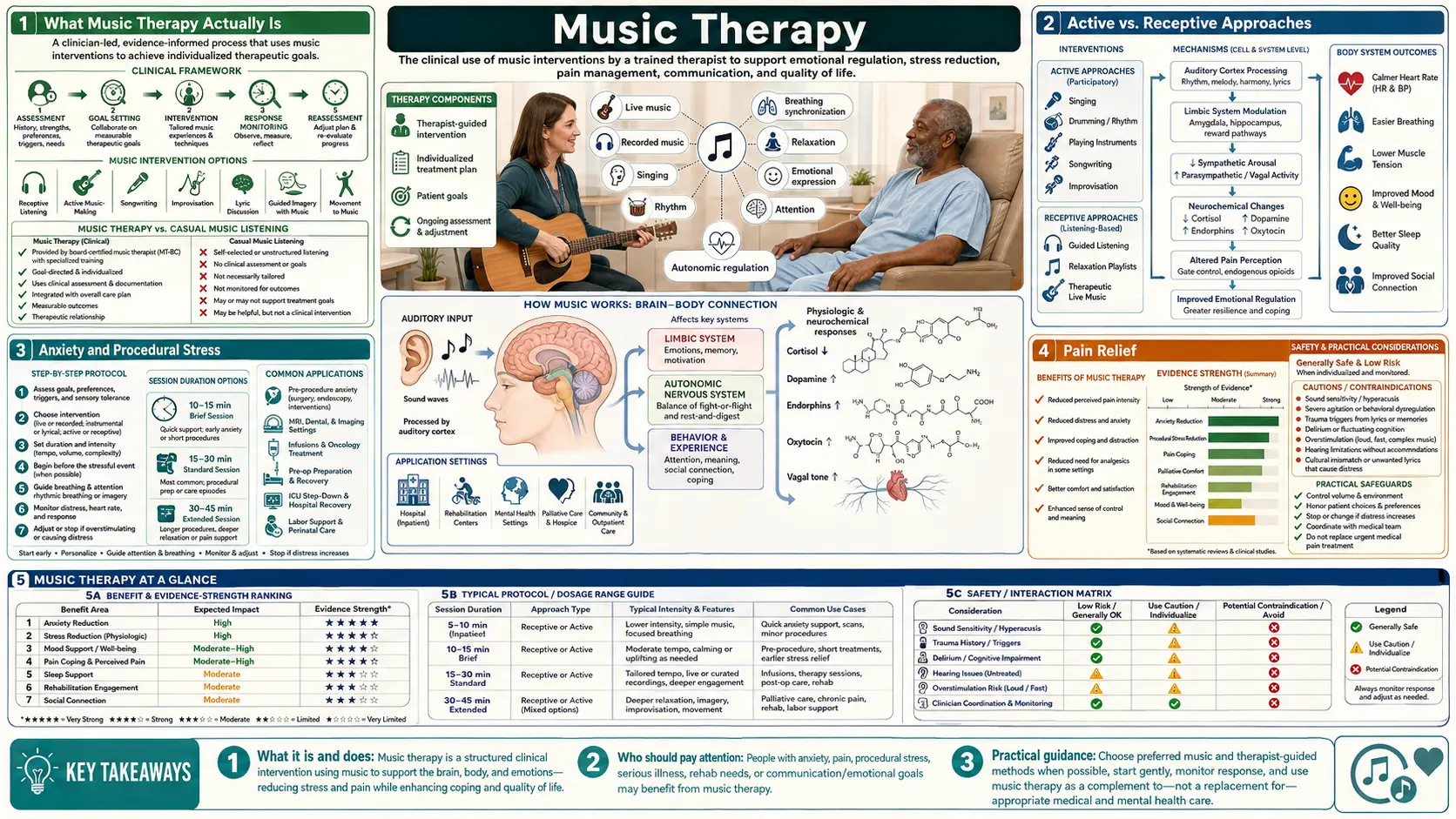
Music therapy is a real, credentialed clinical health profession — not just putting on a favorite playlist, though that helps too. Board-certified music therapists are trained clinicians who use active music-making, singing, songwriting, and guided listening to work toward specific goals: calming anxiety before surgery, easing pain, lifting depression, reaching a person with dementia, or helping someone walk or speak again after a stroke. The research here is genuinely encouraging in several areas, backed by Cochrane systematic reviews rather than hype. It is also honest work: the effects are usually helpful rather than miraculous, they vary from person to person, and "music therapy" is an umbrella over very different treatments. This page walks through what the profession actually is, where the evidence is strongest, how it may work in the brain and body, how to find a therapist or use music well on your own, and the plain-spoken bottom line.
Table of Contents
- What Music Therapy Actually Is
- Active vs. Receptive Approaches
- Anxiety and Procedural Stress
- Pain Relief
- Depression
- Dementia
- Stroke and Neurologic Rehabilitation
- Premature Infants and the NICU
- Autism and Neurodevelopment
- How Music Therapy May Work
- Getting Care, Caveats, Safety & Bottom Line
- Research Papers
- Connections
- Featured Videos
What Music Therapy Actually Is
Music therapy is a regulated clinical profession, not a casual activity. In the United States a music therapist earns a bachelor's or master's degree, completes a supervised clinical internship, and passes a national exam to become MT-BC (Music Therapist – Board Certified) through the Certification Board for Music Therapists. Similar credentials exist in the UK, Australia, and much of Europe. These clinicians assess a person's needs, set measurable goals with the care team, deliver sessions, and document progress — the same way a physical therapist or speech therapist does.
What makes it a therapy, rather than entertainment, is that the music is used deliberately toward a clinical goal. A therapist might drum with a stroke patient to rebuild arm movement, write a song with a grieving teenager to put feelings into words, or sing a familiar hymn with someone whose dementia has taken most of their speech. The relationship between therapist and person is part of the treatment.
It helps to separate two things researchers sometimes lump together:
- Music therapy — a trained therapist tailoring live, interactive music to a person's goals and responses in the moment.
- Music medicine — pre-recorded music offered by a nurse or the person themselves (for example, headphones during a procedure). This is simpler, self-directed, and also useful.
Both have real value, and this page covers both. You do not need a credentialed therapist to get everyday benefit from music you love — but for a specific clinical problem, a therapist adds skill, structure, and safety.
Active vs. Receptive Approaches
Music therapy techniques fall into two broad families, and most therapists blend them.
Active (or "expressive") methods have the person make music: playing simple instruments, drumming, singing, improvising, or songwriting. Active music-making engages the body and mind at once — breath, voice, movement, timing, attention, and emotion — which is why it is central to rehabilitation and to expressing feelings that are hard to say out loud.
Receptive (or "listening") methods have the person take music in: guided relaxation to calming music, listening paired with mental imagery, or discussing the memories and emotions a song brings up. Receptive work is often used for relaxation, mood, sleep, and pain, and it is gentle enough for someone who is very ill or very young.
The right mix depends on the goal. A person recovering from a stroke may drum and step to a beat (active), while someone anxious before surgery may simply listen (receptive). Neither is "better" — they solve different problems.
Anxiety and Procedural Stress
This is where the evidence is strongest and most consistent. Across many trials, music reliably lowers anxiety, and it does so cheaply and safely. A Cochrane review of music for preoperative anxiety found that listening to music before surgery reduces anxiety compared with standard care — a small but dependable effect that can mean a calmer patient and, in some studies, less need for sedative medication.
Around medical procedures more broadly, music can reduce anxiety and, in some settings, lower the amount of sedation or pain medication needed and steady the body's stress signals. A Cochrane review in coronary heart disease found music listening reduced anxiety and was associated with modest drops in heart rate, breathing rate, and blood pressure. In people undergoing cancer treatment, a Cochrane review found music interventions may reduce anxiety, help mood, and improve quality of life, with possible benefits for pain and fatigue.
The honest summary: the reductions in anxiety are usually modest in size, but they show up again and again, they carry essentially no risk, and they cost almost nothing. That combination is unusual and genuinely valuable in a hospital.
Pain Relief
Music can take the edge off pain, both the sharp pain of a procedure and the grinding pain of a chronic condition — but as an add-on, not a substitute for proper pain treatment. A Cochrane review of music for pain relief concluded that listening to music reduces pain intensity and can lower the amount of opioid painkiller people need. The catch is that the average reduction is small, and it is unclear how much difference that makes for any one person in daily life.
Why does it help at all? Part of it is distraction — attention is limited, and music competes with pain for it. Part is relaxation, which loosens the muscle tension and anxiety that amplify pain. Used alongside standard care, music is a low-risk way to make painful experiences a little more bearable, which is exactly how it should be offered.
Depression
For depression, a Cochrane review found that music therapy added to usual treatment produced short-term improvements in depressive symptoms compared with usual treatment alone, and also helped reduce anxiety and improve day-to-day functioning. The certainty of the evidence is low to moderate, and the benefit is best understood as an adjunct — something offered alongside talk therapy, medication, or both, not instead of them.
What music therapy seems to offer someone who is depressed is a way to express and process emotion without having to find the words first, a structured activity that provides small experiences of mastery and pleasure, and a supportive relationship with the therapist. For many people that is a meaningful complement to standard care, especially when words feel impossible.
Dementia
This is one of the most humane and widely used applications, and also one where honesty matters. A Cochrane review of music-based interventions for people with dementia found they probably reduce depressive symptoms and improve overall behavioral problems, and may improve emotional wellbeing and quality of life and reduce anxiety. Familiar songs from a person's youth can reach them when ordinary conversation no longer can — a spouse who has stopped speaking may still sing every word of a wedding-day song.
The honest limits: the same review found music has little to no effect on agitation and aggression in the pooled results, and its effect on cognition (memory and thinking) is uncertain and, at best, small. So music therapy is not a treatment that slows the disease or restores memory. What it can do — ease mood, reduce distress, spark connection, and restore moments of dignity and joy — is worth a great deal to people living with dementia and to their families.
Stroke and Neurologic Rehabilitation
Some of the most fascinating uses of music are in rebuilding the injured nervous system, where rhythm and melody are used as precise tools rather than as background comfort.
Rhythmic auditory stimulation for walking
The brain naturally tends to synchronize movement to a steady beat — think of how hard it is to stay still to a strong rhythm. Rhythmic auditory stimulation (RAS) uses that reflex therapeutically: a metronome or beat is set to a target pace, and the person walks in time with it. In Parkinson's disease, a classic study showed RAS improved gait speed, stride length, and cadence, and the technique has since been applied to stroke recovery. A Cochrane review of music interventions after acquired brain injury found rhythmic cueing may improve aspects of walking such as gait velocity in stroke survivors.
Melodic intonation therapy for aphasia
After a stroke in the brain's left-side language areas, some people lose the ability to speak fluently (non-fluent, or Broca's, aphasia) yet can still sing familiar songs. Melodic intonation therapy (MIT) turns that surprising fact into treatment: patients "sing" short phrases using slow, exaggerated melody and rhythm, tapping the beat with one hand, gradually shaping the intoned phrases back toward normal speech. The leading hypothesis is that MIT recruits music and language networks in the right hemisphere to take over some of what the damaged left hemisphere can no longer do. It does not work for everyone, but for the right patient it can be remarkable.
Premature Infants and the NICU
In neonatal intensive care units, specially trained music therapists use very gentle, infant-led techniques — soft live lullabies, a parent's humming, or instruments that mimic the whooshing and heartbeat sounds of the womb. The aims are practical: help a fragile baby stay physiologically stable (steadier heart rate and breathing), support sucking, feeding, and sleep, and calm and connect stressed parents with their infant.
The evidence is promising but genuinely mixed. A meta-analysis of music therapy for preterm infants and their parents found some benefits but a lot of variation between studies, so the results depend heavily on the specific technique, the outcome measured, and the baby's condition. The takeaway is cautious optimism: done skillfully and quietly, music appears to be a safe, soothing support in the NICU, but it is not a proven fix for the serious medical challenges of prematurity.
Autism and Neurodevelopment
Music therapy is often used with autistic children to support communication, social connection, and emotional expression, and here the research tells a genuinely mixed story that is worth reporting straight. A Cochrane review found that, compared with standard care, music therapy may improve social interaction, verbal and non-verbal communication, and a child's initiating of engagement — but those findings came mostly from small studies.
Then came the largest trial to date, the international TIME-A randomized study of 364 children published in JAMA. It found that improvisational music therapy added to enhanced standard care did not significantly reduce core autism symptom severity compared with enhanced standard care alone. That result tempered a lot of earlier optimism.
So what is fair to say? Music therapy is not an evidence-backed treatment for the core features of autism, and it should not be sold that way. It may still be a valuable, enjoyable, low-risk way for some autistic children to engage, communicate non-verbally, and build a relationship — goals that matter even if a symptom-severity score does not change. Families deserve that honest, unhyped framing.
How Music Therapy May Work
Music reaches us through several channels at once, which is probably why it can help such different problems. The main proposed mechanisms:
- Arousal and autonomic regulation. Slow, calming music can slow the heart and breathing, relax muscles, and quiet the body's stress response — the likely route by which it eases anxiety, procedural stress, and pain.
- The brain's reward system. Music we find pleasurable engages dopamine-driven reward pathways, which is part of why a beloved song can lift mood and motivation.
- Motor entrainment. The motor system automatically locks onto a steady beat. This rhythmic pull is the engine behind gait training with rhythmic auditory stimulation.
- Emotional expression and processing. Making or listening to music offers a non-verbal outlet for feelings that are hard to speak — useful in depression, grief, trauma, and dementia.
- Social connection. Singing, drumming, or playing together builds bonding and a sense of belonging, and the therapeutic relationship itself is part of the effect.
- Attention and distraction. Attention is a limited resource; absorbing music competes with pain and worry for it, leaving less room for either.
Getting Care, Caveats, Safety & Bottom Line
How to get music therapy
For a specific clinical goal, look for a board-certified music therapist (in the US, the credential MT-BC). They practice in hospitals, cancer centers, hospice and palliative care, rehabilitation units, mental-health programs, schools, and memory-care and long-term-care settings. Good ways to find one: ask your oncology, rehabilitation, or palliative-care team for a referral; contact a nearby children's or rehabilitation hospital; or use the professional directories run by the American Music Therapy Association and the Certification Board for Music Therapists. Coverage varies — music therapy is sometimes reimbursed under hospice, rehabilitation, or developmental-services benefits, so it is worth asking.
Using music well on your own
You do not need a therapist to get real everyday benefit. Simple, free practices work: build playlists for relaxation, sleep, or focus; use upbeat music to power a walk or workout; sing, hum, drum, or learn an instrument; move to a strong beat. One principle matters most — choose music that is personally meaningful to you. Personal connection to a song predicts its effect far better than genre or any "scientifically calming" label. For a loved one with dementia, reach for the music of their teens and twenties, which is usually the most deeply anchored.
Honest caveats
A few things keep this evidence grounded. Effect sizes are often modest, so music is usually an add-on rather than a standalone cure. Blinding is nearly impossible — you always know whether you are getting music — so expectation and placebo effects are hard to rule out. And "music therapy" spans wildly different interventions, from a recorded playlist to months of live improvisation, which means results from one study do not automatically transfer to another. Treat it as a helpful complement to good medical, psychiatric, and rehabilitative care, not a replacement for any of them.
Is it safe?
Music therapy is very safe, with few side effects, which is a big part of its appeal. The rare things to know: musicogenic epilepsy, in which music can trigger seizures, is genuinely uncommon but real; loud volume or headphone use should be sensible to protect hearing; and powerful music can surface intense emotions or memories — usually a good thing in skilled hands, and a reason a trained therapist is valuable for trauma or grief work. In the NICU, therapists deliberately keep everything quiet, slow, and led by the baby.
The bottom line
Music therapy is a legitimate, evidence-supported adjunctive therapy delivered by trained clinicians. The support is strongest for reducing anxiety and procedural stress, easing pain as an add-on, improving depressive symptoms, and helping mood, behavior, and quality of life in dementia; the neurologic-rehabilitation uses — rhythm for walking and singing for aphasia — are among the most striking. It is not magic, not a cure, and not a substitute for the care a condition requires. But it is low-risk, low-cost, and often genuinely helpful — and the everyday version, listening to and making music you love, is free and available to almost everyone.
Research Papers
- Bradt J, Dileo C, Shim M. Music interventions for preoperative anxiety. Cochrane Database of Systematic Reviews. 2013;(6):CD006908. doi:10.1002/14651858.CD006908.pub2 — music listening before surgery reduces preoperative anxiety versus standard care.
- Bradt J, Dileo C, Magill L, Teague A. Music interventions for improving psychological and physical outcomes in cancer patients. Cochrane Database of Systematic Reviews. 2016;(8):CD006911. doi:10.1002/14651858.CD006911.pub3 — may reduce anxiety, help mood and quality of life, with possible pain and fatigue benefits.
- Bradt J, Dileo C, Potvin N. Music for stress and anxiety reduction in coronary heart disease patients. Cochrane Database of Systematic Reviews. 2013;(12):CD006577. doi:10.1002/14651858.CD006577.pub3 — reduced anxiety with modest drops in heart rate, breathing rate, and blood pressure.
- Cepeda MS, Carr DB, Lau J, Alvarez H. Music for pain relief. Cochrane Database of Systematic Reviews. 2006;(2):CD004843. doi:10.1002/14651858.CD004843.pub2 — lowers pain intensity and opioid requirements, though the average effect is small.
- Aalbers S, Fusar-Poli L, Freeman RE, et al. Music therapy for depression. Cochrane Database of Systematic Reviews. 2017;(11):CD004517. doi:10.1002/14651858.CD004517.pub3 — added to usual care, gives short-term improvement in depressive symptoms and functioning.
- van der Steen JT, Smaling HJA, van der Wouden JC, et al. Music-based therapeutic interventions for people with dementia. Cochrane Database of Systematic Reviews. 2018;(7):CD003477. doi:10.1002/14651858.CD003477.pub4 — probably reduces depressive symptoms and behavioral problems; little effect on agitation or cognition.
- Magee WL, Clark I, Tamplin J, Bradt J. Music interventions for acquired brain injury. Cochrane Database of Systematic Reviews. 2017;(1):CD006787. doi:10.1002/14651858.CD006787.pub3 — rhythmic auditory cueing may improve gait velocity and other outcomes after stroke.
- Thaut MH, McIntosh GC, Rice RR, Miller RA, et al. Rhythmic auditory stimulation in gait training for Parkinson's disease patients. Movement Disorders. 1996;11(2):193-200. doi:10.1002/mds.870110213 — a beat cue improved gait velocity, cadence, and stride length.
- Schlaug G, Marchina S, Norton A. From singing to speaking: why singing may lead to recovery of expressive language function in patients with Broca's aphasia. Music Perception. 2008;25(4):315-323. doi:10.1525/mp.2008.25.4.315 — the neuroscientific rationale for melodic intonation therapy in non-fluent aphasia.
- Bieleninik Ł, Ghetti C, Gold C. Music therapy for preterm infants and their parents: a meta-analysis. Pediatrics. 2016;138(3):e20160971. doi:10.1542/peds.2016-0971 — some NICU benefits, but findings varied and were technique-dependent.
- Geretsegger M, Elefant C, Mössler KA, Gold C. Music therapy for people with autism spectrum disorder. Cochrane Database of Systematic Reviews. 2014;(6):CD004381. doi:10.1002/14651858.CD004381.pub3 — small studies suggested gains in social interaction and communication.
- Bieleninik Ł, Geretsegger M, Mössler K, Assmus J, et al. Effects of improvisational music therapy vs enhanced standard care on symptom severity among children with autism spectrum disorder: the TIME-A randomized clinical trial. JAMA. 2017;318(6):525-535. doi:10.1001/jama.2017.9478 — the largest trial found no significant benefit on core autism symptom severity.
Connections
- All Remedies
- Meditation
- Stress Management
- Yoga
- Exercise
- Anxiety
- Depression
- Autism
- Alzheimer's Disease
- Parkinson's Disease
- Stroke
- Neurology
- Psychiatry