Longevity Protocols — Benefits Deep Dive
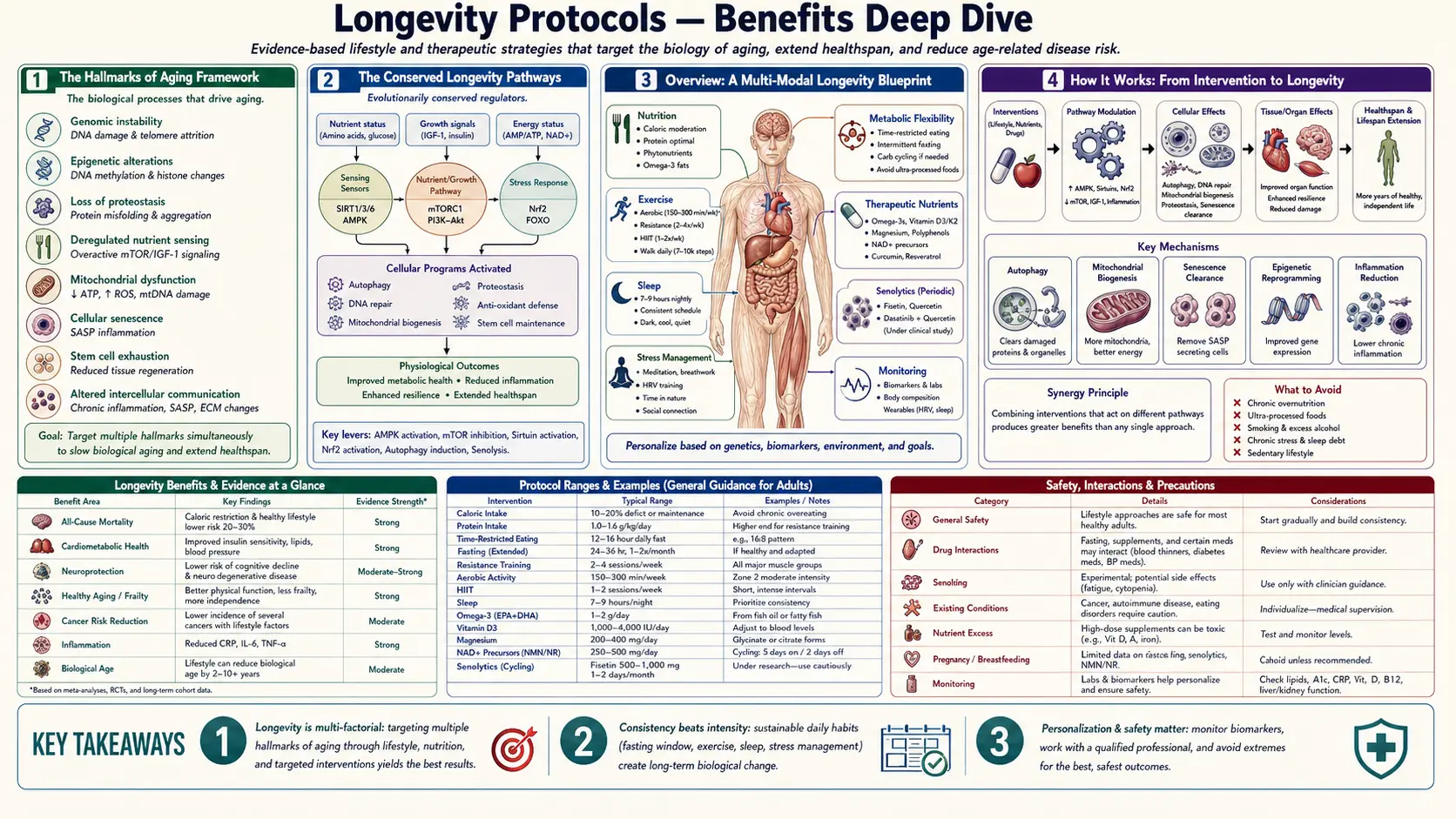
Modern longevity science has converged on a small number of conserved molecular pathways — mTOR, AMPK, sirtuins, NAD+ metabolism, autophagy, and senescent-cell clearance — that, when manipulated, extend lifespan in every model organism tested from yeast to mice. The four benefit pages below dissect the most cited and most contested human interventions: caloric restriction and its pharmaceutical mimetics (rapamycin, metformin), the NAD-boosting precursors NMN and NR, the sirtuin-activating polyphenols led by resveratrol and pterostilbene, and the popular "Sinclair Stack" of NMN + resveratrol + metformin + Vitamin D3 + statin alongside a scientific critique of which components are evidence-supported and which are speculative.
Deep-Dive Articles
Caloric Restriction and Mimetics
The 90-year history of caloric restriction (CR) as the single most reproducible lifespan-extending intervention across species, the CALERIE-II human trial (15% CR for two years in non-obese adults), intermittent and time-restricted eating, the rhesus monkey divergence between Wisconsin and NIA trials, and the leading pharmaceutical CR mimetics — rapamycin (mTOR inhibition, ITP data), metformin (AMPK activation, TAME trial), acarbose, and SGLT2 inhibitors.
NAD Boosters
Why NAD+ levels decline by approximately 50% between ages 40 and 60, the salvage pathway and CD38-driven NAD consumption, the precursor cascade (nicotinamide riboside → nicotinamide mononucleotide → NAD+), the David Sinclair vs Charles Brenner debate over NMN versus NR, the Slc12a8 transporter controversy, human trials showing roughly doubled blood NAD on 1g/day NR, and what is and is not established about clinical endpoints.
Sirtuin Activators
The seven mammalian sirtuins (SIRT1–SIRT7) as NAD+-dependent deacylases, their roles in metabolism, DNA repair, and stress response, the resveratrol-SIRT1 controversy (allosteric activation or fluorophore artifact), the more potent pterostilbene, second-generation STACs (SRT2104, SRT1720), the Information Theory of Aging, and what sirtuin activation can plausibly deliver in humans.
Sinclair Stack and Critique
The exact David Sinclair daily protocol (1g NMN, 1g resveratrol in yogurt, 1g metformin, Vitamin D3, statin, low-dose aspirin), an unflinching critique of the evidence behind each component, the conflicts of interest (Sirtris/GSK, Tally Health, Metro International), what a more conservative evidence-graded longevity stack looks like, and how to think about adopting any of these compounds personally.
Table of Contents
- Deep-Dive Articles
- The Hallmarks of Aging Framework
- The Conserved Longevity Pathways
- Research Papers: Caloric Restriction and Mimetics
- Research Papers: NAD Boosters
- Research Papers: Sirtuin Activators
- Research Papers: The Sinclair Stack and Aging Biomarkers
- Research Papers: Cross-Cutting (Hallmarks, Biomarkers, Senescence)
- External Authoritative Resources
- Connections
- Featured Videos
The Hallmarks of Aging Framework
The most widely used framework for organizing longevity research is the "Hallmarks of Aging" framework first published by Carlos López-Otín and colleagues in Cell in 2013 and updated in 2023. The framework identifies a small number of interconnected cellular and molecular processes that drive biological aging across species. Any intervention that demonstrably extends healthy lifespan does so by modifying one or more of these hallmarks.
The 2023 update lists twelve hallmarks, grouped into three categories. The primary hallmarks (causes of damage) are genomic instability, telomere attrition, epigenetic alterations, and loss of proteostasis. The antagonistic hallmarks (responses to damage) are disabled macroautophagy, deregulated nutrient sensing, mitochondrial dysfunction, and cellular senescence. The integrative hallmarks (consequences at the tissue level) are stem cell exhaustion, altered intercellular communication, chronic inflammation, and dysbiosis. The longevity interventions discussed across these four pages map cleanly onto specific hallmarks: caloric restriction targets deregulated nutrient sensing, NAD boosters address loss of proteostasis and mitochondrial dysfunction, sirtuin activators address epigenetic alterations and genomic instability, and senolytics address cellular senescence.
The hallmarks framework matters because it provides a discipline against the central failure mode of consumer longevity science: trying single compounds in isolation against the integrated biology of aging. Any serious intervention should be able to articulate which hallmarks it addresses and through what mechanism. Compounds that cannot answer that question (and many in the popular longevity supplement market cannot) belong in the speculative category until they can.
The Conserved Longevity Pathways
A second organizing principle is the small set of molecular pathways that, when manipulated, extend lifespan across yeast, worms, flies, and mice — the evolutionarily conserved "longevity pathways." These pathways are the targets of essentially every credible longevity intervention.
- mTOR (mechanistic Target of Rapamycin) — a master nutrient-sensing kinase that, when inhibited, suppresses anabolic processes and activates autophagy. Inhibited by rapamycin and indirectly by caloric restriction. Rapamycin extended lifespan in mice in the NIA Interventions Testing Program (ITP) even when started in middle age.
- AMPK (AMP-activated Protein Kinase) — the cellular "low energy" sensor, activated when ATP/AMP ratio falls. Activated by caloric restriction, exercise, metformin, and berberine. Activates autophagy and shifts metabolism toward catabolism.
- Sirtuins (SIRT1–SIRT7) — NAD+-dependent deacylases that regulate gene expression, DNA repair, and metabolism. Activated by caloric restriction (via increased NAD+/NADH ratio), resveratrol, and pterostilbene. Discussed in depth on the Sirtuin Activators page.
- IGF-1 / Growth Hormone — loss-of-function mutations in this pathway dramatically extend lifespan in worms (daf-2), flies, and mice (Ames and Snell dwarf mice). Laron syndrome patients (humans with GHR mutations) show very low cancer and diabetes rates.
- NAD+ metabolism — the cofactor for sirtuins, PARPs, and CD38. Falls roughly 50% from age 40 to 60. Restored by precursors NMN and NR. Discussed in depth on the NAD Boosters page.
- Autophagy — the cellular recycling system that clears damaged proteins and organelles. Activated by fasting, caloric restriction, rapamycin, and spermidine. Declines with age.
- Cellular senescence and SASP — senescent cells accumulate with age and secrete inflammatory cytokines (SASP). Cleared by senolytics (dasatinib + quercetin, fisetin). Reduces inflammation when reduced.
The interventions on the four pages below act through one or more of these pathways. Caloric restriction is the most pleiotropic, hitting mTOR, AMPK, sirtuins, autophagy, and IGF-1 simultaneously. Rapamycin and metformin partially mimic CR by targeting subsets of these pathways. NAD boosters and resveratrol act primarily through sirtuins. The honest summary is that no single small molecule fully reproduces caloric restriction, and the most promising approaches combine moderate lifestyle changes (CR or time-restricted eating) with a small number of targeted pharmacological tools.
Research Papers: Caloric Restriction and Mimetics
- McCay CM original caloric restriction in rats (1935) and follow-up reviews PubMed: McCay 1935 CR rat
- CALERIE-II trial: 15% caloric restriction for two years in non-obese adults (Kraus, Lancet Diabetes Endocrinol 2019) — PubMed PMID: 31303390
- Wisconsin rhesus monkey caloric restriction trial (Colman, Science 2009; updates) — PubMed PMID: 19590001
- NIA rhesus monkey trial showing reduced benefit (Mattison, Nature 2012) — PubMed PMID: 22932268
- Harrison DE et al., Rapamycin extends mouse lifespan (NIA ITP, Nature 2009) — PubMed PMID: 19587680
- Strong R et al., Acarbose extends male mouse lifespan (Aging Cell 2016) — Search PubMed
- Bannister CA et al., Metformin and survival in type 2 diabetes (Diabetes Obes Metab 2014) — PubMed PMID: 25041462
- Barzilai N et al., Targeting Aging with Metformin (TAME) trial rationale (Cell Metab 2016) — PubMed PMID: 27304501
- Mitchell SJ et al., Time-restricted feeding extends lifespan in mice (Cell Metab 2019) — Search PubMed
- Madeo F et al., Spermidine, autophagy, and longevity (Science 2018) — PubMed PMID: 29371440
Research Papers: NAD Boosters
- Yoshino J et al., NMN restores age-associated physiological decline in mice (Cell Metab 2016) — Search PubMed
- Trammell SAJ et al., Nicotinamide riboside is uniquely and orally bioavailable (Nat Commun 2016) — PubMed PMID: 27721479
- Martens CR et al., Chronic NR supplementation safety and NAD+ in healthy middle-aged adults (Nat Commun 2018) — PubMed PMID: 29599478
- Mills KF et al., Long-term NMN administration mitigates age-associated decline (Cell Metab 2016) — Search PubMed
- Grozio A et al., Slc12a8 is a nicotinamide mononucleotide transporter (Nat Metab 2019; controversial) — Search PubMed
- Camacho-Pereira J et al., CD38 dictates age-related NAD decline (Cell Metab 2016) — PubMed PMID: 27304511
- Imai S, Guarente L — NAD+ and sirtuins in aging and disease (Trends Cell Biol 2014) — PubMed PMID: 24786309
- Brenner C — NR vs NMN review and critique of NMN transporter claims (Cell Metab 2022) PubMed: Brenner NMN critique
- Yoshino M et al., NMN increases insulin sensitivity in prediabetic women (Science 2021) — PubMed PMID: 33888596
- Conze D et al., Safety and pharmacokinetics of chronic Niagen NR in adults (Sci Rep 2019) — Search PubMed
Research Papers: Sirtuin Activators
- Howitz KT et al., Resveratrol activates SIRT1 and extends yeast lifespan (Nature 2003) — PubMed PMID: 12939617
- Baur JA et al., Resveratrol improves health and survival of mice on high-calorie diet (Nature 2006) — PubMed PMID: 17086191
- Pacholec M et al., SRT1720, SRT2183, SRT1460, and resveratrol are not direct SIRT1 activators (J Biol Chem 2010; the "artifact" critique) — PubMed PMID: 20061378
- Hubbard BP et al., Evidence for a common mechanism of SIRT1 regulation by allosteric activators (Science 2013) — PubMed PMID: 23471411
- Kanfi Y et al., SIRT6 overexpression extends lifespan in male mice (Nature 2012) — PubMed PMID: 22367546
- Mitchell SJ et al., The SIRT3 activator pterostilbene improves healthspan (Cell Rep 2014) — Search PubMed
- McCubrey JA et al., Effects of resveratrol, curcumin, berberine and other nutraceuticals on aging (Aging 2017) — Search PubMed
- Yang SJ et al., Nicotinamide and PNC1 govern lifespan extension by CR (Nature 2003) — PubMed PMID: 12736687
- Pearson KJ et al., Resveratrol delays age-related deterioration but does not extend lifespan (Cell Metab 2008) — PubMed PMID: 18599363
- Sinclair DA et al., Information theory of aging and epigenetic clocks (Cell 2023) PubMed: Information theory of aging
Research Papers: The Sinclair Stack and Aging Biomarkers
- Sinclair DA — "Lifespan: Why We Age and Why We Don't Have To" protocol discussion (popular framework) PubMed: Sinclair longevity work
- Horvath S — DNA methylation age of human tissues and cell types (Genome Biol 2013, the first epigenetic clock) — PubMed PMID: 24138928
- Levine ME et al., PhenoAge epigenetic clock (Aging 2018) — PubMed PMID: 29676998
- Lu AT et al., GrimAge predicts time-to-death and morbidity (Aging 2019) — PubMed PMID: 30669119
- Belsky DW et al., DunedinPACE pace-of-aging clock (eLife 2022) — PubMed PMID: 35029144
- Fahy GM et al., Reversal of epigenetic age in humans with thymic regeneration cocktail (Aging Cell 2019; TRIIM trial) — PubMed PMID: 31496122
- Justice JN et al., Senolytic dasatinib plus quercetin in idiopathic pulmonary fibrosis (EBioMedicine 2019) — PubMed PMID: 30616998
- Hickson LJ et al., Senolytics in diabetic kidney disease (EBioMedicine 2019) — PubMed PMID: 31542391
- Zhang Y et al., Aging biomarkers panel and longevity interventions review (Cell 2023) PubMed: Aging biomarkers
- López-Otín C et al., Hallmarks of aging: an expanding universe (Cell 2023) — PubMed PMID: 36599349
Research Papers: Cross-Cutting (Hallmarks, Biomarkers, Senescence)
- López-Otín C et al., The hallmarks of aging (Cell 2013, original framework) — PubMed PMID: 23746838
- Campisi J — Aging, cellular senescence, and cancer (Annu Rev Physiol 2013) — PubMed PMID: 23140366
- Kirkland JL, Tchkonia T — Senolytic drugs: from discovery to translation (J Intern Med 2020) — PubMed PMID: 32686219
- Fontana L et al., Extending healthy life span: from yeast to humans (Science 2010) — PubMed PMID: 20395504
- Longo VD, Mattson MP — Fasting: molecular mechanisms and clinical applications (Cell Metab 2014) — PubMed PMID: 24440038
- Kennedy BK et al., Geroscience: linking aging to chronic disease (Cell 2014) — PubMed PMID: 25417146
- Olshansky SJ — From lifespan to healthspan (JAMA 2018) — Search PubMed
- Bjedov I, Rallis C — The target of rapamycin signalling pathway in ageing (Trends Cell Biol 2020) PubMed: mTOR in aging
- Madeo F, Carmona-Gutierrez D — Caloric restriction mimetics: towards a molecular definition (Nat Rev Drug Discov 2014) — Search PubMed
- Partridge L, Fuentealba M, Kennedy BK — The quest to slow ageing through drug discovery (Nat Rev Drug Discov 2020) — Search PubMed
External Authoritative Resources
- American Federation for Aging Research (AFAR) — non-profit funding biomedical aging research, sponsor of the TAME trial
- NIA Interventions Testing Program (ITP) — the gold-standard government-run rodent lifespan trial that rigorously tested rapamycin, acarbose, and dozens of other compounds
- Geroscience research journal landing (Springer Aging title)
- Lifespan.io / Longevity.Technology — advocacy and news, plus rigorous coverage of trial results
- Open Longevity / OurAging open biomarker projects
- PubMed — All longevity pathway research
Connections
- All Remedies
- Longevity Protocols (Main Hub)
- Caloric Restriction and Mimetics
- NAD Boosters
- Sirtuin Activators
- Sinclair Stack and Critique
- Intermittent Fasting
- Autophagy
- Resveratrol
- NMN (Nicotinamide Mononucleotide)
- NR (Nicotinamide Riboside)
- Metformin
- Rapamycin
- Vitamin D3
- Spermidine
- Senolytics