Lactulose
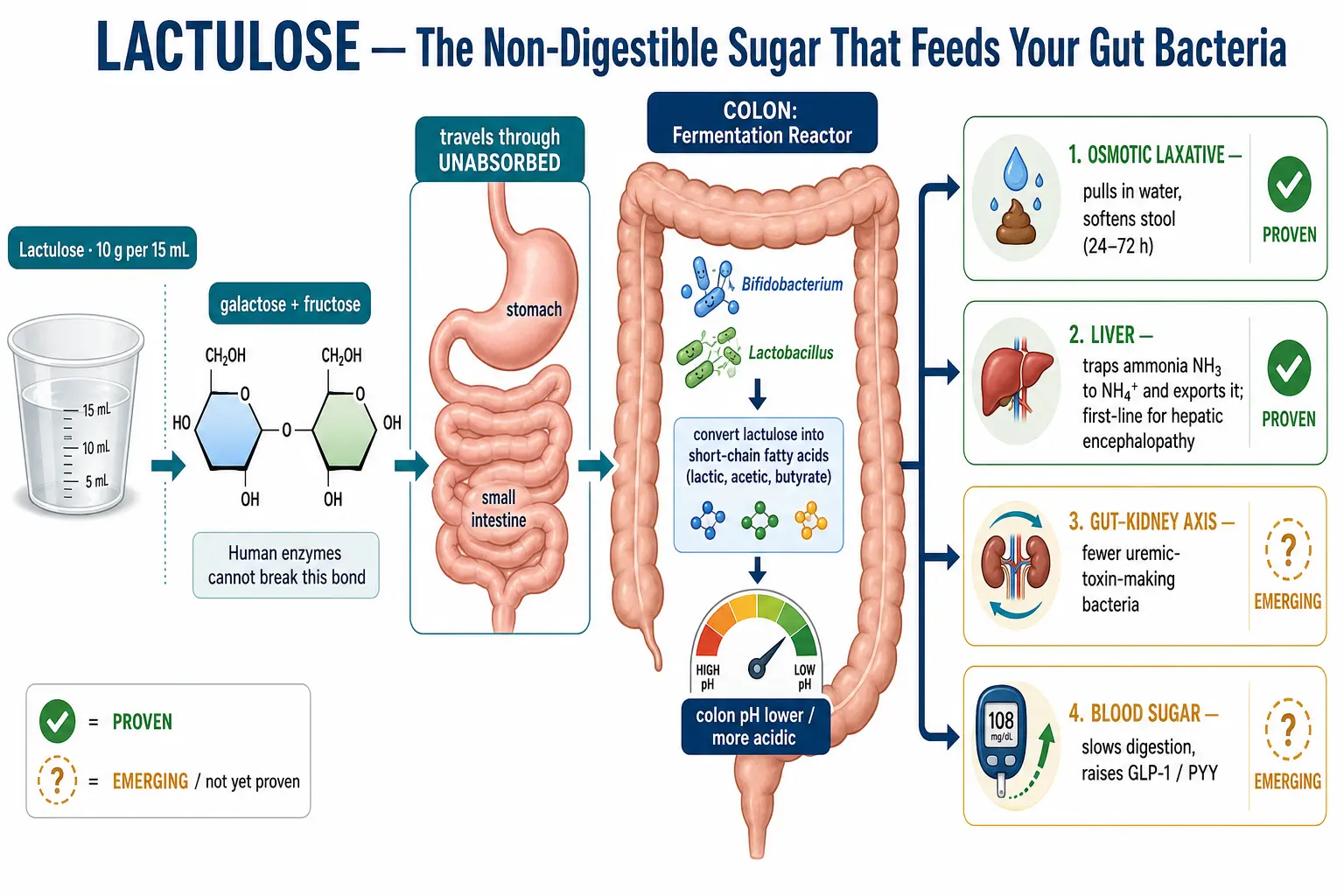
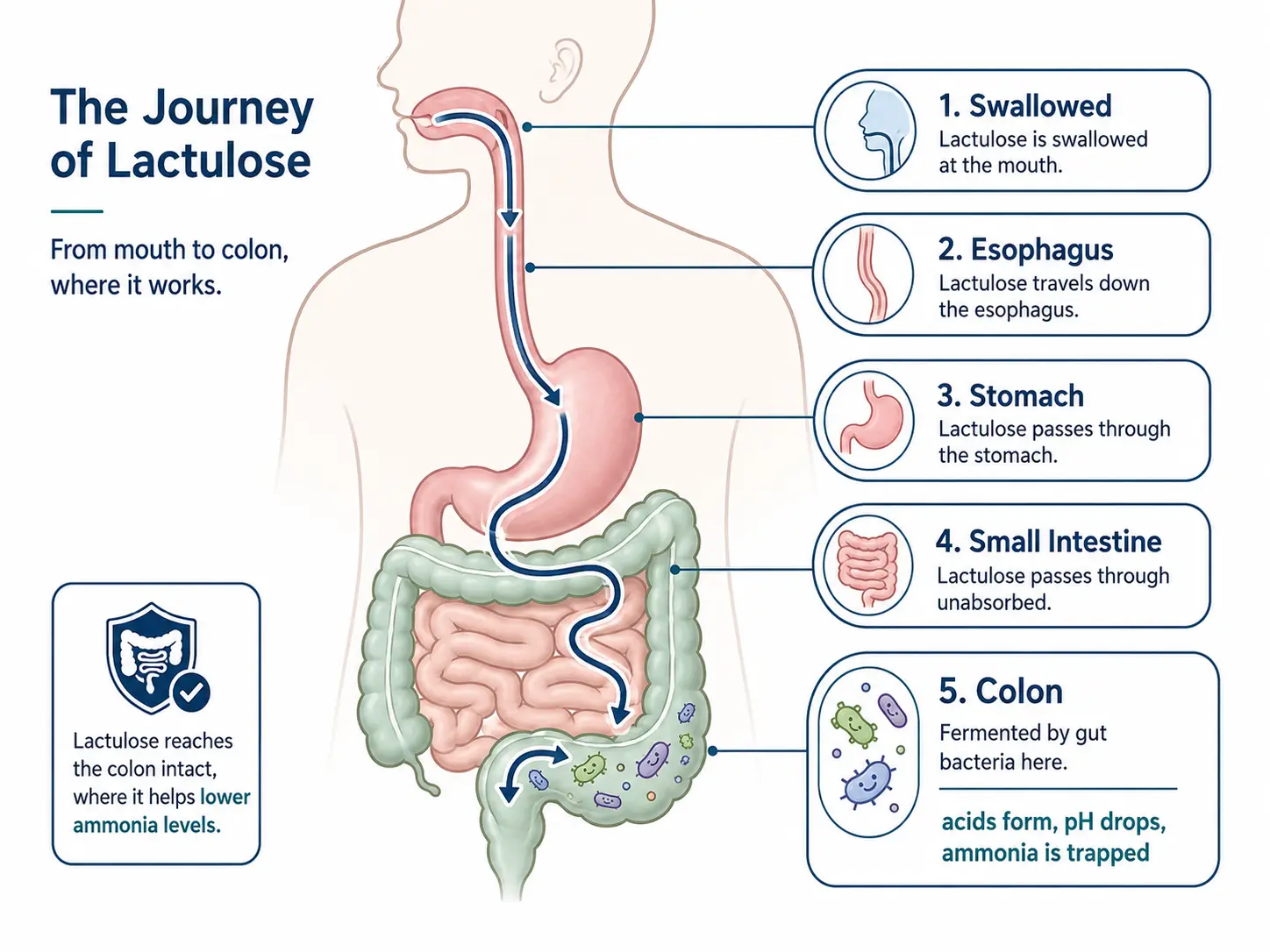
Lactulose is a synthetic sugar used as a prescription medicine — best known as a gentle osmotic laxative and as a frontline treatment for the confusion of advanced liver disease. What makes it scientifically interesting is that the human body cannot digest it at all. It travels untouched the length of the small intestine and arrives in the colon intact, where gut bacteria ferment it. Almost every effect lactulose has — softer stools, the drop in blood ammonia that protects the brain in liver failure, and its emerging roles in kidney and metabolic health — flows from that one fact. This page explains what lactulose is, how it works, what it treats, how it is taken, its side effects, and the honest state of the newer research. It is education, not medical advice; lactulose is prescription-only in the United States.
Table of Contents
- What Lactulose Is
- How It Works
- What It's Used For
- The Prebiotic Effect
- The Gut–Kidney Axis (Emerging)
- Lactulose & Blood Sugar (Emerging)
- Forms, Dosage & Availability
- Side Effects & Cautions
- Research Papers
- Connections
- Featured Videos
What Lactulose Is
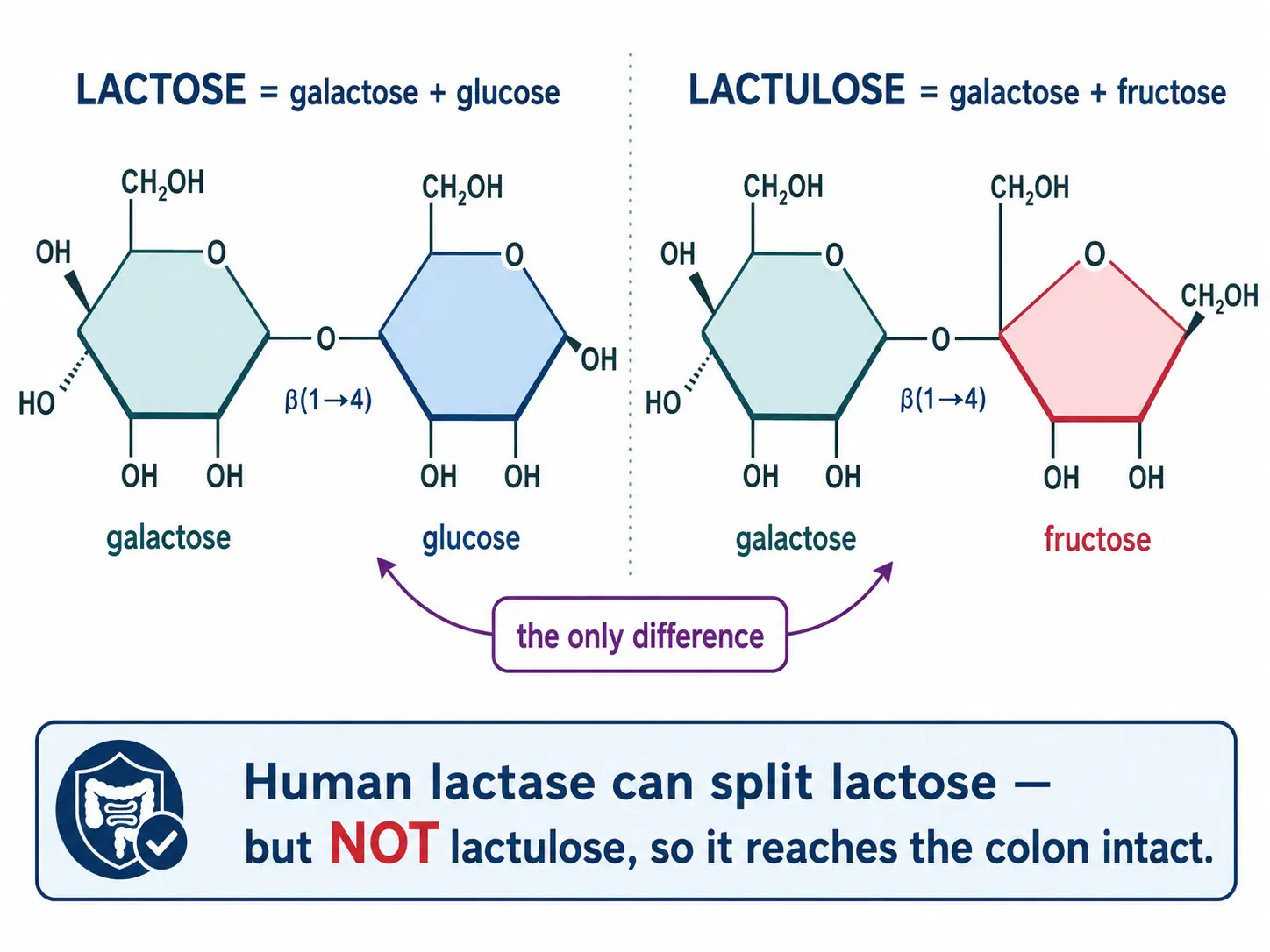
Lactulose is a synthetic disaccharide — two simple sugars joined together. In its case the halves are galactose and fructose (chemically, 4-O-β-D-galactopyranosyl-D-fructose). It is a close cousin of lactose, the natural sugar in milk, which is galactose joined to glucose. That one swapped sugar is the whole story: humans make an enzyme (lactase) that splits lactose, but no human enzyme can split lactulose. So it passes through the small intestine unabsorbed and reaches the colon carrying all of its chemical energy — food not for you, but for your colon's bacteria.
Despite being synthetic, lactulose is made from a milk sugar, not from petroleum. Manufacturers start with lactose (typically purified from whey, a cheese-making byproduct) and use alkaline isomerization to flip its glucose half into a fructose half, converting lactose into lactulose. It has been in clinical use since the 1960s, is generic and inexpensive, and has two well-established, regulator-approved uses: constipation and hepatic encephalopathy (the brain dysfunction of liver failure).
How It Works
When lactulose reaches the colon, two things happen at once — and both are driven by bacteria, not by your own tissues.
- Fermentation. Gut bacteria consume lactulose and ferment it into small organic acids — chiefly lactic and acetic acid, plus other short-chain fatty acids.
- Osmosis. Those acids, together with the unfermented sugar, raise the osmotic pressure inside the bowel and draw in water. Stool becomes softer, bulkier, and easier to pass.
This is why lactulose is classed as an osmotic laxative — though, unusually, its osmotic pull is partly a downstream product of fermentation rather than a purely physical effect. The same fermentation acidifies the colon, and that drop in pH is the key to its liver use (below). Because it works through microbes rather than by irritating the bowel wall, lactulose is not fast: it typically takes 24–48 hours, sometimes up to 72, to produce its full effect. The fermentation also explains its most common side effect — gas and bloating, especially in the first days of use.
What It's Used For
Lactulose has two core, approved uses backed by very different amounts of evidence.
Constipation
As a gentle osmotic laxative, lactulose softens and bulks the stool and is widely used for chronic constipation, including in children, older adults, and pregnancy when a clinician judges it appropriate. It does not force the bowel the way a stimulant laxative does, so it tends to be predictable and well tolerated — at the cost of a slower onset and some gas.
Hepatic encephalopathy (frontline)
This is where lactulose's evidence is strongest. In advanced liver disease and cirrhosis, the liver can no longer clear ammonia — a nitrogen-rich waste made largely by gut bacteria breaking down protein. Ammonia builds up, crosses into the brain, and causes hepatic encephalopathy: confusion, disorientation, tremor, and in severe cases coma. Lactulose treats it by pure colonic chemistry: by acidifying the colon it converts absorbable ammonia (NH3) into trapped, non-absorbable ammonium (NH4+); the well-fed bacteria pull nitrogen into their own bodies; and the laxative effect exports that nitrogen in the stool before it can reach the bloodstream. A 2016 Cochrane systematic review of 38 randomized trials found that non-absorbable disaccharides such as lactulose reduced the risk of hepatic encephalopathy and reduced mortality compared with placebo, and the 2022 EASL guidelines list it as first-line therapy.
The Prebiotic Effect
Because lactulose is fermented by bacteria, it meets the textbook definition of a prebiotic: a non-digestible substrate that selectively nourishes beneficial gut microbes — specifically Bifidobacterium and Lactobacillus, the same families people pay for in probiotic products. As these microbes ferment lactulose they lower the colon's pH, which itself favors beneficial acid-tolerant species and suppresses some harmful ones.
The dividing line between "laxative" and "prebiotic" is dose. A 2021 review in Frontiers in Nutrition (Karakan and colleagues) pooling nine trials in 537 participants found that low doses — roughly 5–10 g/day — produce the prebiotic effect (more Bifidobacterium and Lactobacillus, more short-chain fatty acids, lower fecal pH) without the strong laxative effect that only appears at the much higher 30–60 g/day doses. A randomized trial by Bouhnik and colleagues showed just 5 g twice daily for six weeks significantly raised fecal bifidobacterial counts in healthy adults.
The Gut–Kidney Axis (Emerging)
If lactulose can lighten the body's nitrogen burden in liver failure, could the same trick help failing kidneys? The mechanism is plausible and the early data are encouraging — but this is not established therapy. Many of the toxins the kidneys must clear actually originate in the gut: bacteria turn dietary amino acids into indole and p-cresol, which the body converts into the uremic toxins indoxyl sulfate and p-cresyl sulfate. Lactulose feeds the beneficial fermenters rather than these toxin-makers.
An animal study (Sueyoshi and colleagues, 2019) found lactulose lowered serum uremic toxins, improved kidney markers, and reduced kidney scarring in rats with chronic kidney disease, while shifting the microbiome toward Bifidobacterium. A small randomized human trial (Tayebi-Khosroshahi and colleagues, 2016) in 32 patients with stage 3–4 chronic kidney disease found that lactulose raised beneficial bacteria and produced a modest fall in serum creatinine. This is real, measured signal — but it is one rodent study and one 32-person trial, not the large trials that back the liver use. Lactulose is not an approved kidney treatment and nephrologists do not prescribe it for kidney function alone.
Lactulose & Blood Sugar (Emerging)
A sweet syrup being studied for type 2 diabetes sounds like a contradiction — until you remember the body cannot turn lactulose into blood glucose. A 2022 review in Frontiers in Endocrinology (Chu and colleagues), pointedly titled "The potential role of lactulose pharmacotherapy in the treatment and prevention of diabetes," gathers two proposed mechanisms. First, taken with food, a low dose "delayed gastric emptying and increased the whole gut transit times, attenuating the hyperglycemic response" — the same slow-the-meal logic behind the drug acarbose, producing a smaller after-meal glucose spike. Second, by feeding SCFA-producing bacteria, lactulose may raise the gut hormones GLP-1 and PYY and lower inflammatory LPS endotoxin, improving insulin sensitivity.
Crucially for anyone who already has diabetes, a 2021 study in the World Journal of Diabetes (Pieber and colleagues) gave people with type 2 diabetes 20 g and 30 g doses and found blood glucose stayed essentially flat — the residual sugars in lactulose are too small a quantity to matter. So lactulose appears glycemically safe in diabetes. But the prevention idea remains exactly that — a hypothesis. The same review states plainly that "there is no long-term…lactulose feeding study in subjects with prediabetes or type 2 diabetes." Lactulose is not an approved diabetes treatment and has not been shown to prevent diabetes or lower HbA1c. (The expanded in-depth article walks through this evidence in full.)
Forms, Dosage & Availability
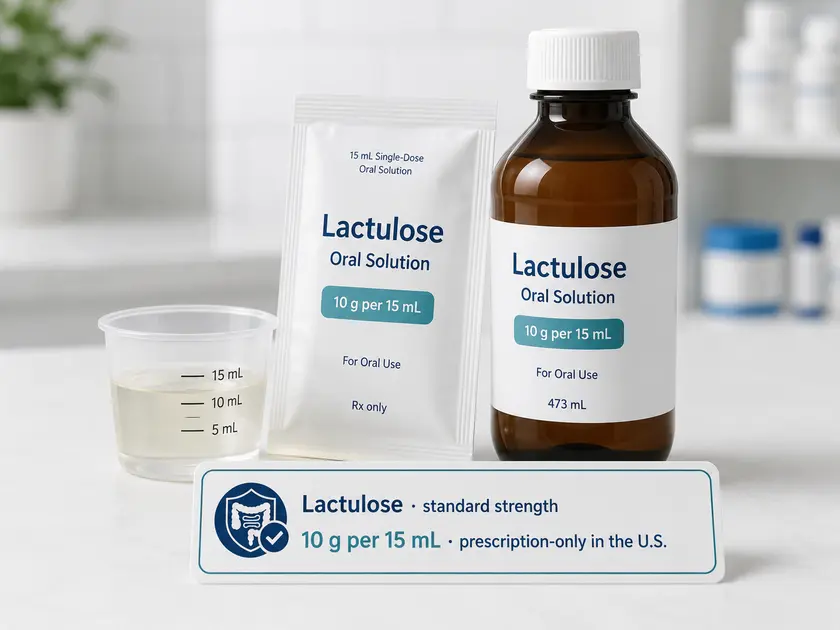
One standard strength. Almost all lactulose delivers 10 g per 15 mL (equivalently 667 g/L or 670 mg/mL), whether the label reads Duphalac (the originator brand) or any of the many generics. Because the strength is near-universal, dosing instructions translate cleanly across brands and countries.
Three formats. The syrup is sold as bottles (measured by cup or spoon; most economical for daily use), single-dose 15 mL sachets (pre-measured, travel-friendly), and portable tubes. Lactulose is a single-ingredient product — it is not combined with fiber or probiotics in one package, so those are bought separately. In the United States it is also available as a crystalline powder (Kristalose) that dissolves in water.
Typical dosing is individualized by a clinician. For constipation, adults often start around 15–30 mL daily (about 10–20 g) and adjust to response; for hepatic encephalopathy the dose is higher and titrated to produce two to three soft stools per day; the prebiotic effect appears at a much lower ~5–10 g/day. Remember the 24–72 hour onset — it is not a same-day fix.
Availability. In much of Asia, Europe, and Latin America lactulose is sold over the counter. In the United States it is prescription-only — a quirk of regulatory history rather than a sign of unusual danger. For readers without insurance, the in-depth news article covers legitimate routes to a prescription and the different products in detail.
Side Effects & Cautions
Lactulose is poorly absorbed and acts locally, so it is generally very safe — but it has predictable quirks:
- Gas, bloating, and cramping are the most common complaints, driven by the fermentation. They often ease with time or by starting at a lower dose.
- Overuse can cause diarrhea and, with significant fluid loss, electrolyte disturbances — a particular reason for people with advanced kidney disease to use it only under medical guidance.
- Galactosemia (an inherited inability to handle galactose) is a contraindication, because lactulose contains galactose.
- Diabetes: lactulose contains small amounts of free sugars, but as noted above the glycemic impact is minimal; people with diabetes can generally use it, ideally with a clinician's awareness.
A gentle correction worth making: regular users often say lactulose "cleans out" or "detoxes" the gut. Physiologically that is not quite what happens — it draws in water, softens the stool, and shifts which bacteria dominate, which helps the bowel empty more completely. That is a real and useful effect; it is just worth naming accurately. As always, decisions about using lactulose belong with you and a clinician who knows your history.
Research Papers
- Gluud LL, Vilstrup H, Morgan MY. Non-absorbable disaccharides for hepatic encephalopathy in people with cirrhosis. Cochrane Database of Systematic Reviews, 2016;(5):CD003044. doi:10.1002/14651858.CD003044.pub4 — 38-trial review: lactulose reduced hepatic encephalopathy and mortality versus placebo.
- European Association for the Study of the Liver. EASL Clinical Practice Guidelines on the management of hepatic encephalopathy. Journal of Hepatology, 2022;77(3):807–824. doi:10.1016/j.jhep.2022.06.001 — Guideline positioning lactulose as first-line therapy.
- Karakan T, Tuohy KM, Janssen-van Solingen G. Low-Dose Lactulose as a Prebiotic for Improved Gut Health and Enhanced Mineral Absorption. Frontiers in Nutrition, 2021;8:672925. doi:10.3389/fnut.2021.672925 — Review showing the prebiotic effect at low doses (~5–10 g/day) without a laxative effect.
- Bouhnik Y, Attar A, Joly FA, et al. Lactulose ingestion increases faecal bifidobacterial counts: a randomised double-blind study in healthy humans. European Journal of Clinical Nutrition, 2004;58(3):462–466. doi:10.1038/sj.ejcn.1601829 — 5 g twice daily significantly raised fecal bifidobacteria.
- Sueyoshi M, Fukunaga M, Mei M, et al. Effects of lactulose on renal function and gut microbiota in adenine-induced chronic kidney disease rats. Clinical and Experimental Nephrology, 2019;23(7):908–919. doi:10.1007/s10157-019-01727-4 — Animal evidence: lower uremic toxins, less fibrosis, more Bifidobacterium.
- Tayebi-Khosroshahi H, Habibzadeh A, Niknafs B, et al. The effect of lactulose supplementation on fecal microflora of patients with chronic kidney disease; a randomized clinical trial. Journal of Renal Injury Prevention, 2016;5(3):162–167. doi:10.15171/jrip.2016.34 — Small human RCT: more beneficial bacteria and a modest fall in creatinine.
- Chu N, Ling J, Jie H, Leung KS, Poon ETC. The potential role of lactulose pharmacotherapy in the treatment and prevention of diabetes. Frontiers in Endocrinology, 2022;13:956203. doi:10.3389/fendo.2022.956203 — Review of the slowed-digestion and microbiome mechanisms; frames diabetes use as potential, not proven.
- Pieber TR, Svehlikova E, Mursic I, et al. Blood glucose response after oral lactulose intake in type 2 diabetic individuals. World Journal of Diabetes, 2021;12(6):893–907. doi:10.4239/wjd.v12.i6.893 — Lactulose's sugar impurities did not raise blood glucose in type 2 diabetes.
- Karim A, Aïder M. Sustainable Electroisomerization of Lactose into Lactulose… ACS Omega, 2020;5(5):2318–2333. doi:10.1021/acsomega.9b03705 — How lactulose is manufactured from the milk sugar lactose.
PubMed Topic Searches
- PubMed — lactulose hepatic encephalopathy ammonia
- PubMed — lactulose prebiotic Bifidobacterium
- PubMed — lactulose chronic kidney disease uremic toxins
- PubMed — lactulose type 2 diabetes glucose
- PubMed — lactulose constipation randomized
External Authoritative Resources
- MedlinePlus — Lactulose (drug information)
- DailyMed — Lactulose product labels
- PubMed — All research on lactulose
Connections
- All Remedies
- Lactulose — Gut Bacteria, Ammonia & Blood Sugar (In-Depth)
- Hepatic Encephalopathy
- Cirrhosis
- Liver Disease
- Kidney Disease
- Constipation
- Type 2 Diabetes
- Insulin Resistance
- Probiotics
- Resistant Starches
- Gut Healing
- Metformin
- SIBO Breath Test Guide — lactulose is the substrate drunk at the start of the standard SIBO breath test.