 — June 21, 2026
· Lactulose — The Milk Sugar That Feeds Gut Bacteria and Traps Ammonia
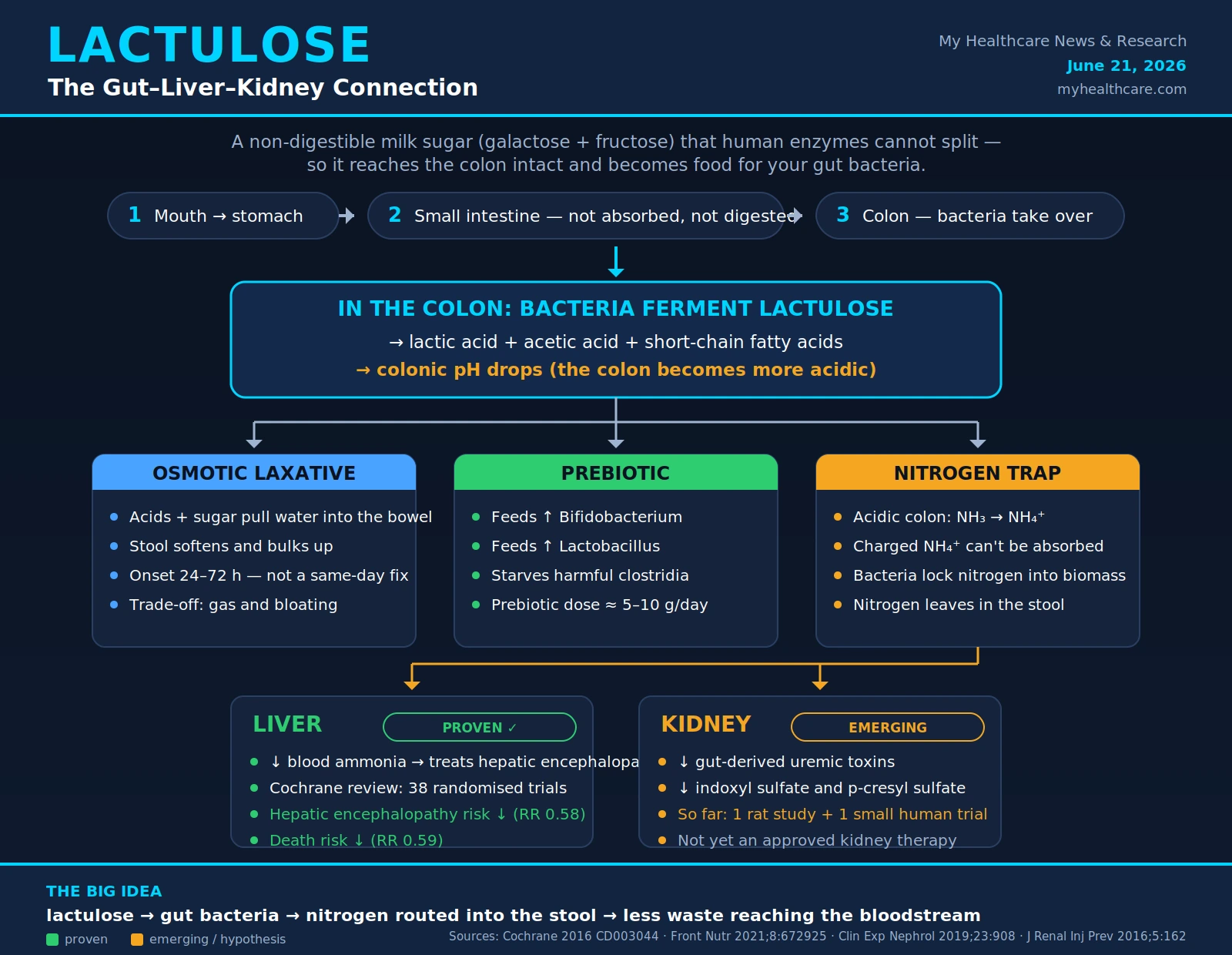
Most people meet lactulose on a pharmacy shelf labeled simply “laxative,” and most never look past that label. But lactulose is one of the more scientifically interesting molecules in the medicine cabinet, because it does almost nothing to your body directly. It is not absorbed. It does not stimulate the bowel wall. Your digestive enzymes cannot even break it apart. What it actually does is feed the trillions of bacteria living in your colon — and it is their metabolism, not yours, that produces every one of lactulose’s effects: the softer stool, the gas, the drop in blood ammonia that makes it a frontline liver-failure medicine, and the still-emerging signal that it may lighten the waste load on failing kidneys — and even a newer hint that it may flatten the rise in blood sugar after a meal.
This edition takes lactulose apart from the microbe’s point of view. The thread that ties it all together — and the part most worth understanding — is nitrogen: where ammonia comes from, why an acidic colon traps it, and how a sugar that bacteria eat can end up exporting nitrogen waste into the toilet instead of the bloodstream. That single mechanism is why the same cheap syrup shows up in cirrhosis wards and in kidney-disease research. This expanded edition follows that thread one organ further — into the newest question of whether lactulose’s microbiome effects could help with blood sugar and type 2 diabetes — and then turns to how lactulose is regulated and sold, the forms it comes in, and the routes to a prescription in the United States.
Table of Contents
- 1. What Lactulose Actually Is
- 2. Made From Milk Sugar, Not Petroleum
- 3. How It Works: Osmosis Plus Fermentation
- 4. Lactulose vs. PEG 3350 vs. Kiwifruit
- 5. A Prebiotic, Not Just a Laxative
- 6. The Ammonia Story — Why Liver Medicine Relies on It
- 7. The Gut–Kidney Axis — A Plausible, Emerging Benefit
- 8. The Unifying Idea: Lactulose Routes Nitrogen Out of the Body
- 9. Lactulose and Blood Sugar — The Type 2 Diabetes Question
- 10. Label Facts: Dosing, Prescription Status, Cautions
- 11. Prescription Access in the United States
- 12. Types of Lactulose: Syrups, Sachets, and Generics
- 13. Online Pharmacies and U.S. Import Rules
- Key Research Papers
- PubMed Topic Searches
- Connections
- Featured Videos
1. What Lactulose Actually Is
Lactulose is a synthetic sugar — a disaccharide, meaning two simple sugars joined together. In its case the two halves are galactose and fructose, chemically written as 4-O-β-D-galactopyranosyl-D-fructose. It is a close cousin of lactose, the natural sugar in milk, which is galactose joined to glucose. The only difference is which sugar sits on one half of the molecule and the exact bond that links them — but that small difference is everything.
Humans produce an enzyme (lactase) that splits lactose so we can absorb it. We make no enzyme that can split the galactose–fructose bond in lactulose. So lactulose travels the length of the small intestine essentially untouched, arriving in the colon intact and still carrying all of its chemical energy. That single fact — indigestible by us, but edible by bacteria — is the source of every effect described in this article. Lactulose is best understood not as a drug that acts on you, but as food delivered specifically to your colon’s microbes.
2. Made From Milk Sugar, Not Petroleum
A question we hear often — usually from people who prefer not to use petrochemical-derived products — is where lactulose comes from. Commercial lactulose is manufactured from lactose, the natural sugar of milk, typically purified from whey, a byproduct of cheese-making. There is no petroleum feedstock in the chain.
The manufacturing logic is elegant. Lactose is galactose-plus-glucose; lactulose is galactose-plus-fructose. Glucose and fructose are isomers — the same atoms arranged differently — so converting one into the other does not require building anything new, only rearranging it. Industrially this is done by alkaline isomerization: lactose is treated under controlled alkaline conditions (often with a catalyst) that flip the glucose half of the molecule into a fructose half, turning lactose into lactulose. The syrup is then purified to remove unreacted lactose and side products. Newer routes use enzymes (such as cellobiose 2-epimerase) or even electrochemical methods; in one 2020 laboratory study, electro-isomerization reached a higher lactulose yield in a shorter reaction time than chemical isomerization at the same alkalinity (a top yield of 38% at 40 minutes). In short, lactulose is manufactured rather than foraged — it is not abundant in any natural food — but its raw material is a milk sugar, not a barrel of oil.
3. How It Works: Osmosis Plus Fermentation
When lactulose reaches the colon, two things happen at once, and both come from the bacteria.
- Fermentation. Gut bacteria consume lactulose as fuel and ferment it into small organic acids — chiefly lactic acid, with smaller amounts of acetic and formic acids, according to the U.S. prescribing label; reviews of the fermentation research report acetate as the most abundant short-chain fatty acid produced.
- Osmosis. Those acids, plus the un-fermented sugar itself, raise the osmotic pressure inside the colon. Water is pulled into the bowel to balance it. Stool becomes softer, bulkier, and easier to pass.
This is why lactulose is classified as an osmotic laxative — but note that the osmotic effect is partly a downstream product of fermentation, not a purely physical effect. The same fermentation explains the most common complaint: gas, bloating, abdominal rumbling, and mild cramping. The U.S. label reports gaseous distention with flatulence or belching, and abdominal discomfort such as cramping, in about 20% of patients. The rumbling after a dose is gas produced as colon bacteria ferment the sugar.
One consequence of working through bacteria rather than by irritating the bowel: lactulose is not fast. The U.S. label states that 24 to 48 hours may be required to produce a bowel movement, and the UK’s National Health Service says it can take 2 to 3 days to start working. It does not “force” the bowel the way a stimulant laxative does, so a same-day result from a single dose is not the expected pattern.
4. Lactulose vs. PEG 3350 vs. Kiwifruit
Because readers frequently compare laxative options — particularly those wary of synthetic polymers — here is how lactulose lines up against polyethylene glycol 3350 (PEG, sold over the counter under several brand names) and against the gentle food approach of kiwifruit.
| Feature | Lactulose | PEG 3350 |
|---|---|---|
| Origin | Made from milk sugar (lactose) | Petrochemical-derived polymer |
| Fermented by gut bacteria? | Yes — this is the whole point | No — chemically inert |
| Gas and bloating | Common | Less common |
| Mechanism | Osmotic plus bacterial fermentation | Osmotic only |
| Prebiotic / microbiome effect | Yes (feeds beneficial bacteria) | Minimal to none |
| Taste / form | Sweet syrup | Nearly tasteless powder |
The two are genuinely different tools. PEG is an inert polymer: it holds water in the stool and passes through without gut bacteria fermenting it, the usual explanation for why it causes less gas. Lactulose does the opposite — it is fermented by colon microbes, and the gas comes with the microbiome effect. Neither origin makes one “clean” and the other “toxic”; the distinction is mechanistic, not moral. Of the two, lactulose is the one made from a milk sugar. Head-to-head trials have favoured PEG for constipation: in a 1999 randomized trial in 115 patients with chronic constipation, PEG 3350 produced more stools and less straining over four weeks than lactulose, and flatus was reported less often; a 2010 Cochrane review of ten randomized trials found PEG better than lactulose for weekly stool frequency, stool form, relief of abdominal pain and the need for additional products, and its authors concluded that PEG is preferable to lactulose for chronic constipation.
For constipation, food has also been tested directly. In a 2021 U.S. trial in 79 adults with chronic constipation, two green kiwifruit per day for four weeks performed similarly to prunes (100 g/day) and to the fiber laxative psyllium (12 g/day) on the main responder measure, improved stool consistency and straining, and had the lowest rates of side effects and of dissatisfaction. A 2022 meta-analysis of seven randomized trials (399 participants) rated the overall evidence that kiwifruit increases bowel movements as low certainty and called for larger, rigorous trials. Kiwifruit is thought to work through fiber, water-holding capacity, and gradual fermentation rather than a single osmotic push. None of these trials compared kiwifruit with lactulose directly.
5. A Prebiotic, Not Just a Laxative
Here is the part the “laxative” label hides. Because lactulose is fermented by bacteria, it meets the textbook definition of a prebiotic: a non-digestible substrate that selectively nourishes beneficial members of the gut community. And the bacteria it favors are the same genera found in many probiotic products:
- Bifidobacterium
- Lactobacillus
As these microbes ferment lactulose, they pour out lactic acid, acetic acid, and short-chain fatty acids, which lower the pH of the colon — making it more acidic. That acidity is thought to be selective in itself: reviews describe a lower gut pH as favoring acid-tolerant beneficial species and leaving less room for several potentially harmful, pH-sensitive organisms. Trials measure the result as a shift in the bacterial community, not just a bowel movement.
The dose is what separates the two faces of lactulose. A 2021 review in Frontiers in Nutrition by Karakan and colleagues identified nine clinical trials of low-dose lactulose totaling 537 participants, most of them in healthy volunteers. It describes about 15 mL a day (about 10 g) as a prebiotic dose, about 30–60 mL a day (about 20–40 g) as the laxative range used for constipation, and more than 90 mL a day (more than 60 g) as the range used for hepatic encephalopathy, while noting that it is not clear whether these effects are mutually exclusive. Across the trials it reviewed, low doses increased Bifidobacterium and Lactobacillus counts and short-chain fatty acids, reduced certain clostridia, and lowered fecal pH, and the authors proposed 5–10 g/day as a practical prebiotic dose for adults (one of the three authors is employed by a lactulose manufacturer). In a randomized double-blind trial in 16 healthy adults, Bouhnik and colleagues found that 5 g twice daily for six weeks raised fecal bifidobacterial counts compared with a sucrose placebo; Lactobacillus counts and stool pH did not change significantly in that trial, and excess flatus was more common but very mild. In a computer-controlled laboratory model of the human proximal large intestine, the effect was dose-dependent: 2 g a day already raised short-chain fatty acids, and 5 g a day for five days was needed for the full prebiotic profile, including lower ammonia (a study run by a lactulose manufacturer).
The prebiotic trials gave lactulose daily, for days to weeks. None tested an occasional single dose — for example a 15 mL sachet (about 10 g) once a week — so whether that pattern produces a lasting shift in Bifidobacterium and Lactobacillus has not been measured.
6. The Ammonia Story — Why Liver Medicine Relies on It
This is where the evidence for lactulose is strongest, and where the nitrogen story begins. In advanced liver disease and cirrhosis, the liver can no longer clear ammonia — a nitrogen-rich waste product, much of it generated in the gut as bacteria break down protein and urea. Ammonia builds up in the blood, crosses into the brain, and causes hepatic encephalopathy: confusion, disorientation, tremor, and in severe cases coma. Lactulose is a frontline treatment for it, and the reason is pure chemistry happening in the colon:
- The acid trap. Ammonia (NH3) and ammonium (NH4+) exist in a balance that depends on pH. NH3 is a small, uncharged molecule that slips easily across the gut wall into the blood. NH4+ is charged and cannot be absorbed. By fermenting lactulose into acids and dropping colonic pH, lactulose pushes the balance toward NH4+, locking ammonia inside the gut where it cannot reach the brain.
- Bacterial uptake. The blooming, well-fed bacteria need nitrogen to build their own bodies, so they pull ammonia out of the gut contents and incorporate it into their biomass. That nitrogen is now inside bacterial cells. In a 1987 study of people with stable cirrhosis, lactulose (about 56–63 g a day) raised the nitrogen excreted in the bacterial fraction of stool by 165% and lowered the body’s urea production rate by 23%; a later review by the same researcher notes that lactulose increases fecal nitrogen but adds very little ammonia nitrogen itself.
- Export in stool. The laxative effect then carries those nitrogen-loaded bacteria, and the trapped ammonium, out of the body in the feces — before the nitrogen can be reabsorbed.
The clinical evidence is unusually deep for a humble syrup. A 2016 Cochrane systematic review by Gluud, Vilstrup, and Morgan included 38 randomized controlled trials (1,828 participants) in people with cirrhosis. Compared with placebo or no intervention, non-absorbable disaccharides such as lactulose were associated with a beneficial effect on hepatic encephalopathy (risk ratio 0.58, 95% CI 0.50–0.69; 22 trials), lower mortality (risk ratio 0.59, 95% CI 0.40–0.87; 24 trials), and fewer serious complications of the underlying liver disease such as liver failure, hepatorenal syndrome, and variceal bleeding (risk ratio 0.47), all rated moderate-quality evidence. The authors note that every trial had a high risk of bias for the outcomes other than mortality, and they concluded that these drugs “may be associated with a beneficial effect on clinically relevant outcomes.” The same review describes lactulose and lactitol as “recommended as first-line treatment for hepatic encephalopathy”; current European guidance is set out in the 2022 EASL clinical practice guidelines. In the liver context lactulose has the deepest trial record of any use covered here — and its effect runs through gut bacteria and nitrogen.
7. The Gut–Kidney Axis — A Plausible, Emerging Benefit
Now the question that prompted this article: if lactulose can lighten the nitrogen burden on the brain in liver failure, could the same trick lighten the waste burden on failing kidneys? The honest answer is: the mechanism is biologically plausible and the early data are encouraging, but this is not established therapy. Here is exactly what is known, graded honestly.
Where the toxins come from
The kidneys clear many waste compounds, and a surprising share of them originate in the gut. Bacteria metabolize dietary amino acids into precursors — indole (from tryptophan) and p-cresol (from tyrosine and phenylalanine) — that are absorbed and converted by the liver into indoxyl sulfate and p-cresyl sulfate. These are called uremic toxins because they accumulate to harmful levels when kidney function declines, and they are linked to faster kidney decline and cardiovascular damage. Crucially, the bacteria that produce indole — certain Bacteroides and Clostridium species — are different from the Bifidobacterium and Lactobacillus that lactulose feeds.
What the studies show
Animal evidence. In a 2019 study in Clinical and Experimental Nephrology, Sueyoshi and colleagues fed rats with adenine-induced chronic kidney disease a diet containing 3.0% or 7.5% lactulose for four weeks. The treated animals showed lower serum indoxyl sulfate and p-cresyl sulfate, improved serum creatinine and blood urea nitrogen, and significantly less kidney scarring (tubulointerstitial fibrosis). The microbiome explained it: lactulose increased Bifidobacterium and reduced the indole-producing Bacteroides and Clostridium cluster XI — fewer toxin-makers, more beneficial fermenters.
Human evidence. A small randomized trial by Tayebi-Khosroshahi and colleagues (2016) gave 32 patients with stage 3–4 chronic kidney disease either lactulose syrup three times daily (the paper reports the amount inconsistently, as 30 per dose in its methods and as 30 mL a day in a results table) or a matching placebo for eight weeks. In the lactulose group, fecal Bifidobacteria and Lactobacilli counts rose significantly, and serum creatinine fell modestly (from 3.90 to 3.60 mg/dL, p = 0.003) while it rose in the placebo group (from 3.87 to 4.11 mg/dL). End-of-study creatinine did not differ significantly between the groups, although the percentage change did. That is a measured signal in actual patients, from a small trial.
The honest limits
Now the limits. This evidence is one rodent study and one 32-person trial, plus supporting microbiome reviews — not the dozens of large randomized trials that back the liver use. The human creatinine change was modest. Lactulose is not an approved kidney treatment, has not been shown to prevent kidney failure, and is not part of standard treatment for kidney function. The evidence reads as a testable hypothesis with early support, not a settled benefit. The open questions — does it raise Bifidobacterium, increase short-chain fatty acids, lower indoxyl sulfate, and slow decline in large trials? — are measurable. They have not yet been answered at the scale that would change practice.
8. The Unifying Idea: Lactulose Routes Nitrogen Out of the Body
Step back, and the liver use and the kidney hypothesis turn out to be the same mechanism viewed from two ends. Lactulose does not act on the liver or the kidney directly. It acts on bacteria, and through them, on nitrogen routing:
- Lactulose reaches the colon undigested and feeds bacteria.
- The bacteria multiply, ferment it into acids, and make the colon more acidic.
- Growing bacteria pull nitrogen into their own biomass; the acidic environment simultaneously traps ammonia as ammonium so it cannot be absorbed.
- The colon becomes a larger “sink” for nitrogen, and the laxative effect exports that nitrogen in the stool.
- Less nitrogen-containing waste enters the bloodstream in the first place — whether that waste is the ammonia that poisons the brain in liver failure, or the gut-derived precursors of the uremic toxins the kidneys would otherwise have to clear.
That is the whole idea in one line: lactulose → gut bacteria → nitrogen handling and microbial metabolites → less waste burden entering the circulation. The brain benefit in liver disease rests on dozens of randomized trials; the kidney effect is the same lever, applied one organ over, and is still being measured.
9. Lactulose and Blood Sugar — The Type 2 Diabetes Question
There is a third frontier where lactulose is being studied, and it surprises almost everyone who hears it: type 2 diabetes. A sweet syrup — a sugar, no less — being investigated to help control blood sugar sounds like a contradiction. It is not, once you remember the rule that governs everything lactulose does: humans cannot digest it. The galactose–fructose bond that our enzymes can’t break is the very reason lactulose does not behave like ordinary table sugar in the bloodstream. It is, in effect, a sugar your body cannot turn into blood glucose.
Unlike the liver and kidney stories — which are two views of one “nitrogen-routing” mechanism — the diabetes story runs on a different set of levers. A 2022 review in Frontiers in Endocrinology by Chu and colleagues gathered the evidence under the title “The potential role of lactulose pharmacotherapy in the treatment and prevention of diabetes.” The word potential is doing real work in that title, and we will keep it front and center throughout. Here is what the science actually proposes.
Lever one: slowing the meal down
The most immediate effect concerns the speed of digestion. The review distills it — drawing on small feeding studies, including one in 10 healthy volunteers — into a single sentence worth unpacking carefully: “A low dose of lactulose with food delayed gastric emptying and increased the whole gut transit times, attenuating the hyperglycemic response without adverse gastrointestinal events.” That one line contains four separate claims, and each translates cleanly into plain language:
- “Delayed gastric emptying.” Gastric emptying is the rate at which food leaves the stomach for the small intestine. Lactulose taken with a meal slowed that hand-off, so food left the stomach more gradually instead of all at once.
- “Increased the whole gut transit times.” The meal also moved more slowly through the entire digestive tract, so its carbohydrates were absorbed over a longer window rather than in a single rush.
- “Attenuating the hyperglycemic response.” The “hyperglycemic response” is the rise in blood glucose after eating. Because digestion and absorption were stretched out, the after-meal spike came out smaller and flatter.
- “Without adverse gastrointestinal events.” At the low dose studied, this happened without the diarrhea, bloating, or cramping the high laxative doses can cause. As with the prebiotic effect in Section 5, the metabolic effect and the laxative effect are separated by dose.
The mechanism is a familiar one. It is the same principle behind several mainstream blood-sugar strategies: eating slowly, front-loading a meal with vegetables or fiber, and the prescription drug class called alpha-glucosidase inhibitors (such as acarbose) all work by the same logic — deliver carbohydrate to the bloodstream more slowly, and the glucose peak shrinks. Lowering the after-meal glucose peak is one of the targets of diabetes care.
Lever two: the microbiome and its hormones
The second lever is the one this whole article has been building toward — the gut bacteria. The metabolic benefit, the review argues, is not merely mechanical slowing; it is the downstream consequence of feeding the right microbes. The chain of events runs like this:
- Better bacteria, fewer harmful ones. Similar to acarbose, the review notes, lactulose “can also increase the abundance of the short-chain fatty acid (SCFA)-producing bacteria Lactobacillus and Bifidobacterium as well as suppress the potentially pathogenic bacteria Escherichia coli.” The authors go as far as to say lactulose and acarbose “shared a similar mechanism” through changes to the gut microbiota — the diabetes drug and the humble laxative may be doing some of the same work on the microbiome.
- More short-chain fatty acids. Those well-fed bacteria pour out short-chain fatty acids (SCFAs) — acetate, propionate, and butyrate. SCFAs are not waste products; they are signaling molecules. They nourish the cells lining the colon, strengthen the gut barrier, and are linked in research to improved insulin sensitivity and lower inflammation.
- Gut hormones switch on. SCFAs and a healthier gut lining prompt the release of two key hormones — GLP-1 (glucagon-like peptide 1) and PYY (peptide YY). GLP-1 is the hormone the blockbuster diabetes and weight-loss drugs (the “-glutides”) are built to imitate. It triggers insulin when it is needed, slows the stomach, and curbs appetite — and the review proposes that lactulose, through these fermentation products, nudges the body into making a little more of its own.
- Less “leaky-gut” inflammation. A stronger gut barrier means fewer bacterial fragments called lipopolysaccharides (LPS) — endotoxins — slipping into the blood. Circulating LPS is linked in research to the low-grade, chronic inflammation associated with insulin resistance; the review’s argument is that less leakage would mean less inflammation and a better insulin response.
Put the two levers together and you have the review’s thesis: lactulose may flatten the after-meal spike today (by slowing digestion) while improving the metabolic terrain over time (by reshaping the microbiome and its hormone signals). It is, in the authors’ framing, a prebiotic that happens to pull several of the same levers as real diabetes drugs.
A worked example (illustrative numbers)
To make the “flatter peak” idea concrete, here is a simple before-and-after — with one honest warning up front: these are illustrative numbers chosen to show the principle, not measured results from any specific patient.
Suppose a particular meal would normally push someone’s blood glucose from a fasting 90 mg/dL up to a peak of about 170 mg/dL — rising fast and falling fast. If a small dose of lactulose taken with that meal slows stomach emptying and stretches carbohydrate absorption over a longer period, the same meal might instead produce a slower, gentler rise to roughly 140–150 mg/dL, spread across more time. The total carbohydrate absorbed is similar; what changes is the shape of the curve — a rolling hill instead of a sharp mountain. The exact figures vary enormously from person to person and meal to meal; the point of the example is the shape: a lower, broader peak.
Does lactulose raise blood sugar in people with diabetes?
This is the obvious worry, and it is exactly the question the paper that prompted this section set out to answer. Commercial lactulose is not chemically pure — manufacturing leaves behind small amounts of free lactose, galactose, and fructose. Could those leftover real sugars spike blood glucose in someone with diabetes and cancel out the benefit?
A 2021 randomized, double-blind trial in the World Journal of Diabetes by Pieber and colleagues tested precisely this in 24 mildly constipated adults with type 2 diabetes who did not use insulin. Each received single doses of 20 g or 30 g of crystal or liquid lactulose, water, or 30 g of glucose, and capillary blood glucose was tracked for three hours while fasting. The lactulose curves were almost identical to water, even though the liquid form carried about 30% carbohydrate impurities (3% or less for the crystals); the one difference was a small rise in peak glucose after 30 g of liquid lactulose (a mean 0.63 mmol/L, about 11 mg/dL, above water), while glucose itself raised every blood-glucose measure. The authors concluded that these patients “may particularly benefit from the prebiotic effect of this laxative without experiencing an impact on blood glucose levels and glycemic management.” The trial was sponsored by a lactulose manufacturer, and it measured single doses over three hours, not daily use over months.
Where lactulose sits among proven tools
It helps to place lactulose honestly alongside the strategies that already carry strong diabetes evidence. The point of the table below is not that lactulose equals these tools — it is that lactulose appears to pull some of the same levers, while sitting far lower on the evidence ladder.
| Approach | Main lever | Evidence in diabetes |
|---|---|---|
| Diet, weight loss, exercise | Improves insulin sensitivity directly | Proven — first-line |
| GLP-1 receptor agonists (“-glutides”) | Mimic the GLP-1 hormone | Proven — major drug class |
| Acarbose (α-glucosidase inhibitor) | Slows carbohydrate absorption; shifts microbiota | Proven — approved drug |
| Dietary fiber / resistant starch | Feeds SCFA-producing microbes; slows absorption | Good supportive evidence |
| Lactulose | Slows gastric emptying; raises SCFAs, GLP-1/PYY; lowers LPS | Proposed only — no long-term human trials yet |
The honest limits — “potential,” not “proven”
The diabetes story sits at an earlier, more tentative stage than even the kidney story, and it must be read that way. The same Frontiers review that proposes the benefit states the limitation plainly: “there is no long-term…lactulose feeding study in subjects with prediabetes or type 2 diabetes.” The gastric-emptying and microbiome findings come largely from healthy volunteers and mechanistic reasoning; the safety study shows that single doses did not raise glucose, not that lactulose prevents diabetes. Stated bluntly:
- Lactulose is not an approved diabetes treatment anywhere. Its approved uses remain constipation and hepatic encephalopathy.
- No trial has yet shown that taking lactulose prevents type 2 diabetes or lowers HbA1c (the three-month blood-sugar average) in people who already have it.
- The review’s own closing statement is that the potential of lactulose as a pharmacotherapy for prediabetes and diabetes “needs to be formally evaluated in larger randomized controlled studies across populations” — a hypothesis still to be tested, not an established blood-sugar treatment.
The proposed levers (slower digestion, more SCFAs, more GLP-1, less endotoxin) are measurable, which makes the question a testable one. The large human trials that would move this from “potential” to “proven” have not been done yet. For people with diabetes or prediabetes, the findings so far are narrow: in the one dedicated trial, single 20–30 g doses did not change three-hour blood glucose, and no trial has compared lactulose with, or added it to, the diet, exercise, and medication approaches with proven benefit.
10. Label Facts: Dosing, Prescription Status, Cautions
Prescription status. In the United States, lactulose oral solution is prescription-only (“Rx only”) per FDA-approved labeling. The label describes lactulose as poorly absorbed from the gastrointestinal tract, with urinary excretion of 3% or less. Rules differ by country: in the United Kingdom, for example, the National Health Service states that it can be bought from pharmacies, while children under 14 need a prescription. Section 11 describes U.S. routes to a prescription, Section 12 the product forms, and Section 13 online pharmacies and U.S. import rules.
Labeled doses. The U.S. constipation label gives the usual adult dose as 15–30 mL daily (10–20 g of lactulose), which may be increased to 60 mL daily. The U.S. label for hepatic encephalopathy gives 30–45 mL (20–30 g) three or four times daily, adjusted every day or two to produce two or three soft stools a day. The prebiotic studies above used much lower amounts, and the 2021 review proposed 5–10 g/day for that purpose. Onset is not same-day: 24–48 hours on the U.S. label, 2–3 days per the NHS.
A gentle correction worth making. Regular users often say lactulose “cleans out the intestine.” Physiologically that is not quite what happens — lactulose does not scrub the gut wall or remove “toxins” in the detox sense. It draws in water, softens and bulks the stool, and shifts which bacteria and metabolites dominate, which helps the bowel empty more completely and comfortably. That can feel like being cleaned out, and it is a real and useful effect — it is just worth naming accurately.
Cautions. The U.S. label lists galactose (less than 1.6 g per 15 mL) among the solution’s contents and makes lactulose contraindicated in patients who require a low-galactose diet, such as people with galactosemia (an inherited inability to handle galactose). Because the solution also contains lactose (less than 1.2 g per 15 mL), the label calls for caution in people with diabetes; the single-dose trial in Section 9 found little effect on blood glucose. The fermentation-driven gas, bloating, and cramping are the most common side effects. The labels add that excessive dosage can lead to diarrhea with loss of fluids, low potassium, and high sodium, and call for periodic electrolyte checks in elderly, debilitated patients who take lactulose for more than six months — effects that matter most for people whose fluid and electrolyte balance is already fragile, such as people with advanced kidney disease. This article is education, not a prescription; decisions about lactulose for any medical condition belong with a clinician.
11. Prescription Access in the United States
Access to lactulose depends on the country. In some countries, including the United Kingdom, it can be bought from a pharmacy without a prescription. In the United States it is prescription-only. For people with a regular doctor this is a routine prescription; for the uninsured, or anyone without an established physician, it can be a barrier. This section describes the routes to a U.S. prescription that exist.
A number of telehealth services offer brief online visits, some on a cash basis without insurance; after the visit a clinician may send a prescription to a pharmacy the patient chooses, if the clinician judges it appropriate. The U.S. product is the oral solution, 10 g per 15 mL, sold generically and under several brand names, plus a crystalline powder form that is dissolved in water.
A valid U.S. prescription can be filled at any U.S. pharmacy; Section 13 covers online pharmacies outside the U.S. and the FDA’s rules on importing medicines.
12. Types of Lactulose: Syrups, Sachets, and Generics
Walk into a pharmacy anywhere in the world and the lactulose on the shelf will look more varied than it really is. Almost all of it is the same molecule at the same strength; what differs is the packaging, the brand, and a few details of purity. Here is how the options differ. (No brands and no prices are listed — prices vary by country and change constantly; this is purely about the forms on sale.)
One standard strength
The overwhelming majority of lactulose products deliver 10 g of lactulose per 15 mL — equivalently labeled 667 g/L or 670 mg/mL. Whatever the brand, and for local generics, that 10 g-per-15 mL concentration is the near-universal default, and it is the strength on U.S. labels. This is why dosing figures translate cleanly across brands and borders: “15 mL” means roughly 10 g almost everywhere.
Three delivery formats
The real choice is how that syrup is packaged, and there are three common formats:
- Bottles. The classic format — a bottle of syrup (commonly 100 mL, 200 mL, 500 mL, or 1 L) measured out with a cup or spoon. Both the originator product and many generics are sold this way.
- Single-dose sachets. Pre-measured 15 mL pouches, each delivering one 10 g dose, so no measuring is involved. Several brands outside the U.S. are offered in this form.
- Portable tubes / ampoules. A less common variant — individual squeezable tubes at the same 670 mg/mL strength. Functionally identical to a sachet; the difference is packaging.
Originator brand versus generics
The originator product has been sold for decades, and its brand name is the one many clinicians know. Because lactulose is old and off-patent, many generics exist, under names that vary by country. A generic at the same 10 g/15 mL strength contains the same active ingredient at the same dose; brand and generic products differ mainly in price and availability.
A note on purity and “extra” sugars
One genuine difference between products is how much residual sugar they carry. Some product inserts state no added excipients, while noting that small amounts of lactose, galactose, and fructose can remain from manufacturing. U.S. labels give the ceiling per 15 mL: less than 1.6 g galactose, less than 1.2 g lactose, and 0.1 g or less of fructose. In the Pieber trial the crystal form carried 3% or less of these impurities and the liquid about 30%. The residual sugars matter in the two situations covered earlier: diabetes (where the Pieber trial found that single 20–30 g doses of either form left three-hour blood glucose almost unchanged) and galactosemia (where the U.S. label lists lactulose as contraindicated for anyone who requires a low-galactose diet).
What lactulose is not bundled with
Finally, a clarification about combination products. Lactulose medicines are single-ingredient products; lactulose is not typically packaged together with psyllium, fiber, or probiotics. Combination “fiber + probiotic” supplements exist, but they do not contain lactulose — they are a different product category for a different purpose. (Food-based fiber that ferments in a similar way is covered on the resistant starches and probiotic foods pages.)
13. Online Pharmacies and U.S. Import Rules
A U.S. prescription (Section 11) can be filled at any local U.S. pharmacy. Some patients look to international online pharmacies instead — usually for larger bottle sizes or lower cash prices. Because lactulose is standardized at 10 g/15 mL, the products are comparable; what differs is bottle size, price, and shipping.
The legal position. The U.S. Food and Drug Administration states that “in most circumstances, it is illegal for individuals to import drugs or devices into the U.S. for personal use,” with limited exceptions it may allow — for example, a product for a serious condition for which effective treatment may not be available domestically, limited to about a 90-day supply. Its page also lists grounds on which it would refuse a personal importation, so an online pharmacy accepting and charging for an order does not settle whether the shipment is admitted. The FDA explains its position on personal importation here. A U.S. prescription filled at a U.S.-licensed pharmacy (Section 11) falls outside these import rules.
Pharmacy licensing. U.S. pharmacy licences are recorded by state boards of pharmacy, and the National Association of Boards of Pharmacy runs a pharmacy-verification program.
Key Research Papers
Prebiotic & Gut-Bacteria Effects
- Karakan T, Tuohy KM, Janssen-van Solingen G. Low-Dose Lactulose as a Prebiotic for Improved Gut Health and Enhanced Mineral Absorption. Frontiers in Nutrition. 2021;8:672925. — doi:10.3389/fnut.2021.672925 (PubMed PMID: 34386514)
- Bouhnik Y, Attar A, Joly FA, et al. Lactulose ingestion increases faecal bifidobacterial counts: a randomised double-blind study in healthy humans. European Journal of Clinical Nutrition. 2004;58(3):462–466. — doi:10.1038/sj.ejcn.1601829 (PubMed PMID: 14985684)
- Bothe MK, Maathuis AJH, Bellmann S, et al. Dose-Dependent Prebiotic Effect of Lactulose in a Computer-Controlled In Vitro Model of the Human Large Intestine. Nutrients. 2017;9(7):767. — doi:10.3390/nu9070767 (PubMed PMID: 28718839)
Ammonia & Hepatic Encephalopathy (Strongest Evidence)
- Gluud LL, Vilstrup H, Morgan MY. Non-absorbable disaccharides versus placebo/no intervention and lactulose versus lactitol for the prevention and treatment of hepatic encephalopathy in people with cirrhosis. Cochrane Database of Systematic Reviews. 2016;(5):CD003044. — doi:10.1002/14651858.CD003044.pub4 (PubMed PMID: 27153247; the earlier April 2016 version of the same review, CD003044.pub3, is PubMed PMID: 27089005)
- European Association for the Study of the Liver. EASL Clinical Practice Guidelines on the management of hepatic encephalopathy. Journal of Hepatology. 2022;77(3):807–824. — doi:10.1016/j.jhep.2022.06.001 (PubMed PMID: 35724930)
Gut–Kidney Axis & Uremic Toxins (Emerging Evidence)
- Sueyoshi M, Fukunaga M, Mei M, et al. Effects of lactulose on renal function and gut microbiota in adenine-induced chronic kidney disease rats. Clinical and Experimental Nephrology. 2019;23(7):908–919. — doi:10.1007/s10157-019-01727-4 (PubMed PMID: 30895529)
- Tayebi-Khosroshahi H, Habibzadeh A, Niknafs B, et al. The effect of lactulose supplementation on fecal microflora of patients with chronic kidney disease; a randomized clinical trial. Journal of Renal Injury Prevention. 2016;5(3):162–167. — doi:10.15171/jrip.2016.34 (PubMed PMID: 27689115)
Metabolic Health & Type 2 Diabetes (Emerging Evidence)
- Chu N, Ling J, Jie H, Leung KS, Poon ETC. The potential role of lactulose pharmacotherapy in the treatment and prevention of diabetes. Frontiers in Endocrinology. 2022;13:956203. — doi:10.3389/fendo.2022.956203 (PubMed PMID: 36187096)
- Pieber TR, Svehlikova E, Mursic I, et al. Blood glucose response after oral lactulose intake in type 2 diabetic individuals. World Journal of Diabetes. 2021;12(6):893–907. — doi:10.4239/wjd.v12.i6.893 (PubMed PMID: 34168736)
Chemistry & Manufacture
- Karim A, Aïder M. Sustainable Electroisomerization of Lactose into Lactulose and Comparison with the Chemical Isomerization at Equivalent Solution Alkalinity. ACS Omega. 2020;5(5):2318–2333. — doi:10.1021/acsomega.9b03705 (PubMed PMID: 32064394)
Constipation Comparisons: PEG 3350 and Kiwifruit
- Lee-Robichaud H, Thomas K, Morgan J, Nelson RL. Lactulose versus Polyethylene Glycol for Chronic Constipation. Cochrane Database of Systematic Reviews. 2010;(7):CD007570. — doi:10.1002/14651858.CD007570.pub2 (PubMed PMID: 20614462)
- Attar A, Lémann M, Ferguson A, et al. Comparison of a low dose polyethylene glycol electrolyte solution with lactulose for treatment of chronic constipation. Gut. 1999;44(2):226–230. — doi:10.1136/gut.44.2.226 (PubMed PMID: 9895382)
- Chey SW, Chey WD, Jackson K, Eswaran S. Exploratory Comparative Effectiveness Trial of Green Kiwifruit, Psyllium, or Prunes in US Patients With Chronic Constipation. American Journal of Gastroenterology. 2021;116(6):1304–1312. — doi:10.14309/ajg.0000000000001149 (PubMed PMID: 34074830)
- Eltorki M, Leong R, Ratcliffe EM. Kiwifruit and Kiwifruit Extracts for Treatment of Constipation: A Systematic Review and Meta-Analysis. Canadian Journal of Gastroenterology and Hepatology. 2022;2022:7596920. — doi:10.1155/2022/7596920 (PubMed PMID: 36247043)
Nitrogen Excretion in Cirrhosis
- Weber FL Jr, Banwell JG, Fresard KM, Cummings JH. Nitrogen in fecal bacterial, fiber, and soluble fractions of patients with cirrhosis: effects of lactulose and lactulose plus neomycin. Journal of Laboratory and Clinical Medicine. 1987;110(3):259–263. — PubMed PMID: 3611949
- Weber FL Jr. Effects of lactulose on nitrogen metabolism. Scandinavian Journal of Gastroenterology. Supplement. 1997;222:83–87. — doi:10.1080/00365521.1997.11720726 (PubMed PMID: 9145455)
PubMed Topic Searches
- PubMed: lactulose prebiotic Bifidobacterium
- PubMed: lactulose hepatic encephalopathy ammonia
- PubMed: lactulose chronic kidney disease uremic toxins
- PubMed: indoxyl sulfate p-cresyl sulfate gut microbiota
- PubMed: gut-kidney axis chronic kidney disease
- PubMed: lactulose short-chain fatty acids colonic pH
- PubMed: lactulose type 2 diabetes glucose
- PubMed: lactulose microbiota GLP-1 SCFA
Connections
- Lactulose — Remedies Topic Page
- Probiotics — Beneficial Gut Bacteria
- Fermented Foods
- Gut Healing
- Gut–Brain Axis
- Constipation
- Natural Constipation Relief
- SIBO
- Type 2 Diabetes
- Prediabetes
- Insulin Resistance
- Metabolic Syndrome
- Resistant Starches
- Nephrology & Hepatology
- Kidney Disease
- Liver Disease
- Cirrhosis
- Liver Function Tests
- Prunes
- May 11, 2026 — Methylene Blue and the Kidneys
- May 28, 2026 — Active Forms & Reversible Biology
- News Archive