Cramp Prevention — Benefits Deep Dive
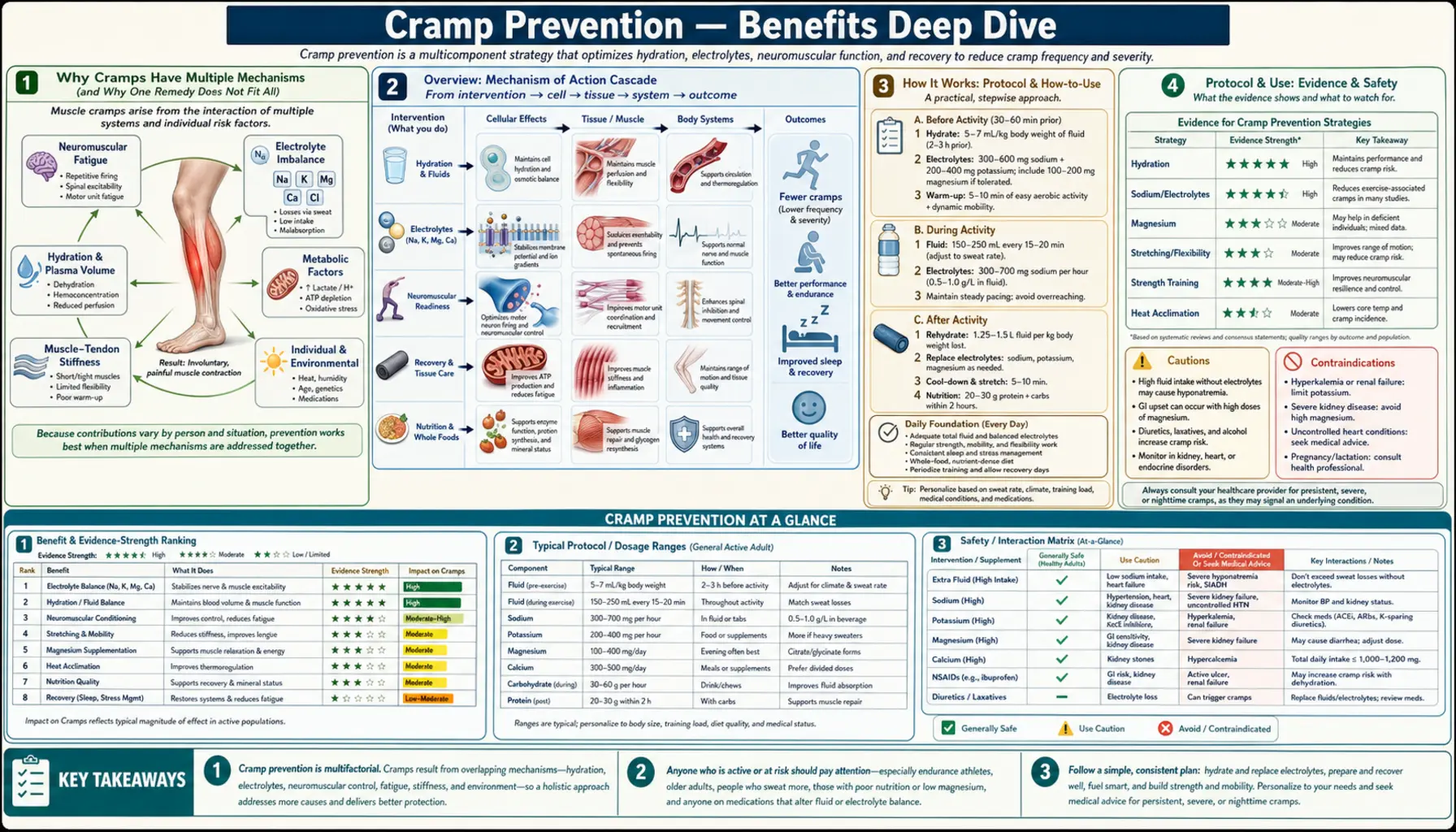
Muscle cramps look like a single problem — an involuntary, painful contraction that won't let go — but they emerge from at least four mechanistically distinct origins. Electrolyte gradient collapse (low intracellular magnesium and potassium, low extracellular sodium relative to total body water), neural over-excitation at the alpha-motoneuron pool, dehydration-driven compartment shifts, and structural shortening of chronically immobilized muscle fibers each respond to different interventions. The four deep-dive pages below map each mechanism to the strategy that addresses it, with the evidence base and practical regimen for each.
Deep-Dive Articles
Magnesium & Electrolytes
The Na/K/Mg/Ca ionic gradient that determines whether a muscle relaxes after contraction. Why magnesium glycinate, malate, and citrate all work but oxide does not. The 350-500 mg elemental magnesium nightly protocol for nocturnal leg cramps. Potassium from food vs. supplements. The serum-vs-cellular paradox that explains why a normal blood test does not rule out functional deficiency.
Pickle Juice & the Neural Reflex
Why a 1-ounce sip of pickle juice abolishes an exercise-induced cramp in 85 seconds — far too fast to be electrolyte absorption. The TRPV1/TRPA1 receptor reflex hypothesis, the Miller 2010 hyperventilation-cramp trial, the comparable effects of mustard, vinegar, and ginger, and how to use this knowledge in real-time cramp interruption.
Hydration Beyond Water
Why drinking plain water actually worsens cramp risk above ~3 liters/day. The sodium-volume relationship: total body water expands faster than electrolyte intake, diluting plasma sodium and producing exercise-associated hyponatremia. Properly built oral rehydration solution (WHO ORS), the LMNT/Nuun salt-stick math, and matching fluid choice to sweat rate.
Stretch & Reset Techniques
Passive stretching as the only intervention with consistent randomized-trial evidence for reducing nocturnal cramp frequency. The Daniel Hallegraeff 3-times-daily calf-stretch protocol, contract-relax (PNF) for acute cramp termination, foam rolling for chronic shortening, and why static post-workout stretching gets a partial pass despite the broader controversy.
Interactive Visualization Magnesium — the mineral that makes ATP work Bare ATP is useless and enzymes reject it. Watch magnesium clamp the phosphates and switch it on, plug the NMDA channel, and let a cramping muscle finally let go. Launch →
Table of Contents
- Deep-Dive Articles
- Why Cramps Have Multiple Mechanisms (and Why One Remedy Does Not Fit All)
- Research Papers: Magnesium & Electrolytes
- Research Papers: Pickle Juice & Neural Reflex
- Research Papers: Hydration & Sodium
- Research Papers: Stretching & Manual Therapy
- Research Papers: Cross-Cutting (Pathophysiology, Drugs, Older Adults)
- External Authoritative Resources
- Connections
- Featured Videos
Why Cramps Have Multiple Mechanisms (and Why One Remedy Does Not Fit All)
Muscle cramps come in at least four clinically distinct types, and the same person can experience more than one. Sorting which type is dominant in a given episode is the single most useful diagnostic step, because the four types respond to different interventions:
- Exercise-associated muscle cramps (EAMC) — the hard, focal cramps experienced by athletes during or shortly after sustained submaximal exercise. The current dominant model is not the older "dehydration / electrolyte loss" hypothesis but the altered neuromuscular control model proposed by Schwellnus and colleagues at the University of Cape Town. Under fatigue, alpha-motoneuron excitability rises while Golgi tendon organ inhibitory feedback falls, and a motor unit fires sustained involuntary discharges. Pickle juice, mustard, and other "neural reflex" interventions work for this type by triggering oropharyngeal TRPV1/TRPA1 receptors that descend-inhibit the motor pool.
- Nocturnal leg cramps (the geriatric cramp) — the cramp that wakes adults over 50 at 3 AM with a vise-grip in the gastrocnemius or arch. Affects ~30% of adults over 60 and ~50% of adults over 80. Mechanism is mixed: chronic calf shortening from sedentary posture, peripheral nerve hyperexcitability, and (in many) functional magnesium and potassium insufficiency. Responds best to consistent passive calf stretching plus nightly elemental magnesium. Pickle juice does nothing for this type.
- Heat / dehydration cramps — the "salt cramps" historically described in steel-mill and construction workers in hot environments. Driven by genuine sodium-volume depletion: the worker sweats out 2-4 liters of dilute saline per shift, replaces with plain water, and develops hyponatremic muscle cramps that resolve with oral salt and electrolyte solution. Properly built oral rehydration (sodium and glucose, not water alone) is the specific remedy.
- Drug-induced and disease-induced cramps — cramps caused by statins (myopathy, CoQ10 depletion), diuretics (potassium and magnesium loss), beta-agonists (catecholamine-driven hyperexcitability), nifedipine, donepezil, raloxifene, lithium, and others. Also cramps from electrolyte disorders, hypothyroidism, peripheral neuropathy, restless legs / Willis-Ekbom disease, ALS, and pregnancy. Treatment is to identify and (where possible) modify the underlying cause; symptomatic measures help but are secondary.
The diagnostic question to ask is therefore not "what stops a cramp" but "which kind of cramp is this." A 65-year-old with 3 AM calf cramps three nights per week does not need pickle juice; she needs a calf stretch protocol, 350 mg of elemental magnesium with dinner, and a review of her medication list. A 28-year-old marathoner with end-of-race quad cramps does not need magnesium; he needs the neural reflex remedy in his belt pocket and possibly a sodium top-up. The four deep-dive pages below treat each mechanism in clinical depth.
Research Papers: Magnesium & Electrolytes
- Garrison SR et al., Magnesium for skeletal muscle cramps (Cochrane review 2020) — PubMed 32956536
- Roffe C et al., Randomised, cross-over, placebo controlled trial of magnesium citrate in the treatment of chronic persistent leg cramps — PubMed 12011773
- Frusso R et al., Magnesium for treating nocturnal leg cramps (randomized trial) — Search PubMed
- Dahle LO et al., The effect of oral magnesium substitution on pregnancy-induced leg cramps Search PubMed
- Maor NR et al., Effect of magnesium oxide supplementation on nocturnal leg cramps (RCT) — Search PubMed
- Walker AF et al., Mg citrate found more bioavailable than other Mg preparations — PubMed 14596323
- Coudray C et al., Study of magnesium bioavailability from ten organic and inorganic Mg salts in Mg-depleted rats — PubMed 16548135
- Lindberg JS et al., Magnesium bioavailability from magnesium citrate and magnesium oxide — PubMed 2407766
- Costello R et al., Perspective: The case for an evidence-based reference interval for serum magnesium Search PubMed
- Schwalfenberg GK, Genuis SJ, The Importance of Magnesium in Clinical Healthcare — PubMed 29093983
Research Papers: Pickle Juice & Neural Reflex
- Miller KC et al., Reflex inhibition of electrically induced muscle cramps in hypohydrated humans (the pickle juice trial) — PubMed 19997012
- Miller KC, Plasma electrolyte and osmolality responses to pickle juice ingestion Search PubMed
- Behringer M et al., Effects of TRP channel agonist ingestion on exercise-induced muscle cramps Search PubMed
- Craighead DH et al., Ingestion of transient receptor potential channel agonists attenuates exercise-induced muscle cramps Search PubMed
- Schwellnus MP, Cause of exercise associated muscle cramps (EAMC) — altered neuromuscular control, dehydration or electrolyte depletion? Search PubMed
- Schwellnus MP et al., Serum electrolyte concentrations and hydration status are not associated with exercise associated muscle cramping Search PubMed
- Khan SI, Burne JA, Reflex inhibition of normal cramp following electrical stimulation of the muscle tendon Search PubMed
- Bertolasi L et al., The influence of muscular lengthening on cramps Search PubMed
- Short E et al., Pickle juice intervention for cramping (case observational) PubMed: Pickle juice clinical reports
- Westwood C et al., A reflex mechanism for the rapid termination of cramps PubMed: TRPV1 motoneuron reflex
Research Papers: Hydration & Sodium
- Hew-Butler T et al., Statement of the Third International Exercise-Associated Hyponatremia Consensus Development Conference — PubMed 26102445
- Almond CS et al., Hyponatremia among runners in the Boston Marathon (NEJM 2005) — PubMed 15829535
- Sawka MN et al., American College of Sports Medicine position stand: Exercise and fluid replacement — PubMed 17277604
- Maughan RJ, Shirreffs SM, Dehydration and rehydration in competitive sport PubMed: Maughan rehydration
- Noakes TD, Speedy DB, Time for the medical profession to acknowledge that overhydration causes problems Search PubMed
- Lau WY et al., Water intake after dehydration makes muscles more susceptible to cramp but electrolytes reverse that effect Search PubMed
- Eichner ER, The role of sodium in heat cramping Search PubMed
- Bergeron MF, Heat cramps: fluid and electrolyte challenges during tennis in the heat Search PubMed
- WHO/UNICEF, Oral rehydration salts (ORS) composition and reduced osmolarity formulation PubMed: WHO ORS
- Speedy DB et al., A randomized controlled trial of the effect of sodium supplementation on hyponatremia in ultradistance triathletes Search PubMed
Research Papers: Stretching & Manual Therapy
- Hallegraeff JM et al., Stretching before sleep reduces the frequency and severity of nocturnal leg cramps in older adults (RCT) — Search PubMed
- Daniel HW, Simple cure for nocturnal leg cramps (calf stretching) — Search PubMed
- Coppin RJ et al., Managing nocturnal leg cramps — calf-stretching exercises and cessation of quinine treatment Search PubMed
- Allen RE, Kirby KA, Nocturnal leg cramps (American Family Physician review) — Search PubMed
- Maisonneuve H et al., Prevalence of cramps in patients over the age of 60 in primary care PubMed: Cramp prevalence over 60
- Garrison SR et al., Nocturnal leg cramps and prescription use that precede them (PharmacoMetrics) — Search PubMed
- Page P et al., Current concepts in muscle stretching for exercise and rehabilitation — PubMed 22319684
- Sharman MJ et al., Proprioceptive neuromuscular facilitation stretching: mechanisms and clinical implications Search PubMed
- Cheatham SW et al., The effects of self-myofascial release using a foam roll or roller massager — PubMed 26618062
- Healy AF et al., Stretching before sleep for cramp frequency in middle aged adults PubMed: Stretch RCT mid-age
Research Papers: Cross-Cutting (Pathophysiology, Drugs, Older Adults)
- Miller KC et al., An evidence-based review of the pathophysiology, treatment, and prevention of exercise-associated muscle cramps Search PubMed
- Minetto MA et al., Origin and development of muscle cramps Search PubMed
- Katzberg HD et al., Assessment: symptomatic treatment for muscle cramps (an evidence-based review): report of the AAN therapeutics and technology assessment subcommittee Search PubMed
- Mandal AK, Hypokalemia and hyperkalemia Search PubMed
- Mansoor GA, Frishman WH, Comprehensive management of hypertension-induced muscle cramps with thiazide diuretics PubMed: Thiazides and cramps
- Mantle D et al., Coenzyme Q10 supplementation in statin myopathy PubMed: CoQ10 and statin myopathy
- El-Tawil S et al., Quinine for muscle cramps (Cochrane review) — PubMed 25842375
- FDA, Drug Safety Communication: New risk management plan and patient Medication Guide for Qualaquin (quinine sulfate) PubMed: FDA quinine warning
- Garrison SR et al., Exploring the cramp triggers in older adults PubMed: Garrison cramp triggers
- Hertz MI et al., Restless legs syndrome and Willis-Ekbom disease versus nocturnal leg cramps differential PubMed: RLS vs cramp differential
External Authoritative Resources
- Linus Pauling Institute — Magnesium Micronutrient Information Center — the most authoritative summary of magnesium biology
- NIH Office of Dietary Supplements — Magnesium Fact Sheet
- American Family Physician — Nocturnal Leg Cramps (Allen & Kirby 2012)
- ACSM Position Stand — Exercise and Fluid Replacement
- PubMed — All research on muscle cramp pathophysiology and prevention
Connections
- All Remedies
- Magnesium: The Mineral That Makes ATP Work — interactive animation
- Cramp Prevention (Main Page)
- Magnesium & Electrolytes for Cramps
- Pickle Juice & the Neural Reflex
- Hydration Beyond Water
- Stretch & Reset Techniques
- Magnesium
- Potassium
- Sodium
- Calcium
- Vitamin D3
- Restless Legs Syndrome
- Hyponatremia
- Bananas (Potassium)
- Pumpkin Seeds (Magnesium)