Colon Hydrotherapy
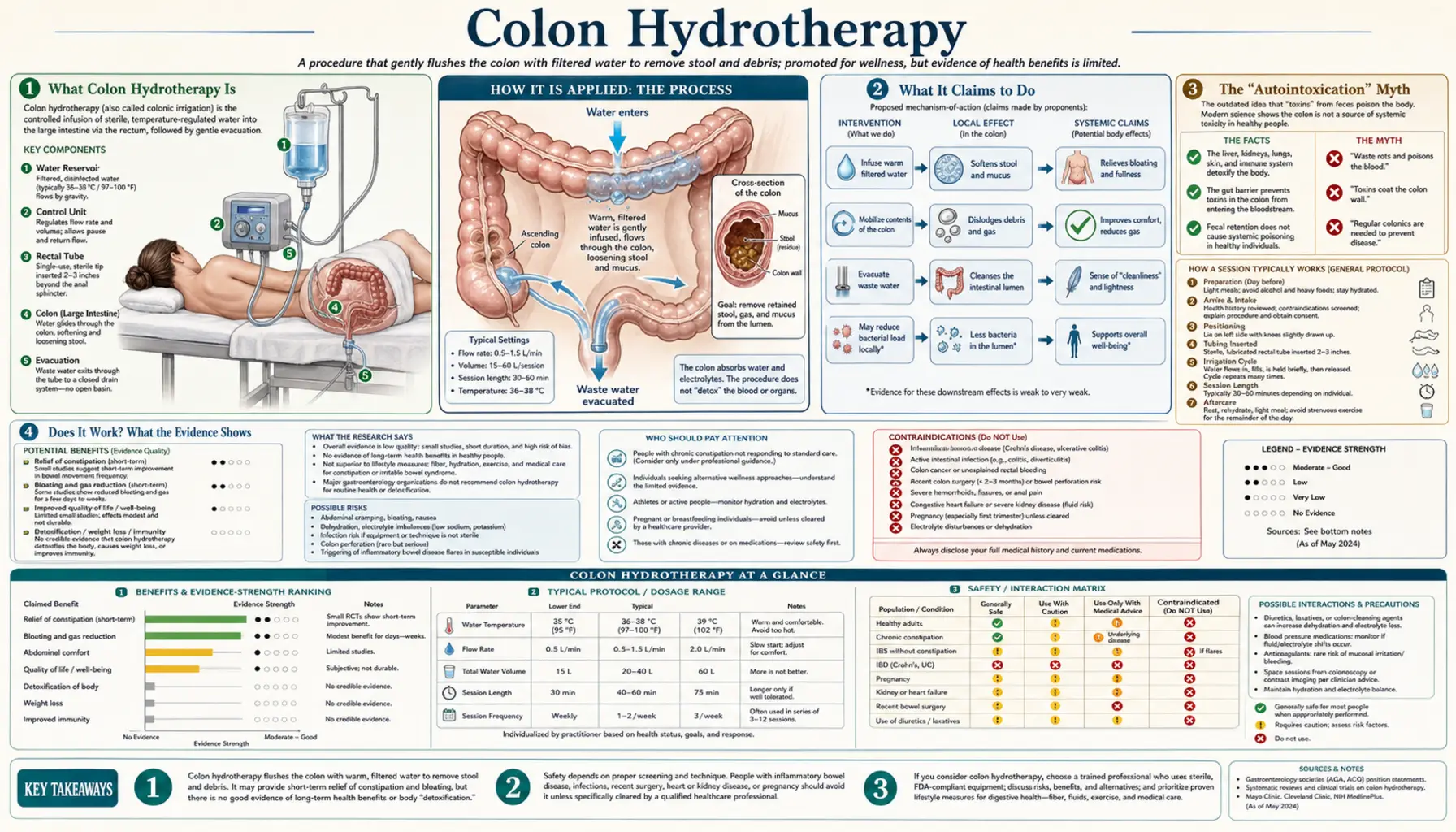
Colon hydrotherapy — also called colonic irrigation, a colonic, or colon cleansing — is a wellness practice in which large volumes of warm water are flushed into the colon through a tube inserted into the rectum, with the goal of "washing out" the large intestine. It is marketed for detoxification, more energy, weight loss, clearer skin, better digestion, and a general sense of feeling "cleaner." This page looks honestly at whether any of that holds up. The short version, up front: the idea that the colon stores rotting waste that slowly poisons you is a discredited theory that mainstream medicine set aside about a century ago, and there is no good evidence that wellness colonics improve health or produce lasting weight loss. More importantly, the procedure carries real and occasionally serious risks. We will walk through what the practice is, what it claims, what the science actually says, where the genuine dangers lie, who should never do it, and how to support your colon in ways that truly help. One important distinction we will keep clear throughout: medically supervised bowel preparation before a colonoscopy or surgery is a legitimate, different thing — not the same as a wellness "colonic."
Table of Contents
- What Colon Hydrotherapy Is
- What It Claims to Do
- The "Autointoxication" Myth
- Does It Work? What the Evidence Shows
- The Real Risks
- Who Should Absolutely Avoid It
- Colonics Are Not the Same as Medical Bowel Prep
- What Actually Keeps Your Colon Healthy
- The Honest Bottom Line
- Research Papers
- Connections
- Featured Videos
What Colon Hydrotherapy Is
In a typical session, you lie on a table while a practitioner inserts a small tube into your rectum. Warm, filtered water then flows into your colon, is held briefly, and drains back out, carrying loosened stool with it. This fill-and-release cycle is repeated many times over roughly 30 to 45 minutes, and a single session can move a large amount of water — often many litres in total — through the large intestine. Some setups use gravity-fed water; others use pressurized machines. Practitioners may add herbs, coffee, enzymes, probiotics, or oxygen to the water, though none of these additions has good evidence behind it.
Colon hydrotherapy is not the same as an enema you might buy at a pharmacy. A standard enema introduces a small amount of fluid into the lower rectum for short-term relief of constipation. Colonic irrigation is far more involved: much larger water volumes, higher up into the colon, delivered repeatedly by a machine or a trained operator, usually in a clinic or spa setting. It is generally sold as a package — a single session or a course of several — and is often bundled with "detox" programs, juice fasts, or weight-loss plans.
It is worth knowing that in most places this is an unregulated wellness service, not a medical treatment. The people who perform it are frequently not doctors or nurses, the equipment is not always held to hospital sterilization standards, and the claims made in marketing are not reviewed by any health authority. That regulatory gap matters a great deal once we get to the risks.
What It Claims to Do
The marketing around colon hydrotherapy is consistent and appealing. To be fair to it, here is what practitioners typically promise:
- Removing "trapped toxins" and "impacted fecal matter" — the central claim that old, hardened waste clings to the colon wall for years and needs to be flushed out.
- Boosting energy and immunity — the notion that a "clean" colon frees the body to work better and lifts fatigue.
- Weight loss — often promoted as an easy way to drop several pounds quickly, or to "jump-start" a diet.
- Clearer skin and a brighter complexion — the idea that skin problems reflect a "toxic" gut.
- Better digestion and relief from bloating, gas, or constipation.
- A vague but powerful sense of feeling "cleansed," lighter, and renewed.
These are attractive promises, and many people genuinely feel better for a day or two afterward. But feeling lighter after emptying your bowel is not the same as removing toxins or improving your health, and the sections below explain why the underlying story does not hold together.
The "Autointoxication" Myth
Almost every claim for colon cleansing rests on one old idea: autointoxication. This is the belief that undigested food and waste stagnate and putrefy in the colon, producing toxins that seep into the bloodstream and gradually poison the whole body, causing fatigue, headaches, bad skin, and disease. It sounds plausible. It is also wrong.
Autointoxication was a mainstream medical theory in the late 1800s and early 1900s — you can find it taken seriously in journals of the period, including a 1900 discussion in the Journal of the American Medical Association. As physiology advanced, the theory collapsed. Careful study showed that the colon does not store years of caked-on waste, that no mysterious poisons build up in a healthy bowel, and that the symptoms blamed on autointoxication have ordinary explanations. By the 1920s and 1930s, mainstream medicine had largely abandoned the idea. In other words, the rationale for colon cleansing was discredited roughly a century ago.
Here is what a healthy colon actually does. Its lining is not a passive pipe that collects sludge; it is a living, self-renewing surface that continuously moves waste along and out. Stool does not "stick" to it for years. The colon also does not need help "detoxifying" the body, because that is not its main job — and detoxification is not some pooled sludge waiting to be rinsed away. Your liver chemically neutralizes drugs, alcohol, hormones, and metabolic byproducts, and your kidneys filter your blood and excrete water-soluble waste in urine. These organs work around the clock, and in a healthy person they handle the job well without any flushing of the colon. Reviews written specifically to examine the autointoxication idea have called colonic irrigation a treatment built on a theory that physiology retired long ago.
The mental image of dark, ropey material coming out during a colonic is often shown as proof that toxins are being removed. In reality, what you see is normal stool, water, and mucus — and sometimes gel-like material formed by supplements or additives given as part of the "cleanse" itself. It is not decades-old impacted waste, and it is not toxins being drawn out of your tissues.
Does It Work? What the Evidence Shows
When researchers have actually looked for benefits, they have not found them. A systematic review of colonic cleansing for general health, published in the American Journal of Gastroenterology, concluded there is no convincing evidence that colon cleansing improves health or well-being, and it catalogued a list of adverse effects instead. A separate critical review in a family-medicine journal reached the same conclusion and was pointedly titled "The dangers of colon cleansing." The available literature on colon hydrotherapy is thin, largely low-quality, and does not support the wellness claims made for it.
What about weight loss? Any drop on the scale right after a colonic is water and stool, not fat. The intestine refills within a day or two of normal eating and drinking, and the weight returns. Colon hydrotherapy does not reduce body fat, and using it to "lose weight" mainly risks dehydration and electrolyte loss for a number that bounces right back.
What about the "I feel great afterward" reports? Those are real, but they are not evidence that toxins were removed. Emptying the bowel can genuinely feel relieving, especially if you were bloated or constipated; the ritual, the rest, and the expectation of feeling better all contribute; and people who pay for a wellness service and hope it works tend to report improvement (a placebo effect that is well documented across alternative therapies). None of that requires — or demonstrates — any cleansing of stored poison.
The Real Risks
This is the part that matters most, because colon hydrotherapy is not simply an expensive way to do nothing. It can cause harm, and some of that harm is serious. The risks are the strongest reason to skip it.
- Electrolyte disturbances and dehydration. Flushing the colon with large volumes of water can wash out sodium, potassium, and other electrolytes and shift your fluid balance. Low potassium and sodium can trigger weakness, confusion, dangerous heart-rhythm changes, and in severe cases can be life-threatening — a risk that is higher in older adults and in anyone with kidney or heart conditions.
- Bowel perforation. Rare but among the most dangerous outcomes, a tear in the rectum or colon wall from the tube or water pressure is a surgical emergency that can spill bowel contents into the abdomen and cause life-threatening infection. Cases of rectal perforation after colonic irrigation performed by alternative practitioners have been reported in the medical literature.
- Serious infections from equipment. When tubing and machines are not properly sterilized, they can transmit infection. Published case reports include deep abscesses and even Escherichia coli septic shock following colon hydrotherapy. Outbreaks of gut infection have historically been traced to contaminated colonic-irrigation equipment.
- Disruption of the gut microbiome. Repeated flushing does not selectively remove "bad" organisms; it washes out the beneficial bacteria your colon depends on for digestion, immune balance, and the production of helpful compounds. Disturbing this ecosystem can leave you worse off, not better.
- Cramping, bloating, nausea, and vomiting during and after the procedure are common and usually reflect the bowel being distended and irritated.
- Dependence and impaired natural function. Relying on flushes rather than fiber, fluids, and movement can, over time, work against the bowel's own rhythm.
These are not merely theoretical. They are documented in case reports and reviews, and they are exactly the kind of low-frequency, high-severity harms that make a procedure with no proven benefit a poor trade.
Who Should Absolutely Avoid It
For some people the risk is unacceptable under any circumstances. Do not undergo colon hydrotherapy if any of the following apply to you, and be aware that a wellness clinic may not screen for them:
- Any bowel disease — Crohn's disease, ulcerative colitis, diverticulitis, severe or symptomatic hemorrhoids, anal fissures, bowel tumors, or a history of bowel obstruction. Flushing an inflamed, fragile, or narrowed bowel sharply raises the risk of perforation and bleeding.
- Recent bowel or abdominal surgery — healing tissue and fresh surgical connections are especially vulnerable to pressure and tearing.
- Kidney disease — impaired kidneys cannot compensate for the fluid and electrolyte shifts a colonic can cause.
- Heart disease — electrolyte swings, especially in potassium, can provoke dangerous rhythm disturbances.
- Pregnancy — the procedure is not appropriate during pregnancy.
- Severe or uncontrolled hemorrhoids and anal fissures — insertion and pressure can worsen bleeding and pain.
Older adults, people taking diuretics or medications that affect kidney function or electrolytes, and anyone who is frail or dehydrated should also treat colon hydrotherapy as off-limits. If a symptom is troubling you — persistent constipation, blood in the stool, unexplained weight loss, ongoing abdominal pain — the right step is to see a doctor and find out what is actually going on, not to flush the colon.
Colonics Are Not the Same as Medical Bowel Prep
It is easy to blur two very different things, so let us keep them separate. When you empty your bowel before a colonoscopy or bowel surgery, you take a prescribed bowel preparation — usually an oral laxative solution — under medical guidance, for a clear clinical reason: the doctor needs the colon empty to see it or operate safely. That is legitimate, evidence-based medicine. It is short-term, purposeful, and supervised.
There is also a genuine medical procedure called transanal irrigation, in which people with neurogenic bowel dysfunction — for example, after a spinal-cord injury or with certain neurological conditions — irrigate the lower bowel on a schedule to manage constipation and incontinence. This is a real therapy with a supporting evidence base, taught and monitored by clinicians for specific patients. It exists to solve a defined problem, not to "detoxify" a healthy person.
Neither of these is what a spa "colonic" is selling. Wellness colon hydrotherapy is marketed to healthy people, for vague benefits, on the basis of a discredited theory, usually outside any medical setting. Recognizing the difference protects you from a common sleight of hand: pointing to legitimate medical uses of bowel irrigation to make wellness colonics sound medically endorsed. They are not.
What Actually Keeps Your Colon Healthy
The good news is that a healthy colon does not need flushing — it needs the ordinary conditions it evolved for. These are cheap, safe, and genuinely effective:
- Eat plenty of fiber. Vegetables, fruit, beans and lentils, whole grains, nuts, and seeds add bulk, feed beneficial gut bacteria, and keep stool moving comfortably. Fiber is the single most useful thing most people can do for regularity.
- Drink enough water. Adequate fluids keep stool soft and easy to pass, which does far more for "regularity" than any flush.
- Move your body. Regular physical activity — even daily walking — stimulates the natural muscular contractions that propel the bowel.
- Feed your microbiome, don't wash it away. A varied, plant-rich diet and fermented foods support the beneficial bacteria that colonics disrupt. Let that ecosystem thrive rather than repeatedly rinsing it out.
- Respond to your body's signals and don't routinely ignore the urge to go; consistency and enough fiber and fluid usually keep things working on their own.
- Get real symptoms checked. Ongoing constipation, bleeding, pain, or a change in bowel habits deserve a medical evaluation, not a self-prescribed cleanse.
For more on eating in ways that support digestion and the gut lining, see our pages on gut healing and whole foods, and for a candid look at "detox" programs in general, see Detox Protocols.
The Honest Bottom Line
Colon hydrotherapy is built on a theory that medicine discarded about a hundred years ago. It has no convincing evidence of benefit for general health, it does not remove "trapped toxins," and it does not cause meaningful lasting weight loss — any pound or two you drop is water and stool that comes right back. Against that empty benefit, it carries real risks: electrolyte disturbances, dehydration, disruption of your gut bacteria, infections from unsterilized equipment, and, rarely, bowel perforation and life-threatening infection. Certain people — those with bowel disease, recent surgery, hemorrhoids or fissures, kidney or heart disease, or who are pregnant — should never have it done at all.
Our honest recommendation is simple: do not use colon hydrotherapy for "detox" or wellness. Save your money, protect your gut, and give your colon what it genuinely wants — fiber, fluids, and movement. If something feels wrong with your digestion, see a doctor and get a real answer. Your liver, kidneys, and a well-fed colon are already doing the cleansing, quietly and continuously, and they do it better than any hose ever could.
Research Papers
- Acosta RD, Cash BD. Clinical effects of colonic cleansing for general health promotion: a systematic review. American Journal of Gastroenterology. 2009;104(11):2830–2836. — Search PubMed — found no convincing evidence of benefit and documented a range of adverse effects.
- Mishori R, Otubu A, Jones AA. The dangers of colon cleansing. Journal of Family Practice. 2011;60(8):454–457. — Search PubMed — a clinical review of colon-cleansing harms, from cramping and electrolyte loss to infection and perforation.
- Ernst E. Colonic irrigation and the theory of autointoxication: a triumph of ignorance over science. Journal of Clinical Gastroenterology. 1997;24(4):196–198. doi:10.1097/00004836-199706000-00002 — dismantles the discredited rationale behind colonic irrigation.
- Chen TSN, Chen PSY. Intestinal autointoxication. Journal of Clinical Gastroenterology. 1989;11(4):434–441. doi:10.1097/00004836-198908000-00017 — traces how the autointoxication theory rose and then fell out of medicine.
- Autointoxication. Journal of the American Medical Association. 1900;XXXIV(16):1007. doi:10.1001/jama.1900.02460160049008 — a period source showing the theory taken seriously before it was abandoned.
- Klein AV, Kiat H. Detox diets for toxin elimination and weight management: a critical review of the evidence. Journal of Human Nutrition and Dietetics. 2015;28(6):675–686. doi:10.1111/jhn.12286 — finds no sound evidence that "detox" regimens remove toxins or manage weight.
- Handley DV, Rieger NA, Rodda DJ. Rectal perforation from colonic irrigation administered by alternative practitioners. Medical Journal of Australia. 2004;181(10):575–576. PMID: 15540974 — case reports of a serious perforation complication.
- Ratnaraja N, Raymond N. Extensive abscesses following colonic hydrotherapy. Lancet Infectious Diseases. 2005;5(8):527. doi:10.1016/s1473-3099(05)70194-8 — a deep-infection complication linked to the procedure.
- Dore M, Gleeson T. Escherichia coli septic shock following colonic hydrotherapy. American Journal of Medicine. 2015;128(10):e31. doi:10.1016/j.amjmed.2015.05.032 — a life-threatening infection after a colonic.
- Kelvinson RC. Colonic hydrotherapy: a review of the available literature. Complementary Therapies in Medicine. 1995;3(2):88–92. doi:10.1016/s0965-2299(95)80007-7 — an early review noting the weakness of the supporting evidence.
- Christensen P, Krogh K. Transanal irrigation for disordered defecation: a systematic review. Scandinavian Journal of Gastroenterology. 2010;45(5):517–527. doi:10.3109/00365520903583855 — the legitimate medical use of bowel irrigation for neurogenic bowel, distinct from wellness colonics.
- Seow-Choen F. The physiology of colonic hydrotherapy. Colorectal Disease. 2009;11(7):686–688. doi:10.1111/j.1463-1318.2009.01837.x — a colorectal-surgery perspective on what irrigation does and does not achieve.
Connections
- All Remedies
- Detox Protocols
- Gut Healing
- Liver Detox
- Fasting
- Gerson Therapy
- Gastroenterology
- SIBO
- Diverticulitis
- Crohn's Disease
- Potassium
- Whole Foods & Fiber
- Hydrotherapy — the broader therapeutic use of water.