Hydrotherapy
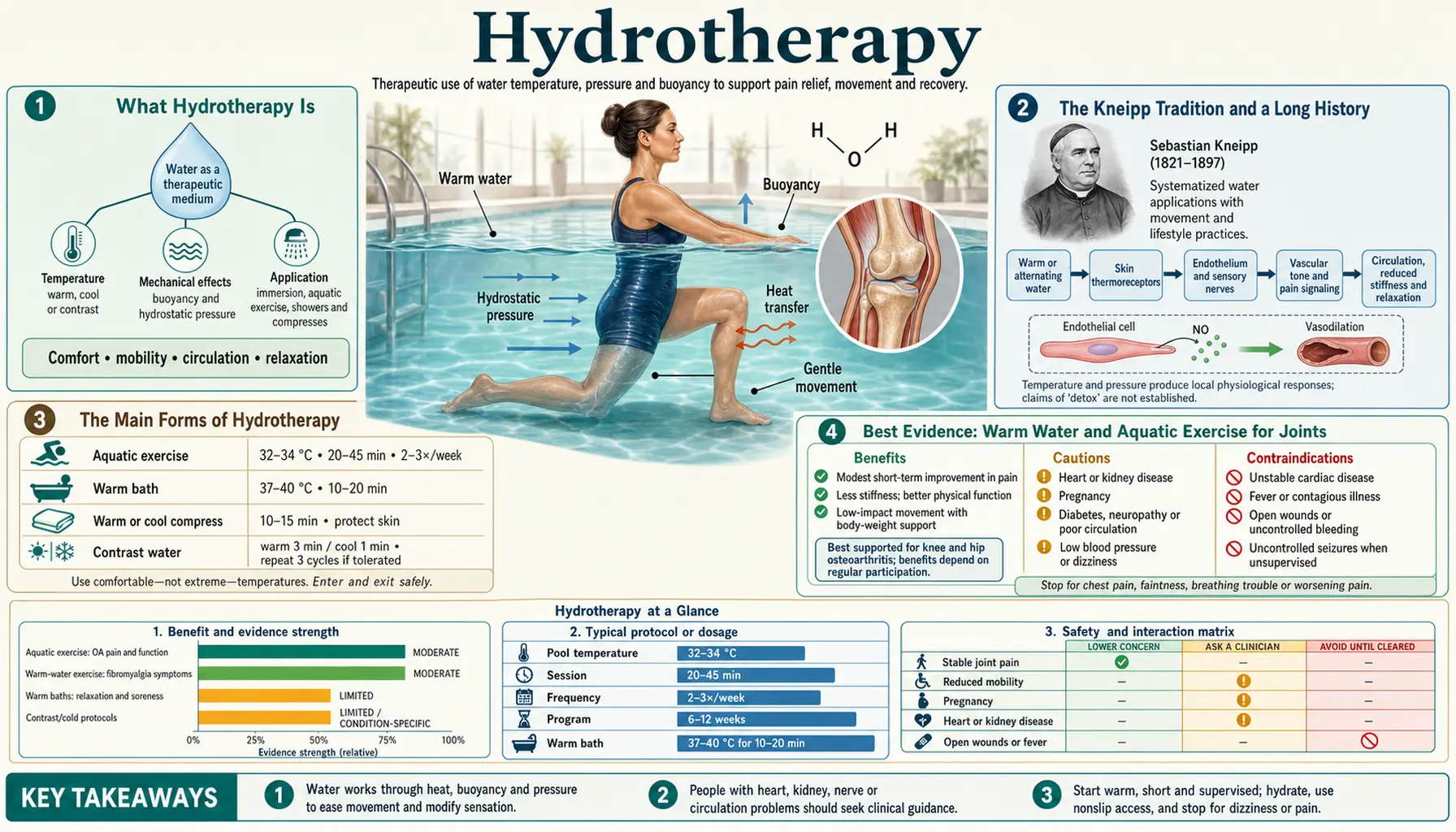
Hydrotherapy simply means using water — its warmth, its coldness, its buoyancy, and its pressure — to help the body feel better and move better. It is one of the oldest health practices there is: warm springs, cold plunges, steam rooms, and healing baths appear in almost every culture, and the formal European tradition traces back to the 19th-century priest Sebastian Kneipp, whose water cures still lend their name to spa towns today. Modern medicine uses the same basic idea in a more grounded way — warm pools for arthritis rehabilitation, ice baths for sore athletes, warm baths to unwind before sleep. This page walks through what hydrotherapy actually covers, its main forms, and, most importantly, an honest look at what the research does and does not support. The short version: for a few specific uses — exercising in warm water for stiff, painful joints above all — the evidence is genuinely reasonable; for others, such as recovery ice baths or spa "balneotherapy" for chronic pain, the benefits are real but modest and the studies are often low quality. We will keep the two apart, plainly, and steer clear of the "detox" and cure-all language that gets attached to water so often.
Table of Contents
- What Hydrotherapy Is
- The Kneipp Tradition and a Long History
- The Main Forms of Hydrotherapy
- Best Evidence: Warm Water and Aquatic Exercise for Joints
- Cold-Water Immersion and Contrast for Recovery
- Warm Baths for Relaxation and Sleep
- Balneotherapy and Chronic Pain: A Weaker Base
- How It May Work
- How to Do It: Practical Uses
- Safety: Who Should Be Cautious
- The Honest Bottom Line
- Research Papers
- Connections
- Featured Videos
What Hydrotherapy Is
Hydrotherapy — sometimes called aquatic therapy, water therapy, or balneotherapy when it involves mineral spa water — is the therapeutic use of water in any of its forms. What makes water so useful is that it works on the body through several channels at once:
- Temperature. Warm water relaxes muscles, eases stiffness, and soothes; cold water numbs pain and dampens the feeling of soreness. Water carries heat and cold to the skin far more efficiently than air does, which is why a warm bath feels warmer than a warm room and a cold plunge feels far colder than cold air.
- Buoyancy. In a pool you weigh a fraction of your land weight, so sore hips, knees, and backs are unloaded. This lets people move and exercise who would be in too much pain to do so on dry ground.
- Pressure and resistance. Water pushes gently and evenly on the body (hydrostatic pressure), which can help with swelling, and it provides smooth resistance in every direction for gentle strengthening.
Under that one umbrella sits a wide range of practices, from a hot bath at home to a supervised rehabilitation session in a heated therapy pool. Because "hydrotherapy" covers so much, the single most important habit when reading about it is to ask which form, for which purpose — the evidence for warm-water exercise in arthritis is a completely different question from the evidence for a cold plunge after a workout. This page keeps those questions separate.
The Kneipp Tradition and a Long History
People have sought out water for healing for thousands of years. Roman bath houses, Japanese onsen hot springs, Turkish steam baths, and the mineral spa towns of central Europe all built entire cultures around bathing. The most influential figure in formal Western hydrotherapy, though, was Sebastian Kneipp, a 19th-century Bavarian priest who, after reportedly recovering from tuberculosis with cold-water treatments, developed a whole system of water applications — cold and warm washes, wraps, walking barefoot through cold streams and dewy grass, and alternating hot-and-cold pours. His "Kneipp cure" became hugely popular, and the spa town of Bad Wörishofen still carries the tradition. Kneipp's approach also fed into the broader "nature cure" and naturopathic movements.
It is worth being honest about what that heritage does and does not prove. A long tradition tells us a practice is broadly safe, well-tolerated, and valued — that is real, and it is a good reason to study something seriously. It does not, on its own, confirm specific medical claims. Kneipp's more sweeping ideas about water curing serious disease do not hold up to modern testing. So the sensible stance is to honor the tradition as the origin of a genuinely useful comfort-and-rehabilitation tool, while judging each specific claim on the actual research — which is what the sections below do.
The Main Forms of Hydrotherapy
Hydrotherapy is really a family of methods. The common ones you will meet are:
- Warm-water immersion and balneotherapy. Soaking in warm water — a bath, a hot tub, or a mineral spring. When the water is naturally mineral-rich spa water, it is called balneotherapy. Used for relaxation, stiffness, and chronic musculoskeletal pain.
- Aquatic exercise (pool therapy). Exercising in a warm therapy pool — walking, gentle range-of-motion, and strengthening. This is the workhorse of clinical hydrotherapy and the form with the best evidence, especially for arthritis and rehabilitation after injury or surgery.
- Cold-water immersion. Cold baths, ice baths, and cold plunges, used mainly by athletes for post-exercise recovery, and increasingly as a general "cold therapy" habit. Covered in depth on the Cold Exposure page.
- Contrast (hot-and-cold) therapy. Deliberately alternating warm and cold water — contrast baths for the hands and feet, contrast showers, or the sauna-and-plunge ritual. Its own page covers the details: Contrast Therapy.
- Steam and heat baths. Steam rooms and the closely related dry sauna, used for relaxation and to loosen congestion. (Dry-heat sauna, which has the strongest research of the heat methods, has its own page.)
- Sitz baths. Sitting in a few inches of warm (sometimes alternating warm and cool) water to soothe the pelvic and anal area — a well-established comfort measure for hemorrhoids, anal fissures, and healing after childbirth or pelvic surgery.
- Compresses, wraps, and douches. Localized applications — a warm compress on a stiff neck, a cold compress on a fresh bump, or the alternating pours and wraps of the classic Kneipp cure.
Because these forms differ so much in intensity — a warm sitz bath and an ice plunge are worlds apart — both their benefits and their safety cautions differ too. Keep that in mind as we look at the evidence.
Best Evidence: Warm Water and Aquatic Exercise for Joints
If hydrotherapy has a strongest suit, this is it. Exercising in warm water is a well-studied, widely recommended treatment for osteoarthritis and other painful joint and muscle conditions, and here the research is genuinely reasonable rather than hopeful.
Cochrane reviews — among the most rigorous summaries in medicine — have looked at aquatic exercise for knee and hip osteoarthritis and found a small but real short-term benefit for pain, physical function, and quality of life compared with no exercise. The effects are modest, not miraculous, but they are consistent, and they come with an important practical advantage: the buoyancy of the water offloads the joints, so people who hurt too much to exercise on land can often move comfortably in a pool. That makes aquatic exercise a valuable on-ramp back to activity, and staying active is one of the best things a person with arthritis can do.
The picture is similar for other conditions. Aquatic exercise has reasonable evidence for lower-limb osteoarthritis generally, and it is a standard, safe option in rehabilitation after joint surgery, for chronic low back pain, and for people who need low-impact conditioning. For fibromyalgia, warm-water exercise has some of the better evidence in a field where good options are scarce: reviews suggest it can modestly improve pain, stiffness, and well-being. Across these uses the honest summary is the same — the benefits are small to moderate and much of it may come from the exercise itself as much as the water, but warm-water exercise is safe, tolerable, and a legitimate, evidence-backed tool. It is also worth noting what this is not: it is not passive. The benefit comes from moving in the water, not merely soaking in it.
Cold-Water Immersion and Contrast for Recovery
The other heavily studied use of hydrotherapy is athletic recovery — the ice baths and cold plunges athletes take after hard training, and the contrast (hot-and-cold) baths used for the same purpose. Here the honest verdict is: mixed and modest.
Cold-water immersion after exercise does appear to reduce the muscle soreness that shows up a day or two later (delayed-onset muscle soreness, or DOMS) compared with doing nothing. That is a repeated finding. But the quality of the evidence is low, the effect is modest, and cold immersion is usually no better — and sometimes no different — than simpler active recovery like a gentle warm-down. There is also an important wrinkle for people trying to build muscle: regularly icing after strength training may slightly blunt the muscle-building adaptations you are training for, so timing matters. Contrast water therapy tells a nearly identical story: modestly helpful for short-term soreness versus rest, roughly on par with plain cold immersion, with low-quality and inconsistent studies. Both are covered in more depth on the dedicated Cold Exposure and Contrast Therapy pages.
So if a cold plunge after a tough session leaves you feeling less sore and more refreshed the next day, that experience fits the evidence — just do not expect it to outperform the basics or to be essential. For many people the biggest honest benefit is that it feels invigorating and is a habit they enjoy.
Warm Baths for Relaxation and Sleep
One of the most reliable and pleasant uses of water needs no grand theory: a warm bath is relaxing, and that is worth something. Beyond the obvious comfort, there is decent evidence for one specific claim — that a warm bath or shower in the evening can help you fall asleep faster and sleep a little better.
The mechanism is neat and well understood. To fall asleep, your body's core temperature naturally needs to drop. A warm bath an hour or two before bed draws blood to the skin and hands and feet, and when you get out, that warmed blood releases heat to the air — so your core temperature actually falls faster afterward, nudging you toward sleep. A systematic review pooling many studies found that warm bathing in the evening (roughly 40–43°C, about one to two hours before bed) modestly improved sleep quality and shortened the time it took to fall asleep. It is a small, safe, low-cost habit with a plausible mechanism and supporting data — a rare and welcome combination. Add the everyday value of a warm soak for easing muscle tension and general stress, and warm-water immersion earns an honest place in a self-care routine, no exaggeration required.
Balneotherapy and Chronic Pain: A Weaker Base
Balneotherapy — bathing in warm mineral spa waters, often as part of a multi-week spa stay — is a huge tradition, especially in Europe and Japan, and it is genuinely soothing. It is also where the evidence gets shakiest, and it is important to say so plainly.
Reviews of balneotherapy for conditions like osteoarthritis, rheumatoid arthritis, fibromyalgia, and low back pain do report reductions in pain and improvements in well-being. But the same reviews are unusually blunt about a serious problem: the studies are mostly small, poorly designed, and at high risk of bias. It is very hard to run a fair, blinded trial of sitting in a warm mineral bath — you cannot give someone a convincing "fake" bath — so a large part of the apparent benefit may be relaxation, the placebo effect, the pleasant break of a spa holiday, and the natural ebb and flow of chronic pain, rather than anything special in the mineral water itself. The Cochrane reviewers on these topics consistently conclude that the evidence is insufficient to be confident of a real, specific effect.
That does not make balneotherapy worthless. A warm, relaxing, low-risk experience that people find comforting has value on its own terms, and for some chronic-pain sufferers a spa regimen is a pleasant and harmless adjunct. It simply means the honest claim is "a soothing, generally safe comfort measure with weak proof of any specific medical effect" — not the disease-treating power the marketing around famous spas often implies. And it is emphatically not a "detox": mineral water does not draw toxins out of the body, and no reputable evidence supports that idea.
How It May Work
Water's effects on the body are real and measurable, even where the clinical benefits are modest. Three mechanisms do most of the work:
- Temperature and blood flow. Warmth widens blood vessels near the skin (vasodilation), relaxes muscle, reduces stiffness, and feels soothing; it also raises tissue temperature enough to make gentle movement easier. Cold does the reverse — it constricts vessels, numbs nerve endings, and reduces the sensation of pain and soreness. These are well-documented physical effects, which is why heat and cold each have honest uses.
- Buoyancy and unloading. This is probably the single most useful mechanism in clinical hydrotherapy. Immersed to the chest, you bear only a small fraction of your body weight, so painful, arthritic, or recovering joints are unloaded. That mechanical relief is what lets people move, stretch, and strengthen in water when land exercise would be too painful — and the movement is where much of the benefit comes from.
- Relaxation and the nervous system. Warm immersion calms the body's stress response and promotes a relaxed, parasympathetic state; the evening core-temperature drop after a warm bath aids sleep. Cold immersion does the opposite in a way many find bracing — a jolt of alertness and mood lift. These autonomic and psychological effects are a genuine part of why hydrotherapy feels good.
What the mechanisms do not support is the popular idea that water flushes "toxins" from the body or that soaking dissolves illness. The kidneys and liver handle detoxification; a bath does not. Keeping the real mechanisms in view helps set fair expectations: water can soothe, unload, and relax — meaningfully — but it is not a purifier or a cure.
How to Do It: Practical Uses
None of the common home uses require special equipment. A few practical recipes, offered as sensible conventions rather than proven prescriptions:
A relaxing (and sleep-friendly) warm bath
- Use comfortably warm water — around 40–43°C / 104–109°F, warm but never scalding. Test it with your hand or elbow first.
- Soak for about 10 to 20 minutes.
- For sleep, time it about one to two hours before bed — that gives your core temperature time to fall afterward, which is the part that helps you drift off. A warm shower works too if you do not have a tub.
A contrast shower for a morning lift
- Shower warm as usual, then finish by alternating: about 20–60 seconds of cold, then back to warm, repeated 2 to 4 times.
- Ease into the cold rather than shocking yourself; keep it strong but tolerable, never painful.
- Many people finish on cold for the alertness boost, but there is no rule — do what feels right. (See the Contrast Therapy page for more.)
A sitz bath for soothing the pelvic area
- A sitz bath is simply sitting in a few inches of warm water so it covers the hips and buttocks — use the tub, or an inexpensive basin that fits over a toilet.
- Use plain warm water; soak for 10 to 15 minutes, two or three times a day as needed.
- It is a well-established comfort measure for hemorrhoids, anal fissures, and healing after childbirth or pelvic surgery — soothing and low-risk. Keep the water clean and pat the area dry gently afterward.
Warm-water exercise for stiff, painful joints
- The most evidence-backed use. A warm therapy pool (many community pools and clinics offer arthritis or aquatic classes) lets you walk, stretch, and do gentle strengthening with the joints unloaded.
- If you have arthritis or are recovering from an injury or surgery, ask a physician or physical therapist about a supervised aquatic program — this is where hydrotherapy delivers the most.
General common sense applies to all of it: stay hydrated, do not overheat, get out if you feel dizzy or unwell, and build up gradually rather than diving into extremes.
Safety: Who Should Be Cautious
For most people, gentle hydrotherapy is very safe. But the extremes — very hot water and very cold water — carry real risks, and some people should take particular care. Please do not skip this part.
Heart and circulation problems
Both very hot and very cold water stress the cardiovascular system. Hot immersion widens vessels and can drop blood pressure enough to cause fainting; a plunge into cold water triggers a sharp jump in heart rate and blood pressure. In a healthy person these are tolerated, but for people with high blood pressure, heart disease, a history of heart attack or stroke, or an irregular heartbeat, the extremes can be dangerous. If that describes you, keep to gentle, moderate-temperature water and ask your doctor before hot tubs, saunas, or cold plunges.
Pregnancy
During pregnancy, avoid hot tubs, very hot baths, and saunas — raising core body temperature (hyperthermia), especially in early pregnancy, is a genuine concern. Warm (not hot) baths and gentle aquatic exercise are generally fine and often helpful, but check with your prenatal provider.
Reduced sensation: burn and frostbite risk
If you cannot feel temperature normally, you cannot protect yourself from it. People with peripheral neuropathy (nerve damage that dulls sensation, common in diabetes) or any condition that reduces feeling in the hands and feet must be very careful with hot and cold water — they may not notice water hot enough to scald or cold enough to injure. Always test water temperature with a part of the body that has normal sensation, or a thermometer.
Cold-sensitive conditions
People with Raynaud's, where cold triggers painful spasms in the fingers and toes, should generally avoid cold immersion or keep it very mild.
Children, older adults, and alcohol
Young children and frail older adults regulate temperature less well and are more vulnerable to both overheating and chilling, so they need closer supervision and gentler temperatures. Never mix intense heat or cold water with alcohol — it impairs temperature regulation and judgment and sharply raises the risk of fainting and drowning. And never do cold-water immersion or a hot-and-cold session alone if you are new to it or have any health concern; the cold-shock response can be hazardous. When in doubt, keep the water moderate, keep sessions short, and check with a clinician.
The Honest Bottom Line
Hydrotherapy is a pleasant, low-cost, and generally safe way to use water — its warmth, cold, buoyancy, and pressure — to feel and move better. Its strongest, most legitimate use is warm-water (aquatic) exercise for arthritis and rehabilitation, where the buoyancy lets painful joints move and the evidence for modest, real benefit is reasonable. A warm evening bath has decent support for improving sleep and is genuinely relaxing. Cold-water immersion and contrast baths can modestly ease post-exercise soreness, but the evidence is mixed and they are no better than simpler recovery methods. Spa-style balneotherapy for chronic pain is soothing but rests on weak, low-quality studies, and much of its benefit is likely relaxation and placebo rather than anything special in the water.
The sensible way to think about hydrotherapy is as a comforting, useful adjunct — especially valuable for getting stiff, sore bodies moving — not as a cure-all and certainly not a "detox." Enjoy it for what it honestly is. Respect the real cautions around very hot and very cold water if you have heart, circulation, nerve, or pregnancy concerns, keep alcohol out of it, and favor moderate temperatures. Within those limits, water is one of the oldest and gentlest tools we have for easing the body.
This page is general health information, not medical advice. Talk with a qualified healthcare professional before starting hydrotherapy if you have any heart, circulation, nerve, or pregnancy-related condition.
Research Papers
- Bartels EM, Juhl CB, Christensen R, et al. Aquatic exercise for the treatment of knee and hip osteoarthritis. Cochrane Database Syst Rev. 2016;3:CD005523. doi:10.1002/14651858.CD005523.pub3 — Aquatic exercise produced small, short-term improvements in pain, function, and quality of life for knee and hip osteoarthritis.
- Waller B, Ogonowska-Słodownik A, Vitor M, et al. Effect of therapeutic aquatic exercise on symptoms and function associated with lower limb osteoarthritis: systematic review with meta-analysis. Phys Ther. 2014;94(10):1383–1395. doi:10.2522/ptj.20130417 — Water-based exercise had a small beneficial effect on pain and physical function in lower-limb osteoarthritis.
- Bidonde J, Busch AJ, Webber SC, et al. Aquatic exercise training for fibromyalgia. Cochrane Database Syst Rev. 2014;(10):CD011336. doi:10.1002/14651858.CD011336 — Warm-water exercise modestly improved wellbeing, symptoms, and fitness in fibromyalgia, with low-to-moderate quality evidence.
- Naumann J, Sadaghiani C. Therapeutic benefit of balneotherapy and hydrotherapy in the management of fibromyalgia syndrome: a qualitative systematic review and meta-analysis of randomized controlled trials. Arthritis Res Ther. 2014;16(4):R141. doi:10.1186/ar4603 — Found reductions in fibromyalgia pain but cautioned that most included trials were of low methodological quality.
- Verhagen AP, Bierma-Zeinstra SM, Boers M, et al. Balneotherapy for osteoarthritis. Cochrane Database Syst Rev. 2007;(4):CD006864. doi:10.1002/14651858.CD006864 — Reported possible benefits for osteoarthritis but concluded the evidence was too weak and the trials too flawed to be confident.
- Verhagen AP, Bierma-Zeinstra SM, Boers M, et al. Balneotherapy (or spa therapy) for rheumatoid arthritis. Cochrane Database Syst Rev. 2015;CD000518. doi:10.1002/14651858.CD000518.pub2 — Found no convincing, high-quality evidence that spa therapy improves rheumatoid arthritis beyond its soothing effects.
- Pittler MH, Karagülle MZ, Karagülle M, Ernst E. Spa therapy and balneotherapy for treating low back pain: meta-analysis of randomized trials. Rheumatology (Oxford). 2006;45(7):880–884. doi:10.1093/rheumatology/kel018 — Suggested spa/balneotherapy may reduce low back pain, while noting the small number and modest quality of trials.
- Haghayegh S, Khoshnevis S, Smolensky MH, Diller KR, Castriotta RJ. Before-bedtime passive body heating by warm shower or bath to improve sleep: a systematic review and meta-analysis. Sleep Med Rev. 2019;46:124–135. doi:10.1016/j.smrv.2019.04.008 — A warm bath or shower 1–2 hours before bed improved sleep quality and shortened the time taken to fall asleep.
- Bleakley C, McDonough S, Gardner E, Baxter GD, Hopkins JT, Davison GW. Cold-water immersion (cryotherapy) for preventing and treating muscle soreness after exercise. Cochrane Database Syst Rev. 2012;(2):CD008262. doi:10.1002/14651858.CD008262.pub2 — Cold-water immersion reduced post-exercise soreness versus rest, but the evidence was low quality and no better than active recovery.
- Higgins TR, Greene DA, Baker MK. Effects of cold water immersion and contrast water therapy for recovery from team sport: a systematic review and meta-analysis. J Strength Cond Res. 2017;31(5):1443–1460. doi:10.1519/JSC.0000000000001559 — Both cold and contrast water therapy aided recovery versus doing nothing, but benefits were modest and studies varied widely.
- Bieuzen F, Bleakley CM, Costello JT. Contrast water therapy and exercise induced muscle damage: a systematic review and meta-analysis. PLoS One. 2013;8(4):e62356. doi:10.1371/journal.pone.0062356 — Contrast water therapy eased soreness better than passive rest but was no better than other active recovery methods; evidence quality was low.
- Mooventhan A, Nivethitha L. Scientific evidence-based effects of hydrotherapy on various systems of the body. N Am J Med Sci. 2014;6(5):199–209. doi:10.4103/1947-2714.132935 — A broad overview of how warm and cold water applications affect circulation, muscles, and the nervous system.
Connections
- All Remedies
- Cold Exposure
- Contrast Therapy
- Sauna (heat therapy)
- Exercise
- Physical Therapy
- Massage
- Float Therapy
- Osteoarthritis
- Rheumatoid Arthritis
- Fibromyalgia
- Peripheral Neuropathy
- Raynaud's Disease
- High Blood Pressure (Hypertension)
- Salt in Socks — the salted-sock remedy, and the warm footbath that is doing the actual work
- Colon Hydrotherapy — colonic irrigation, its claims and its documented risks.