Yoshinori Ohsumi: Autophagy, Fasting, and the Cell's Recycling Program
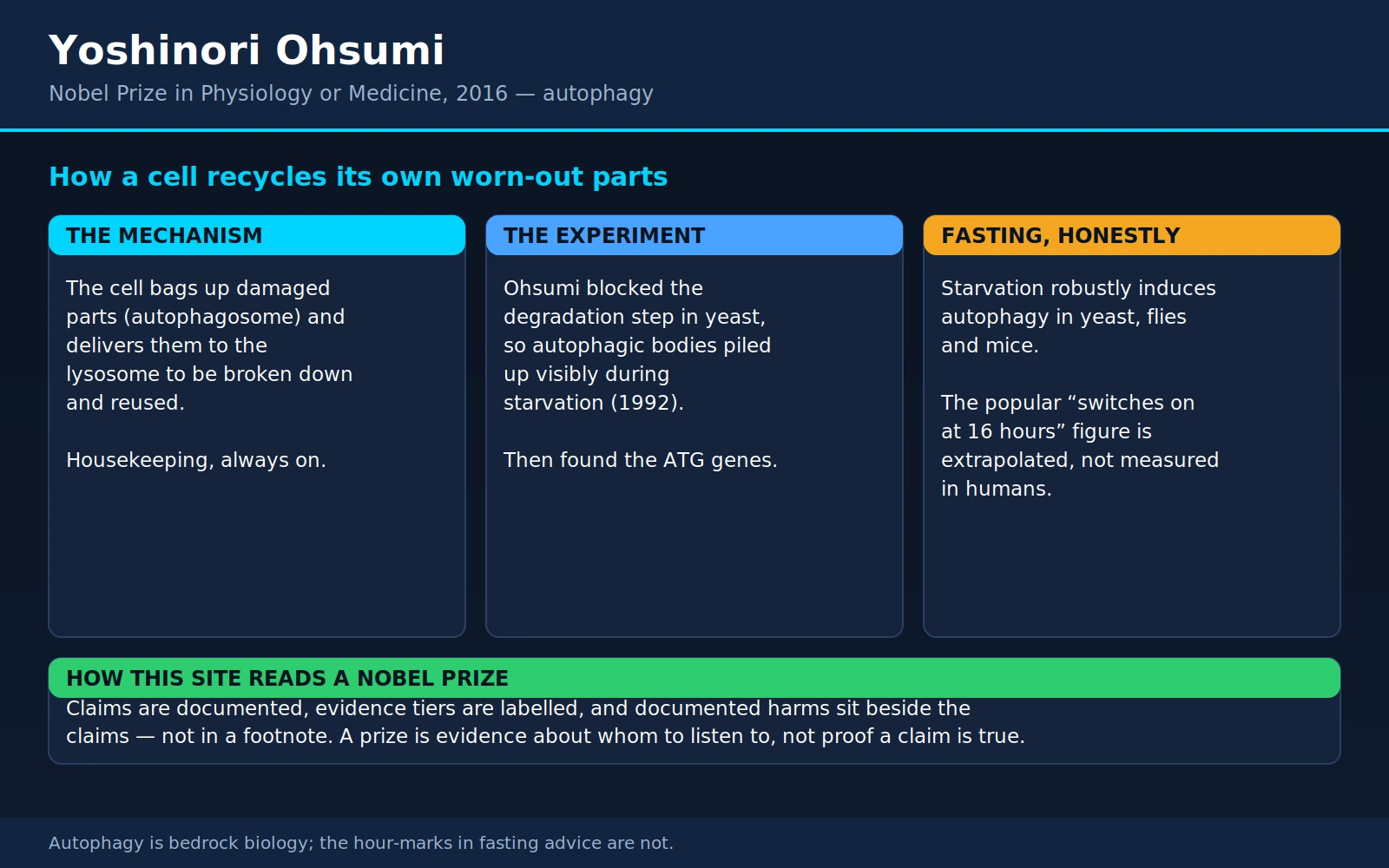
Table of Contents
- Who He Is
- What Autophagy Is, in Plain Language
- The Yeast Experiment That Cracked It
- The Machinery: How a Cell Builds a Garbage Bag
- Why Your Body Needs It
- Autophagy and Fasting: What's Real, What's Extrapolated
- Where Mainstream Medicine Agrees
- Where the Claims Outrun the Evidence
- What Ohsumi's Work Means for You Today
- The Basic-Science Lesson
- Key Research Papers
- Connections
- Featured Videos
1. Who He Is
Yoshinori Ohsumi (大隅良典, born February 9, 1945, in Fukuoka, Japan) is the cell biologist who worked out how a cell recycles itself — the process called autophagy, literally "self-eating." In 2016 he received the Nobel Prize in Physiology or Medicine, and he received it alone. Unshared prizes have become rare in modern science; the Medicine committee had not given one since 2010. When the Nobel Assembly declines to split a prize three ways, it is saying something specific: this field exists because of one person's decision to look where nobody else was looking.
Nothing about his early career predicted it. Ohsumi was born in the last months of World War II, the fourth son of an engineering professor at Kyushu University, and grew up in postwar Japan when food itself was scarce. He studied at the University of Tokyo, finished a PhD in 1974, and struggled to find a position. A postdoctoral stint at Rockefeller University in New York went badly — he was assigned projects far from his training and later described it as one of the hardest stretches of his life. What rescued him was yeast: ordinary baker's yeast, the workhorse of cell biology, which he began studying at Rockefeller and never put down.
Back in Tokyo he spent more than a decade in junior positions — the unglamorous, low-status years of a researcher who has not yet made his name. He did not get a laboratory of his own until 1988, when he was 43 years old. It was a small lab on the Komaba campus of the University of Tokyo, and he deliberately picked a subject with no crowd in it: the yeast vacuole, a large baggy compartment that most biologists at the time dismissed as the cell's trash can. "I have no competitive spirit," he told interviewers after the prize — he found it more enjoyable to do something nobody else was doing. The trash can turned out to contain one of the fundamental programs of life.
In 1996 he moved to the National Institute for Basic Biology in Okazaki, and in 2009 to the Tokyo Institute of Technology (today part of Institute of Science Tokyo), where he was an honorary professor when the Nobel call came on October 3, 2016. The citation read: "for his discoveries of mechanisms for autophagy." Behind that dry phrase sits the reason the word "autophagy" now appears on supplement bottles, fasting apps, and podcast titles — and this page will sort out which of those uses his science actually supports.
2. What Autophagy Is, in Plain Language
The word comes from Greek: auto (self) + phagein (to eat). It was coined in 1963 by the Belgian scientist Christian de Duve, who had discovered the lysosome — the cell's acid-filled digestion chamber — and could see under the electron microscope that cells sometimes digested pieces of themselves. What nobody knew for the next thirty years was how, or why, or what controlled it. That is what Ohsumi supplied.
Here is the process in one picture. Imagine a building with a permanent renovation crew. Day and night, the crew walks the floors looking for worn-out furniture, broken appliances, and clutter. When it finds some, it does three things:
- Bags it up. The cell builds a double-walled membrane sack — the autophagosome — around the worn-out parts: damaged mitochondria, clumped and misfolded proteins, surplus machinery the cell no longer needs.
- Delivers it to the recycling center. The autophagosome travels to the lysosome (in yeast, the vacuole) and fuses with it, dumping the cargo into a bath of digestive enzymes.
- Reuses the parts. The cargo is broken down to amino acids, fatty acids, and sugars, which are shipped back out and used to build new proteins and generate energy. Nothing is wasted.
Two settings matter. There is baseline housekeeping — a constant low hum of quality control that runs whether or not you have eaten, quietly culling defective components before they cause trouble. And there is starvation-triggered recycling — when nutrients run short, the cell sharply ramps autophagy up, cannibalizing its less essential parts to keep the essential ones running. A cell that cannot do this starves quickly; a cell that can do it survives famine by, in effect, eating its own furniture to heat the house — and rebuilding the furniture when supplies return.
Every cell in your body runs this program. It is not something you switch on by buying a product. What diet, fasting, and exercise can do is turn the dial — and how far the dial turns in humans, on what schedule, is exactly where honest science and marketing part ways. We will get there in Section 6.
3. The Yeast Experiment That Cracked It
By the late 1980s, autophagy had been photographed in mammalian cells for decades but remained a scientific dead end — observable, unexplainable. Nobody could find the genes, because nobody had a system where the process could be seen easily and mutated freely. Ohsumi's insight was that yeast, his unfashionable specialty, might be that system — if only he could make the invisible visible. A yeast cell's vacuole is one of the few structures large enough to see with an ordinary light microscope, no electron microscopy required.
The problem: if autophagy worked in yeast, the vacuole's enzymes would destroy the incoming cargo instantly. You would never see it. Ohsumi's trick was beautifully simple — break the garbage disposal, then watch the garbage pile up. He used mutant yeast lacking the vacuole's main digestive proteinases and starved them. Within about half an hour, small vesicles began accumulating inside the vacuole — and kept accumulating for hours until the vacuole was visibly packed with them, churning under the microscope. These were autophagic bodies: bags of cytoplasm delivered for recycling that could no longer be digested. Starvation was triggering wholesale self-cannibalization, and now anyone could watch it happen through a student microscope. He published this in the Journal of Cell Biology in 1992 — the paper that established yeast does autophagy at all.
Then came the masterstroke, and it followed within a year. Because the piled-up autophagic bodies were visible, their absence was visible too — which meant Ohsumi could hunt for mutants in which starvation produced no pile. He and graduate student Miki Tsukada exposed yeast to a mutation-causing chemical and screened thousands of colonies for exactly that failure. The first autophagy-defective mutant they caught was named apg1. The full screen, published in FEBS Letters in 1993, identified 15 genes essential for starvation-induced autophagy — the genes now known worldwide as the ATG genes (the field unified the naming in 2003).
Pause on the timeline. In 1988, autophagy had exactly zero known genes and one man in a small lab deciding to study a compartment his colleagues considered a garbage dump. By 1993 — from one man's microscope to roughly fifteen genes in two years of published work — the entire genetic parts list of a fundamental cellular program was on the table. Nearly every ATG gene has a human counterpart, which is why a discovery made in baker's yeast now shapes research on Parkinson's disease, cancer, immunity, and aging.
4. The Machinery: How a Cell Builds a Garbage Bag
Finding the genes was the beginning; Ohsumi's lab spent the next decade working out what the proteins they encode actually do. You do not need the full wiring diagram, but three pieces are worth knowing, because they explain terms you will meet anywhere autophagy is discussed.
The starter switch: Atg1
Atg1 — the very first gene from the 1993 screen — encodes a kinase, an enzyme that flips other proteins on and off. It sits at the head of the whole program. When nutrients are plentiful, the cell's master nutrient sensor (a protein complex called TOR — "target of rapamycin") keeps Atg1 suppressed: food is coming in, no need to recycle. When nutrients fall, TOR releases the brake, Atg1 fires, and the construction of autophagosomes begins. Humans have a direct counterpart called ULK1 doing the same job in your cells right now. This is the molecular reason fasting and autophagy are connected at all: the pathway is literally wired to the nutrient supply.
The bag-building crews: two tag-and-attach systems
Building the autophagosome membrane requires two protein systems that work like tagging crews, chemically attaching proteins to each other and to the growing membrane the way ubiquitin (the cell's famous "destroy this" tag) gets attached to proteins. One crew links a protein called Atg12 to a partner, Atg5. The other attaches Atg8 directly to a fat molecule in the membrane itself, so the protein becomes part of the expanding bag. Ohsumi's lab published the first of these systems in Nature in 1998 — a genuinely surprising discovery, because nothing like a ubiquitin-style reaction had ever been seen building a membrane.
The marker everyone measures: LC3
The human version of Atg8 is called LC3. Because LC3 physically embeds in autophagosome membranes, a cell that is making lots of autophagosomes accumulates lots of membrane-bound LC3 — which scientists can see by tagging LC3 with a fluorescent protein or detecting its lipid-attached form on a lab gel. That single fact made LC3 the standard readout of autophagy: when a paper (or a supplement ad) says something "increased autophagy," the underlying experiment was very often "LC3 went up in cells or in mice." Keep that in mind — it matters later, because LC3 is easy to measure in a dish and very hard to measure in a living human being.
5. Why Your Body Needs It
Autophagy is not a wellness bonus feature; it is load-bearing biology. Mice engineered to lack core ATG genes die at or shortly after birth. Here is what the program does for you, organ by organ and job by job.
- Culling damaged mitochondria (mitophagy). Mitochondria — the cell's power plants — wear out, and a damaged one is worse than useless: it leaks reactive molecules that injure everything around it. A dedicated branch of autophagy called mitophagy identifies failing mitochondria and recycles them. Two proteins that flag damaged mitochondria for pickup, PINK1 and Parkin, are the products of genes mutated in inherited forms of Parkinson's disease — among the strongest links between autophagy failure and a human disease.
- Clearing misfolded proteins. Proteins that fold wrongly tend to clump, and clumped proteins are the signature of neurodegenerative disease — the aggregates of Alzheimer's, Parkinson's, and Huntington's. Neurons live for decades and cannot dilute their junk by dividing, which makes them uniquely dependent on autophagy as garbage service. In mice, deleting autophagy genes only in neurons produces protein clumps and neurodegeneration without any other insult.
- Eating invaders (xenophagy). Some bacteria — Salmonella, Mycobacterium tuberculosis, Group A Streptococcus — survive by getting inside your cells, out of reach of antibodies. Autophagy is one of the cell's answers: the same membrane-bag machinery can wrap an intracellular microbe and deliver it to the lysosome to be destroyed. This is called xenophagy — "eating the foreign."
- Fueling you through famine. The starvation response that Ohsumi watched in yeast runs in mammals too, and its most dramatic hour is your first one: in newborn mice, autophagy surges immediately after birth, when the placental supply line is cut and nursing has not yet begun. The newborn literally self-recycles across the gap. Throughout life, the same program buffers every stretch between meals.
- Cancer — where autophagy plays both sides. Early on, autophagy protects against cancer: it removes damaged mitochondria and reduces the cellular stress and DNA damage that start tumors, and one core autophagy gene (Beclin 1) is missing one of its two copies in a large fraction of human breast and ovarian cancers. But once a tumor exists, the same program helps the tumor survive — cancer cells in a poorly supplied, oxygen-starved tumor core use autophagy to endure conditions that should kill them, and to weather chemotherapy. Suppressor early, survival tool late. Any claim about autophagy and cancer that mentions only one of these two faces is telling you half the story — hold that thought for Section 8.
6. Autophagy and Fasting: What's Real, What's Extrapolated
This is the section most readers came for, so let's do it properly — what is established, what is extrapolated, and how to tell which claim is which.
What is solidly established
Starvation is the classic, most reliable trigger of autophagy, full stop. That is true in yeast (Ohsumi's original experiment), in flies, and in mice — where researchers can watch it directly using mice engineered with glowing fluorescent LC3: fast the mouse, and autophagosomes light up in liver, muscle, heart, and pancreas within hours. The wiring makes sense of it: the nutrient sensor TOR sits directly on top of the Atg1/ULK1 starter switch, so falling nutrients mechanically release the brake. Insulin and amino acids (especially from protein) push the same lever from the food side — eating suppresses autophagy; not eating permits it. None of this is controversial. It is also established that autophagy is real and essential in humans — our machinery is the same, and people born with defects in it have serious congenital diseases.
Where the honest gap is
Here is the part the fasting internet skips: the popular hour-marks are not established in humans. You have likely heard that "autophagy switches on at 16 hours" or "peaks at 24–72 hours." Those numbers are not measurements from people. Human autophagy is genuinely hard to measure — there is no blood test for it, the LC3 methods that work in cells and mice require tissue biopsies plus assumptions about flux, and the handful of small human studies (mostly in blood cells after multi-day fasts) use methods too inconsistent to hang a schedule on. The hour-marks are extrapolations from rodents — and a fasting mouse is not a small fasting human: a mouse fasted 24 hours loses a substantial share of its body weight and is in genuine metabolic crisis; a human at 24 hours is merely hungry. Even within mice the picture is uneven — in the standard fluorescent-reporter experiments, fasting lit up liver and muscle but notably not the brain. So "fasting induces autophagy" is well grounded; "your autophagy switches on at hour 16" is a number nobody has measured.
Notice also what human fasting trials actually measure. The randomized trials behind intermittent fasting's real credibility — summarized in a major 2019 New England Journal of Medicine review — report body weight, insulin sensitivity, blood lipids, blood pressure, and inflammatory markers. Those benefits are real and worth having. But they are not autophagy measurements, and attributing them to autophagy specifically (rather than to eating less, losing weight, or the metabolic switch to fat-burning and ketones) goes beyond the data. See our full Fasting page for what those trials found protocol by protocol.
Other levers, honestly labeled
- Exercise — strong animal evidence, plausible in you. A landmark 2012 Nature study showed exercise briskly induces autophagy in mouse muscle and heart, and mice with exercise-resistant autophagy machinery lost part of exercise's metabolic benefit. Human muscle-biopsy studies show autophagy markers shifting after exercise too. If you want a daily autophagy lever with independently proven health outcomes, exercise is the best-documented one you own.
- Spermidine — promising, unproven for outcomes. This natural polyamine (rich in wheat germ, soybeans/natto, mushrooms, aged cheese) extended lifespan in yeast, flies, and worms in a 2009 Nature Cell Biology paper, and the effect required autophagy. Higher dietary spermidine tracks with better outcomes in observational human studies — which cannot prove cause. Small human supplement trials aimed at memory in older adults have had mixed results, and the largest randomized trial found no significant benefit. Tier: strong mechanism, suggestive epidemiology, no proven human outcome. See Spermidine.
- Resveratrol — mostly preclinical. It induces autophagy in cells and animal models, but human bioavailability is poor and clinical trials on hard outcomes have disappointed. Tier: laboratory evidence, not clinical. See Resveratrol.
- Caloric restriction and ketogenic states. Sustained caloric restriction is the oldest autophagy inducer in the animal literature, and low-insulin states like the ketogenic diet plausibly permit more of it — again with the human measurement caveat applying throughout.
7. Where Mainstream Medicine Agrees
It is worth being clear that autophagy is not "alternative" science with a Nobel attached. It is bedrock, textbook cell biology — among the most-cited topics in the modern biomedical literature, with tens of thousands of papers building directly on Ohsumi's genes. The unshared 2016 prize was the establishment's own verdict on how central the field had become.
Mainstream medicine also accepts, with solid genetic evidence, that autophagy failure contributes to human disease:
- Parkinson's disease. Mutations in the mitophagy genes PINK1 and PRKN (Parkin) cause inherited early-onset Parkinson's — damaged mitochondria that cannot be flagged for recycling accumulate in exactly the neurons that die.
- Crohn's disease. One of the most replicated genetic risk factors for Crohn's disease is a common variant of the core autophagy gene ATG16L1, which impairs the gut's ability to handle its resident bacteria — a direct line from Ohsumi's parts list to a common human illness.
- Rare congenital disorders. Children born with mutations in autophagy genes (Vici syndrome, and a form of childhood neurodegeneration caused by WDR45 mutations) have severe multi-system disease — the human proof that this machinery is not optional.
- Drug development. Pharmaceutical research actively targets the pathway in both directions — activators for neurodegeneration, and inhibitors (such as hydroxychloroquine) tested against cancer, which tells you how seriously the two-faced cancer biology of Section 5 is taken.
8. Where the Claims Outrun the Evidence
Because "autophagy" is real Nobel-grade science, the word gets borrowed to sell things the science does not support. Here are the three biggest claims, each stated in its strongest form first, then graded.
- "Fasting cures cancer by making autophagy eat the tumor." Strongest version: in mice, fasting and fasting-mimicking diets have slowed some tumors and improved chemotherapy tolerance, and small human trials suggest fasting around chemo is feasible and may ease side effects. But the leap to "cure" fails twice. The human trials are small and measure tolerability, not survival. And the biology points the wrong way: in an established tumor, autophagy is often the tumor's survival tool — which is why oncologists run trials of autophagy inhibitors as cancer therapy, the exact opposite of the wellness claim. Nobody with a cancer diagnosis should replace treatment with fasting. Tier: animal evidence plus early feasibility trials; no proven human anticancer effect; mechanism cuts both ways.
- "This supplement activates your autophagy." Strongest version: spermidine and some other compounds genuinely induce autophagy in cells and animals, in careful published work. The unbridgeable problem for marketing: since there is no validated way to measure autophagy in a living customer, no product can honestly claim it raised yours — and none of the popular "autophagy activator" blends has shown a health outcome in a randomized human trial. Tier: mechanism real in the lab; the customer-facing claim is unmeasurable and unproven.
- "Autophagy switches on at hour 16, peaks at hour 48." Strongest version: the direction is right — longer without food means less insulin and amino-acid signaling, which permits more autophagy. But as Section 6 laid out, the specific human timeline has never been measured; the numbers are rodent extrapolations repeated until they sounded like data. Choose an eating window because its proven effects (weight, insulin, appetite control) suit your life — not to hit an autophagy o'clock that exists only in mice. Tier: direction supported; the clock numbers are unestablished.
9. What Ohsumi's Work Means for You Today
Strip away the marketing and something genuinely useful is left — arguably more useful, because it is true.
Your recycling program is already running. You do not need to purchase autophagy; you have been doing it since the hour you were born. The practical question is only whether your habits give the housekeeping crew room to work — and the two levers with real human evidence behind their broader benefits are ones you own already: time between meals and exercise. If you finish dinner earlier, skip the late-night snack, and move most days, you are pulling the same TOR-and-ULK1 lever that Ohsumi mapped — while collecting the weight, insulin, and cardiovascular benefits that human trials have actually documented. If a structured approach appeals to you, our Fasting page walks through the protocols with the same honesty about evidence, and dietary patterns like the Mediterranean diet supply spermidine and polyphenols from food rather than capsules.
You do not need to white-knuckle long fasts to "get" autophagy. Given that nobody can measure the human autophagy clock, suffering through a 72-hour fast specifically for autophagy is paying a certain cost for an unverifiable reward. Eat in a way you can sustain, keep the proven benefits, and let the recycling take care of itself. One genuine caution, stated once: extended fasting is a real physiological stress, and people with diabetes, anyone on glucose-lowering or other dose-sensitive medications, pregnant or breastfeeding women, and anyone underweight or with a history of disordered eating should involve their clinician before attempting it.
Protect the machinery itself. The autophagy story is one more reason the boring advice works: chronic overfeeding keeps insulin high and the recycling brake on; sleep is when neurons do much of their cleanup; exercise triggers the program directly. Ohsumi did not discover a hack. He discovered why the un-hacks work.
10. The Basic-Science Lesson
There is a final thing Ohsumi's story teaches, and he spent his post-Nobel years saying it to anyone who would listen. Nobody funded a quiet man's curiosity about yeast vacuoles expecting medicine. By every modern metric — deliverables, near-term application, competitive positioning — his 1988 research program was unfundable. It produced the parts list now driving drug development for Parkinson's, cancer, and rare childhood disease.
Ohsumi has been blunt that today's science funding, in Japan and elsewhere, increasingly demands "useful" results on short timelines, and that he doubts his own career would be possible under such rules. He put a share of his prize money into a foundation supporting young basic scientists. The 2016 Nobel is, among other things, an argument: that the deepest practical payoffs come from letting careful people study what is true rather than what is billable — and that the cell's garbage can deserved a decade of one man's undivided attention. Every fasting app citing "autophagy" today is, whether it knows it or not, quoting a man who succeeded because he refused to compete.
11. Key Research Papers
- Takeshige K, Baba M, Tsuboi S, Noda T, Ohsumi Y. Autophagy in yeast demonstrated with proteinase-deficient mutants and conditions for its induction. J Cell Biol 1992;119(2):301-11
- Tsukada M, Ohsumi Y. Isolation and characterization of autophagy-defective mutants of Saccharomyces cerevisiae. FEBS Lett 1993;333(1-2):169-74
- Mizushima N, Noda T, Yoshimori T, et al. A protein conjugation system essential for autophagy. Nature 1998;395(6700):395-8
- Kabeya Y, Mizushima N, Ueno T, et al. LC3, a mammalian homologue of yeast Apg8p, is localized in autophagosome membranes after processing. EMBO J 2000;19(21):5720-8
- Levine B, Kroemer G. Autophagy in the pathogenesis of disease. Cell 2008;132(1):27-42
- Eisenberg T, Knauer H, Schauer A, et al. Induction of autophagy by spermidine promotes longevity. Nat Cell Biol 2009;11(11):1305-14
- Mizushima N, Komatsu M. Autophagy: renovation of cells and tissues. Cell 2011;147(4):728-41
- He C, Bassik MC, Moresi V, et al. Exercise-induced BCL2-regulated autophagy is required for muscle glucose homeostasis. Nature 2012;481(7382):511-5
- Ohsumi Y. Historical landmarks of autophagy research. Cell Res 2014;24(1):9-23
- Pickles S, Vigié P, Youle RJ. Mitophagy and quality control mechanisms in mitochondrial maintenance. Curr Biol 2018;28(4):R170-R185
- de Cabo R, Mattson MP. Effects of intermittent fasting on health, aging, and disease. N Engl J Med 2019;381(26):2541-2551
Live PubMed Searches
- Autophagy mechanisms
- Intermittent fasting autophagy human
- Mitophagy neurodegeneration
- Spermidine autophagy
- Exercise-induced autophagy
12. Connections
- All Notable Doctors
- Nobel Prize in Medicine — the laureates wing this page belongs to
- Otto Warburg — the other Nobel name every metabolism debate borrows; cancer-cell energetics
- Élie Metchnikoff — the first "cells eating things" Nobel: phagocytosis, autophagy's outward-facing cousin
- Frederick Banting — insulin, the hormone whose fall releases autophagy's brake
- Fasting — the protocols, the trials, and what they actually measured
- Caloric Restriction — the oldest autophagy inducer in the longevity literature
- Exercise — the best-documented daily autophagy lever you own
- Ketogenic Diet — the low-insulin state that permits recycling
- Mediterranean Diet — spermidine and polyphenols from food, not capsules
- Spermidine — the most credible dietary autophagy inducer, honestly tiered
- Resveratrol — lab-bench autophagy inducer with a bioavailability problem
- Parkinson's Disease — where failed mitophagy meets a human illness
- Crohn's Disease — the ATG16L1 gene variant link
- Claude, de Duve & Palade (Nobel 1974) — de Duve discovered the lysosome and named autophagy — the compartment your genes deliver cargo to