William Campbell: The Drug Hunter Who Turned a Soil Microbe into Ivermectin
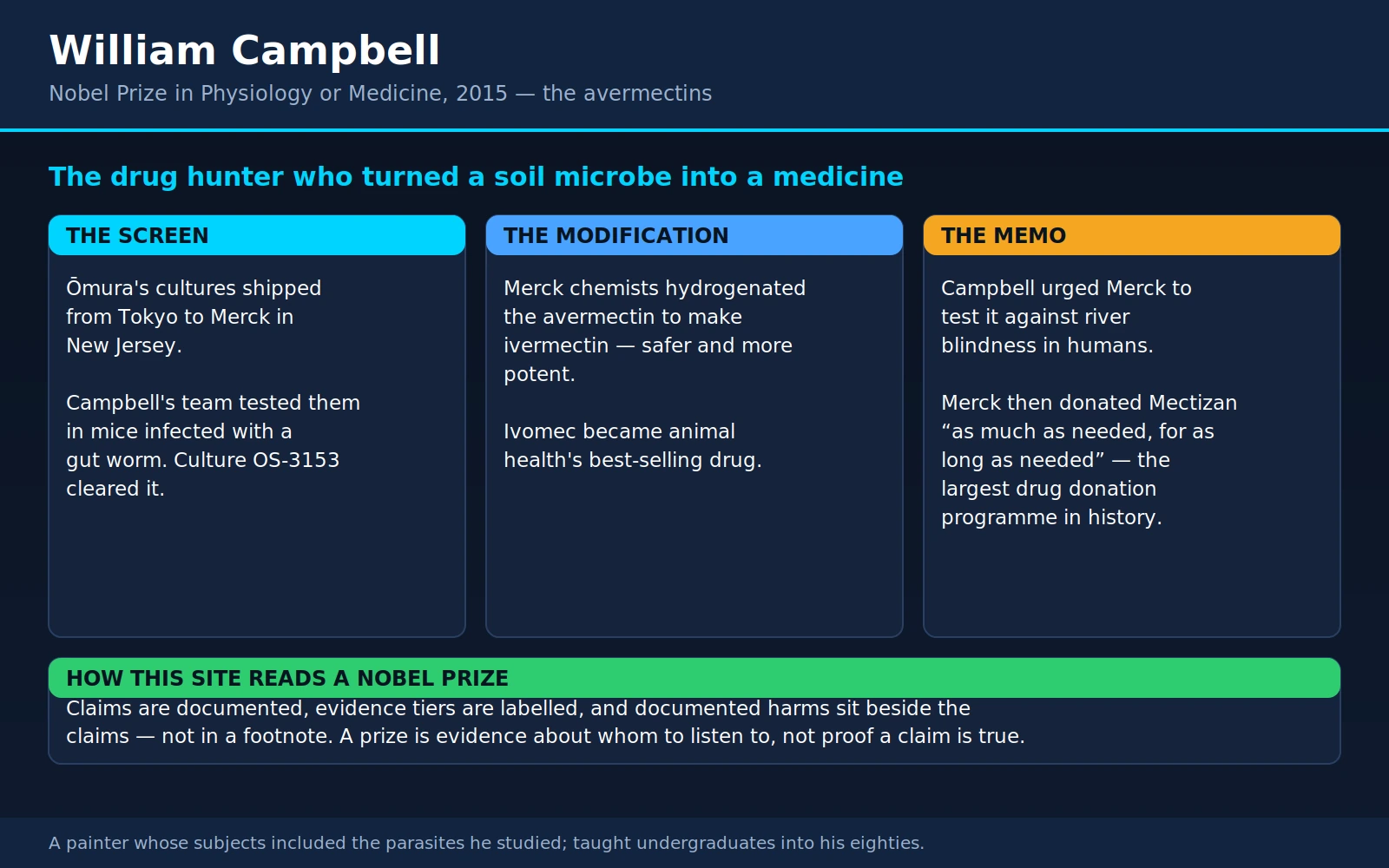
Table of Contents
- Who He Was
- The Merck Parasitology Program
- A Package from Japan: The Mouse Assay
- Making Ivermectin
- The Leap to River Blindness
- The Nobel and After
- What His Method Teaches
- Where Mainstream Medicine Agrees — and What Gets Misattributed
- Key Research Papers
- Connections
- Featured Videos
1. Who He Was
William Cecil Campbell (born June 28, 1930) is an Irish-American parasitologist who spent thirty-three years hunting worm-killing drugs for Merck — and found the one that changed global health. He was born in Ramelton, County Donegal, a small town on an estuary in the far northwest of Ireland, one of the children of a farm-supplies merchant. Growing up around a business that served farmers, he absorbed early something most people never think about: that parasitic worms quietly drain the health of livestock everywhere, and that the medicines of the day could do remarkably little about it.
He studied zoology at Trinity College Dublin, graduating with first-class honours in 1952, and a Fulbright scholarship carried him to the University of Wisconsin–Madison, where he earned his PhD in 1957 with work on the giant liver fluke, a flatworm parasite of sheep, cattle, and deer. Liver fluke was a fitting start — it was a scourge of the kind of farm animals his father's customers raised, and it fixed his career on a question he never abandoned: how do you kill a parasite living inside an animal without killing the animal?
Straight out of Wisconsin he joined the Merck Institute for Therapeutic Research in Rahway, New Jersey, and stayed from 1957 until his retirement in 1990. Drug-industry parasitology was an unglamorous corner of science — his own specialty, the pork roundworm Trichinella, was about as far from fashionable research as it was possible to get — but it turned out to be the corner from which one of the most consequential medicines of the twentieth century emerged. After retiring, Campbell did not stop: he became a research fellow emeritus at Drew University in Madison, New Jersey, where for decades he guided undergraduates through real laboratory research on parasites.
Two personal details are worth knowing, because they say something about the man. First, he is a painter, and among his favorite subjects are the parasites themselves — he has spoken of finding genuine beauty in organisms most people find repulsive, and he has painted them the way other artists paint landscapes. Second, he is relentlessly modest. From the day the Nobel Prize was announced, Campbell insisted that ivermectin was the work of a large team of fermentation scientists, chemists, parasitologists, and clinicians, with himself as one contributor among many. The record supports both halves of that: it was a team effort, and his contributions — running the assay that caught the discovery, and pushing the drug toward human use — were decisive.
2. The Merck Parasitology Program
To understand what Campbell did, it helps to understand the machine he worked inside. Merck in the 1950s and 60s ran one of the world's most serious anthelmintic programs — the word simply means "worm-expelling drug," from the Greek helminthos, worm. The economic logic was blunt: parasitic worms cost farmers enormous losses in dead and stunted animals, so a genuinely effective dewormer would sell. The medical logic rode along quietly behind it, because many of the worms that torment livestock have close cousins that infect people.
Campbell's first major mark came with thiabendazole, the breakthrough dewormer Merck introduced in the early 1960s. He was part of the team that developed it, and thiabendazole mattered for two reasons. It was the first of the benzimidazole family — a class of worm drugs still in use today (albendazole and mebendazole, the standard treatments for childhood worm infections worldwide, are its descendants). And Campbell personally pushed it across the species line: drawing on his own research specialty, he championed thiabendazole as a treatment for trichinosis, the disease people catch from Trichinella larvae in undercooked pork. He would later edit the definitive scientific book on Trichinella. The pattern of his whole career shows up here in miniature — a veterinary drug, carefully studied, walked over to human medicine by someone who understood the parasites on both sides of the fence.
What did "screening" actually look like? Nothing like elegance. A candidate compound — synthesized by chemists, or brewed by a microbe — was given to animals deliberately infected with parasites, and afterward you counted worms. Did the treated animals clear their infection? Did they stay healthy while doing it? Thousands of candidates failed for every one that showed promise, and almost every "promise" then died on the second question: plenty of chemicals kill worms, but most of them injure the host too. Campbell has been frank that this kind of science runs on patience, careful technique, and a tolerance for years of negative results. By the early 1970s, Merck's screening had one more thing going for it — a well-oiled infected-mouse assay, cheap and fast, that could test hundreds of samples a year. It was about to catch the biggest fish in the history of the field.
3. A Package from Japan: The Mouse Assay
The other half of this story begins nine thousand miles away. Satoshi Ōmura, a microbiologist at Tokyo's Kitasato Institute, was a virtuoso at isolating Streptomyces — soil bacteria with an extraordinary talent for making natural chemicals, the same group that had already given the world streptomycin and most other antibiotics. In 1973, Ōmura struck a research agreement with Merck: his laboratory would collect Japanese soil samples, grow the bacteria out of them, and ship the most promising cultures to Rahway, where Merck would test them against targets its labs cared about — parasitic worms very much included. Royalties would flow back to Kitasato if anything succeeded. The full Japanese side of the story is told on our Ivermectin Discovery page.
Campbell's group put Ōmura's cultures through Merck's infected-mouse screen, and the design is worth savoring for its simplicity. Mice were infected with Heligmosomoides polygyrus, an intestinal roundworm of rodents. Fermentation broth from each bacterial culture was blended into the mouse chow. The mice ate medicated food for several days; then you checked whether the worms were gone and whether the mouse was thriving. One living assay, in other words, asked both make-or-break questions at once — does it kill the worm? and does it spare the host? — which is exactly what a test tube of worms cannot tell you.
In 1975 the screen flagged a culture that stood apart from everything the program had ever seen. Its broth wiped out the intestinal worms at dilutions that left the mice visibly untroubled. The culture carried the label OS-3153, and its paperwork traced it to soil that Ōmura's team had collected near a golf course at Kawana, close to the city of Ito on Japan's Shizuoka coast. The organism was a previously unknown species, eventually named Streptomyces avermitilis — loosely, "the Streptomyces capable of separating worms" from their hosts. Despite decades of soil-sampling since, on every continent, an avermectin-producing strain has never again been found in nature. The entire global supply of this drug class descends from that one Japanese soil sample.
Merck's fermentation scientists and natural-products chemists then pulled the broth apart to find what was doing the killing. The answer, published in 1979 by Burg, Egerton, Campbell, and colleagues, was a family of eight closely related molecules named the avermectins — large, ornate ring-shaped structures (macrocyclic lactones, in the chemists' language) unlike any worm drug known. Their potency was astonishing: where existing dewormers worked in doses of milligrams per kilogram, avermectins worked in micrograms — roughly a thousandfold less. The team had not merely found a new drug; they had found a new class, sitting at a potency level nobody knew existed.
4. Making Ivermectin
A potent natural molecule is a starting point, not a medicine. Of the eight natural avermectins, the B1 pair was the strongest, and Merck's medicinal chemists began tuning it. The winning modification turned out to be almost humble: using a carefully chosen catalyst, they added two hydrogen atoms across one specific double bond in the molecule's ring — the bond between carbon atoms 22 and 23. The product, 22,23-dihydroavermectin B1, kept essentially all of the killing power while gaining a wider safety margin and a smoother profile across parasite species. That molecule is ivermectin. Campbell, characteristically, titled his Nobel lecture "Ivermectin: A Reflection on Simplicity" — a molecule from dirt, improved by two hydrogen atoms, that went on to conquer a disease.
Why is it so lethal to parasites and so gentle to their hosts? Ivermectin clamps open a kind of nerve-signal channel — the glutamate-gated chloride channel — found in the nerve and muscle cells of roundworms and many insects and mites, but not in mammals. With the channel stuck open, the parasite's muscles go slack; it stops feeding, stops holding its place in the body, and is paralyzed and cleared. Mammals run their nerves on different hardware, and the closest equivalent channels sit behind the blood–brain barrier, where a pump protein actively keeps ivermectin out. The drug's limits come from the same biology, and they are worth stating honestly: tapeworms and flukes lack the target channel, so ivermectin does nothing against them, and it kills the microscopic larval stages of some worms far better than the armored adults.
Commercially, the results rewrote the industry. Launched in 1981 under the name Ivomec, ivermectin dosed cattle at a level so low it seemed like a misprint — and killed roundworms, lungworms, grubs, lice, and mange mites in one shot, inside and outside the animal at once. Within a few years it became the best-selling animal-health product on Earth, a position it held for two decades. And one descendant of that franchise sits in millions of American kitchen drawers: the monthly heartworm preventive that dog owners give as a chewable tablet is a tiny dose of ivermectin, protecting the dog by killing heartworm larvae before they can mature. A pet owner who has never heard of William Campbell has probably handed his discovery to a Labrador.
5. The Leap to River Blindness
Here is where Campbell made the decision the Nobel committee ultimately honored. Among the mountains of veterinary data, he fixed on one finding: ivermectin killed the immature stages — the microfilariae — of Onchocerca cervicalis, a threadlike parasite of horses. That worm has a far more terrible cousin. Onchocerca volvulus infects only humans, and it causes onchocerciasis — river blindness. In 1977 Campbell put the case in writing to Merck's research leadership: the horse result was a signal, and ivermectin deserved to be tested against the human disease. It was a commercially absurd suggestion — a drug for people who could not possibly pay for it — and Merck's leadership, to its lasting credit, said yes.
River blindness is worth pausing on, because the scale of the misery explains everything that followed. The parasite spreads through the bites of blackflies that breed in fast-flowing rivers — hence the name. Adult worms settle in nodules under the skin and live for a decade or more, and the females release millions of microfilariae over their lifetimes. It is these swarming offspring that do the damage as they migrate: through the skin, where they cause itching so unbearable that it is documented to have driven sufferers to suicide, and into the eyes, where the inflammation around dying larvae scars the tissues and extinguishes sight. In the worst-hit river valleys of West Africa, blindness was not a misfortune but an expectation — whole villages abandoned their most fertile land to escape the flies. At the disease's peak, on the order of 18 million people were infected and hundreds of thousands were blind.
Medicine's existing tools were almost worse than nothing. The old drug diethylcarbamazine killed microfilariae so violently that the resulting inflammatory storm could accelerate the very eye damage it was meant to prevent, and the adult-worm drug suramin was outright dangerous. What the disease needed was a medicine that cleared the larvae gently. Merck clinician Mohammed A. Aziz took ivermectin to Senegal, and the first human trial — published in The Lancet in 1982 — showed exactly that: a single oral dose drove skin microfilariae down dramatically, for months, without the feared reactions. Larger trials confirmed it, and in October 1987 French regulators approved the human formulation under the name Mectizan. One tablet, once a year, does not cure the infection — the adult worms survive — but it suppresses the microfilariae so completely that the patient neither goes blind nor readily transmits the parasite. Repeat annually until the adult worms die of old age, and the disease starves.
Then came the decision no business school would have predicted. No market for the drug existed — its entire target population lived on subsistence income. So in October 1987 Merck's chief executive, P. Roy Vagelos, announced that the company would donate Mectizan — as much as needed, for as long as needed — free of charge. The Mectizan Donation Program became the largest drug-donation effort in history: more than four billion treatments shipped since 1987, delivered village by village by armies of local volunteers, later expanded to fight lymphatic filariasis (elephantiasis) as well. Four Latin American countries — Colombia, Ecuador, Mexico, and Guatemala — have been verified free of river blindness, and in 2025 Niger became the first African country verified to have eliminated transmission. The full public-health story, including the program's honest difficulties, is told on our River Blindness & Global Health page.
6. The Nobel and After
On October 5, 2015, the Nobel Assembly at the Karolinska Institute awarded the Nobel Prize in Physiology or Medicine one half jointly to William C. Campbell and Satoshi Ōmura "for their discoveries concerning a novel therapy against infections caused by roundworm parasites," and the other half to Tu Youyou for artemisinin, the drug that transformed malaria treatment. The committee's theme was unmistakable: a single year's prize for the two medicines that broke the ancient grip of parasitic disease on the world's poorest people. Campbell was 85 years old, a quarter-century retired from Merck, and became the first Irish-born winner of the medicine prize. In Ramelton, his home town hung out the flags.
His response to the honor was entirely in character. He repeatedly told interviewers that he accepted the prize on behalf of the whole Merck team — the fermentation scientists who grew the cultures, the chemists who isolated and refined the molecules, the assay technicians, and clinicians like Aziz, who had died in 1991 and could not share the recognition. His Nobel lecture dwelt not on personal triumph but on the unglamorous machinery of discovery: assays, teamwork, and the willingness of a company to fund a search with no guaranteed payoff. He also kept teaching. At Drew University's institute for retired scientists he had spent twenty-five years by then showing undergraduates how to do real parasitology — a Nobel laureate whose day job was mentoring twenty-year-olds through worm experiments.
The prize also, quietly, honored a philosophy of drug discovery. Nothing about ivermectin came from designing a molecule on a whiteboard. It came from screening nature at scale — from the conviction, shared by Ōmura and Campbell, that soil bacteria had been inventing chemical weapons for a billion years and that the job of the scientist was to build a net fine enough to catch one. The 2015 prize was, among other things, a rebuke to the idea that this kind of patient, empirical hunting is old-fashioned. It found two of the most valuable molecules in medical history.
7. What His Method Teaches
Campbell's career is a compact lesson in how unfashionable science produces indispensable results, and the lessons transfer well beyond parasitology.
The screen is only as good as its honesty. Merck's infected-mouse assay caught the avermectins because it asked the whole question at once — kill the worm and spare the host — in a living animal, where the answer cannot be flattered. A thousand shortcuts existed, and every one of them would have missed the discovery or drowned it in false hope. When you evaluate any health claim, Campbell's assay is a useful mental standard: was this tested in a system that could have said no?
Persistence is the substrate of luck. One culture out of tens of thousands of soil samples, screened over years of mostly negative results, produced the avermectins — and no second producer has ever been found. It is tempting to call that fantastic luck, and Campbell himself cheerfully does. But the luck landed on a program built to receive it: a standing assay, trained people, and a pipeline that kept feeding candidates through regardless of how discouraging last year had been. Chance favored the prepared screen.
Follow the biology across species lines. The single most valuable judgment call in this story was Campbell seeing a horse parasite result and thinking of African villages. That leap required knowing the worms themselves — that Onchocerca cervicalis in a horse's neck and Onchocerca volvulus in a human eye are near kin — which is exactly the kind of knowledge a fashionable career would never have accumulated. Parasitology was a backwater; the backwater held the bridge.
A drug is not a cure until it reaches people. Ivermectin worked in 1982; river blindness only began to collapse after 1987, when the donation program solved the problem no molecule can solve — that the patients had no money. Campbell's discovery needed Aziz's trials, Vagelos's decision, and thirty-five years of village-level distribution by local volunteers. Anyone who tells you a discovery alone saved millions of lives is skipping the hard half of the story.
8. Where Mainstream Medicine Agrees — and What Gets Misattributed
On the parasitic diseases, there is no controversy to report: ivermectin is one of the most validated medicines in existence. It sits on the World Health Organization's List of Essential Medicines; it is the backbone of the global campaigns against river blindness and lymphatic filariasis; and it is standard, first-line therapy for strongyloidiasis and scabies — uses covered honestly, evidence and limits included, on our Strongyloides ivermectin page and throughout the Parasites section. What gets misattributed is the drug's reach. During the COVID-19 pandemic, ivermectin was promoted as an antiviral on the strength of laboratory findings at concentrations no safe human dose can reach, and the large, rigorous randomized trials that followed found no meaningful benefit against COVID-19. A medicine can be a genuine miracle against the organisms it was made for and still be no better than placebo against an unrelated virus — both facts honor the science that produced it. The full account, trial by trial, is on our Ivermectin & COVID: What the Evidence Shows page.
9. Key Research Papers
- Burg RW, Miller BM, Baker EE, Birnbaum J, et al. Avermectins, new family of potent anthelmintic agents: producing organism and fermentation. Antimicrob Agents Chemother 1979;15(3):361-7
- Egerton JR, Ostlind DA, Blair LS, Eary CH, et al. Avermectins, new family of potent anthelmintic agents: efficacy of the B1a component. Antimicrob Agents Chemother 1979;15(3):372-8
- Chabala JC, Mrozik H, Tolman RL, Eskola P, et al. Ivermectin, a new broad-spectrum antiparasitic agent. J Med Chem 1980;23(10):1134-6
- Campbell WC, Fisher MH, Stapley EO, Albers-Schönberg G, Jacob TA. Ivermectin: a potent new antiparasitic agent. Science 1983;221(4613):823-8
- Aziz MA, Diallo S, Diop IM, Lariviere M, Porta M. Efficacy and tolerance of ivermectin in human onchocerciasis. Lancet 1982;2(8291):171-3
- Aziz MA, Diallo S, Lariviere M, Diop IM, et al. Ivermectin in onchocerciasis. Lancet 1982;2(8313):1456-7
- Campbell WC. Ivermectin as an antiparasitic agent for use in humans. Annu Rev Microbiol 1991;45:445-74
- Campbell WC. History of avermectin and ivermectin, with notes on the history of other macrocyclic lactone antiparasitic agents. Curr Pharm Biotechnol 2012;13(6):853-65
- Ōmura S, Crump A. The life and times of ivermectin — a success story. Nat Rev Microbiol 2004;2(12):984-9
- Crump A, Ōmura S. Ivermectin, 'wonder drug' from Japan: the human use perspective. Proc Jpn Acad Ser B Phys Biol Sci 2011;87(2):13-28
Live PubMed Searches
- Ivermectin for onchocerciasis
- Avermectins and their source microbe
- Ivermectin mass drug administration
- Ivermectin for strongyloidiasis
- Ivermectin heartworm prevention
Connections
- All Notable Doctors
- Satoshi Ōmura — the microbe hunter whose soil sample started it all; co-recipient of Campbell's half of the 2015 Nobel
- The Discovery of Ivermectin — the Kitasato–Merck collaboration told from the Japanese side
- River Blindness & Global Health — the Mectizan Donation Program and the campaign to eliminate onchocerciasis
- Ivermectin & COVID — what the rigorous trials actually showed
- Tu Youyou — artemisinin and the other half of the 2015 Nobel Prize
- Alexander Fleming — another world-changing medicine caught by a prepared observer
- Parasites — the diseases, the treatments, and the evidence
- Ivermectin for Strongyloides — the drug's most important mainstream human use after river blindness
- Ivermectin and Acanthamoeba — an honest look at where the drug does not reach
- Cyclospora and the Ivermectin Question — why an antiparasitic drug does not treat this parasite
- Sweet Wormwood (Artemisia annua) — the plant behind the prize's other half