Stanley Prusiner: Prions, the Infectious Proteins Nobody Believed In
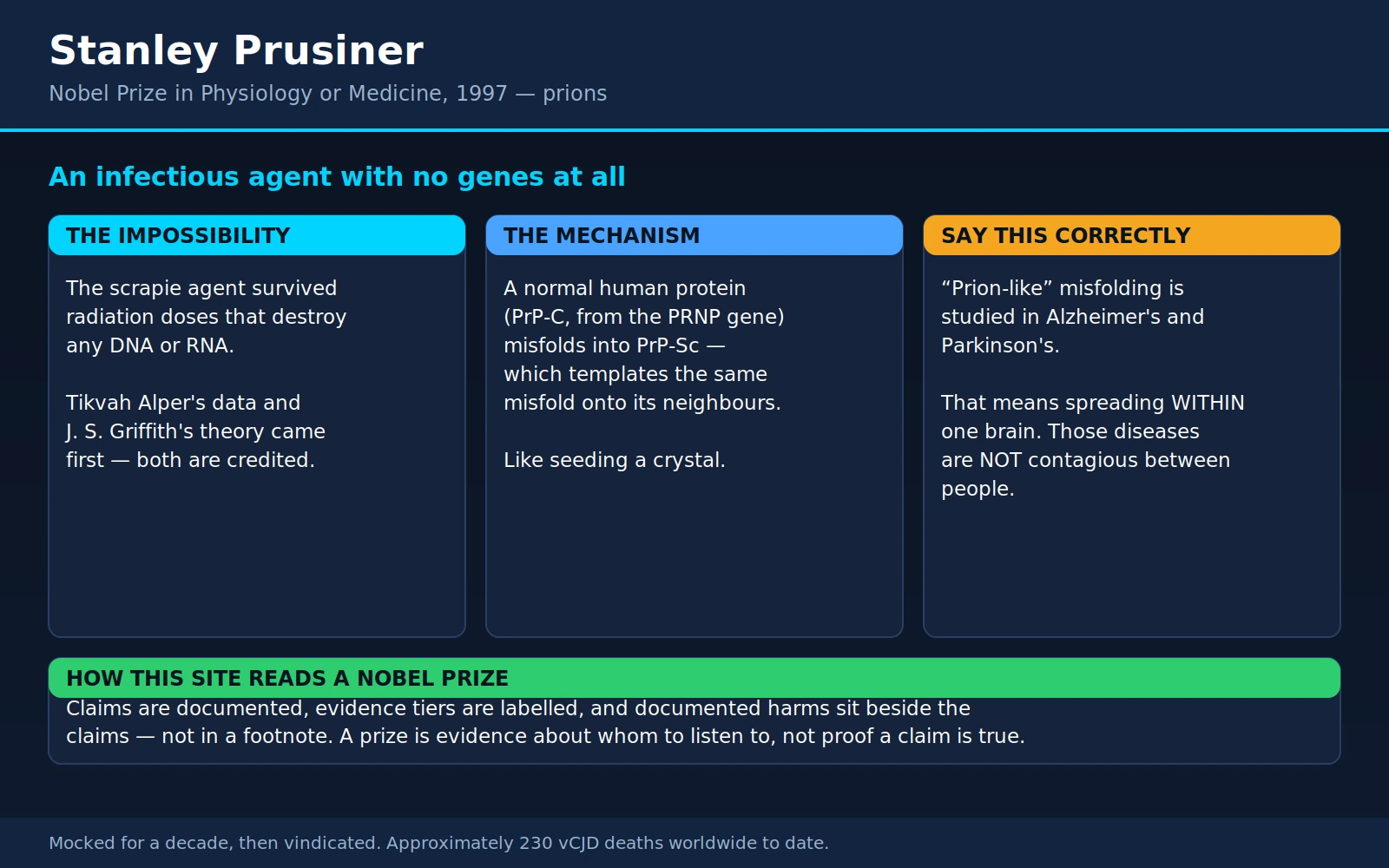
Table of Contents
- The Prize and the Man
- The Patient Who Started It
- The Impossible Agent
- Kuru and the Fore
- Coining “Prion,” 1982
- The Human Prion Diseases in Plain Language
- Mad Cow and vCJD, Honestly
- Chronic Wasting Disease
- The Bigger Idea — and the Claim the Internet Always Garbles
- Treatment, and Where Hope Actually Is
- Where Mainstream Medicine Agrees — and What Remains Debated
- Key Research Papers
- Connections
- Featured Videos
1. The Prize and the Man
Stanley B. Prusiner (born 1942 in Des Moines, Iowa) is an American neurologist and biochemist at the University of California, San Francisco who won the 1997 Nobel Prize in Physiology or Medicine, alone and undivided, with a citation of unusual boldness: “for his discovery of Prions — a new biological principle of infection.” The Nobel Assembly rarely uses the phrase new biological principle. Here it was accurate, and it was also a rebuke to fifteen years of very public scorn.
What Prusiner proposed in 1982 sounded, to most biologists of the day, like a category error. Every infectious agent then known — bacterium, virus, fungus, parasite — carried its own DNA or RNA and copied it to make more of itself. That was not a pattern; it was close to a law. Prusiner said the agent causing a family of fatal brain diseases in sheep, cattle, and humans contained no genetic material at all. It was a protein, he argued, and it reproduced by persuading other copies of the same protein to change shape.
The reaction was not polite disagreement. Colleagues wrote that he had abandoned evidence for showmanship; reviewers rejected his grants and funding became precarious for years; a widely read 1986 Discover profile framed him as a self-promoter, and the label stuck for a decade. When the Nobel was announced, several prominent researchers publicly objected — some because they thought the hypothesis unproven, others because they believed the prize should have been shared.
He was vindicated, and it is worth saying in what sense. The protein-only mechanism is now mainstream: it is in the textbooks, it underpins how health agencies handle prion-contaminated surgical instruments and cattle feed, and it explained a disease family that had defied explanation for two centuries. It also opened onto something larger — the idea that a misfolded protein can template its shape onto its neighbors, now central to how researchers think about Alzheimer's, Parkinson's, and ALS. He also remains a polarizing figure: cofactor requirements and prion “strain” diversity are still argued over, and so is credit, because Prusiner did not start from nothing. Both things are true at once, and this page tells it that way.
2. The Patient Who Started It
In 1972 Prusiner was a first-year resident in neurology at UCSF. One of his patients was a woman who had been losing her memory and coordination over a few months, and who was now unmistakably dying. She had Creutzfeldt-Jakob disease. Prusiner has described the moment repeatedly since: he went to the library to find out what caused it, and discovered that essentially nobody knew.
What the literature did say was that the disease was transmissible — brain tissue from a patient could sicken a chimpanzee after a long delay — and that the agent had resisted every attempt to identify it. There was no treatment, no reliable test in a living patient, and no answer to the simplest question a family asks: what is this?
His patient died. Prusiner decided to spend his career on the question — a professionally strange choice in 1972, since Creutzfeldt-Jakob disease affects on the order of one person per million per year. He began by attempting what everyone had failed at: purifying the agent, isolating enough to hold in a tube and analyze. That took a decade of grinding work with rodent-adapted scrapie, whose short incubation let an experiment run in months rather than years.
3. The Impossible Agent
Prusiner inherited a puzzle already famous among the few who knew of it. Scrapie — a fatal, itching, staggering disease of sheep and goats, described in Britain since the eighteenth century — behaved like an infection: brain material from a sick sheep would, after a long delay, sicken a healthy one. But the agent doing the spreading was impossible. It survived formaldehyde, which fixes and inactivates viruses. It survived boiling and standard autoclaving. It survived nucleases, the enzymes that chew up DNA and RNA. Most damning of all, it survived ultraviolet and ionizing radiation at doses that would shred any nucleic acid large enough to encode a replicating organism.
That last observation is not Prusiner's, and it is the foundation of everything that followed. In 1967, the British radiobiologist Tikvah Alper, with W. A. Cramp, D. A. Haig, and M. C. Clarke, published a paper in Nature whose title asked the question outright: “Does the agent of scrapie replicate without nucleic acid?” Their radiation-inactivation data implied a target far too small to be a conventional gene-carrying agent. Alper rarely gets named in popular accounts, and she should be.
In the same year and journal, the Oxford mathematician J. S. Griffith published a two-page theoretical note, “Self-replication and scrapie,” sketching how a protein could reproduce itself without nucleic acid — including a mechanism in which a protein exists in two shapes and the abnormal shape converts the normal one into more of itself. That is, in outline, the mechanism accepted today, proposed fifteen years early by a mathematician who did no experiments on it.
So the honest framing is this: Alper showed the agent behaved as if it had no genome; Griffith showed how that could work in theory; Prusiner did the biochemistry that proved what the agent actually was, named it, and spent fifteen years defending it against a hostile field. That is a real and substantial contribution — and it is not a contribution from a blank page.
4. Kuru and the Fore
The other thread came from the Eastern Highlands of Papua New Guinea. Among the Fore people, from roughly the 1950s onward, observers documented an epidemic of a fatal neurological disease the Fore called kuru — a word associated with trembling. It began with unsteadiness, progressed to severe tremor and loss of coordination, and killed within about a year. At its height it was the leading cause of death in affected communities, and it fell overwhelmingly on women and children.
The explanation was a mortuary practice. Among the Fore, the bodies of the dead were prepared and consumed by relatives as an act of mourning and respect — a way of returning a person to the community rather than leaving the body to decay alone. Adult men largely abstained; women and children participated, and handled and ate the brain and other high-risk tissues. That is the whole epidemiology of kuru, and it deserves to be stated without the leering tone Western accounts have often used: this was a funeral rite in a society with its own coherent ideas about death and obligation, and the people practicing it had no way of knowing it carried a disease with an incubation period longer than a childhood.
D. Carleton Gajdusek, an American physician working in the region, showed kuru was transmissible: in 1966, with Joe Gibbs and colleagues, he reported that brain material from kuru victims produced the disease in chimpanzees after long delays. He received the 1976 Nobel Prize in Physiology or Medicine (shared with Baruch Blumberg) for work on what he called “unconventional slow virus” infections. Gajdusek later pleaded guilty to child sexual abuse involving boys he had brought to the United States from the Pacific, and served a prison sentence in 1997. This site records that plainly rather than omitting it; it does not change the scientific record, and the record does not soften it.
The mortuary practice ended around the late 1950s. Kuru then did something remarkable: it kept killing people for another half-century. In 2006, John Collinge and colleagues analysed in The Lancet kuru patients identified between 1996 and 2004 — people whose only plausible exposure was decades earlier — and estimated incubation periods that could exceed 50 years. That finding is why prion risk is managed so conservatively, and why the vCJD story in section 7 cannot be declared closed with total confidence even now.
5. Coining “Prion,” 1982
In April 1982, Prusiner published a paper in Science titled “Novel proteinaceous infectious particles cause scrapie,” reporting that his purified, highly infectious scrapie preparations were inactivated by treatments that destroy proteins and not by treatments that destroy nucleic acids. And he named the agent, from proteinaceous infectious particle: prion, pronounced PREE-on.
Naming it was the provocation. A name asserts that a thing exists as its own category, and the claim — an infectious particle made of protein, without a genome — was read as an attack on molecular biology's central logic. The common counter-argument was reasonable on its face: no purification is perfect, and a tiny, well-hidden virus could be riding along. For years, every improvement was answered with “then the virus is smaller than that.”
What turned the idea from an affront into a mechanism came a few years later, and it is the most surprising twist in the story. Prusiner's group purified the protein, sequenced part of it, and used that sequence to find the gene encoding it. The gene, PRNP, was not foreign, smuggled in by an infection. It was a normal gene in the host's own chromosomes — present in hamsters, sheep, cattle, and every healthy human being, on chromosome 20.
So the picture inverted. The prion protein is ours. Everyone reading this page is making it right now, mostly on the surface of nerve cells, where its normal job is still not fully settled. Researchers write the healthy form as PrPC, for “cellular.” The disease form, PrPSc (for “scrapie”), has the identical amino-acid sequence — nothing added, nothing deleted. What differs is the shape, the way the chain folds, and the misfolded shape is dense, sticky, and resistant to the enzymes that normally clear worn-out proteins.
And the misfolded shape is contagious to its neighbors. When PrPSc contacts a normal PrPC molecule it acts as a template, coaxing the healthy protein into the abnormal fold. Now there are two; those two convert two more; the aggregates grow, fragment, and each fragment becomes a new seed. Nothing has been copied in the genetic sense — no gene read, no message transcribed. The information being transmitted is the shape itself.
The usual analogy is crystal seeding, and it is a good one. A supersaturated sugar solution can sit clear for a long time; drop in one seed crystal and the whole jar turns to crystal — not because the seed carried instructions, but because it supplied a template the surrounding molecules could copy by contact. Prion disease is that process running inside a brain over years, the crystals being useless clumps of a protein the neuron needs. It is also why the agent survives formaldehyde and boiling — you cannot kill what was never alive — and why no replicating genes are needed for it to spread.
6. The Human Prion Diseases in Plain Language
Human prion diseases are rare and, at present, uniformly fatal. They come in three routes, and understanding which route you are reading about is the difference between sensible caution and needless fear.
Sporadic Creutzfeldt-Jakob disease (sCJD) accounts for roughly 85 percent of cases and occurs at about one to two cases per million people per year, a rate stable across countries and decades. “Sporadic” means no inherited mutation and no identified exposure; the leading explanation is that a PrP molecule somewhere misfolds by chance and seeds the rest. Onset is typically in the sixties. The picture is a rapidly progressive dementia — weeks to months, not the years of Alzheimer's — with myoclonus (sudden involuntary jerks), loss of coordination, visual disturbance, and mutism; median survival is around four to six months. Diagnosis uses MRI patterns, CSF markers, and above all the RT-QuIC assay, which detects seeding activity in spinal fluid or a nasal brushing — a real advance, since for most of this story a confident diagnosis required an autopsy.
Genetic (inherited) prion diseases account for roughly 10 to 15 percent and come from mutations in PRNP itself, inherited in an autosomal dominant pattern — a child of an affected parent has a 50 percent chance of carrying the mutation. The named forms are familial CJD; fatal familial insomnia (FFI), in which the thalamus is attacked and the earliest symptom is a progressive, eventually total inability to sleep; and Gerstmann-Sträussler-Scheinker syndrome (GSS), slower, often starting with unsteadiness in middle age. These are not contagious — what is inherited is the gene, not the illness.
Acquired prion diseases are the smallest group and the one that generated all the alarm: kuru; variant CJD from beef exposure (section 7); and iatrogenic CJD, transmitted by medical treatment. The historic iatrogenic sources are specific and now closed — cadaveric human growth hormone, from pooled pituitary glands, given to children of short stature until 1985 and causing more than 200 deaths worldwide; cadaveric dura mater grafts used in neurosurgery, causing over 200 more; a few corneal transplants; and contaminated neurosurgical instruments and electrodes.
That last route explains a piece of hospital practice that sounds excessive until you know why. Prions resist standard autoclaving. The routine cycle that reliably kills bacteria, spores, and viruses — 121 °C for 15 to 20 minutes — does not reliably destroy prion infectivity, and neither do the usual chemical disinfectants. Prion protocols therefore call for prolonged autoclaving at 134 °C, sodium hydroxide or concentrated hypochlorite, or simply destroying the instruments — a direct consequence of Prusiner's mechanism: you are not killing an organism, you are trying to unfold a shape.
7. Mad Cow and vCJD, Honestly
Bovine spongiform encephalopathy (BSE), the disease the press named “mad cow,” was first identified in British cattle in 1986. Its cause was an agricultural practice that reads, in hindsight, like a designed experiment in prion amplification: cattle — herbivores — were fed protein supplements made from rendered animal carcasses, including the remains of other ruminants. One infected animal's most dangerous tissues could be processed into feed and distributed to many others, whose own remains were then processed again.
The scale was enormous: more than 180,000 British cattle confirmed with BSE, the true number infected likely far higher, and over four million culled. For years the official line was that BSE posed no risk to humans. On 20 March 1996, the government announced the opposite. The subsequent Phillips Inquiry documented a decade of institutional reassurance that had outrun the evidence, and the damage to food-safety credibility lasted a generation.
Variant CJD (vCJD) was clinically unlike sporadic CJD, which is what allowed it to be spotted at all. It struck the young — median age around 28 — began with psychiatric symptoms and painful sensory disturbance rather than dementia, ran longer (around 14 months), and showed a distinctive “florid plaque” pattern and a pulvinar sign on MRI. Will, Ironside and colleagues described the first ten cases in The Lancet in 1996. Nearly all confirmed patients carried methionine on both copies of codon 129 of PRNP, raising the question of whether other genotypes simply had longer incubation periods.
Now the numbers, which are the part most people misremember. Total confirmed vCJD deaths worldwide are approximately 230 — roughly 178 in the United Kingdom, around 28 in France, small numbers elsewhere. (These figures are approximate; national surveillance units maintain the current counts.) Cases peaked in 2000 and have dwindled to essentially none. The catastrophic epidemic some models projected — scenarios running to tens or hundreds of thousands — did not happen.
The controls worked, and they are why current risk is low. The ruminant feed ban (1988 in the UK, progressively tightened and adopted internationally) broke the amplification loop. The specified risk material (SRM) controls removed the tissues that actually carry infectivity — brain, spinal cord, and specified nervous and lymphoid tissue — from the human food chain, banned mechanically recovered meat from the spinal column, kept older cattle out of the food supply, and added surveillance testing. Blood services introduced leucodepletion and long-running donor deferrals: the United States and others barred donation from people who had lived in Britain during the exposure years, a restriction the FDA removed only in 2022. Four UK cases of vCJD transmission by transfusion were documented, which is why those deferrals lasted so long.
Here is the framing readers deserve, without scaremongering and without dismissal. BSE was a catastrophic failure of industrial agriculture — a cost-saving practice that turned herbivores into recyclers of their own species and created a novel human pathogen. Its death toll was small in absolute terms; its economic, institutional, and public-trust costs were gigantic. And in countries with feed bans and SRM controls in place, the risk from beef today is very low; isolated BSE-like cases still turn up in aging cattle and are caught by surveillance, which is the system working rather than the epidemic returning. Anyone calling beef a meaningful prion hazard in a regulated market is overstating it; anyone calling the affair a media panic over nothing has not read the inquiry.
8. Chronic Wasting Disease
The live question in prion science is not mad cow. It is chronic wasting disease (CWD), a prion disease of deer, elk, moose, and reindeer, first recognized in captive mule deer in Colorado in the late 1960s and identified as a prion disease in 1978. It has since spread across well over thirty US states and several Canadian provinces, and reached wild reindeer and moose in Scandinavia. It is far harder to contain than BSE: it spreads animal to animal in the wild through saliva, urine, feces, and carcasses, and CWD prions persist in soil and on plants for years. There is no feed ban to impose on wild deer, and in heavily affected areas herd infection rates can reach substantial fractions.
The honest position on human risk: no confirmed human case of CWD has ever been identified, despite decades of hunting and venison consumption and surveillance specifically looking for it, and human prion protein in conversion systems and transgenic mice generally shows a strong species barrier. A Canadian study reported oral transmission to macaques, which caused considerable concern; other macaque studies have not reproduced it, and the finding remains contested. This is genuine scientific uncertainty — not a cover-up, and not a confirmed danger.
What follows for hunting readers is the advice public-health agencies actually give, and it is measured rather than alarmist. The CDC and state wildlife agencies recommend: have your animal tested if you hunt where CWD occurs, and wait for the result; do not eat an animal that tests positive, or one that looked sick, or one found dead; wear gloves and avoid the highest-risk tissues when field dressing — brain, spinal cord, eyes, spleen, tonsils, lymph nodes. Because prion incubation can span decades — kuru is the proof — the absence of human cases is reassuring but not a guarantee. Testing is cheap and the disease is untreatable; that asymmetry makes the precaution reasonable.
9. The Bigger Idea — and the Claim the Internet Always Garbles
Prusiner's work matters far beyond a one-in-a-million disease because templated misfolding turned out not to be unique to PrP. Researchers now describe several common neurodegenerative diseases as involving “prion-like” mechanisms:
- Alzheimer's disease — misfolded amyloid-β and tau. Tau pathology spreads through the brain in a stereotyped sequence that tracks neural connections, exactly what a seeding-and-templating process predicts.
- Parkinson's disease — misfolded alpha-synuclein. What made the idea hard to ignore was that healthy fetal neurons grafted into patients decades earlier had themselves developed Lewy pathology, as though the host tissue seeded the graft.
- ALS and frontotemporal dementia — misfolded TDP-43, showing similar templated aggregation and spread.
Now the point worth more than anything else on this page, because it is the single most commonly garbled claim in health content online.
“Prion-like” does not mean contagious. Alzheimer's, Parkinson's, and ALS are not transmissible between people. You cannot catch them. Not from a spouse, not from a parent, not from caring for someone with dementia, not from sharing a household, a meal, a bathroom, or a bed. When a researcher says a protein behaves in a “prion-like” way, they are describing a mechanism that operates inside one person's brain — misfolded protein in one region seeding misfolding in the next region along the connection — and nothing more than that. The word borrows the templating half of prion biology, not the infectious-between-organisms half. Those two properties came bundled together in PrP; they do not come bundled in general, and no epidemiological study of dementia has ever found the pattern of person-to-person spread that a communicable disease produces.
There is one real caveat, and it should be labeled as exactly what it is: narrow, historical, and iatrogenic. In 2015, Zane Jaunmuktane, John Collinge and colleagues reported in Nature that people who had died of iatrogenic CJD after receiving cadaveric human growth hormone decades earlier also showed unexpected amyloid-β deposits and cerebral amyloid angiopathy for their age — suggesting those hormone batches carried amyloid-β seeds along with prions. Later work found amyloid-β in archived samples, reproduced the seeding in mice, and in 2024 described a few recipients who developed early-onset Alzheimer's-type dementia. That is a genuine signal and it is genuinely limited: the exposure was injection of extract from thousands of pooled human pituitary glands, a practice discontinued worldwide in 1985. It says something about seeding biology and nothing about whether you can catch Alzheimer's from a person; an article using it to imply dementia is contagious is misrepresenting it.
10. Treatment, and Where Hope Actually Is
There is no cure for prion disease, and no treatment that meaningfully extends survival. That has to be said first and without softening, because the vacuum around a rapidly fatal untreatable illness draws in a great deal of false hope. Care is supportive and palliative — controlling myoclonus and seizures, managing agitation and pain, hospice early rather than late — and specialist prion centers help with diagnosis, genetic counseling, and trial access. Repurposed drugs (quinacrine, pentosan polysulfate, doxycycline, flupirtine) looked promising in cell culture and changed nothing in humans, which is why research moved to the mechanism itself.
Two such strategies are now in patients. PRN100 is a humanized monoclonal antibody against the prion protein, developed at the MRC Prion Unit in London. In a first-in-human compassionate-use programme reported in Lancet Neurology in 2022, six CJD patients received it: it was well tolerated and reached the brain at target concentrations, and in a couple the course appeared to stabilize — but this was not a controlled trial and showed no survival benefit. It established only that the approach is safe enough to test.
The second is PrP lowering with antisense oligonucleotides (ASOs), and it rests on an elegant piece of logic. If the disease needs the normal protein as raw material — and mice lacking PrP entirely are healthy and cannot be infected — you need not attack the misfolded form at all. You reduce the supply. ASOs are short synthetic strands that bind PRNP messenger RNA and cause it to be degraded, so the neuron makes less prion protein. In mice this extends survival substantially, including when treatment starts after infection. An ASO against PRNP entered early-phase human trials in 2024.
That work has an unusual human face. Sonia Vallabh watched her mother die of a rapid, undiagnosed neurological illness in 2010; it was identified afterward as fatal familial insomnia, and testing showed Sonia had inherited the same PRNP mutation. She was a lawyer; her husband, Eric Minikel, was a transportation planner. They left their careers, went back to school, earned doctorates in biology, and now lead a prion-therapeutics laboratory at the Broad Institute of MIT and Harvard, working on lowering PrP before symptoms ever begin. They are the honest face of where this field is: a small, serious effort that has not yet saved anyone, working against a clock one of them can read.
And one plain sentence about the alternative-health market: no supplement, herb, detox protocol, chelation, diet, or cleanse has any evidence of preventing, slowing, or treating prion disease. The honest options are supportive care, genetic counseling, and clinical trials.
11. Where Mainstream Medicine Agrees — and What Remains Debated
Settled. The protein-only hypothesis is accepted: prion diseases are caused by conformational conversion of the host's own PrPC into a self-templating misfolded form, with no agent-specific nucleic acid. The strongest evidence is that infectious prions have been generated de novo from bacterially produced recombinant prion protein — no brain material, no possible hidden virus — and used to cause disease in animals.
Debated: cofactors. Recombinant PrP alone converts poorly; making highly infectious material in a tube generally needs additional ingredients, notably certain lipids and polyanions such as RNA. Whether these are part of the agent, catalysts, or an artifact is open — and it matters, because strict “protein-only” is harder to defend than “protein-conformation-encoded.”
Debated: strains. Prion “strains” behave like distinct pathogens — different incubation periods, lesion patterns, and species barriers — and breed true through many passages. With no genome to carry that information, the accepted explanation is distinct stable conformations of the same protein. Cryo-electron microscopy has resolved several prion fibril structures and largely supports this, but how many conformations exist and how a strain adapts on crossing a species barrier is unfinished work. A small minority — Laura Manuelidis most prominently — still argue for a virus-like particle, a view well outside the consensus.
Debated: credit, and the bitterness around it. Prusiner's 1997 prize was undivided, and the objections were real. Alper supplied the physical evidence that the agent had no genome; Griffith supplied the mechanism in theory, fifteen years early; Gajdusek established that these diseases were transmissible at all. Critics argue Prusiner underplayed how much of the framework already existed; his defenders answer that only he did the biochemistry and stayed with a question the field had abandoned. A reader can hold all of it: the mechanism is right, it was not conjured from nothing, and it took someone stubborn to prove it. And prions break Koch's postulates, which require growing the causal organism in pure culture — not because Robert Koch was wrong, but because biology had one more category in it than 1890 knew, the same lesson Barry Marshall taught with Helicobacter pylori.
12. Key Research Papers
- Prusiner SB. Novel proteinaceous infectious particles cause scrapie. Science 1982;216(4542):136-44
- Prusiner SB. Prions. Proc Natl Acad Sci U S A 1998;95(23):13363-83
- Alper T, Cramp WA, Haig DA, Clarke MC. Does the agent of scrapie replicate without nucleic acid? Nature 1967;214(5090):764-6
- Griffith JS. Self-replication and scrapie. Nature 1967;215(5105):1043-4
- Gajdusek DC. Unconventional viruses and the origin and disappearance of kuru. Science 1977;197(4307):943-60
- Collinge J, Whitfield J, McKintosh E, et al. Kuru in the 21st century — an acquired human prion disease with very long incubation periods. Lancet 2006;367(9528):2068-74
- Will RG, Ironside JW, Zeidler M, et al. A new variant of Creutzfeldt-Jakob disease in the UK. Lancet 1996;347(9006):921-5
- Jaunmuktane Z, Mead S, Ellis M, et al. Evidence for human transmission of amyloid-β pathology and cerebral amyloid angiopathy. Nature 2015;525(7568):247-50
- Osterholm MT, Anderson CJ, Zabel MD, et al. Chronic wasting disease in cervids: implications for prion transmission to humans and other animal species. mBio 2019;10(4):e01091-19
- Mead S, Khalili-Shirazi A, Potter C, et al. Prion protein monoclonal antibody (PRN100) therapy for Creutzfeldt-Jakob disease: evaluation of a first-in-human treatment programme. Lancet Neurol 2022;21(4):342-354
Live PubMed Searches
- Prion protein misfolding
- Variant CJD and BSE
- Chronic wasting disease human risk
- Kuru incubation period
- Prion disease treatment trials
Connections
- All Notable Doctors
- Nobel Prize in Medicine — the full roll of laureates
- Barry Marshall — the other heretic mocked and then vindicated: H. pylori
- Robert Koch — whose postulates prions break, since a prion cannot be cultured
- Harald zur Hausen — another laureate who argued an unpopular causal claim into the mainstream
- Neurology — the full index of neurological conditions
- Creutzfeldt-Jakob Disease — the human prion disease itself
- Alzheimer's Disease — amyloid-β and tau, and what “prion-like” does not mean
- Parkinson's Disease — alpha-synuclein and templated spread within one brain
- ALS — TDP-43 aggregation and the same seeding vocabulary
- Delirium — the commoner cause of rapid mental change, and the first thing to rule out
- Beef — sourcing, and the controls that followed the BSE crisis