Fischer and Krebs: The Phosphate Switch, and the Cancer Drugs Built From It
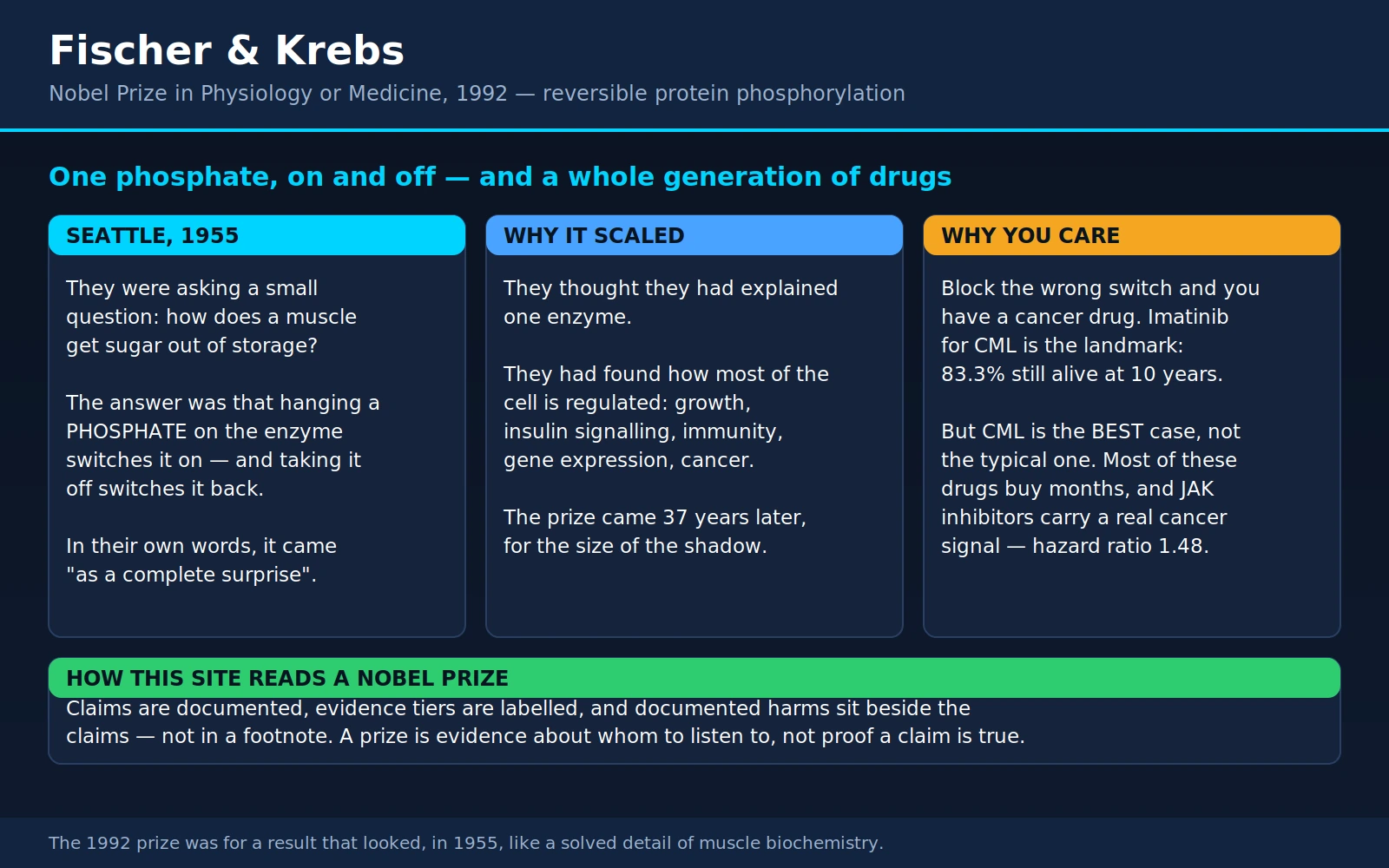
The 1992 Nobel Prize in Physiology or Medicine went to Edmond H. Fischer and Edwin G. Krebs "for their discoveries concerning reversible protein phosphorylation as a biological regulatory mechanism." It is, on the face of it, the least quotable Nobel citation of the century. Nobody has ever been moved by the phrase reversible protein phosphorylation.
Here is what it means. A cell can turn a protein on by hanging a single phosphate group on it, and turn that same protein off again by taking the phosphate away. On, off. On, off. Two men working on a muscle enzyme in Seattle in 1955 found this happening to one protein, and assumed they had explained one protein. They had in fact stumbled onto the mechanism the cell uses for almost everything — how a muscle finds fuel, how insulin tells a cell to take up sugar, how a cell decides to divide, how the immune system fires and stands down.
And because it is a switch, it can be jammed. That is the part that shows up in a pharmacy. When a switch in a cancer cell is stuck in the "on" position, a drug that blocks the switch is a cancer drug — not poison aimed at fast-growing cells, but a key snapped off in one specific lock. There are now 94 such drugs approved in the United States, and the first great one turned a leukaemia that killed most patients within a few years into a condition many people live with for decades.
This page tells that story honestly, which means telling both halves: the case where it worked spectacularly, and the far more common case where it buys months rather than years, and where the cancer learns to get around the drug.
Table of Contents
- Two Men and One Enzyme
- The Question in 1955: Where Does a Muscle Get Its Sugar?
- The Experiment: A Phosphate Switches the Enzyme On
- Why "Reversible" Is the Entire Point
- From One Enzyme to the Whole Cell
- Insulin: A Receptor That Is Its Own Kinase
- Thirty-Seven Years to the Prize
- The Payoff: Imatinib and Chronic Myeloid Leukaemia
- Honest Reckoning: CML Is the Best Case, Not the Typical One
- Lung Cancer: EGFR and ALK
- Why Resistance Is Routine
- Beyond Cancer: BTK and JAK Inhibitors, and Their Real Harms
- What This Means If You Are Taking One of These Drugs
- Key Research Papers
- Connections
- Featured Videos
1. Two Men and One Enzyme
Edwin Gerhard Krebs (1918–2009) was an American physician. He qualified in medicine at Washington University in St. Louis during the Second World War, and when a research position opened rather than a clinical one, he took it — in the laboratory of Carl and Gerty Cori, who would win their own Nobel Prize in 1947 for working out how the body stores and releases sugar. That apprenticeship matters to everything that follows: Krebs learned his craft on the exact enzyme he would later crack open.
Edmond Henri Fischer (1920–2021) came from the other direction entirely. Born in Shanghai to European parents, educated in Switzerland, he took a doctorate in organic chemistry at the University of Geneva and arrived in the United States as a chemist, not a physician. He and Krebs both landed in the Department of Biochemistry at the University of Washington in Seattle in the early 1950s, discovered they were circling the same enzyme from opposite sides, and decided to work on it together. Fischer lived to 101, long enough to see the drugs that came out of that decision.
The enzyme was glycogen phosphorylase. It is the enzyme that breaks stored sugar out of muscle. And in 1955, in two papers published back to back in the Journal of Biological Chemistry, Fischer and Krebs showed that what switches it on is a phosphate group, added by one enzyme and removed by another.
2. The Question in 1955: Where Does a Muscle Get Its Sugar?
Start with the everyday version of the problem, because the everyday version is what the enzyme is actually for.
You are walking, and then something startles you and you run. Within a second or two your leg muscles need far more fuel than they were using. The fuel is glucose, and muscle keeps a private store of it — glycogen, a branched tree of glucose molecules packed into the muscle cell. Glycogen phosphorylase is the enzyme that chews glucose units off that tree. When you sprint, phosphorylase has to go from idling to full output almost immediately.
So the question is: how does the enzyme know? Something has to tell it. And whatever tells it has to work in seconds, has to work inside a cell that the signalling hormone never enters, and — crucially — has to be able to tell it to stop as well, because a muscle that kept dismantling its own glycogen store after the sprint ended would be in serious trouble.
By the early 1950s a partial answer was on the table and it was wrong in an instructive way. Phosphorylase was known to exist in two forms. The Coris had crystallised both: one form, called phosphorylase a, worked on its own; the other, phosphorylase b, only worked if you added AMP (adenosine monophosphate, a small molecule that accumulates when a cell is running low on energy). The obvious reading was that AMP was the regulator — that the enzyme sensed the cell's fuel gauge directly and switched itself on. Something also converted b into a, and the Coris had a name for the responsible activity, but nobody knew what it did.
Fischer himself, looking back fifty-five years later, described exactly this dead end: phosphorylase "was originally thought to be regulated by AMP", which we now know serves as an allosteric effector — a fine-tuning knob rather than the master switch. The real hormonal control turned out to be something else entirely, and, in his words, "essentially nothing was known at that time about the structure and function of phosphoproteins", so what they found "came nevertheless as a complete surprise".
3. The Experiment: A Phosphate Switches the Enzyme On
The two 1955 papers are, in their titles alone, a small masterpiece of understatement: Phosphorylase activity of skeletal muscle extracts, and then Conversion of phosphorylase b to phosphorylase a in muscle extracts.
What Fischer and Krebs showed is that the conversion of the inactive form into the active form requires ATP — the cell's energy currency — and magnesium. That combination is the fingerprint of a phosphate-transfer reaction. The mysterious "converting" activity the Coris had noticed was not removing a cofactor; it was attaching a phosphate group to the protein itself. The following year Fischer and Krebs published the enzyme responsible as a distinct entity: the phosphorylase-b-to-a converting enzyme of rabbit skeletal muscle, which we now call phosphorylase kinase.
Picture it as concretely as you can. The enzyme is a large folded protein. Somewhere on its surface is a single amino acid — a serine — carrying a hydroxyl group, an oxygen and a hydrogen. A phosphate group is roughly the size of a thumbtack next to a beach ball. Hang that thumbtack on the serine and the whole beach ball changes shape slightly, and the changed shape works. Pull the thumbtack off and it stops working.
That is the discovery. It sounds trivial written down, and Fischer said so himself — "although that reaction is extremely simple, it came nevertheless as a complete surprise". Proteins in 1955 were understood as the machinery of the cell, fixed objects that did their job. The idea that a cell routinely modifies its own finished proteins, chemically, as a way of controlling them, and then undoes the modification, was new.
Two further pieces fell into place quickly and both matter medically. First, phosphorylase kinase does not run on its own either: it is itself activated by calcium and ATP. Calcium is the ion that floods into a muscle cell when a nerve tells it to contract. So the same signal that makes a muscle contract also, in the same instant, opens its fuel tap. As Fischer put it, the system "showed how two different physiological processes — carbohydrate metabolism and muscle contraction — could be regulated in concert." Second, the reverse reaction has its own dedicated enzyme, a phosphorylase phosphatase, whose only job is to take the phosphate off.
4. Why "Reversible" Is the Entire Point
The word doing all the work in that Nobel citation is reversible, and it is worth slowing down on.
Cells modify proteins in many one-way ways. An enzyme that cuts a protein in half has made a permanent decision; there is no putting it back. That is fine for events that happen once — digesting a meal, clotting a wound — but useless for control. Control requires the ability to go back.
Phosphorylation is reversible because it is run by two opposing enzyme families. A kinase puts phosphates on. A phosphatase takes them off. Both are working at the same time on the same protein, which means the protein's state at any moment is not a fixed setting but a balance — like a sink with the tap running and the plug out. Change the tap or the drain and the water level moves within seconds, and moves back just as fast when the signal ends.
This is why the mechanism took over the cell. It is fast, it is cheap (one phosphate from one ATP), it is graded rather than all-or-nothing, and it is undoable. Anything the cell needs to control on a timescale of seconds to minutes — rather than the tens of minutes it takes to make a new protein from scratch — tends to be controlled this way.
It is also, for the same reason, exactly the kind of system a drug can interfere with. A drug that blocks a kinase is not destroying anything. It is holding one tap shut. When the drug is cleared from the body, the tap opens again. That reversibility is why kinase inhibitors are taken as a daily tablet rather than given as a course, and why stopping them usually lets the disease come straight back.
5. From One Enzyme to the Whole Cell
The generalisation happened in stages, and each stage widened the claim.
Stage one: the cascade. Phosphorylase is switched on by phosphorylase kinase. Phosphorylase kinase is itself switched on by phosphorylation. So you have kinases acting on kinases — a chain of amplifying steps in which one signalling molecule at the top produces an enormous change in enzyme activity at the bottom. Fischer described this as the first hormonal cascade of successive enzymatic reactions ever established, and noted that the thing that starts it is cyclic AMP, discovered by Earl Sutherland, whose own Nobel Prize came in 1971. The middle of that chain — how a hormone outside the cell produces cyclic AMP inside it — was filled in later by Gilman and Rodbell and the G proteins. Read those three pages together and you have the complete path from adrenaline landing on a liver cell to sugar entering the blood.
Stage two: a kinase that is not fussy. In 1968 Donal Walsh, John Perkins and Krebs isolated a cyclic-AMP-dependent protein kinase from rabbit skeletal muscle — the enzyme now universally called protein kinase A. The significance was that it was not a phosphorylase-specific tool. It was a general-purpose kinase that phosphorylates many different target proteins, and it is switched on directly by cyclic AMP. At that point the mechanism stopped looking like a quirk of muscle metabolism and started looking like infrastructure.
Stage three: tyrosine. For twenty-five years the phosphates were understood to go onto serine and threonine residues. In 1979 a third target appeared — tyrosine — found in work on a tumour virus protein. Tyrosine phosphorylation turned out to be relatively rare but disproportionately important: it is the language of growth-factor receptors, and it is where most of the cancer drugs on this page act.
Stage four: counting. When the human genome was sequenced, it became possible to ask how many kinases we actually have. The 2002 catalogue found 518 protein kinase genes — roughly one in every forty human genes — of which 244 map to disease loci or cancer amplicons. Asking how many proteins get phosphorylated took longer, because the answer depends on how hard you look. A 2014 study using an exceptionally deep method mapped more than 50,000 distinct phosphorylated peptides in a single human cancer cell line and detected more than three-quarters of that line's proteins as phosphoproteins.
6. Insulin: A Receptor That Is Its Own Kinase
If you want the single most consequential everyday example, it is insulin — and it is a good example precisely because it does not work like the adrenaline cascade above.
Insulin arrives at a muscle or fat cell and binds a receptor sitting in the cell membrane. That receptor does not need a middleman, because the inner half of the receptor is itself a tyrosine kinase. Insulin binding changes the receptor's shape; the two halves of the receptor phosphorylate each other; the now-active kinase phosphorylates a set of docking proteins inside the cell; those recruit further enzymes, several of them kinases, and the end result is that glucose transporters move to the cell surface and sugar comes out of the blood.
Every step of that is phosphate on, phosphate off. Insulin signalling is Fischer and Krebs's mechanism running in a system that affects almost every adult reading this page.
It also explains why insulin resistance is such a slippery thing to describe. There is no single broken part. The pathway is "a complex network of signalling pathways, activated by the insulin receptor", and numerous other hormones and signalling events can attenuate insulin's action at various points along it. When someone says a cell has "become resistant to insulin", what they are describing is a phosphorylation network whose balance has shifted — more damping at several nodes at once, not one snapped wire. That is why type 2 diabetes has no single mechanistic fix and why the interventions that work best are the ones that change the whole system's set point rather than blocking one enzyme.
7. Thirty-Seven Years to the Prize
The papers were published in 1955 and 1956. The Nobel Prize came in 1992. That is one of the longer gaps in the modern history of the award, and the reason is instructive.
In 1955, the discovery looked like a solved detail of muscle biochemistry. Its importance was not in the finding itself but in how far the finding generalised — and that took three decades to become obvious. By the late 1980s, protein phosphorylation was in every part of cell biology: cell division, immune activation, neurotransmission, gene expression, cancer. The prize, when it came, was effectively awarded for the size of the shadow the 1955 result had cast.
Both men kept working. Krebs spent his career on the kinases and on how signals from outside a cell reach the nucleus. Fischer moved to the other side of the switch and spent his later decades on the protein tyrosine phosphatases — the enzymes that take the phosphates off. The phosphatases are the neglected half of the story. They are harder to drug, because it is easier to design a molecule that plugs one specific pocket than one that stops a general-purpose eraser, and to this day the great majority of approved drugs in this field target kinases rather than phosphatases. Fischer's insistence that the off-switch mattered as much as the on-switch has aged very well and remains largely unexploited therapeutically.
Krebs's 1992 Nobel lecture was published the following year under the title "Protein phosphorylation and cellular regulation I"; Fischer's companion lecture carried the matching "II". PubMed carries no abstract for the Krebs lecture, which is normal for published lecture texts, so we cite it here as a primary document rather than as evidence for any specific claim.
8. The Payoff: Imatinib and Chronic Myeloid Leukaemia
Now the part that changed how people are treated.
Chronic myeloid leukaemia (CML) is a cancer of the blood-forming cells in the marrow. It has a single, beautifully well-defined cause: two chromosomes swap pieces, and the swap fuses two genes together into a hybrid called BCR-ABL. The protein that hybrid gene makes is a tyrosine kinase that is permanently switched on. It has no off state. It never waits for a signal. The cell it lives in behaves as though it is being continuously told to divide, because in the only language a cell understands — phosphate on a tyrosine — it is.
That is a Fischer-and-Krebs problem stated in cancer terms, and it invites a Fischer-and-Krebs answer: block the kinase.
The drug that did it was imatinib (Gleevec / Glivec), and the first clinical results, published in 2001, were startling enough that people remember where they were when they read them. In a phase 1 dose-finding study — the kind of trial that is normally about safety, not benefit — 83 patients whose CML had already failed interferon alfa were given escalating oral doses. Of the 54 patients who received 300 mg a day or more, 53 had a complete haematologic response, usually within the first four weeks. Seventeen of those 54 (31%) had a major cytogenetic response, meaning the Philadelphia chromosome largely disappeared from their dividing marrow cells; seven had complete cytogenetic remissions. A maximum tolerated dose was never reached. The commonest side effects were nausea, muscle aches, swelling and diarrhoea.
The randomised confirmation, the IRIS trial, followed in 2003. It enrolled 1,106 newly diagnosed chronic-phase patients, half to imatinib and half to the previous standard of interferon alfa plus low-dose cytarabine. At 18 months the estimated rate of major cytogenetic response was 87.1% with imatinib versus 34.7% with the old regimen; complete cytogenetic response, 76.2% versus 14.5%; freedom from progression to accelerated-phase or blast-crisis disease, 96.7% versus 91.5%. Imatinib was also better tolerated. Enough patients crossed over from the comparator arm — ultimately 65.6% of them — that the trial stopped being a clean two-arm comparison, but the direction was never in doubt.
The long view arrived in 2017, with a median follow-up of 10.9 years. Among patients originally assigned to imatinib, estimated overall survival at 10 years was 83.3%, and 82.8% had achieved a complete cytogenetic response. Serious drug-related adverse events were uncommon and clustered in the first year. Just under half (48.3%) were still on study treatment with imatinib at the end — the rest had switched drugs, left the study or died.
And the population-level number, which is the one that actually answers a patient's question. A Swedish national registry study followed 2,662 people diagnosed with CML between 1973 and 2013 and modelled how many years of life the disease costs. The answer for people diagnosed in 2013, at every age: on average, fewer than three life-years lost. A disease that was a death sentence within living memory now costs most of the people who get it less life expectancy than a number of chronic conditions nobody calls fatal.
9. Honest Reckoning: CML Is the Best Case, Not the Typical One
Everything above is true, and it is also the most favourable example in the entire field. Presenting it as representative would be dishonest, so here is why CML is exceptional.
One cause, and only one. CML is driven by a single genetic event that is present in essentially every leukaemic cell and that the cell genuinely depends on. Most cancers are not like this. A typical solid tumour carries dozens of mutations, several of which could sustain it, and knocking out one kinase leaves the others running. When researchers examined why imatinib eventually failed in some patients, the striking finding was that resistance "was associated with the reactivation of BCR-ABL signal transduction in all cases examined" — the cancer had not found a different route; it had restored the original one. That kind of single-mindedness is a gift, and it is rare.
The target is on the surface of the problem. BCR-ABL is a kinase whose ATP pocket a small molecule can reach and occupy. Many cancer drivers are not enzymes at all, or are proteins with no convenient pocket. Roughly speaking, kinases are druggable because Fischer and Krebs's chemistry gave them a well-shaped hole where a nucleotide binds — and a great many other cancer-driving proteins simply do not have one.
It is control, not cure, for most people. This is the point most often lost. Imatinib does not eradicate the leukaemic stem cells; it suppresses the disease while you take it. The French STIM trial tested stopping the drug in a hand-picked best-case group: 100 patients who had been on imatinib for more than two years and had no detectable BCR-ABL transcripts at all. Among the 69 followed for at least a year, 42 (61%) relapsed molecularly — 40 of them within six months. The probability of staying in complete molecular remission at 12 months was 41% (95% CI 29–52). The reassuring half of the result is that every patient who relapsed responded again when imatinib was restarted. But the headline is the one to carry: even among the most successfully treated patients in the world, most cannot stop the tablet. Treatment-free remission is a real and growing option, attempted under close molecular monitoring, and it is a minority outcome.
Nobody stops paying, either. A daily targeted tablet taken for decades is a permanent cost to a patient or a health system, in a way a finite course of chemotherapy is not.
10. Lung Cancer: EGFR and ALK
The second-best example is non-small-cell lung cancer, and it teaches a different lesson: the drug only helps the people whose tumour has the specific broken switch. Give it to everyone and you do harm.
The trial that established this was IPASS (2009), which randomised 1,217 East Asian never-smokers or light former smokers with advanced lung adenocarcinoma to the EGFR inhibitor gefitinib or to standard carboplatin–paclitaxel chemotherapy. Overall, gefitinib won on progression-free survival (12-month rates 24.9% versus 6.7%; hazard ratio 0.74). But the prespecified breakdown by EGFR mutation status is the part worth memorising:
- In the 261 patients whose tumours carried an EGFR mutation, gefitinib was substantially better than chemotherapy (hazard ratio for progression or death 0.48).
- In the 176 patients whose tumours did not, gefitinib was substantially worse than chemotherapy (hazard ratio 2.85 — that is, roughly a tripling of the rate of progression or death).
Same drug, same disease name, opposite result depending on one molecular test. This is why lung cancer is now genotyped before treatment, and why "targeted therapy" is not a synonym for "gentler chemotherapy" — it is a drug that is either aimed at your tumour or it is not.
For patients who do carry an EGFR mutation, the current first-line standard is the third-generation inhibitor osimertinib. In the FLAURA trial (556 patients), median progression-free survival was 18.9 months versus 10.2 months for the older EGFR inhibitors (hazard ratio 0.46), with fewer severe adverse events (34% versus 45%). Response rates were similar in both arms — 80% versus 76% — so the gain came from responses lasting longer, not from more tumours shrinking. The final survival analysis, published in 2020, gave median overall survival of 38.6 months versus 31.8 months (hazard ratio 0.80, P = 0.046).
Hold onto those last two numbers, because they are the honest scale of the whole field: a median gain of just under seven months, in the best drug for the best-characterised target in this disease, in a trial where the comparator was itself a targeted drug. It is a real benefit. It is not a cure, and the survival curves come back together.
The ALK story is similar in shape. ALK-rearranged lung cancer is rarer, and in the ALEX trial (303 patients) the newer inhibitor alectinib beat the older crizotinib — 12-month event-free survival 68.4% versus 48.7%, hazard ratio 0.47, with fewer severe adverse events (41% versus 50%). The most human number in that trial concerns the brain: ALK lung cancer frequently spreads to the central nervous system, and CNS progression occurred in 12% of the alectinib group versus 45% of the crizotinib group. For a patient, that is the difference between a treatment that keeps disease out of the brain and one that does not. Note that the objective response rates were not significantly different (82.9% versus 75.5%, P = 0.09) — again, the benefit is in duration and in where the disease does not go.
11. Why Resistance Is Routine
Every drug on this page is eventually outmanoeuvred in most patients, and the mechanism is the same one Fischer and Krebs described, read backwards.
A kinase inhibitor works by sitting in a specific pocket on a specific protein and holding it shut. The fit depends on a handful of contacts between drug and protein — sometimes on a single hydrogen bond. Change one amino acid at the contact point and the drug no longer fits, while the kinase carries on working. A cancer contains billions of cells dividing under selection pressure; if even one cell has that change, the drug clears the field for it.
This was documented for imatinib in 2001, almost as soon as the drug worked. Studying nine patients whose advanced-stage CML had responded and then relapsed, researchers found that in six of the nine, resistance came from a single amino-acid substitution in the Abl kinase domain — a threonine, known to form a critical hydrogen bond with the drug, replaced by an isoleucine. Introducing that one change into cells was by itself enough to confer resistance. In the other three patients, the tumour had simply amplified the BCR-ABL gene — making so much of the target that the drug could not keep up. One bond, or one gene copy-number change, and a spectacular drug stops working.
The same pattern recurs everywhere: in EGFR-mutant lung cancer, a second mutation at the drug's contact point is the classic route to resistance, which is exactly why third-generation inhibitors like osimertinib were designed — they were built to bind tumours carrying that escape mutation. And then tumours evolve past those too. The field is a genuine arms race, with each generation of drug buying a fresh interval rather than closing the question.
12. Beyond Cancer: BTK and JAK Inhibitors, and Their Real Harms
Kinases are not only cancer drivers — they are also how immune cells decide to activate. Two drug families exploit that, and both carry lessons.
BTK inhibitors. Bruton's tyrosine kinase sits in the signalling chain of B lymphocytes. Block it and B cells lose their survival signal. In the RESONATE trial, 391 patients with relapsed or refractory chronic lymphocytic leukaemia were randomised to the BTK inhibitor ibrutinib or to the antibody ofatumumab. Median progression-free survival was not reached with ibrutinib versus 8.1 months with ofatumumab (hazard ratio 0.22); overall survival also improved (hazard ratio 0.43, P = 0.005; 12-month survival 90% versus 81%); the overall response rate was 42.6% versus 4.1%. The benefit held regardless of the 17p13.1 deletion, historically one of the worst prognostic markers in CLL. The honest caveat is that median follow-up was only 9.4 months at publication — an impressive early result, not a long-term one.
JAK inhibitors, and the boxed warning. The Janus kinases carry signals from a large family of inflammatory cytokines. Blocking them is effective in rheumatoid arthritis and several other immune conditions, and the drugs (tofacitinib, baricitinib, upadacitinib and relatives) work well. They also carry a boxed warning in the United States, and it is important to understand precisely what produced it, because the popular summary is coarser than the evidence.
The trial is ORAL Surveillance, published in 2022. It is worth reading its design carefully:
- Who was studied. 4,362 people with active rheumatoid arthritis despite methotrexate, aged 50 or over, each with at least one additional cardiovascular risk factor. This was deliberately a high-risk population, not the average person prescribed a JAK inhibitor.
- What it compared. Tofacitinib 5 mg twice daily, or 10 mg twice daily, against a TNF inhibitor — an active, effective comparator, not placebo. The trial was designed to test whether tofacitinib was non-inferior, with the bar set at an upper confidence bound below 1.8.
- What it found, over a median 4.0 years. Major adverse cardiovascular events occurred in 3.4% (98 patients) on combined tofacitinib doses versus 2.5% (37) on a TNF inhibitor — hazard ratio 1.33 (95% CI 0.91–1.94). Cancers excluding non-melanoma skin cancer occurred in 4.2% (122) versus 2.9% (42) — hazard ratio 1.48 (95% CI 1.04–2.09). Non-inferiority was not shown for either endpoint. Opportunistic infections including shingles and tuberculosis, all shingles, and non-melanoma skin cancers were also more common with tofacitinib. Efficacy was similar across all three groups.
Read that carefully and two things are true at once. The cancer signal is statistically solid — the confidence interval excludes 1. The cardiovascular signal is not, on its own: that interval (0.91 to 1.94) crosses 1, so the trial did not demonstrate a significant excess of heart events; what it failed to demonstrate was safety equivalence, which is a different and weaker statement than "this drug causes heart attacks." Regulators in the United States and Europe responded by adding class warnings and restricting these drugs — generally to people who have already tried a TNF inhibitor, with particular caution in those over 65, current or former smokers, and people with cardiovascular risk factors or a history of cancer.
That is a proportionate response to a real finding in a high-risk group. It is not a reason for someone doing well on a JAK inhibitor to stop it unilaterally, and it is not evidence that these drugs are dangerous for everyone. It is a reason for the conversation about risk factors to be an explicit one.
13. What This Means If You Are Taking One of These Drugs
There are now 94 FDA-approved small-molecule protein kinase inhibitors, ten of them approved in 2025 alone. About 80 are prescribed for cancers; the rest treat inflammatory and miscellaneous conditions. Ninety of the 94 are taken by mouth. Every one of them exists because of what two men worked out about a muscle enzyme in 1955.
A few things follow that are worth knowing.
- These drugs are aimed, and the aim has to be checked. A kinase inhibitor is prescribed on the basis of a molecular test — a fusion gene, a mutation, a rearrangement. If your treatment plan involves one, it is entirely reasonable to ask which test was done, what it showed, and whether it needs repeating if the disease changes. IPASS is the standing reminder of why: the same drug helped one group and harmed another.
- They are usually taken indefinitely. Because the mechanism is reversible, so is the benefit. Stopping generally means the signal switches back on. Stopping deliberately — treatment-free remission in CML, for instance — is a specific medical decision made under intensive monitoring, not something to try alone.
- "Targeted" does not mean "no side effects." Kinases are everywhere, and no inhibitor hits only one. Rashes, diarrhoea, fluid retention, liver-enzyme changes, blood-count effects and, for some agents, cardiac or clotting effects are common. Being on a precision drug is not the same as being on a benign one.
- Interactions matter more than usual. Most of these are oral drugs handled by the liver's cytochrome enzymes, so other prescriptions, some over-the-counter products and some herbal preparations — St John's wort is the classic offender — can push blood levels up or down substantially. Tell the prescribing team about everything you take, including supplements.
- Expect the plan to change. Resistance is the norm, not a failure. Sequencing through successive generations of inhibitor is the standard strategy in CML and in EGFR- and ALK-driven lung cancer, and a switch of drug is usually a planned next step rather than a disaster.
- Beware the word "cure". With the partial exception of CML, these drugs control disease. The published gains in advanced solid tumours are typically measured in months of median survival — genuinely valuable months, often good ones, but months. Any source promising otherwise is selling something.
Fischer and Krebs found a thumbtack on a beach ball. Sixty years later that thumbtack is the target of a hundred drugs, and the reason a leukaemia diagnosis in 2026 means something entirely different from what it meant in 1990. It is one of the strongest arguments in modern medicine for funding work whose usefulness is not yet visible — because in 1955, nobody could have told you what a phosphate on a serine had to do with cancer.
14. Key Research Papers
Every citation below was checked against PubMed before publication, and the finding attributed to each paper was read in its abstract. Where a paper has no abstract in PubMed — normal for journal articles of the 1950s and 1960s and for published lecture texts — that is noted, and the paper is cited as a primary document rather than as the source of a numerical claim.
The discovery and its generalisation
- Fischer EH, Krebs EG. Conversion of phosphorylase b to phosphorylase a in muscle extracts. J Biol Chem 1955;216(1):121-32 — the founding paper. No abstract in PubMed.
- Krebs EG, Fischer EH. Phosphorylase activity of skeletal muscle extracts. J Biol Chem 1955;216(1):113-20 — the companion paper, published immediately before it in the same issue. No abstract in PubMed.
- Krebs EG, Fischer EH. The phosphorylase b to a converting enzyme of rabbit skeletal muscle. Biochim Biophys Acta 1956;20(1):150-7 — the converting activity isolated as an enzyme in its own right; what we now call phosphorylase kinase. No abstract in PubMed.
- Walsh DA, Perkins JP, Krebs EG. An adenosine 3',5'-monophosphate-dependant protein kinase from rabbit skeletal muscle. J Biol Chem 1968;243(13):3763-5 — protein kinase A: a general-purpose kinase, not a phosphorylase-specific one. No abstract in PubMed. (The spelling "dependant" is as indexed.)
- Krebs EG. Nobel Lecture. Protein phosphorylation and cellular regulation I. Biosci Rep 1993;13(3):127-42 — no abstract in PubMed.
- Fischer EH. Phosphorylase and the origin of reversible protein phosphorylation. Biol Chem 2010;391(2-3):131-137 — Fischer's own retrospective, and the source for the AMP dead end, the calcium link between contraction and fuel release, the first hormonal cascade, and his verdict that phosphorylase was "almost the absolute exception" rather than the prototype.
- Manning G, Whyte DB, Martinez R, Hunter T, Sudarsanam S. The protein kinase complement of the human genome. Science 2002;298(5600):1912-34 — 518 protein kinase genes; 244 map to disease loci or cancer amplicons.
- Sharma K, D'Souza RC, Tyanova S, et al. Ultradeep human phosphoproteome reveals a distinct regulatory nature of Tyr and Ser/Thr-based signaling. Cell Rep 2014;8(5):1583-94 — more than 50,000 distinct phosphorylated peptides in a single human cancer cell line; more than three-quarters of that line's proteins detected as phosphoproteins.
- Saltiel AR, Kahn CR. Insulin signalling and the regulation of glucose and lipid metabolism. Nature 2001;414(6865):799-806 — the review behind the insulin section; insulin resistance as a network phenomenon rather than a single broken step.
Imatinib and chronic myeloid leukaemia
- Druker BJ, Talpaz M, Resta DJ, et al. Efficacy and safety of a specific inhibitor of the BCR-ABL tyrosine kinase in chronic myeloid leukemia. N Engl J Med 2001;344(14):1031-7 — the phase 1 trial; 83 patients, 53 of 54 complete haematologic responses at 300 mg/day or more.
- O'Brien SG, Guilhot F, Larson RA, et al. Imatinib compared with interferon and low-dose cytarabine for newly diagnosed chronic-phase chronic myeloid leukemia. N Engl J Med 2003;348(11):994-1004 — the IRIS randomised trial, 1,106 patients.
- Hochhaus A, Larson RA, Guilhot F, et al. Long-Term Outcomes of Imatinib Treatment for Chronic Myeloid Leukemia. N Engl J Med 2017;376(10):917-927 — IRIS at a median 10.9 years; 83.3% estimated overall survival at 10 years in the imatinib arm.
- Bower H, Björkholm M, Dickman PW, et al. Life Expectancy of Patients With Chronic Myeloid Leukemia Approaches the Life Expectancy of the General Population. J Clin Oncol 2016;34(24):2851-7 — Swedish registry, 2,662 patients; under three life-years lost, at all ages, for those diagnosed in 2013.
- Gorre ME, Mohammed M, Ellwood K, et al. Clinical resistance to STI-571 cancer therapy caused by BCR-ABL gene mutation or amplification. Science 2001;293(5531):876-80 — resistance in nine patients: six by a threonine-to-isoleucine substitution at the drug's critical hydrogen bond, three by gene amplification.
- Mahon FX, Réa D, Guilhot J, et al. Discontinuation of imatinib in patients with chronic myeloid leukaemia who have maintained complete molecular remission for at least 2 years: the prospective, multicentre Stop Imatinib (STIM) trial. Lancet Oncol 2010;11(11):1029-35 — 61% molecular relapse among those followed a year or more; all responded to restarting the drug.
The wider class, and its harms
- Mok TS, Wu YL, Thongprasert S, et al. Gefitinib or carboplatin-paclitaxel in pulmonary adenocarcinoma. N Engl J Med 2009;361(10):947-57 — IPASS; the EGFR-positive and EGFR-negative subgroups pointing in opposite directions.
- Soria JC, Ohe Y, Vansteenkiste J, et al. Osimertinib in Untreated EGFR-Mutated Advanced Non-Small-Cell Lung Cancer. N Engl J Med 2018;378(2):113-125 — FLAURA; median progression-free survival 18.9 versus 10.2 months.
- Ramalingam SS, Vansteenkiste J, Planchard D, et al. Overall Survival with Osimertinib in Untreated, EGFR-Mutated Advanced NSCLC. N Engl J Med 2020;382(1):41-50 — FLAURA final survival analysis; median 38.6 versus 31.8 months.
- Peters S, Camidge DR, Shaw AT, et al. Alectinib versus Crizotinib in Untreated ALK-Positive Non-Small-Cell Lung Cancer. N Engl J Med 2017;377(9):829-838 — ALEX; CNS progression in 12% versus 45%.
- Byrd JC, Brown JR, O'Brien S, et al. Ibrutinib versus ofatumumab in previously treated chronic lymphoid leukemia. N Engl J Med 2014;371(3):213-23 — RESONATE; median follow-up only 9.4 months at publication.
- Ytterberg SR, Bhatt DL, Mikuls TR, et al. Cardiovascular and Cancer Risk with Tofacitinib in Rheumatoid Arthritis. N Engl J Med 2022;386(4):316-326 — ORAL Surveillance. Note this is the trial report, not the identically titled authors' reply letter at 386(18):1768.
- Roskoski R Jr. Properties of FDA-approved small molecule protein kinase inhibitors: A 2026 update. Pharmacol Res 2026;224:108107 — 94 approved agents, ten of them in 2025; about 80 for neoplasms; 90 orally bioavailable.
Live PubMed Searches
- Reversible protein phosphorylation
- Protein kinase inhibitors in cancer therapy
- Imatinib in CML, long-term outcomes
- EGFR inhibitor resistance
- JAK inhibitor safety in rheumatoid arthritis
- Protein tyrosine phosphatases as drug targets
15. Connections
- All Notable Doctors
- Nobel Prize in Physiology or Medicine — the full roll, 1901 to the present
- Carl & Gerty Cori — glycogen, the Cori cycle, and the laboratory where Edwin Krebs trained. They crystallised the two forms of phosphorylase; Fischer and Krebs explained what separates them
- Earl Sutherland — cyclic AMP and the second messenger, the molecule that starts the cascade this page describes
- Gilman & Rodbell — G proteins: how a hormone outside the cell produces cyclic AMP inside it. Their story ends where this one begins
- Hans Krebs — the citric acid cycle, and a different Krebs entirely. No relation
- Hartwell, Hunt & Nurse — the cell cycle, which is run by a family of kinases and their partner cyclins. The clearest case of phosphorylation controlling a decision rather than a metabolic rate
- Bishop & Varmus — oncogenes: how a normal growth-signalling gene becomes a cancer driver, which is what BCR-ABL is
- Black, Elion & Hitchings — rational drug design, the tradition imatinib belongs to: build the molecule from what you know about the target
- Chronic Myeloid Leukaemia — the disease that became the proof of concept for the whole class
- Lung Cancer — where EGFR and ALK inhibitors are used, and where genotyping decides treatment
- Leukaemia — the wider family of blood cancers
- Rheumatoid Arthritis — where JAK inhibitors are prescribed, and where the ORAL Surveillance findings apply
- Insulin Resistance — a phosphorylation network out of balance, described in clinical terms
- Type 2 Diabetes — what happens downstream when that network stops responding
- Liver Glucose Regulation — an interactive animation of the hormone-to-glycogen pathway these discoveries explain
- Prizes That Aged Badly — the companion page for Nobel decisions the century did not vindicate. This one is emphatically not on it