Carlsson, Greengard & Kandel: Dopamine, Memory, and How Brain Cells Talk
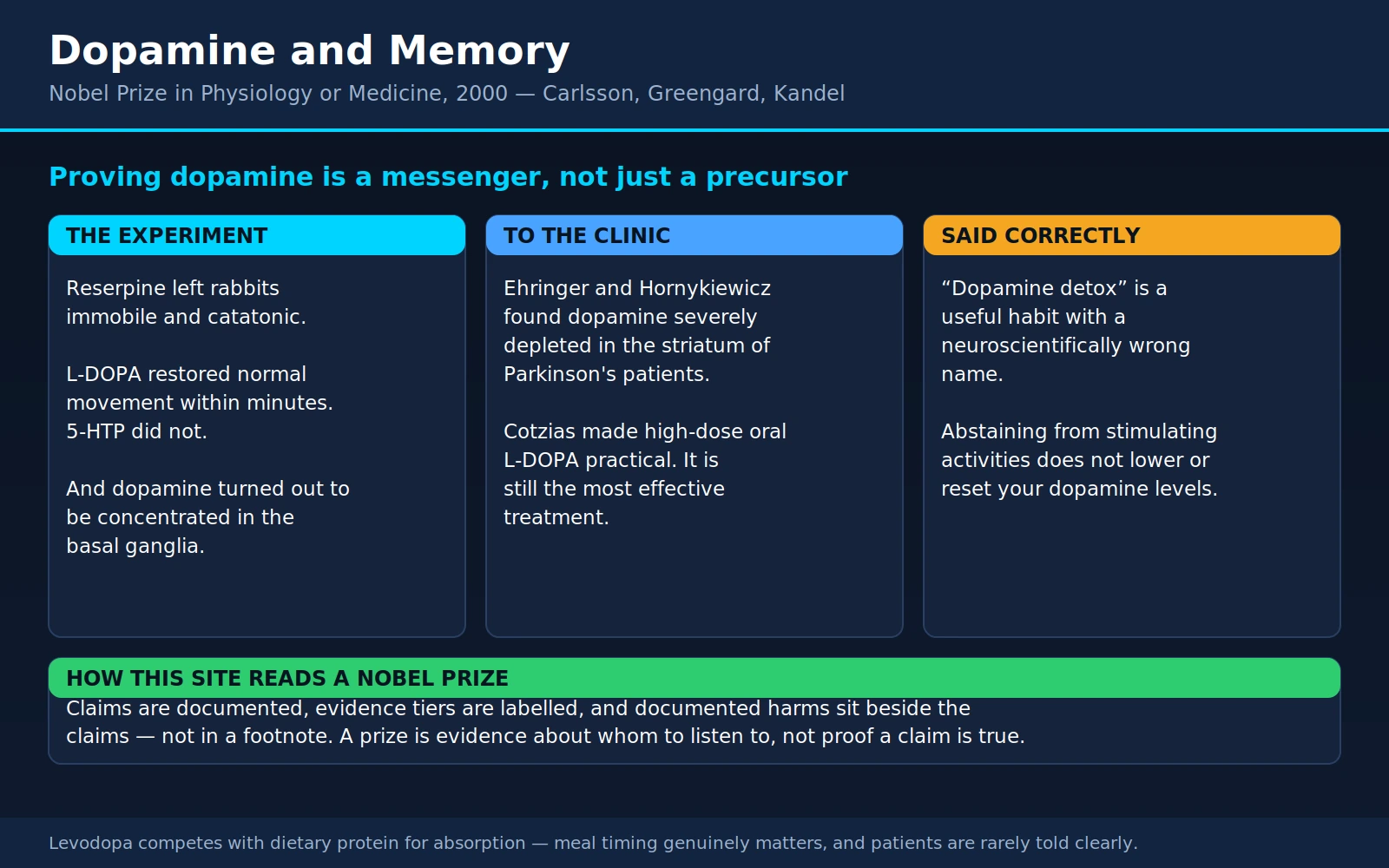
Table of Contents
- The Prize and the Three Men
- What Was Still Unsettled in 1960
- Carlsson's Reserpine Experiment
- From Rabbits to Patients
- Levodopa Today, Honestly
- Greengard: The Slow Conversation Between Cells
- Kandel: A Sea Slug and the Cell Biology of Memory
- The Dopamine You Hear About Online
- Carlsson's Second Act: Serotonin and the SSRIs
- Where Mainstream Medicine Agrees — and What Remains Debated
- What This Means for You Today
- Key Research Papers
- Connections
- Featured Videos
1. The Prize and the Three Men
The 2000 Nobel Prize in Physiology or Medicine went, in the committee's phrase, "for their discoveries concerning signal transduction in the nervous system." That is a dry sentence for a very large idea: it is the prize for working out how one brain cell actually changes another — not just in the thousandth of a second an electrical impulse lasts, but over minutes, hours, and a lifetime.
Three men shared it, and their work fits together like three chapters of one book.
Arvid Carlsson (1923–2018) was a Swedish pharmacologist at the University of Gothenburg. In the late 1950s he proved that dopamine is a neurotransmitter in its own right — not, as almost everyone then assumed, a mere waypoint on the road to noradrenaline — and that it is concentrated in the parts of the brain that govern movement. That single finding is the reason people with Parkinson's disease have an effective treatment today. Carlsson kept working into his eighties, and the second half of his career quietly seeded a second class of drugs entirely: the SSRI antidepressants.
Paul Greengard (1925–2019) spent most of his career at Rockefeller University in New York. He asked the next question: once dopamine lands on a receptor, then what? His answer — a cascade of second messengers and protein phosphorylation, a molecular relay race inside the receiving cell — explains how a signal that arrives in a millisecond can still be changing the cell's behaviour ten minutes later. Greengard did something with his prize money that is worth recording. He gave it away, using it to endow the Pearl Meister Greengard Prize for outstanding women in biomedical science. It is named for his mother, who died giving birth to him; he never knew her, and he said he wanted her name spoken. The prize has been awarded since 2004, and several of its recipients later won Nobels themselves.
Eric Kandel (born 1929) is at Columbia University in New York. He took the same molecular machinery and asked what it has to do with memory — and answered it by studying a large, slow, unglamorous sea slug. Kandel was born in Vienna and was nine years old at Kristallnacht in November 1938; his family's apartment was seized, his father's toy shop taken, and he and his brother were sent to relatives in Brooklyn the following year. He has written, at length and without sentimentality, that the experience is why he spent his life on memory — on why some events are burned in permanently while ordinary days dissolve, and on what a mind does with what it cannot put down. His memoir In Search of Memory (2006) makes the connection explicit.
Carlsson is the through-line of this page, because his discovery is the one that reaches furthest into ordinary medicine. But the three prizes are one prize, and the shape of the argument only makes sense with all three.
2. What Was Still Unsettled in 1960
By 1960 the question of whether nerves talk to each other chemically had, in principle, been settled. Otto Loewi and Henry Dale had shown in the 1920s and 1930s that a nerve releases a substance, and that the substance — not the electricity — is what carries the message across the gap to the next cell. They shared their own Nobel Prize for it in 1936.
But "settled in principle" is not the same as "settled everywhere." Loewi's frog-heart experiment was about a nerve talking to a muscle, out in the body. Inside the brain, a large and respectable group of neuroscientists still held that transmission was fundamentally electrical — that brain synapses were too fast, too tightly packed and too numerous for a chemical relay, and that the chemical story was a peripheral-nervous-system curiosity. This was not fringe opinion. It was a genuine, hard-fought disagreement, sometimes called the "soup versus sparks" debate, and it ran into the 1960s.
The second unsettled thing was dopamine itself. Chemists knew the molecule; it had been synthesised in 1910. But its place in biology was thought to be purely that of an intermediate. The body makes noradrenaline from the amino acid tyrosine in steps: tyrosine → L-DOPA → dopamine → noradrenaline. Dopamine sat in the middle of that assembly line, and an intermediate is, by definition, something you pass through on the way to the product that matters. Nobody was looking for a job for it, because nobody thought it had one.
Third, there was a clinical puzzle with no mechanism attached. Reserpine, a compound from the Indian shrub Rauwolfia serpentina, had come into Western medicine in the 1950s as a treatment for high blood pressure and for psychosis. It worked. It also, in a substantial minority of patients, produced a state that looked disturbingly like Parkinson's disease — slowness, rigidity, a mask-like face — and in some, a deep depression. Doctors noticed. Nobody could say why.
Carlsson's contribution was to see that these three loose threads were the same thread.
3. Carlsson's Reserpine Experiment
Working in Sweden in the mid-1950s — partly with Nils-Åke Hillarp, whose histochemical methods let the group see monoamines in tissue — Carlsson had established that reserpine works by emptying nerve terminals of their stored monoamines. It does not block a receptor; it wrecks the storage vesicles, and the amines leak out and are destroyed. Give an animal reserpine and its brain stores of serotonin, noradrenaline and dopamine collapse.
Reserpine-treated rabbits become profoundly immobile. They sit hunched and motionless, eyelids drooping, and will not move even when prodded — a state described at the time as sedation or catatonia. They are not asleep and they are not paralysed; the machinery is intact but nothing starts.
Then Carlsson, with Margit Lindqvist and Tor Magnusson, ran the experiment that made the prize. If the immobility came from losing a monoamine, then replacing that monoamine should reverse it. You cannot simply inject the monoamines themselves, because they do not cross from blood into brain. But their immediate chemical precursors do. So the team gave two precursors, in separate animals:
- L-DOPA, the precursor the brain converts into dopamine.
- 5-HTP (5-hydroxytryptophan), the precursor the brain converts into serotonin.
The result was not subtle, which is part of why it convinced people. Rabbits given L-DOPA came back to life within roughly ten to fifteen minutes — heads up, eyes open, moving normally, in some cases hyperactive. Rabbits given 5-HTP did not. Serotonin was restored; the animals stayed immobile. The 1957 paper in Nature that reported it is one page long.
That established a link between L-DOPA and movement. It did not yet prove dopamine was a transmitter, because a sceptic could argue that the L-DOPA was simply being carried further down the line to noradrenaline, and that noradrenaline was doing the work. Carlsson closed that door with chemistry. Working with Åke Bertler and Evald Rosengren, his group developed a fluorescence assay sensitive enough to measure dopamine in brain tissue directly, and in 1958 they published what they found in Science: dopamine is present in the brain in substantial amounts, it is not distributed like noradrenaline at all, and it is overwhelmingly concentrated in the basal ganglia — the deep structures that organise movement. In some of those regions there is far more dopamine than noradrenaline, which makes no sense if dopamine is only a precursor being consumed on the way to something else.
Put the two papers together and the conclusion is forced:
- Dopamine is a neurotransmitter in its own right, with its own distribution and its own job.
- That job includes the control of movement.
- Chemical transmission is not a peripheral curiosity — it is how the brain works.
The reception was cold. When Carlsson presented the work at a 1960 symposium in London, senior figures — including Henry Dale himself, who by then was the establishment — were unpersuaded, and the meeting has passed into folklore as a case study in how long a field can hold a wrong idea. Carlsson was right, and it took most of a decade for that to be generally conceded. He was 77 when the Nobel arrived.
4. From Rabbits to Patients
This is where the story stops being Carlsson's alone, and it matters to say so plainly. The path from a rabbit in Gothenburg to a prescription in a pharmacy ran through other people's laboratories and clinics, and they deserve their names on it.
Ehringer and Hornykiewicz, Vienna, 1960
Herbert Ehringer and Oleh Hornykiewicz, working in Vienna, took Carlsson's finding to the obvious next place: human brains at autopsy. Hornykiewicz had learned the relevant chemical methods in Hermann Blaschko's lab in Oxford. They obtained post-mortem brain tissue from people who had died with Parkinson's disease and with post-encephalitic parkinsonism, and measured dopamine and noradrenaline region by region.
What they found, published in German in Klinische Wochenschrift in December 1960, was severe and specific: dopamine in the striatum (the caudate nucleus and putamen) was drastically depleted in Parkinson's brains — in some regions reduced to a small fraction of normal — while other transmitters and other regions were comparatively spared. Hornykiewicz later described the striking visual impression that the tissue simply did not produce the colour the assay depended on.
Parkinson's disease had been described clinically in 1817 by James Parkinson and had had no biochemical explanation for 143 years. Now it had one, and the explanation came with a treatment written into it.
In 1961, Hornykiewicz and the neurologist Walther Birkmayer gave intravenous L-DOPA to patients with Parkinson's disease. The effect, in the patients who responded, was dramatic — people who had been rigid and nearly immobile stood and walked. It was also brief, and the intravenous route with the doses then used produced considerable nausea. Similar early trials elsewhere gave mixed and sometimes disappointing results, and for several years L-DOPA looked like a striking laboratory demonstration rather than a therapy.
Cotzias, New York, 1967 and 1969
The person who turned it into medicine was George Cotzias, a Greek-American physician-scientist at Brookhaven National Laboratory. His insight was about dose and route. Nearly all the L-DOPA in a small intravenous dose never reaches the brain; the enzyme that converts it into dopamine is present throughout the body, especially in the gut wall, liver and kidney, and it converts the drug peripherally, where it causes nausea and does nothing useful. Cotzias reasoned that if you gave it by mouth and pushed the dose up slowly, over weeks, letting patients accommodate to the nausea, enough would eventually reach the brain to matter.
He was right. His 1967 report in the New England Journal of Medicine and the fuller 1969 paper on chronic treatment described patients on gram-level daily oral doses whose tremor, rigidity and slowness improved to a degree nothing in medicine had previously achieved for this disease. Levodopa was approved in the United States in 1970.
The "awakenings"
In 1969, at Beth Abraham Hospital in the Bronx, the neurologist Oliver Sacks gave L-DOPA to a group of patients with post-encephalitic parkinsonism — survivors of the encephalitis lethargica epidemic of 1916–1927, who had spent decades in a state of profound immobility and unresponsiveness. Several of them responded, some of them spectacularly, and Sacks wrote about it in Awakenings (1973), later a film.
The story is worth telling accurately rather than dramatically, because the dramatic version has done some harm. Three things are true at once. First, the responses were real, and for some patients they returned a self that had been inaccessible for thirty years. Second, they were unstable: within weeks to months many patients developed violent swings between mobility and immobility, dyskinesias, and in some cases psychiatric disturbance, and the dose could not be titrated to hold them in the good state. Third, these were not typical Parkinson's patients — post-encephalitic parkinsonism is a different, far more severe and largely extinct condition, and the extremity of both the response and the collapse is not what a person with ordinary Parkinson's disease should expect from levodopa.
What is generalisable from that episode is the shape of the problem that still defines levodopa therapy: the drug's effect narrows over time, and the difference between too little and too much gets smaller. That is section 5.
5. Levodopa Today, Honestly
More than fifty years after approval, levodopa remains the most effective symptomatic treatment for Parkinson's disease that exists. Nothing has displaced it. Every newer class — dopamine agonists, MAO-B inhibitors, COMT inhibitors, amantadine — is measured against it, and none of them matches it for raw effect on slowness and rigidity. If you have Parkinson's and levodopa is working for you, you are on the best drug there is.
It is also a drug with real, well-characterised limitations. Here is what a person taking it should understand.
Why it is never given alone: carbidopa
Your prescription is almost certainly carbidopa/levodopa (Sinemet and generics; in much of the world benserazide/levodopa, as Madopar, does the same job). Carbidopa is not a second Parkinson's drug. It is a bodyguard.
The enzyme that turns levodopa into dopamine — aromatic L-amino acid decarboxylase — is everywhere in the body, not just the brain. Without protection, most of a swallowed dose is converted to dopamine in the gut wall and bloodstream, where it cannot enter the brain (dopamine does not cross the blood–brain barrier; levodopa does) and where it causes nausea, vomiting and drops in blood pressure on standing. Carbidopa blocks that enzyme outside the brain and does not cross into the brain itself. The consequences are large:
- Much less nausea and vomiting, which is what made high-dose therapy tolerable in the first place.
- Roughly a four- to five-fold reduction in the levodopa dose needed for the same brain effect.
- Less orthostatic hypotension — though not none.
Practical consequence: about 75–100 mg of carbidopa a day is needed to saturate the peripheral enzyme. Someone on a low total dose (say 25/100 twice daily, giving 50 mg of carbidopa) may get persistent nausea simply because there is not enough carbidopa, and the fix is extra carbidopa rather than less levodopa. This is a real and under-recognised conversation to have with a neurologist.
Motor fluctuations, wearing-off and dyskinesia
Early in the disease, levodopa produces a smooth, all-day benefit; the surviving dopamine neurons still buffer the drug, storing and releasing it gradually. As more of those neurons are lost, that buffer goes, and the brain's dopamine level starts to follow the drug level in the blood almost minute by minute. This produces the classic complications:
- Wearing-off — the benefit fades before the next dose is due. Usually the earliest sign, and often noticed first as returning tremor, stiffness, or a non-motor symptom such as anxiety, sweating, pain or mental fog in the last hour before a dose.
- Delayed "on" and dose failure — a dose takes far longer than usual to work, or does not work at all. Almost always an absorption problem (see the protein section below), not a sign the drug has stopped working.
- Peak-dose dyskinesia — involuntary, flowing, dance-like movements when the drug level is at its highest. Important point that surprises people: dyskinesia is usually much more distressing to family members than to the person having it. Many patients, asked to choose, prefer mild dyskinesia to being "off."
- On–off fluctuations — abrupt, sometimes unpredictable switching between mobile and immobile states, in advanced disease.
Roughly speaking, motor complications appear in a substantial minority of patients within about five years of starting levodopa and in the majority by ten, with younger age at onset being the strongest risk factor.
The "levodopa-sparing" debate, and where it landed
For roughly three decades, a common piece of advice was: delay levodopa as long as you can. Start with a dopamine agonist or an MAO-B inhibitor, save levodopa for later, and you will postpone dyskinesia. Some patients were told, more alarmingly, that levodopa is toxic to dopamine neurons and hastens the disease. Neither claim survived being tested properly.
Three lines of evidence closed the question:
- ELLDOPA (Fahn and colleagues, 2004). A placebo-controlled trial of levodopa in early Parkinson's. Patients on levodopa did better, and — critically — after a washout period they were still better than placebo, not worse. There was no clinical signal of levodopa toxicity. (An imaging sub-study pointed the other way and has been argued about ever since, but the clinical outcome did not show harm.)
- LEAP (Verschuur and colleagues, 2019). A delayed-start trial: one group started levodopa immediately, the other 40 weeks later. At 80 weeks the two groups were indistinguishable. Levodopa is neither disease-modifying nor disease-accelerating. Starting earlier costs you nothing in the long run — and buys you 40 weeks of feeling better.
- The Ghana study (Cilia and colleagues, 2014). This is the elegant one. In sub-Saharan Africa, many patients could not obtain or afford levodopa for years after diagnosis — an accidental experiment impossible to run deliberately. When they finally started it, they developed dyskinesia and fluctuations on a timetable set by how long they had had the disease and what dose they were on, not by how long they had been taking the drug. Withholding levodopa did not bank any protection; it just bought years of avoidable disability.
Meanwhile PD MED (Gray and colleagues, 2014), a large pragmatic trial comparing levodopa, dopamine agonists and MAO-B inhibitors as initial therapy, found small but persistent quality-of-life advantages for starting with levodopa, and more patients discontinuing the agonists because of side effects.
Where this leaves you. Current practice is that levodopa is a reasonable first-line treatment whenever motor symptoms are affecting your life, and that the old blanket advice to delay it is obsolete. Nuance remains — a person diagnosed at 45 faces a different fifty-year arithmetic than a person diagnosed at 78, and dopamine agonists carry their own serious risk of impulse-control disorders (see section 11) — so this is a real discussion to have, not a formula. But if you were told years ago to hold off on levodopa "to save it for when you need it," that advice has been superseded, and it is worth asking about again.
Protein, timing and the transporter nobody explains to patients
This is the most practically useful thing on this page, and it is astonishing how rarely it is spelled out clearly.
Levodopa is an amino acid. It is not absorbed from the gut by simple diffusion; it is carried across the wall of the small intestine by a specific transporter for large neutral amino acids (LNAAs). The same transporter, at the blood–brain barrier, is what carries levodopa into the brain. And the same transporter carries leucine, isoleucine, valine, phenylalanine, tyrosine, tryptophan, methionine and histidine — which is to say, the amino acids that make up dietary protein.
Those amino acids compete with levodopa. Twice: once at the gut, once at the brain. Nutt and colleagues demonstrated this directly back in 1984, showing that infusing large neutral amino acids could switch a patient from "on" to "off" without changing the drug at all.
What this means in practice:
- Take levodopa at least 30 minutes before, or at least 60–90 minutes after, a protein-containing meal. Not "with food" unless someone has specifically told you to. A steak, an omelette, a protein shake or a large glass of milk taken alongside a dose can genuinely make that dose fail.
- If a dose makes you nauseated on an empty stomach, take it with a small low-protein snack — a couple of crackers, apple sauce, a piece of fruit, a plain biscuit. Carbohydrate does not compete for the transporter.
- A "dose failure" is usually a delivery problem, not a drug failure. Common causes: a protein meal, constipation, delayed stomach emptying (very common in Parkinson's), or taking iron supplements at the same time — iron binds levodopa in the gut and both are absorbed less. Separate iron from levodopa by at least two hours.
- Protein redistribution — shifting most of the day's protein to the evening meal, so that daytime doses have a clear run — has been studied in patients with motor fluctuations. Cereda and colleagues' systematic review found it does improve motor function in fluctuating patients. But it should be done with a dietitian and only if you actually have fluctuations. People with Parkinson's are already at high risk of weight loss and muscle wasting, and an unsupervised low-protein diet trades one problem for a worse one. This is a redistribution, not a restriction.
6. Greengard: The Slow Conversation Between Cells
Carlsson showed that dopamine is a messenger. Greengard asked what happens after the message is delivered — and found that the answer is much stranger and more interesting than a switch being flipped.
The textbook picture of a synapse is fast transmission: a transmitter crosses the gap, binds a receptor that is itself an ion channel, the channel opens, ions flow, and the receiving cell fires or doesn't. Start to finish, under a millisecond. That is how glutamate and GABA do most of their work, and it is what the "sparks" side of the old debate was really arguing about.
Greengard's insight was that a large class of transmitters — dopamine, serotonin, noradrenaline, the opioid peptides, and many more — do not work that way at all. They bind receptors that are not ion channels. Instead the receptor activates a G protein inside the cell, which activates an enzyme, which produces a second messenger (classically cyclic AMP), which activates a protein kinase, which attaches phosphate groups onto other proteins — ion channels, receptors, structural proteins, transcription factors — changing what each of them does.
This is slow synaptic transmission, and the word "slow" is doing real work. Adding a phosphate to a protein takes longer than opening a channel, but it also lasts longer: seconds, minutes, in some cases much longer. It is the mechanism by which a signal that arrives in an instant can leave the receiving cell in a different state for the rest of the afternoon. It is not how a neuron sends a bit of information; it is how a neuron changes its own settings.
DARPP-32
The molecule Greengard's laboratory is most identified with is DARPP-32 — dopamine- and cyclic-AMP-regulated phosphoprotein of 32 kilodaltons, described in a series of papers with Charles Ouimet, Hugh Hemmings, Angus Nairn, Ivar Walaas and others from the early 1980s. It is enriched, strikingly, in exactly the dopamine-rich regions Carlsson had identified.
DARPP-32 is an amplifier and a switchboard. When dopamine acts on a D1 receptor, cyclic AMP rises, protein kinase A is activated, and it phosphorylates DARPP-32 at one particular site. In that phosphorylated form, DARPP-32 becomes a potent inhibitor of protein phosphatase-1 — the enzyme whose job is to remove phosphates. So dopamine simultaneously turns on the machinery that adds phosphates and turns off the machinery that removes them. The signal is amplified and sustained. Phosphorylation at a different site does the opposite, switching DARPP-32 into an inhibitor of PKA instead — which makes it a genuine integrator, not a simple relay.
And it does not listen only to dopamine. Glutamate, serotonin, adenosine, GABA, nitric oxide and opioids all converge on DARPP-32's phosphorylation state. It is a place where signals from different systems are added up before the cell decides what to do.
Why this matters for drugs
Three consequences that reach into ordinary prescribing:
- It explains delay. A drug that blocks a receptor does so within an hour of the first dose. Yet antipsychotics take days to weeks for full effect, and antidepressants classically two to six weeks. If the therapeutic effect were the receptor block, that would be inexplicable. If the therapeutic effect is a downstream, slow, phosphorylation-and-gene-expression-dependent remodelling, the delay is exactly what you would predict.
- It explains tolerance and sensitisation. The same signal delivered repeatedly changes the cascade itself. This is the level at which drug tolerance, dependence and the long-lasting changes of addiction actually live. Virtually every drug of abuse — cocaine, amphetamine, nicotine, alcohol, opioids, caffeine — alters DARPP-32 phosphorylation, and so do antipsychotics, from opposite directions.
- It opened a new layer to aim at. If the receptor is only the doorway, you can in principle target the corridor instead, and get more selectivity. That has been a genuinely productive idea in the laboratory. It has been a harder sell in the clinic — drugs aimed at downstream targets such as phosphodiesterase-10A were taken into large schizophrenia trials in the 2010s and largely failed. Worth saying plainly: this is a real and important layer of biology that has not yet produced the drugs people hoped it would.
7. Kandel: A Sea Slug and the Cell Biology of Memory
Kandel's problem was memory, and his strategy was reductionism carried out with some nerve. In the early 1960s the respectable approach to memory was to study it in mammals, where memory is obviously interesting and obviously complicated. Kandel went the other way and chose Aplysia californica, a sea hare — a large marine slug with about 20,000 neurons, some of them big enough to see with the naked eye and, crucially, identifiable from animal to animal. You can find the same individual cell in one slug after another and give it a name. In a mouse you cannot.
His bet was that the molecular grammar of memory — the cellular mechanism by which experience leaves a lasting trace — would be conserved across evolution even though the content of memory obviously is not. The bet paid off.
Two forms of learning in a slug
Aplysia has a gill it withdraws when its siphon is touched — a simple protective reflex, mediated by a circuit small enough to map completely. And it learns:
- Habituation. Touch the siphon gently, repeatedly, with nothing bad happening, and the withdrawal gets smaller and eventually nearly stops. The animal has learned that this stimulus is not worth reacting to. Kandel, with Vincent Castellucci, Irving Kupfermann and Harold Pinsker, showed in 1970 that this corresponds to a measurable weakening of a specific synapse — less transmitter released from the sensory neuron onto the motor neuron. The memory is in the synapse.
- Sensitisation. Give the animal a noxious shock to the tail, and afterwards even a light siphon touch produces an exaggerated withdrawal. The same synapse is now strengthened. This is the elementary form of learning that fear and alarm are built from.
Short-term versus long-term: the crucial distinction
The finding that generalised furthest is the difference between the two timescales.
Short-term memory modifies proteins the cell already has. A single tail shock releases serotonin onto the sensory neuron's terminals. Serotonin raises cyclic AMP; cyclic AMP activates protein kinase A; PKA phosphorylates potassium channels and other proteins already sitting there. The action potential broadens slightly, more calcium enters, more transmitter is released, and the synapse is stronger. This lasts minutes to an hour and requires no new gene expression at all. It is Greengard's slow transmission, doing memory.
Long-term memory requires the cell to build something new. Repeat the training — five spaced shocks rather than one — and something categorically different happens. PKA and MAP kinase move into the nucleus. There they act on a transcription factor called CREB (cyclic-AMP response element binding protein): activating CREB-1, which switches genes on, and relieving the brake imposed by CREB-2, which holds them off. New genes are transcribed, new proteins are made, and — the part that still startles people — the neuron grows new synaptic connections. The number of contacts between the two cells physically increases. Memory lasting days or weeks is a structural change you can photograph.
The decisive experiment came in 1990, when Pradeep Dash, Binyamin Hochner and Kandel injected into the nucleus a short piece of DNA carrying CREB's binding sequence — a decoy, soaking up CREB before it could reach the real genes. Long-term facilitation was blocked. Short-term facilitation was untouched. That is about as clean a dissociation as cell biology offers: two forms of memory, two mechanisms, separable by a single molecular intervention.
The rule that came out of it — short-term memory modifies existing proteins, long-term memory requires new gene expression and new protein synthesis, and the switch between them runs through CREB — has since been confirmed in fruit flies, in mice, in the mammalian hippocampus, and everywhere anyone has looked. Kandel's later work moved into mouse hippocampus, long-term potentiation and spatial memory, and into the question of how a memory stays put at one particular synapse and not its neighbours (his answer involves a prion-like protein, CPEB, which is fascinating and considerably less settled).
What a slug can and cannot tell you about your memory
Honesty is owed here, because this is exactly the kind of finding that gets over-extended in popular writing.
What the evidence supports: the molecular machinery is genuinely conserved. CREB-dependent transcription, the requirement for protein synthesis in long-term but not short-term memory, and structural remodelling of synapses are established across species including mammals. Blocking protein synthesis in a rodent brain during a critical window after learning prevents long-term memory in exactly the way the Aplysia work predicts.
What it does not support: the reflexes Kandel studied are implicit, non-declarative memory — the memory of how, not of what. Human memory for facts and events is declarative, depends on the hippocampus and medial temporal lobe (as Brenda Milner's work with the patient H.M. established), and involves a systems-level consolidation process — the slow reorganisation of a memory across the cortex over months and years — for which a sea slug offers no model at all. Nor does Aplysia tell you anything about how memories are combined into a narrative, distorted on recall, shaped by language, or experienced. A 20,000-neuron animal is a beautiful place to find the mechanism of a synapse. It is not a small human.
And a commercial footnote worth knowing: the obvious application — drugs that boost CREB signalling to enhance memory — has been pursued hard since the 1990s, including by companies Kandel himself co-founded, and has not produced an approved memory-enhancing medicine. If you see a supplement marketed on "CREB activation," that claim is borrowing the prestige of this research without any of its evidence.
8. The Dopamine You Hear About Online
Dopamine is probably the most misdescribed molecule on the internet. Carlsson's discovery has been flattened into a folk theory — dopamine is "the pleasure chemical," you get "hits" of it, you can deplete it and "reset" it — and an industry has grown on top of that theory. Here is what the evidence actually supports, tiered.
🟢 Established
- Dopamine is a neurotransmitter with several largely separate systems. The nigrostriatal pathway governs movement, and its loss causes Parkinson's disease. The mesolimbic and mesocortical pathways are involved in motivation, reinforcement learning and aspects of cognition. The tuberoinfundibular pathway suppresses prolactin release — which is why dopamine-blocking drugs can cause breast milk production and menstrual changes.
- Dopamine neurons fire continuously at a low baseline rate, with brief bursts and pauses on top. There is no "empty" and no "full."
- The best-supported description of what those bursts encode is reward prediction error — the difference between what you got and what you expected — and, behaviourally, wanting rather than liking. Animals with dopamine systems disabled still show normal pleasure responses to sweet tastes; what they lose is the drive to go and get them. Dopamine is not the pleasure chemical. It is closer to the pursuit chemical.
- Levodopa raises brain dopamine and treats Parkinson's disease. Drugs blocking D2 receptors treat psychosis and can cause drug-induced parkinsonism. Stimulants increase synaptic dopamine.
🟡 Plausible but oversold
"Dopamine hits" from phones and apps. The underlying observation is real: apps are designed around variable-ratio reinforcement — unpredictable rewards on an unpredictable schedule — which is the most powerful reinforcement schedule known, and which does engage dopaminergic reward-prediction machinery. Compulsive use is a genuine phenomenon with genuine costs. But describing each notification as a "dopamine hit," on the model of a drug dose, is sloppy in a way that matters. The dopamine change from checking a phone is not remotely comparable in magnitude to that from a stimulant drug, and framing it as a chemical assault tends to displace the more useful framing, which is behavioural: what is the schedule of reinforcement here, and how would I change it?
L-tyrosine supplements. Tyrosine is the amino acid the body builds dopamine from, so "take tyrosine, make more dopamine" sounds inevitable. It mostly isn't. The rate-limiting step is the enzyme tyrosine hydroxylase, which in a normally fed person is already close to saturated with substrate and is regulated by feedback rather than supply. Adding more raw material to a production line that is limited by machine speed does not increase output. What the human evidence does suggest — Jongkees and colleagues' 2015 review is a fair summary — is a narrow effect: tyrosine may support cognitive performance in short-term, catecholamine-depleting stress, such as cold exposure, sleep deprivation or intense multitasking, in people whose catecholamines are being consumed faster than they are made. There is no good evidence it lifts mood in healthy people, treats depression, or does anything for Parkinson's disease. See our Tyrosine page for the fuller picture.
🔴 Wrong, or wrong enough to matter
"Dopamine detox" / "dopamine fasting." This one deserves its own paragraph because the science is unambiguous and the branding has done real confusion.
You cannot fast from dopamine. Abstaining from your phone, from video games, from sugar, from music or from conversation does not lower your dopamine levels, does not "reset" your receptors over a weekend, and does not restore sensitivity to ordinary pleasures by any measured mechanism. Dopamine is not a consumable that you spend and replenish. It is continuously synthesised, released, recaptured and recycled, and it is required — for moving, for staying motivated, for working memory, for regulating prolactin. A brain with genuinely reduced dopamine signalling does not become newly sensitive to simple pleasures. It becomes slow, rigid and apathetic. That is Parkinson's disease.
The technique's originator, the psychologist Cameron Sepah, has said publicly that "dopamine fasting" was a tongue-in-cheek name, that it was never meant literally, and that what he described was stimulus control — a standard, decades-old cognitive-behavioural technique for reducing impulsive behaviour by changing your environment and deliberately scheduling time away from highly stimulating, low-effort activities. The name escaped and the concept behind it was lost in transit; by 2019 there were retreats and apps selling neurochemical renewal.
So: the practice can be worth doing and the explanation is false. Spending a day without your phone, doing something effortful, and noticing what you actually want is a reasonable thing to try. It works, when it works, because of attention, habit and boredom tolerance — not chemistry. If someone is selling you a protocol on the neurochemistry, they do not know the neurochemistry.
Mucuna pruriens (velvet bean, kapikachhu in Ayurvedic medicine) needs the most careful handling on this page, because unlike almost everything else in the supplement aisle, it genuinely works — and that is exactly the problem.
Mucuna seed contains real L-DOPA, typically in the range of 3–6% by weight of the dried seed powder. This is not a marketing claim; it is the same molecule as the prescription drug. Two proper studies have been done in Parkinson's patients:
- Katzenschlager and colleagues (2004) gave eight patients single doses of 15 g and 30 g Mucuna powder against standard levodopa/carbidopa. The 30 g dose (delivering roughly 1,000 mg of L-DOPA) worked: faster onset, longer duration of benefit, and no more dyskinesia than the comparison at those doses.
- Cilia and colleagues (2017) compared single doses of high- and low-dose Mucuna with levodopa/benserazide in 18 patients, and found comparable motor benefit with fewer acute adverse effects, but a shorter duration of effect and a need for a higher L-DOPA dose without a decarboxylase inhibitor.
Read those carefully. Both are single-dose studies in fewer than twenty patients each, conducted with characterised, measured plant material in a hospital. Neither says anything about taking it every day for a year. And several things follow that make Mucuna a poor substitute for a prescription:
- No carbidopa. Prescription levodopa comes packaged with a peripheral decarboxylase inhibitor for the reasons in section 5. Mucuna does not. More of the dose is converted outside the brain, meaning more nausea, vomiting and blood-pressure drops, and a higher dose needed for the same effect. This is the pre-1975 way of taking levodopa, and it was abandoned for good reasons.
- The dose is unknown. L-DOPA content varies substantially between species, growing conditions, preparation methods, products and batches. A supplement label stating a percentage is rarely backed by batch testing. You are dosing a potent dopaminergic drug by guesswork.
- Stacking is the real danger. Somebody already on levodopa who adds Mucuna is silently increasing their total levodopa dose. That is the recipe for dyskinesia, hallucinations, confusion and orthostatic collapse — and because the extra dose is invisible on the medication list, it can take a long time for anyone to work out why.
- Interactions are real. With MAO inhibitors (and with high doses of the MAO-B inhibitors used in Parkinson's), with antihypertensives, with dopamine-blocking antiemetics and antipsychotics, and with diabetes medication (Mucuna can lower blood glucose). Raw or under-prepared seed can cause serious gastrointestinal effects.
- Stopping abruptly matters. Any substantial ongoing dopaminergic exposure — prescription or plant — should not be stopped suddenly. Abrupt withdrawal of dopaminergic drugs can precipitate a rare but dangerous parkinsonism–hyperpyrexia syndrome.
The bottom line on Mucuna: it is a real pharmacological agent, not a gentle herbal tonic, and "natural" here means "unmeasured," not "safe." There are settings — low-income countries where pharmaceutical levodopa is unaffordable or unavailable — where it is a serious and defensible option, and that is worth knowing. In a country with access to prescription carbidopa/levodopa it is a worse version of a drug you can get properly dosed. If you are taking it or thinking about it, the single most important thing is to tell your neurologist, because it changes their calculation of your dose.
9. Carlsson's Second Act: Serotonin and the SSRIs
Most scientists get one idea. Carlsson's laboratory produced a second one that changed a different branch of medicine entirely.
Having established how reserpine emptied monoamine stores, his group had the tools to study the opposite process: reuptake, the mechanism by which a nerve terminal recaptures the transmitter it has just released. In a series of papers around 1969 — Carlsson with Hans Corrodi, Kjell Fuxe and Tomas Hökfelt — they showed that the existing tricyclic antidepressants blocked the reuptake of noradrenaline and serotonin to different degrees, that the two could be told apart pharmacologically, and that a drug could in principle be built to block the serotonin transporter selectively while leaving noradrenaline alone.
That is the founding idea of the SSRI. Carlsson pursued it with the Swedish company Astra, and the result was zimelidine (Zelmid) — the first selective serotonin reuptake inhibitor to reach the market, launched in Europe in 1982. Its commercial life was short: it was withdrawn in 1983 after reports of hypersensitivity reactions and cases of Guillain–Barré syndrome. But the class survived the compound. Fluoxetine reached the United States in 1987, and the SSRIs became among the most prescribed drugs in the world.
What SSRIs do and do not do
This section tries to be fair in both directions, because the public conversation has swung hard from one overclaim to its mirror image.
The "chemical imbalance" story was always a simplification, and the field knew it. The pitch — depression is caused by low serotonin, an antidepressant tops it up, like insulin for diabetes — was a pharmaceutical marketing frame and a doctor's shorthand for a complicated conversation. It was never a serious model in academic psychiatry, for reasons obvious even in the 1970s: SSRIs raise synaptic serotonin within hours but take weeks to work; nobody has ever measured a patient's serotonin to make a diagnosis; and depleting tryptophan in healthy volunteers does not reliably make them depressed. In 2022 Moncrieff and colleagues published an umbrella review concluding there is no consistent evidence that depression is caused by low serotonin or reduced serotonin activity. On the narrow question it asked, that conclusion is a reasonable reading of the literature — and it is largely what specialists already believed.
But "the simple story is wrong" does not mean "the drugs don't work," and the leap from one to the other is a serious error. Whether a drug helps and whether it corrects a measured deficiency are two different questions. Paracetamol relieves a headache without any headache being caused by a paracetamol deficiency. The evidence on efficacy is separate and it is substantial: Cipriani and colleagues' 2018 network meta-analysis pooled 522 trials and more than 116,000 participants and found all 21 antidepressants studied more effective than placebo for acute major depression in adults. Several researchers, in a direct rebuttal to the umbrella review (Jauhar and colleagues, 2023), argued that its method pooled heterogeneous literatures in a way that obscured real evidence of serotonergic involvement, and that "no simple deficiency" is not the same as "no role."
An honest summary looks like this:
- Antidepressants outperform placebo in acute major depression, and the difference is real, not an artefact.
- The average advantage over placebo is modest — a standardised effect size around 0.3 in most analyses — and much of the total improvement people experience in trials occurs in the placebo arms too. The benefit is generally larger in more severe depression than in mild.
- Averages conceal a lot. Some people respond substantially and some not at all, and we cannot yet predict which in advance. "Modest on average" and "life-changing for this particular person" are both true statements.
- They are not correcting a deficiency, and nobody should be told they are. The mechanism is more likely something downstream — changes in neuroplasticity, in emotional processing bias, in the systems Greengard's cascades govern — which fits the weeks-long delay far better than a simple topping-up would.
- Side effects deserve straight talk: sexual dysfunction is common and routinely under-disclosed, and discontinuation symptoms are real, sometimes severe and sometimes prolonged. They were badly underestimated for years. Stopping should be tapered slowly — often far more slowly, and in smaller final steps, than the standard advice used to suggest — and never abruptly.
- For mild depression, exercise, structured psychological therapy and attention to sleep are reasonable first choices, and guidelines say so.
Carlsson himself, characteristically, kept arguing about the mechanism for the rest of his life. He spent his later years on dopamine stabilisers — compounds meant to nudge a dysregulated system towards its middle rather than pushing it in one direction — on the grounds that the "more of this, less of that" model of psychiatric drugs was too crude. That argument is still live.
10. Where Mainstream Medicine Agrees — and What Remains Debated
Not in dispute
- Dopamine is a neurotransmitter in its own right, and chemical transmission is the normal mode of communication in the brain.
- Loss of dopamine-producing neurons in the substantia nigra, and the resulting depletion of dopamine in the striatum, causes the motor features of Parkinson's disease.
- Levodopa — given with a peripheral decarboxylase inhibitor — is the most effective symptomatic treatment for Parkinson's disease available, and has been for half a century.
- Levodopa does not accelerate the underlying disease. Delaying it does not bank protection against later complications.
- Slow synaptic transmission via second messengers and protein phosphorylation is a real and central mode of brain signalling, and DARPP-32 is a genuine integration point for dopamine and other systems.
- Short-term memory depends on modification of existing proteins; long-term memory requires new gene expression, new protein synthesis and structural change at synapses. This is conserved from invertebrates to mammals.
- Exercise improves motor symptoms, balance and quality of life in Parkinson's disease.
- SSRIs are more effective than placebo for acute major depressive disorder in adults.
Genuinely debated
- Which drug to start first, and for whom. Levodopa first is now the mainstream default, but age at onset, occupation, cognitive status and impulse-control risk all shift the calculation, and reasonable specialists differ.
- Whether "continuous dopaminergic stimulation" reduces dyskinesia. The theory says smoother drug delivery should mean fewer complications; the STRIDE-PD trial, which added a COMT inhibitor early to smooth levels, found more dyskinesia, not less. Infusion therapies help advanced patients, but the theory behind them is not settled.
- Whether anything slows Parkinson's disease. Nothing has been shown to. Many candidates — including exercise, for which the mechanistic case is genuinely interesting — are under study, and no disease-modifying therapy is established.
- How far the Aplysia model extends. The molecular grammar transfers. Whether it explains human declarative memory, and how systems-level consolidation across the cortex relates to synapse-level change, is open.
- What SSRIs actually do. The serotonin-deficiency model is dead; the replacement is not agreed. Candidates include changes in neuroplasticity, in emotional-processing bias, and in downstream signalling cascades.
- Whether the downstream signalling layer is druggable in humans. A decade of trials aimed at targets beyond the receptor has produced mostly failures. The biology is right; the therapeutic translation has not arrived.
11. What This Means for You Today
If you or someone you love has Parkinson's disease
- Take levodopa on a schedule, and treat the schedule as the medicine. Set alarms. As the disease progresses, being 45 minutes late for a dose stops being trivial.
- Separate levodopa from protein. Thirty minutes before a meal, or 60–90 minutes after, is the practical rule. If a dose reliably fails at one particular time of day, look at what you ate.
- Separate levodopa from iron supplements by at least two hours.
- Treat constipation seriously. It is one of the commonest non-motor features of Parkinson's, and by slowing stomach emptying it makes drug absorption erratic. Fixing it makes doses more predictable.
- Never stop levodopa abruptly. Sudden withdrawal of dopaminergic medication can trigger a rare, dangerous syndrome resembling neuroleptic malignant syndrome — high fever, extreme rigidity, confusion. This also means: if you are admitted to hospital, your Parkinson's medication must be given on your schedule, not the ward drug round. Take your own supply and a written timetable, and say this out loud to the nurse in charge.
- Watch out for the wrong anti-nausea drug. Metoclopramide and prochlorperazine block dopamine receptors and can make Parkinson's markedly worse. Domperidone or ondansetron are generally the safer choices. The same caution applies to most antipsychotics.
- Ask directly about impulse-control disorders — new gambling, compulsive shopping, binge eating, hypersexuality. These are a well-documented effect of dopamine agonists (less so of levodopa), they can be financially and personally catastrophic, and patients very rarely volunteer them. Families usually notice first. This is treatable by adjusting the medication, and there is nothing shameful in it.
- Keep a symptom diary before appointments — a few days of when you took each dose, when you felt "on," and when you felt "off." Twenty minutes of writing gives a neurologist more to work with than an hour of recollection.
- Tell your clinicians about every supplement, especially Mucuna pruriens, and especially if you are already on levodopa.
Exercise: the one non-drug intervention with real evidence
This is not a wellness platitude. The evidence base in Parkinson's is better than for almost any other lifestyle intervention in any neurological disease.
- The SPARX phase 2 trial (Schenkman and colleagues, 2018) randomised people with newly diagnosed, untreated Parkinson's to high-intensity treadmill exercise (80–85% of maximum heart rate, four times weekly), moderate-intensity exercise, or usual care. High-intensity exercise was safe and feasible, and motor scores in that group were essentially unchanged over six months while the usual-care group worsened. This is a phase 2 result — it establishes feasibility and a signal, not proof of disease modification — but it is a strong signal.
- A Cochrane network meta-analysis (Ernst and colleagues, 2024) pooling well over 150 trials found that several exercise modalities — aerobic, resistance, dance, aquatic, gait and balance training — improve motor symptom severity and quality of life compared with no exercise. No single type is clearly best.
Since no single modality wins, the practical answer is: the exercise you will actually keep doing. A sensible mix is aerobic work hard enough to be out of breath, resistance training twice a week, and something that challenges balance and amplitude of movement — dance, boxing-style classes, tai chi, or a Parkinson's-specific programme. Exercise is an addition to medication, never a replacement for it.
When to ask for a referral
- To a movement disorder specialist — a neurologist with specific Parkinson's expertise — if you are managing fluctuations, if the diagnosis is uncertain, if you are young at onset, or if you have not had a specialist review in over a year. Outcomes are measurably better with specialist care.
- To a Parkinson's nurse specialist, where the service exists. They are frequently the most useful person in the whole system for practical medication problems.
- To physiotherapy with Parkinson's training (programmes such as LSVT BIG target the shrinking of movement amplitude), and to speech and language therapy (LSVT LOUD) for a quiet or fading voice, which is common and very treatable.
- To discuss advanced therapies — deep brain stimulation, intestinal levodopa gel, apomorphine or subcutaneous levodopa infusion — if fluctuations are no longer controllable with oral medication. These have eligibility criteria and long assessment pathways, so the conversation should start earlier than most people start it.
If you are just confused by dopamine content online
Three rules of thumb. Dopamine is about wanting, not liking — any claim that frames it purely as a pleasure chemical is already off. You cannot deplete or reset it by abstaining from anything; the behavioural technique may still be worth doing, but not for the reason given. And anything that genuinely raises brain dopamine is a drug, whether it arrives in a blister pack or a bag of seed powder, and should be treated with a drug's seriousness.
12. Key Research Papers
- Carlsson A, Lindqvist M, Magnusson T. 3,4-Dihydroxyphenylalanine and 5-hydroxytryptophan as reserpine antagonists. Nature 1957;180(4596):1200
- Carlsson A, Lindqvist M, Magnusson T, Waldeck B. On the presence of 3-hydroxytyramine in brain. Science 1958;127(3296):471
- Ehringer H, Hornykiewicz O. Distribution of noradrenaline and dopamine (3-hydroxytyramine) in the human brain and their behaviour in diseases of the extrapyramidal system (in German). Klin Wochenschr 1960;38:1236-9
- Cotzias GC, Van Woert MH, Schiffer LM. Aromatic amino acids and modification of parkinsonism. N Engl J Med 1967;276(7):374-9
- Cotzias GC, Papavasiliou PS, Gellene R. Modification of parkinsonism — chronic treatment with L-dopa. N Engl J Med 1969;280(7):337-45
- Hornykiewicz O. A brief history of levodopa. J Neurol 2010;257(Suppl 2):S249-52
- Carlsson A. A paradigm shift in brain research (Nobel Lecture). Science 2001;294(5544):1021-4
- Greengard P. The neurobiology of slow synaptic transmission (Nobel Lecture). Science 2001;294(5544):1024-30
- Ouimet CC, Miller PE, Hemmings HC Jr, Walaas SI, Greengard P. DARPP-32, a dopamine- and adenosine 3':5'-monophosphate-regulated phosphoprotein enriched in dopamine-innervated brain regions. III. Immunocytochemical localization. J Neurosci 1984;4(1):111-24
- Greengard P, Allen PB, Nairn AC. Beyond the dopamine receptor: the DARPP-32/protein phosphatase-1 cascade. Neuron 1999;23(3):435-47
- Kandel ER. The molecular biology of memory storage: a dialogue between genes and synapses (Nobel Lecture). Science 2001;294(5544):1030-8
- Castellucci V, Pinsker H, Kupfermann I, Kandel ER. Neuronal mechanisms of habituation and dishabituation of the gill-withdrawal reflex in Aplysia. Science 1970;167(3926):1745-8
- Dash PK, Hochner B, Kandel ER. Injection of the cAMP-responsive element into the nucleus of Aplysia sensory neurons blocks long-term facilitation. Nature 1990;345(6277):718-21
- Kandel ER, Dudai Y, Mayford MR. The molecular and systems biology of memory. Cell 2014;157(1):163-86
- Nutt JG, Woodward WR, Hammerstad JP, Carter JH, Anderson JL. The "on-off" phenomenon in Parkinson's disease. Relation to levodopa absorption and transport. N Engl J Med 1984;310(8):483-8
- Cereda E, Barichella M, Pedrolli C, Pezzoli G. Low-protein and protein-redistribution diets for Parkinson's disease patients with motor fluctuations: a systematic review. Mov Disord 2010;25(13):2021-34
- Fahn S, Oakes D, Shoulson I, et al. (Parkinson Study Group). Levodopa and the progression of Parkinson's disease. N Engl J Med 2004;351(24):2498-508
- Verschuur CVM, Suwijn SR, Boel JA, et al. Randomized delayed-start trial of levodopa in Parkinson's disease. N Engl J Med 2019;380(4):315-324
- Cilia R, Akpalu A, Sarfo FS, et al. The modern pre-levodopa era of Parkinson's disease: insights into motor complications from sub-Saharan Africa. Brain 2014;137(Pt 10):2731-42
- Gray R, Ives N, Rick C, et al. (PD MED Collaborative Group). Long-term effectiveness of dopamine agonists and monoamine oxidase B inhibitors compared with levodopa as initial treatment for Parkinson's disease (PD MED): a large, open-label, pragmatic randomised trial. Lancet 2014;384(9949):1196-205
- Espay AJ, Morgante F, Merola A, et al. Levodopa-induced dyskinesia in Parkinson disease: current and evolving concepts. Ann Neurol 2018;84(6):797-811
- Katzenschlager R, Evans A, Manson A, et al. Mucuna pruriens in Parkinson's disease: a double blind clinical and pharmacological study. J Neurol Neurosurg Psychiatry 2004;75(12):1672-7
- Cilia R, Laguna J, Cassani E, et al. Mucuna pruriens in Parkinson disease: a double-blind, randomized, controlled, crossover study. Neurology 2017;89(5):432-438
- Schenkman M, Moore CG, Kohrt WM, et al. Effect of high-intensity treadmill exercise on motor symptoms in patients with de novo Parkinson disease: a phase 2 randomized clinical trial. JAMA Neurol 2018;75(2):219-226
- Ernst M, Folkerts AK, Gollan R, et al. Physical exercise for people with Parkinson's disease: a systematic review and network meta-analysis. Cochrane Database Syst Rev 2024;4(4):CD013856
- Poewe W, Seppi K, Tanner CM, et al. Parkinson disease. Nat Rev Dis Primers 2017;3:17013
- Carlsson A, Corrodi H, Fuxe K, Hökfelt T. Effect of antidepressant drugs on the depletion of intraneuronal brain 5-hydroxytryptamine stores caused by 4-methyl-alpha-ethyl-meta-tyramine. Eur J Pharmacol 1969;5(4):357-66
- Moncrieff J, Cooper RE, Stockmann T, Amendola S, Hengartner MP, Horowitz MA. The serotonin theory of depression: a systematic umbrella review of the evidence. Mol Psychiatry 2023;28(8):3243-3256
- Jauhar S, Arnone D, Baldwin DS, et al. A leaky umbrella has little value: evidence clearly indicates the serotonin system is implicated in depression. Mol Psychiatry 2023;28(8):3149-3152
- Cipriani A, Furukawa TA, Salanti G, et al. Comparative efficacy and acceptability of 21 antidepressant drugs for the acute treatment of adults with major depressive disorder: a systematic review and network meta-analysis. Lancet 2018;391(10128):1357-1366
- Jongkees BJ, Hommel B, Kühn S, Colzato LS. Effect of tyrosine supplementation on clinical and healthy populations under stress or cognitive demands — a review. J Psychiatr Res 2015;70:50-7
Live PubMed Searches
- Dopamine, Parkinson's and the history of levodopa
- Levodopa motor fluctuations and dyskinesia
- Mucuna pruriens in Parkinson's disease
- Exercise trials in Parkinson's disease
- The serotonin hypothesis of depression: evidence
13. Connections
- All Notable Doctors
- Nobel Prize in Physiology or Medicine — the full roll of laureates, 1901 to the present
- Otto Loewi & Henry Dale — the founders of chemical neurotransmission, whose 1920s work this prize completed inside the brain
- Ivan Pavlov — conditioning and learning at the level of the whole animal; Kandel found the cellular machinery underneath it
- Rita Levi-Montalcini & Stanley Cohen — nerve growth factor, and how neurons are told to survive and grow
- David Julius & Ardem Patapoutian — the receptors for heat, cold, touch and pressure: how the message gets started
- Stanley Prusiner — prions; Kandel's later work on memory persistence borrows the prion-like idea
- Parkinson's Disease — symptoms, diagnosis, treatment and living with it
- Neurology — all our brain and nervous-system conditions
- Psychiatry — mental-health conditions and their treatments
- Depression — where the SSRI story in section 9 lands in practice
- Anxiety — often treated with the same drug class, on separate evidence
- Tyrosine — the amino acid dopamine is built from, and what supplementing it does and does not do
- Exercise — the intervention with the strongest non-drug evidence in Parkinson's disease