Beutler, Hoffmann & Steinman: How Your Immune System Detects an Invader
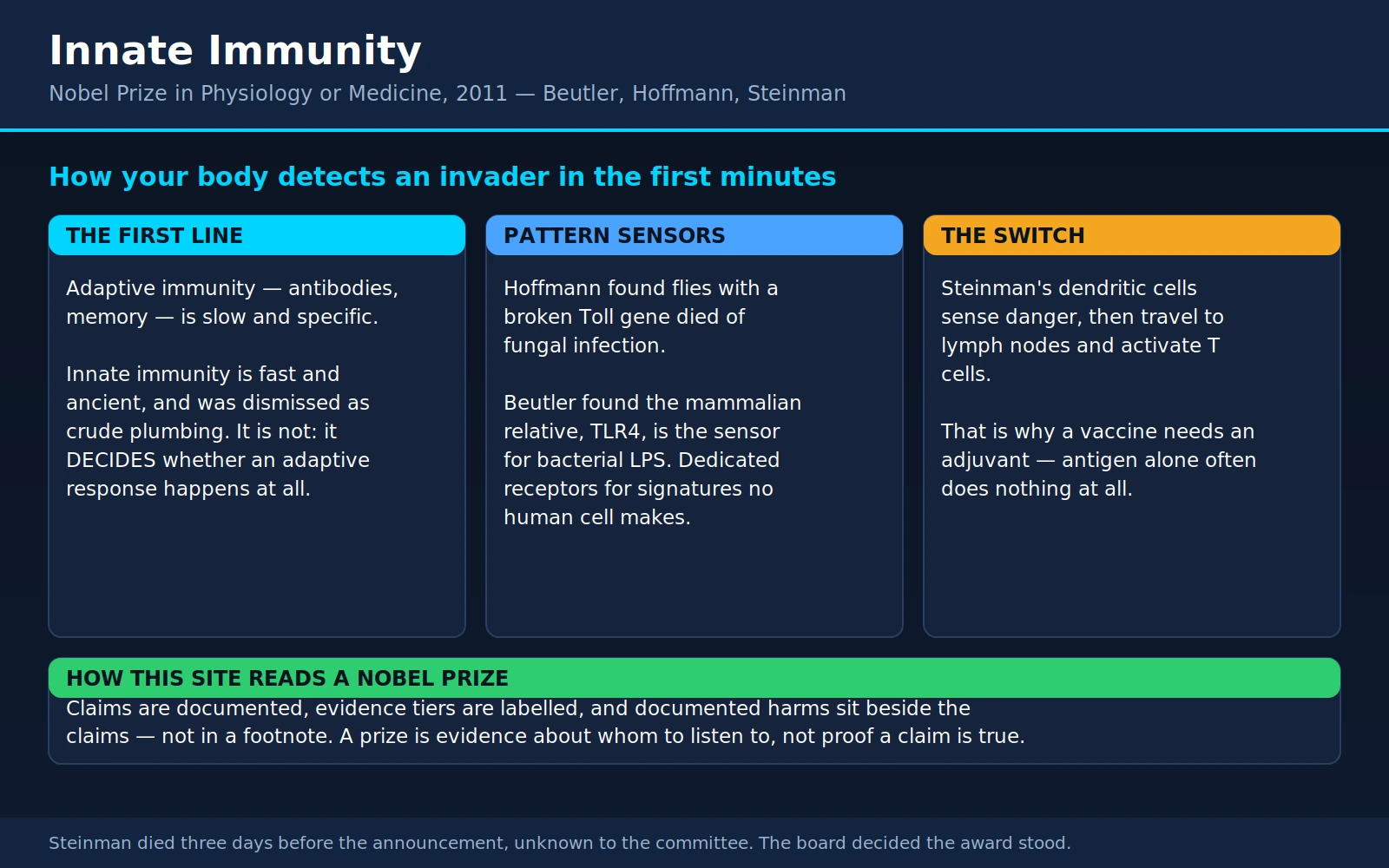
Every day your body meets bacteria, viruses, fungi and parasites, and almost every day nothing happens. You do not notice. There is no fever, no swelling, no illness — because something inside you recognized the intruder within minutes and dealt with it before you had any idea it was there. For most of the twentieth century, immunology could not really explain how. The 2011 Nobel Prize in Physiology or Medicine went to three scientists who answered the question, and their answer reorganized the field: Bruce Beutler and Jules Hoffmann, for finding the sensors that detect a microbe, and Ralph Steinman, for finding the cell that decides what your body does about it.
It is also the Nobel with the most extraordinary human footnote in the prize's history — and that is where this page begins.
Table of Contents
- The Prize, and the Death That Tested a Rule
- The Two Halves of Your Immune System
- Hoffmann and the Fruit Fly, 1996
- Beutler and the Mouse, 1998
- What the Receptors Actually Sense
- Steinman, Cohn, and the Dendritic Cell, 1973
- How the Two Halves Connect
- What This Explains in Everyday Medicine
- Dendritic-Cell Vaccines: The Honest Record
- “Boosting Your Immune System”
- Trained Immunity: The Interesting Frontier
- Where Mainstream Medicine Agrees — and What Remains Debated
- Key Research Papers
- Connections
- Featured Videos
1. The Prize, and the Death That Tested a Rule
On Monday 3 October 2011, the Nobel Assembly at the Karolinska Institutet in Stockholm announced the year's Prize in Physiology or Medicine. Half went jointly to Bruce A. Beutler and Jules A. Hoffmann “for their discoveries concerning the activation of innate immunity.” The other half went to Ralph M. Steinman “for his discovery of the dendritic cell and its role in adaptive immunity.”
Ralph Steinman had died three days earlier, on 30 September 2011, of pancreatic cancer. He was 68. The Assembly did not know. His family and The Rockefeller University, where he had worked for more than four decades, had not yet made the death public; the news reached Stockholm only after the announcement had been read out to the world's press.
This mattered because of a rule. The statutes of the Nobel Foundation have said since 1974 that work by a person who has died shall not be considered for an award — with one explicit exception: if a laureate dies after the announcement but before the December ceremony, the prize is still presented. Steinman fell into a gap the rule had never anticipated. He had died before the announcement, but the decision had been taken while everyone involved believed him to be alive.
The Board of the Nobel Foundation met that same day. Its conclusion was that the purpose of the statute is to prevent a prize being awarded deliberately to someone already dead, and that the 2011 decision had been made in good faith, on the honest belief that Steinman was living. The award stood. His family accepted it in Stockholm that December. No comparable case has arisen before or since.
The part of the story that is easy to tell badly
There is a further detail, and it deserves to be handled carefully rather than dramatically. Steinman was diagnosed with pancreatic cancer in March 2007. Over the four and a half years that followed he underwent conventional treatment — surgery and chemotherapy — and, in parallel, received a series of experimental immunotherapies, several of them dendritic-cell based, designed by colleagues and former students working directly from the biology he had spent his life uncovering. Some used cells grown from his own blood and loaded with material from his own tumour. He tracked his own immune responses in the laboratory. Colleagues have described him continuing to run his lab, review manuscripts and travel between treatments.
He lived four and a half years with a cancer that, at an advanced stage, usually kills within one. It is a remarkable and moving fact, and it is also, on its own, evidence of nothing. A single patient cannot tell you whether a treatment works. He was one man, unusually motivated, with world-class medical access, treated simultaneously with surgery, chemotherapy and multiple experimental agents in sequence — there is no way to separate what did what. Pancreatic cancer survival has a long tail; some people simply live much longer than the median for reasons no one can identify, and those people exist whether or not they receive an experimental therapy. Cases that stand out get reported; cases that do not, do not.
Steinman understood this better than anyone reading about him afterward. He had spent his career insisting on controlled evidence and had watched his own field over-promise for decades. Colleagues who wrote about him after his death — the obituary by Michel Nussenzweig and Ira Mellman in Nature, and the longer appreciation by Carol Moberg in the Journal of Experimental Medicine — describe a scientist treating his own illness as a source of data he could not fully interpret, not as a personal vindication. His family later recounted that he had joked, in his last months, about needing to hold on long enough to receive a prize they do not give to the dead.
The right way to read this story is as one of the most human things that ever happened to a Nobel Prize — not as a testimonial for dendritic-cell therapy. Section 9 gives the actual record of that therapy, which is much more modest.
2. The Two Halves of Your Immune System
Your immune defences come in two layers that work on completely different principles.
Adaptive immunity is the one you learned about in school. It runs on T cells and B cells, each carrying a receptor generated by a random shuffling process, so that between them your lymphocytes can recognize essentially any molecular shape — including shapes that have never existed on Earth before. When one of them happens to match an invader, that cell multiplies, antibodies are produced, and a memory of the encounter is stored so the next exposure is dealt with faster. Adaptive immunity is exquisitely specific, and it is the basis of vaccination. Its weakness is speed: mounting a response from scratch takes roughly a week to ten days. A fast bacterium can kill you in two.
Innate immunity is the other layer — older, faster, and present in some form in nearly every multicellular organism on the planet. It includes physical barriers, antimicrobial peptides, the complement system, and cells like macrophages, neutrophils, and natural killer cells. It responds in minutes to hours, requires no prior exposure, and generates no classical memory. Élie Metchnikoff had described its central cell — the phagocyte — back in the 1880s, and won a Nobel Prize for it in 1908.
For most of the twentieth century, these two layers had very different reputations. Adaptive immunity got the attention, the theory, the prizes and the textbook chapters. Innate immunity was treated as a kind of biological plumbing: useful, unsophisticated, non-specific, and essentially a holding action until the real immune system arrived. It was described as “primitive.” The word was not meant kindly.
The problem with that picture is that it does not survive contact with an insect. A fruit fly has no antibodies, no T cells, no B cells and no immune memory of any kind. It has only innate immunity. Fruit flies live on rotting fruit, in an environment saturated with bacteria and fungi, and they do not die of infection. Whatever innate immunity is doing, “crude” does not cover it.
A second problem was noticed by the American immunologist Charles Janeway Jr. at Yale. In a now-famous 1989 conference paper, “Approaching the asymptote? Evolution and revolution in immunology,” he pointed out something every vaccine developer knew and nobody could explain. If you inject a purified protein into an animal, usually very little happens. If you inject the same protein mixed with something filthy — killed bacteria, mineral salts, oil emulsions — you get a strong antibody response. Immunologists called the filthy additive an adjuvant, used it universally, and had no mechanism for it. Janeway called adjuvants “the immunologist's dirty little secret,” and made a prediction: the body must possess a set of hard-wired, genetically encoded receptors that recognize conserved molecular patterns unique to microbes, and those receptors must be what tells the adaptive system that a threat is real.
He predicted the receptors in 1989. Nobody had found one. That is the problem the 2011 Nobel Prize solved — and the answer turned out to be that innate immunity is not only specific in its own way, it is in charge. It is the layer that decides whether an adaptive response happens at all.
3. Hoffmann and the Fruit Fly, 1996
Jules Hoffmann was born in 1941 in Echternach, Luxembourg, the son of a biology teacher who took him collecting insects. He became a French citizen and spent his career at the CNRS institute in Strasbourg studying, of all things, the immune defences of insects — a subject with almost no obvious medical relevance and correspondingly little glamour.
His entry point was a gene called Toll. Toll had been identified in the 1980s in the laboratory of Christiane Nüsslein-Volhard as a gene controlling the dorsal–ventral axis of the fruit fly embryo — which side becomes the back and which the belly. (The name is a German exclamation, roughly “amazing!”, reportedly her reaction to the appearance of a mutant embryo.) It was a developmental gene, of interest to embryologists, and it had no known connection to infection whatsoever.
Then in 1996 Hoffmann's group published a paper in Cell, with Bruno Lemaitre as first author, that changed the subject entirely: “The dorsoventral regulatory gene cassette spätzle/Toll/cactus controls the potent antifungal response in Drosophila adults.”
The experiment was direct. Flies carrying mutations that disabled the Toll signalling pathway were infected with the mould Aspergillus fumigatus. Normal flies shrugged it off, switching on a battery of antimicrobial peptides including one called drosomycin. The Toll-pathway mutants could not switch on drosomycin — and they died, overgrown with fungal filaments. The photographs in that paper, of a fly visibly sprouting fungus, are among the most reproduced images in immunology.
The interpretation was startling. The same gene that told an embryo which way was up was also, in the adult animal, running the antifungal branch of the immune system. Toll was not a developmental curiosity. It was a receptor pathway for detecting infection — exactly the kind of hard-wired sensor Janeway had predicted, found in an insect. Hoffmann's group went on to map the wider system, showing that a related pathway (Imd) handled Gram-negative bacteria; he later summarized the whole architecture in a 2003 Nature review.
There is a lesson here that this site returns to often. The discovery came out of basic biology on an organism nobody would have described as medically important, funded on curiosity, pursued because it was interesting. There was no route by which a project aimed at human disease would have arrived at it. Genuinely fundamental discoveries frequently come in through a side door, from a fly, a mould, a soil sample or a bacterium in someone's stomach — which is why unglamorous basic science keeps mattering long after it has gone out of fashion.
One matter of credit belongs in the record. Bruno Lemaitre, the first author of the 1996 paper and the researcher who performed the key experiments, was not included in the prize, and has since written publicly and at length about how scientific credit is assigned and misassigned. Nobel Prizes are limited to three people, laboratories are hierarchical, and the person who did the work at the bench and the person named on the medal are not always the same. This will come up again in section 4, and again in section 6.
4. Beutler and the Mouse, 1998
Bruce Beutler, born in Chicago in 1957, came at the same problem from the opposite end — not from what detects a microbe, but from what happens when that detection goes catastrophically wrong.
The specific puzzle was endotoxin, also called lipopolysaccharide or LPS: a molecule that makes up much of the outer membrane of Gram-negative bacteria such as E. coli. LPS is spectacularly inflammatory. Vanishingly small quantities injected into a mammal produce fever, plunging blood pressure, organ failure and death — the picture of septic shock. Something in the body clearly detected it with extraordinary sensitivity. Nobody knew what.
In the 1980s, working with Anthony Cerami at Rockefeller, Beutler had purified the mediator that carried much of the damage — cachectin, which turned out to be identical to tumour necrosis factor — and shown that antibodies against it protected mice from lethal doses of endotoxin. That work identified the weapon. It did not identify the trigger.
The trigger was hiding in a mouse. Since the 1960s, geneticists had known of a strain called C3H/HeJ that was strangely resistant to endotoxin: doses that killed ordinary mice barely bothered it. A second strain, C57BL/10ScCr, behaved the same way. The resistance was inherited as a single genetic locus, called Lps. Whatever gene was broken in those mice had to be the LPS sensor — or something very close to it.
Beutler's laboratory at UT Southwestern in Dallas set out to find it by positional cloning: crossing mice, tracking which stretch of chromosome travelled with the resistant phenotype, and narrowing the region generation by generation until only a handful of candidate genes remained. In the era before a finished mouse genome, this was brute-force work. It took about five years.
In 1998 they published the answer in Science: “Defective LPS signaling in C3H/HeJ and C57BL/10ScCr mice: mutations in Tlr4 gene.” The broken gene was Toll-like receptor 4 — a mammalian relative of Hoffmann's fly gene. The C3H/HeJ mice carried a single amino-acid change in the receptor's signalling tail; the other strain had lost the gene entirely. Break TLR4 and a mouse can no longer see LPS at all.
Two threads snapped together at that moment. The receptor family that defended insects against fungi was the same receptor family that let mammals detect bacteria. The system was hundreds of millions of years old, conserved from flies to humans, and it was not a vague inflammatory reflex — it was a specific receptor binding a specific microbial molecule. Janeway's prediction now had a physical object attached to it. A year earlier, Janeway's own postdoc Ruslan Medzhitov had shown that a human Toll homologue could activate adaptive immunity when switched on artificially; Beutler's mice supplied the missing half, showing what the receptor detects in real life.
Here too the credit is contested, and honestly so. The Japanese immunologist Shizuo Akira and his group, working in parallel, generated TLR4-knockout mice in 1999 that confirmed the result directly, and went on to define the function of most of the other Toll-like receptors and their signalling adaptors — arguably a larger total contribution to the field than any single paper. Akira was not included in the prize. Neither was Medzhitov. Charles Janeway, who predicted the whole system, had died in 2003, and Nobel Prizes are not awarded posthumously. Section 12 returns to this.
5. What the Receptors Actually Sense
Here is the central idea, in plain language.
Your adaptive immune system solves the recognition problem by generating billions of random receptors and hoping one fits. That works, but it is slow and expensive. Innate immunity solves it a completely different way: instead of recognizing which microbe is present, it recognizes that a microbe is present, using a small fixed set of receptors aimed at molecules that microbes have and you do not.
The trick is choosing the right targets. A useful innate sensor has to point at something that is:
- Made by microbes and not by you — otherwise the alarm fires constantly on your own tissue.
- Shared across a wide class of microbes — so a handful of receptors can cover the microbial world.
- Essential to the microbe — so it cannot simply be discarded to escape detection. This is the crucial one. A bacterium can mutate its surface proteins freely, but it cannot stop building its own cell wall.
Molecules meeting those criteria are called pathogen-associated molecular patterns, and the receptors that detect them are pattern-recognition receptors. Humans carry ten Toll-like receptors, and they divide the microbial world up between them:
- TLR4 — lipopolysaccharide, the outer membrane of Gram-negative bacteria.
- TLR2 (with partners TLR1 and TLR6) — lipoproteins and lipoteichoic acid from Gram-positive bacteria, and components of fungi and mycobacteria.
- TLR5 — flagellin, the protein bacteria build their swimming tails from.
- TLR3 — double-stranded RNA, which many viruses produce while replicating and human cells essentially never display in that form.
- TLR7 and TLR8 — single-stranded RNA, again in contexts where your own cells would not present it.
- TLR9 — DNA containing unmethylated CpG sequences, a signature common in bacterial and viral genomes and largely suppressed in vertebrate DNA.
Toll-like receptors are not the only family. Cells also carry NOD-like receptors in the cytoplasm, which assemble into a machine called the inflammasome and release the powerful cytokine interleukin-1; RIG-I-like receptors, which detect viral RNA inside the cell; the cGAS–STING pathway, which detects DNA where DNA should not be; and C-type lectin receptors such as Dectin-1, which detect fungal cell-wall sugars. Together they cover bacteria, viruses, fungi and parasites with perhaps a few dozen receptors rather than billions.
Notice where the receptors sit. Some face outward from the cell surface, watching the outside world. Others sit inside compartments where cells digest what they have swallowed, or free in the cytoplasm — positions where finding a microbial molecule is itself informative, because nothing should be there.
When one of these receptors is engaged, the cell does not deliberate. Within minutes, signalling proteins activate the transcription factor NF-κB and the interferon response, and the cell starts producing cytokines — TNF, interleukin-1, interleukin-6, type I interferons. Blood vessels become leaky, neutrophils are recruited, the temperature set-point rises, and neighbouring cells switch into an antiviral state. This is inflammation, and it is the reason a splinter goes red and hot within an hour rather than next week.
Two features are worth holding onto. It is fast — hours, not days. And it requires no prior exposure — the receptors are encoded in your genome and were shaped by hundreds of millions of years of evolution, so a microbe you have never met is recognized on first contact.
6. Steinman, Cohn, and the Dendritic Cell, 1973
Ralph Steinman was born in Montreal in 1943, trained in medicine at Harvard, and in 1970 joined the laboratory of Zanvil A. Cohn at The Rockefeller University in New York. Cohn was one of the founders of modern cell biology of the immune system — the man who, with James Hirsch, had turned the macrophage from a descriptive category into a studied cell. Steinman stayed at Rockefeller for the rest of his life.
He and Cohn were doing what looked like a plain descriptive job: cataloguing the cells of mouse lymphoid organs by looking at them. In 1973 they published “Identification of a novel cell type in peripheral lymphoid organs of mice” in the Journal of Experimental Medicine. In mouse spleen they had found a rare cell — on the order of one percent of the population — unlike anything catalogued. It had large, constantly moving, branching processes reaching out into the space around it, retracting and extending like a tree in fast-forward. Steinman named it after the Greek word for tree: the dendritic cell.
Finding a new cell type is one thing. Convincing anyone it exists is another, and this is where the story becomes a lesson in scientific patience.
The objections were reasonable. The cells were rare and hard to isolate. They were sticky and adherent, like macrophages. They ate things, like macrophages. To most immunologists, Steinman had found a macrophage in an unusual shape — or worse, an artifact of his purification method. For much of the following decade, dendritic cells were a Rockefeller preoccupation that the field politely ignored.
Steinman's answer was not argument but function. If the cell was distinct, it should do something distinct. In 1978, with Margaret Witmer, he ran the decisive test: mixing purified dendritic cells with T cells from a genetically different mouse, and measuring how strongly the T cells were provoked. The result, published in PNAS, was not a marginal difference. Dendritic cells were dramatically more potent at activating naive T cells than any other cell tested — macrophages and B cells included — by one to two orders of magnitude, and they did it at cell numbers so small that no contaminating population could account for it.
That is what a dendritic cell is for. Naive T cells — ones that have never met their antigen — are extremely difficult to wake up. Almost no cell in the body can do it. The dendritic cell is the specialist that can, which makes it the gateway into adaptive immunity: essentially every T-cell response you have ever mounted was started by one.
Acceptance still took until the late 1980s and 1990s, when methods were developed to grow large numbers of dendritic cells from blood or bone-marrow precursors and any laboratory could work on them. Steinman spent that time methodically defining subtypes, migration, maturation and surface markers, and by the time of his 1998 Nature review with Jacques Banchereau, dendritic cells were central to the field.
Zanvil Cohn is the co-discoverer and should be named as one. He was senior author on the 1973 paper and Steinman's mentor and closest collaborator; the two published together for over twenty years. Cohn died of a heart attack in 1993, aged 67. Had he lived to 2011 there is little doubt he would have shared the prize. Steinman said so repeatedly, in print, for the rest of his life.
7. How the Two Halves Connect
This section is the payoff, and it is the reason the Nobel committee put these three men in one prize rather than two. Beutler and Hoffmann found the sensors. Steinman found the cell. The reason those are one discovery and not two is that the sensors and the cell are wired together.
Here is the sequence, in the body, in order.
- Waiting. Immature dendritic cells sit in the tissues that meet the outside world — skin, gut lining, airways. They are constantly sampling: drinking in fluid, swallowing particles, chopping proteins into fragments. In this state they are excellent at collecting material and useless at activating T cells. That is deliberate.
- Detection. The dendritic cell carries the pattern-recognition receptors of section 5. If the material it has swallowed contains LPS, or flagellin, or viral RNA, or fungal glucan, a receptor fires.
- Maturation. This is the switch. Within hours the cell transforms: it stops sampling, and instead loads its collected antigen fragments onto MHC molecules and pushes them to the surface, dials up co-stimulatory proteins called CD80 and CD86, and changes its homing receptors so that it stops staying put and starts moving.
- Migration. The mature cell travels through the lymphatic vessels to the nearest lymph node — the swollen gland you can feel in your neck during an infection is, in part, this process at scale.
- Presentation. In the lymph node it meets naive T cells, screening thousands of them, and when one carries a receptor matching the displayed fragment, it activates that cell — which then multiplies and drives the whole adaptive response, including the B cells that make antibodies.
Now, the key point. A T cell needs two signals to be activated. Signal one is the antigen itself. Signal two is co-stimulation — CD80 and CD86. If a T cell receives signal one without signal two, it does not simply do nothing: it is switched off, becoming unresponsive or actively tolerant to that antigen in the future.
And the dendritic cell only supplies signal two after an innate receptor has fired.
That single fact is what the 2011 prize is really about. Innate detection is the switch that licenses the adaptive response. Antigen alone does not start an immune reaction; antigen accompanied by evidence of a microbe does. This is why you are not perpetually mounting immune responses against the food you eat, the pollen you breathe or your own tissue — those arrive as signal one without signal two, and the default outcome is tolerance, not attack. It is also, in mirror image, part of why autoimmune disease happens when the wiring fails.
It answers Janeway's dirty little secret exactly. An adjuvant works because it engages innate receptors. Purified protein injected alone is signal one; the immune system reads it as harmless and often responds weakly, or learns to ignore it. Add something the innate receptors recognize and the dendritic cell matures, supplies signal two, and the same protein now provokes a full response with lasting memory. Every vaccine developer had been exploiting this for seventy years without knowing what they were exploiting.
8. What This Explains in Everyday Medicine
This is not abstract biology. A surprising amount of ordinary clinical medicine turns out to be innate immunity, viewed from one angle or another.
Septic shock: the same system, catastrophically
Sepsis is what happens when the response described in section 5 is triggered everywhere at once. Bacteria in the bloodstream present LPS to TLR4 across the entire vascular system; the resulting flood of TNF, interleukin-1 and other mediators makes blood vessels leak and dilate throughout the body. Blood pressure collapses, clotting activates in the microvasculature, and organs fail from inadequate perfusion. The current international definition (Sepsis-3) frames sepsis precisely this way: life-threatening organ dysfunction caused by a dysregulated host response to infection. The damage is not done by the bacteria directly. It is done by your own defences, correctly identifying a real threat and responding at a scale that kills you.
The obvious therapeutic idea — block TLR4 and stop the cascade — was tried properly and failed. The ACCESS trial randomized nearly two thousand patients with severe sepsis to eritoran, a designed TLR4 antagonist, or placebo. Twenty-eight-day mortality was 28.1% with the drug and 26.9% with placebo — no benefit at all. The likely reason is timing: by the time a person is sick enough to reach an intensive care unit, the initiating signal is long past and the cascade downstream of it is redundant and self-sustaining. Understanding a mechanism completely does not guarantee you can intervene in it usefully. That is worth remembering whenever a new mechanism is announced as a treatment.
Why adjuvants work — and what modern ones are
Aluminium salts (“alum”) have been the standard vaccine adjuvant since the 1920s, adopted empirically because they worked. Their mechanism is still argued about; one influential strand of evidence implicates the NLRP3 inflammasome, though alum almost certainly acts through several routes at once. What changed after 1998 is that adjuvants stopped being empirical. If innate receptors license adaptive responses, you can design an adjuvant by choosing a receptor:
- MPL (monophosphoryl lipid A) is a chemically detoxified fragment of bacterial LPS — a deliberate TLR4 agonist. It is a component of AS04, used in one of the HPV vaccines, and of AS01, used in the recombinant shingles vaccine. The HPV connection runs straight back to Harald zur Hausen, whose work established that cervical cancer is caused by a virus in the first place.
- CpG 1018 is a short synthetic DNA sequence built to engage TLR9. It is the adjuvant in Heplisav-B, a hepatitis B vaccine approved in the United States in 2017 — a direct descendant of Baruch Blumberg's discovery of the hepatitis B virus. In its phase 3 trial, two doses given four weeks apart produced seroprotection in 90.0% of adults with type 2 diabetes, against 65.1% for three doses of the conventional alum-adjuvanted vaccine given over six months. A better adjuvant meant fewer injections and better protection in exactly the people in whom the old vaccine worked worst.
Imiquimod: a receptor agonist you rub on
Imiquimod is a small molecule that activates TLR7 — the single-stranded RNA sensor. Applied as a cream, it convinces the skin's immune cells that a viral infection is underway at that spot, and they respond accordingly with local interferon production and immune-cell recruitment. It was approved for external genital and perianal warts after trials in the 1990s showed clearance in a substantial fraction of patients, and it is now also used for actinic keratoses and superficial basal cell carcinoma. It is a treatment that does not attack the target at all — it presses an innate receptor and lets the immune system do the work. The wart connection again leads back to zur Hausen and the papillomaviruses.
The mRNA vaccine problem was an innate immunity problem
This one is a particularly clean illustration. The obstacle that stalled mRNA therapeutics for decades was that injected RNA is too immunogenic: your innate sensors — TLR7, TLR8, TLR3 and the cytoplasmic RNA sensors — are designed to detect exactly that molecule, because foreign RNA means virus. Synthetic mRNA provoked a violent inflammatory response and was destroyed before it could be translated into protein.
The solution, published by Katalin Karikó and Drew Weissman in 2005, was to swap in modified nucleosides — the chemical alterations your own cells make to their RNA — which rendered the mRNA invisible to those receptors. Their paper is literally titled “Suppression of RNA recognition by Toll-like receptors.” It is a direct application of the Beutler–Hoffmann discovery, made seven years later, and it is why the COVID-19 mRNA vaccines exist. Our page on Karikó and Weissman covers that story, including the parts that are less flattering.
BCG in bladder cancer
One of the oldest and most effective immunotherapies in medicine is a live tuberculosis vaccine squirted into the bladder. In 1976 Alvaro Morales reported that intravesical BCG reduced recurrence of superficial bladder tumours, and it has been standard treatment for high-risk non-muscle-invasive bladder cancer ever since. Mechanistically it is an enormous, deliberate, localized innate stimulus: mycobacterial cell-wall components engaging TLR2, TLR4 and NOD2 in the bladder wall, drawing in immune cells that then attack tumour tissue in the neighbourhood. It works, it predates any understanding of why, and it remains one of the clearest demonstrations that innate activation can drive tumour clearance.
Autoinflammatory disease: the alarm stuck on
Autoimmune diseases are adaptive-immunity failures — T cells and antibodies targeting self. Autoinflammatory diseases are the innate equivalent, and they were only recognized as a separate category once the innate machinery was understood. In cryopyrin-associated periodic syndromes, a mutation in the gene encoding the NLRP3 inflammasome component leaves the sensor firing without any microbe present, producing lifelong fevers, rash, joint pain and hearing loss. Familial Mediterranean fever is a related disorder of the same pathway. Because the mechanism is now known, these conditions are treatable by blocking interleukin-1 — a therapy that came directly out of the biology. Gout, incidentally, works through the same inflammasome: uric acid crystals are read by NLRP3 as a danger signal, which is why a gout flare looks and feels like an infection that is not there.
9. Dendritic-Cell Vaccines: The Honest Record
If dendritic cells decide which T-cell responses happen, an obvious idea follows: take a cancer patient's dendritic cells, show them the patient's tumour, put them back, and direct the immune system at the cancer. The idea is nearly as old as the acceptance of dendritic cells themselves. Thirty years of trials have followed. Here is what actually came of it.
What is approved
Sipuleucel-T (Provenge) is the one product of this field to reach regulatory approval — the first therapeutic cancer vaccine of any kind approved by the FDA, in April 2010. It is made individually for each patient: white cells are collected by apheresis, cultured with a fusion protein of prostatic acid phosphatase (a prostate antigen) and GM-CSF, and reinfused, three times over about a month. Strictly it is an autologous cellular immunotherapy rather than a purified dendritic-cell vaccine, but the antigen-presenting cells in the product are doing the work, and the design is Steinman's biology applied directly.
The pivotal IMPACT trial randomized 512 men with metastatic castration-resistant prostate cancer. The result was real and it was modest: a 22% relative reduction in the risk of death (hazard ratio 0.78), median overall survival 25.8 months versus 21.7 — an improvement of 4.1 months — and three-year survival of 31.7% versus 23.0%. An earlier phase 3 trial had pointed the same way.
Two things should be said about that plainly. First, it is a genuine survival benefit from a genuinely novel mechanism, achieved in advanced disease, and it deserves respect. Second, the treatment cost roughly $93,000 for the course at launch, it did not delay tumour progression on scans at all — only death — and the four-month median gain is much less than the phrase “cancer vaccine” suggests to most people. Both statements are true at once. The product has had a commercially difficult life and was withdrawn from the European market for business rather than safety reasons.
What is not approved
Essentially everything else. Hundreds of dendritic-cell vaccine trials have been run in melanoma, glioblastoma, renal cell carcinoma, prostate, colorectal and other cancers. The consistent pattern, summarized in reviews such as Anguille and colleagues in Lancet Oncology, is that these vaccines are safe and reliably produce measurable immune responses — and that measurable immune responses have repeatedly failed to translate into survival benefit in randomized trials. Most studies have been small, single-arm, and reported using immune endpoints rather than clinical ones, which is a design that cannot answer the question that matters.
Why is it so hard? Cancer is made of your own cells, so the antigens are mostly self and the T cells capable of attacking them have already been substantially deleted or suppressed. Tumours actively build an immunosuppressive local environment. And loading a dendritic cell correctly — the right antigen, the right maturation state, the right migration to the lymph node — turns out to involve many variables and no consensus on how to set them.
It is also worth noting where the field's real success went. The approach that transformed cancer immunotherapy in the same period was not vaccination but checkpoint blockade — releasing the brakes on T cells that already exist — the subject of the 2018 Nobel Prize to James Allison and Tasuku Honjo. Combining dendritic-cell vaccines with checkpoint inhibitors is an active and rational research direction, and it may yet make the vaccines work better.
The honest tier
- Established: one approved product, in one cancer, with a four-month median survival benefit.
- Promising but unproven: combination approaches with checkpoint inhibitors, neoantigen-targeted vaccines, in-vivo dendritic-cell targeting.
- Not supported: dendritic-cell therapy sold at private clinics as a general cancer treatment, or as an alternative to standard care. This is a real and expensive market, and the trial record above is what it is being sold against.
Steinman himself, in a 2007 review with Banchereau and in his last published overview, was candid that the clinical translation had been slower and harder than the biology promised. He was working on that problem, on himself among others, when he died.
10. “Boosting Your Immune System”
This section exists because the 2011 Nobel Prize is the natural place on this site to deal with the single most common claim in the supplement industry — and because the innate/adaptive distinction is exactly what shows why the claim is close to meaningless as usually phrased.
Why the phrase does not mean anything
“Boost your immune system” implies a dial that can be turned up. There is no dial. What you have is at least two interlocking systems with dozens of cell types, hundreds of signalling molecules, and elaborate mutual regulation, in which the innate half decides whether the adaptive half responds at all, and a whole separate cell population exists specifically to suppress responses — the regulatory T cells of the 2025 Nobel Prize to Brunkow, Ramsdell and Sakaguchi. “More immune activity” is not a coherent goal, and in the places where you can genuinely produce it, the results are diseases: septic shock is innate immunity at maximum output; autoinflammatory syndromes are an innate sensor stuck on; autoimmunity and anaphylaxis are the adaptive system responding too strongly to the wrong thing.
The correct target is a system that is well-regulated and not impaired. Almost everything that genuinely helps works by removing an impairment rather than adding stimulation.
What is actually supported
- Vaccination. By an enormous margin the most effective way to improve your immune response to a specific pathogen, and the only intervention on this list that provides targeted, durable, pathogen-specific protection. Everything else on this page is a rounding error beside it.
- Sleep. When healthy volunteers were tracked with wrist actigraphy and then deliberately inoculated with rhinovirus, those sleeping under six hours a night were roughly four times more likely to develop a cold than those sleeping more than seven. That is an experimental infection study, not a survey.
- Not smoking. Smoking damages the airway's mucociliary clearance and impairs the local innate defences directly.
- Adequate protein and overall energy intake. Antibodies, cytokines and immune cells are built from amino acids; protein-energy malnutrition is one of the most reliable causes of immune impairment worldwide.
- Correcting genuine deficiencies. This is the honest version of the micronutrient story. Deficiencies of zinc, vitamin A, vitamin D, iron and others impair immune function measurably, and correcting them restores it. Supplementing beyond sufficiency does not keep improving things. The largest analysis of vitamin D and respiratory infection, a meta-analysis of 43 randomized trials, found a small protective effect overall — the kind of small that is real, is worth having if you are deficient, and is not what the marketing describes.
- Regular moderate exercise. In a cohort followed through two twelve-week seasons, people exercising five or more days a week had substantially fewer days with upper respiratory infection than largely sedentary people. Note the word moderate; very heavy endurance training appears to increase susceptibility temporarily.
- Managing chronic stress. Sustained psychological stress raises cortisol and measurably alters immune responses; the effect is real, though the practical interventions are harder to specify than the biology.
This is an unglamorous list. It is unglamorous because the honest version of immune health is mostly about not being deficient, not being exhausted and not being poisoned — none of which can be sold in a bottle.
What is sold, and what the evidence says
- Mega-dose vitamin C. Correcting deficiency matters — scurvy is an immune catastrophe among other things. Beyond that, the Cochrane review of 29 trials in over 11,000 people found that regular supplementation did not reduce the incidence of colds in the general population; it shortened duration by around 8% in adults, and it did reduce incidence roughly by half in a specific group under extreme short-term physical stress, such as marathon runners and soldiers on subarctic exercises. That is the whole finding, and it is a long way from what the labels claim.
- Colostrum and transfer factor. Bovine colostrum contains antibodies and growth factors that matter enormously to a newborn calf. Sold as an adult oral supplement, its proteins face the same fate as any other dietary protein, and human outcome data are thin. “Transfer factor” products rest on a 1950s concept of transferable cellular immunity that was never satisfactorily reproduced and does not map onto the immunology in this article.
- Most “immune-boosting” herbal and mushroom formulas at marketed strength. The problem is usually not that the ingredient is inert, but that the dose, the extract, the route and the outcome measured in the supporting study bear little relationship to the capsule being sold. A cell-culture experiment showing cytokine release, or a mouse study using an injected purified fraction, does not establish that swallowing a proprietary blend changes whether you get sick.
Beta-glucans deserve to be treated precisely
Beta-glucans are the most interesting case on this list, and the one most often handled dishonestly in both directions — oversold by sellers, dismissed too quickly by sceptics. The precise position is worth stating.
The mechanism is real. Beta-glucans from fungal and yeast cell walls are genuine innate-immune ligands, in exactly the sense this whole page has been describing. In 2001, Gordon Brown and Siamon Gordon identified Dectin-1, a C-type lectin receptor on macrophages and dendritic cells whose job is to recognize beta-glucan. Complement receptor 3 binds them too. Dectin-1 is a pattern-recognition receptor of the same family described in section 5, and beta-glucan is a legitimate pathogen-associated molecular pattern — a fungal cell-wall sugar humans do not make. This is not marketing. It is textbook immunology, and it is precisely why the marketing is persuasive: it starts from something true.
Two distinctions matter before going further. First, fungal and yeast beta-glucans are (1,3)/(1,6)-linked and are the ones that engage Dectin-1. Cereal beta-glucans, as in oats, are (1,3)/(1,4)-linked soluble fibre, and their well-established benefit is lowering LDL cholesterol — a different molecule doing a different job. Marketing regularly blurs these. Second, having a receptor for something is not the same as benefiting from eating it. Your innate system also has receptors for LPS, and nobody suggests supplementing with endotoxin.
The human outcome data are thin and mixed. The best trials all use yeast beta-glucan and self-reported colds:
- Auinger and colleagues (2013), 162 adults with recurrent infections over 16 weeks: 25% fewer symptomatic colds versus placebo in the per-protocol analysis (p = 0.041), with the symptom-severity score not reaching significance.
- Dharsono and colleagues (2019), the largest at 299 adults: no difference in the incidence of infections and no difference in overall severity; a significant reduction in physical symptom severity during the first days of an episode.
- Fuller and colleagues (2017), 100 adults aged 50–70 over a winter, with medically confirmed infections: 17 infections on beta-glucan versus 28 on placebo — an odds ratio of 0.55, but with a confidence interval from 0.24 to 1.26 and p = 0.149. Not statistically significant.
Read together: the direction is fairly consistent and the effects are small, the trials are short and modestly sized, most are industry-funded, the endpoints are self-reported cold symptoms rather than anything hard, and the largest trial found no effect on whether people got infected at all. That is a real signal that has not been nailed down, not a demonstrated benefit.
The mushroom-derived polysaccharides have a partly separate literature. PSK, from turkey tail, was tested in Japan as an addition to chemotherapy after cancer surgery, and a 1994 Lancet trial in gastric cancer reported improved survival. It is used in Japan and has never been adopted in the West, where the trials have not been replicated to the standard required. Our medicinal mushrooms section covers the individual species and their evidence honestly, species by species.
The honest tier for beta-glucans, stated plainly: real mechanism, thin and mixed human outcome data. They are not snake oil and they are not established. If you take them, take them knowing that is where the evidence sits.
11. Trained Immunity: The Interesting Frontier
One of the defining textbook claims about innate immunity — that it has no memory — has turned out to be, at minimum, an oversimplification. This is the most genuinely interesting open area in the field, and also the one most heavily borrowed by supplement marketing, so it needs to be reported carefully.
The observation is that innate cells can be persistently changed by an encounter. After exposure to certain stimuli, monocytes and macrophages respond more vigorously to an unrelated challenge weeks or months later. This is not classical memory: there is no antigen-specific receptor and no recall of the particular microbe. It is a raised baseline of responsiveness, produced by epigenetic and metabolic reprogramming — changes to the chemical marks on chromatin around inflammatory genes, and a shift in how the cell generates energy. Mihai Netea and colleagues named the phenomenon trained immunity in 2011, and the 2020 Nature Reviews Immunology consensus paper sets out the current definition.
The two best-characterized inducers are directly relevant to earlier sections of this page:
- BCG. Kleinnijenhuis and colleagues (2012) vaccinated human volunteers with BCG and showed that their monocytes, months later, produced more cytokines in response to entirely unrelated pathogens — a change dependent on the innate receptor NOD2 and accompanied by specific histone modifications.
- Beta-glucan. Quintin and colleagues (2012) showed that mice surviving a Candida albicans infection were protected against later unrelated infection through monocyte reprogramming — and that purified beta-glucan reproduced the effect via Dectin-1, in animals lacking any adaptive immunity at all.
What about clinical outcomes? The most-cited trial is ACTIVATE, which randomized 198 elderly patients to BCG or placebo at hospital discharge. At interim analysis, BCG lengthened the median time to a new infection from 11 to 16 weeks, and reduced the proportion developing a new infection from 42.3% to 25.0%, with the protection concentrated in respiratory infections of probable viral origin. That is a striking result — from an interim analysis of a small single-centre trial whose own authors called for larger studies. Trials of BCG against COVID-19 in various populations have since produced a decidedly mixed record. There is also long-running epidemiological work suggesting BCG reduces all-cause child mortality beyond its effect on tuberculosis, which remains contested.
Two cautions belong here.
First, trained immunity is not automatically good. A persistently raised inflammatory baseline is exactly what you do not want in atherosclerosis, and the same reprogramming mechanisms have been implicated in chronic inflammatory disease. “Trained” does not mean improved; it means altered.
Second — and this is the part that gets lost — none of this validates supplement marketing. The experiments that demonstrate trained immunity use a live attenuated vaccine given by injection, or purified beta-glucan administered in defined doses in animals or in cell culture, and they measure monocyte reprogramming in the laboratory. They do not test oral capsules, they do not use the extracts sold commercially, and in humans they largely do not measure whether anyone gets fewer illnesses. The gap between “beta-glucan can epigenetically reprogram monocytes in a mouse” and “this capsule will stop you catching colds” contains every step that actually matters, and section 10 shows what happens when someone finally tests the capsule. Trained immunity is a real and important discovery. It is not yet a product.
12. Where Mainstream Medicine Agrees — and What Remains Debated
Settled
- Innate immunity is receptor-based and pattern-specific, not vague or non-specific. Toll-like receptors and the other pattern-recognition families are characterized down to their crystal structures and their ligands.
- Dendritic cells are the principal initiators of naive T-cell responses, and therefore the gateway to adaptive immunity.
- Innate detection licenses the adaptive response through co-stimulation. Antigen without innate signalling tends to produce tolerance, not immunity.
- Adjuvants work by engaging innate receptors. This is now a design principle, not an empirical accident.
- Sepsis is a dysregulated host response, and much of its damage is self-inflicted by the innate system.
- Autoinflammatory diseases are innate-sensor disorders, and blocking interleukin-1 treats them.
- The clinical applications listed in section 8 — imiquimod, CpG- and MPL-adjuvanted vaccines, intravesical BCG, sipuleucel-T, nucleoside-modified mRNA — are approved, in routine use, and rest on this biology.
Genuinely open
- Trained immunity's clinical value. How durable is it, how much does it explain of BCG's non-specific effects, and can it be induced deliberately and safely for benefit? The mechanism is established; the clinical payoff is not.
- Oral beta-glucan. How much reaches immune tissue, through what route, and does any achievable oral dose change clinical outcomes? The receptor biology is not in doubt; the pharmacology and the outcomes are.
- Dendritic-cell vaccines. Whether the field becomes a real therapeutic class or remains a single approved product plus a long tail of negative trials, and whether checkpoint combinations change that.
- Innate targets in sepsis. Given the eritoran failure, is there any window in which blocking the initiating receptor helps, or is the intervention point necessarily elsewhere?
- Alum's mechanism. The inflammasome is part of the story; how much of it is still argued.
- The microbiome. How much of the shaping of immune responses by resident bacteria is causal in humans, as opposed to correlated, remains far less settled than popular coverage implies.
The credit question
The 2011 prize is a good case study in the limits of a three-person award. Charles Janeway Jr. predicted the entire pattern-recognition system in 1989 and died in 2003, making him ineligible. Ruslan Medzhitov found the first human Toll-like receptor and showed it could activate adaptive immunity. Bruno Lemaitre did the bench work behind the 1996 fly paper. Shizuo Akira defined the function of most of the Toll-like receptor family and independently confirmed TLR4 as the LPS receptor. Zanvil Cohn co-discovered the dendritic cell and died in 1993. Each of those omissions has been publicly discussed by working immunologists, and none of them is unreasonable to raise. Our page on the Nobel Prize in Physiology or Medicine deals with the structural reasons this keeps happening.
13. Key Research Papers
- Janeway CA Jr. Approaching the asymptote? Evolution and revolution in immunology. Cold Spring Harb Symp Quant Biol 1989;54 Pt 1:1-13 — the prediction of pattern-recognition receptors, and the “dirty little secret” of adjuvants.
- Lemaitre B, Nicolas E, Michaut L, Reichhart JM, Hoffmann JA. The dorsoventral regulatory gene cassette spätzle/Toll/cactus controls the potent antifungal response in Drosophila adults. Cell 1996;86(6):973-83 — Hoffmann's Nobel-cited paper.
- Medzhitov R, Preston-Hurlburt P, Janeway CA Jr. A human homologue of the Drosophila Toll protein signals activation of adaptive immunity. Nature 1997;388(6640):394-7 — the first human Toll-like receptor.
- Poltorak A, He X, Smirnova I, et al. Defective LPS signaling in C3H/HeJ and C57BL/10ScCr mice: mutations in Tlr4 gene. Science 1998;282(5396):2085-8 — Beutler's Nobel-cited paper.
- Hoshino K, Takeuchi O, Kawai T, et al. Cutting edge: Toll-like receptor 4 (TLR4)-deficient mice are hyporesponsive to lipopolysaccharide. J Immunol 1999;162(7):3749-52 — Akira's independent confirmation.
- Steinman RM, Cohn ZA. Identification of a novel cell type in peripheral lymphoid organs of mice. I. Morphology, quantitation, tissue distribution. J Exp Med 1973;137(5):1142-62 — the discovery of the dendritic cell.
- Steinman RM, Witmer MD. Lymphoid dendritic cells are potent stimulators of the primary mixed leukocyte reaction in mice. Proc Natl Acad Sci U S A 1978;75(10):5132-6 — the functional proof that ended the scepticism.
- Banchereau J, Steinman RM. Dendritic cells and the control of immunity. Nature 1998;392(6673):245-52 — the synthesis that put dendritic cells at the centre of the field.
- Brown GD, Gordon S. Immune recognition. A new receptor for beta-glucans. Nature 2001;413(6851):36-7 — the identification of Dectin-1, the beta-glucan receptor.
- Karikó K, Buckstein M, Ni H, Weissman D. Suppression of RNA recognition by Toll-like receptors: the impact of nucleoside modification and the evolutionary origin of RNA. Immunity 2005;23(2):165-75 — the innate-immunity problem whose solution made mRNA vaccines possible.
- Kantoff PW, Higano CS, Shore ND, et al. Sipuleucel-T immunotherapy for castration-resistant prostate cancer. N Engl J Med 2010;363(5):411-22 — the IMPACT trial; the one approved cellular cancer vaccine.
- Opal SM, Laterre PF, Francois B, et al. Effect of eritoran, an antagonist of MD2-TLR4, on mortality in patients with severe sepsis: the ACCESS randomized trial. JAMA 2013;309(11):1154-62 — the negative trial that shows mechanism does not equal treatment.
- Jackson S, Lentino J, Kopp J, et al. Immunogenicity of a two-dose investigational hepatitis B vaccine, HBsAg-1018, using a toll-like receptor 9 agonist adjuvant compared with a licensed hepatitis B vaccine in adults. Vaccine 2018;36(5):668-674 — a designed innate adjuvant in a licensed vaccine.
- Netea MG, Domínguez-Andrés J, Barreiro LB, et al. Defining trained immunity and its role in health and disease. Nat Rev Immunol 2020;20(6):375-388 — the consensus statement on innate immune memory.
Live PubMed Searches
- Toll-like receptor innate immunity discovery
- Dendritic cell antigen presentation
- Sipuleucel-T prostate cancer
- Trained immunity BCG
- Beta-glucan immune human trial
14. Connections
- All Notable Doctors
- Nobel Prize in Physiology or Medicine — every laureate, 1901–2025, and the structural reasons three-person prizes leave people out
- Élie Metchnikoff — innate immunity's founder: the phagocyte, described a century before anyone knew what it was listening to
- Paul Ehrlich — the side-chain theory and the other founding half of immunology, the one that became antibodies
- Burnet & Medawar — immune tolerance: why your immune system spares you, the other side of the signal-two story
- Allison & Honjo — checkpoint blockade, the cancer immunotherapy that succeeded where vaccines struggled
- Brunkow, Ramsdell & Sakaguchi — regulatory T cells: the strongest argument that immunity should be balanced, not boosted
- Karikó & Weissman — taming innate RNA sensing, the discovery that made mRNA vaccines possible
- Baruch Blumberg — hepatitis B, whose modern vaccine uses a TLR9 agonist as its adjuvant
- Harald zur Hausen — HPV and cervical cancer; imiquimod and the AS04 adjuvant both trace back here
- Immunology — immunodeficiencies, allergy and the conditions that show what happens when this machinery fails
- Sepsis — innate immunity at catastrophic scale, and why blocking the receptor did not help
- Medicinal Mushrooms — the beta-glucan sources, covered species by species with their actual evidence
- Turkey Tail: PSK, PSP and Cancer Adjunct Use — the mushroom polysaccharide with real trial data, and its limits