Barré-Sinoussi & Montagnier: Finding HIV, and What Came After
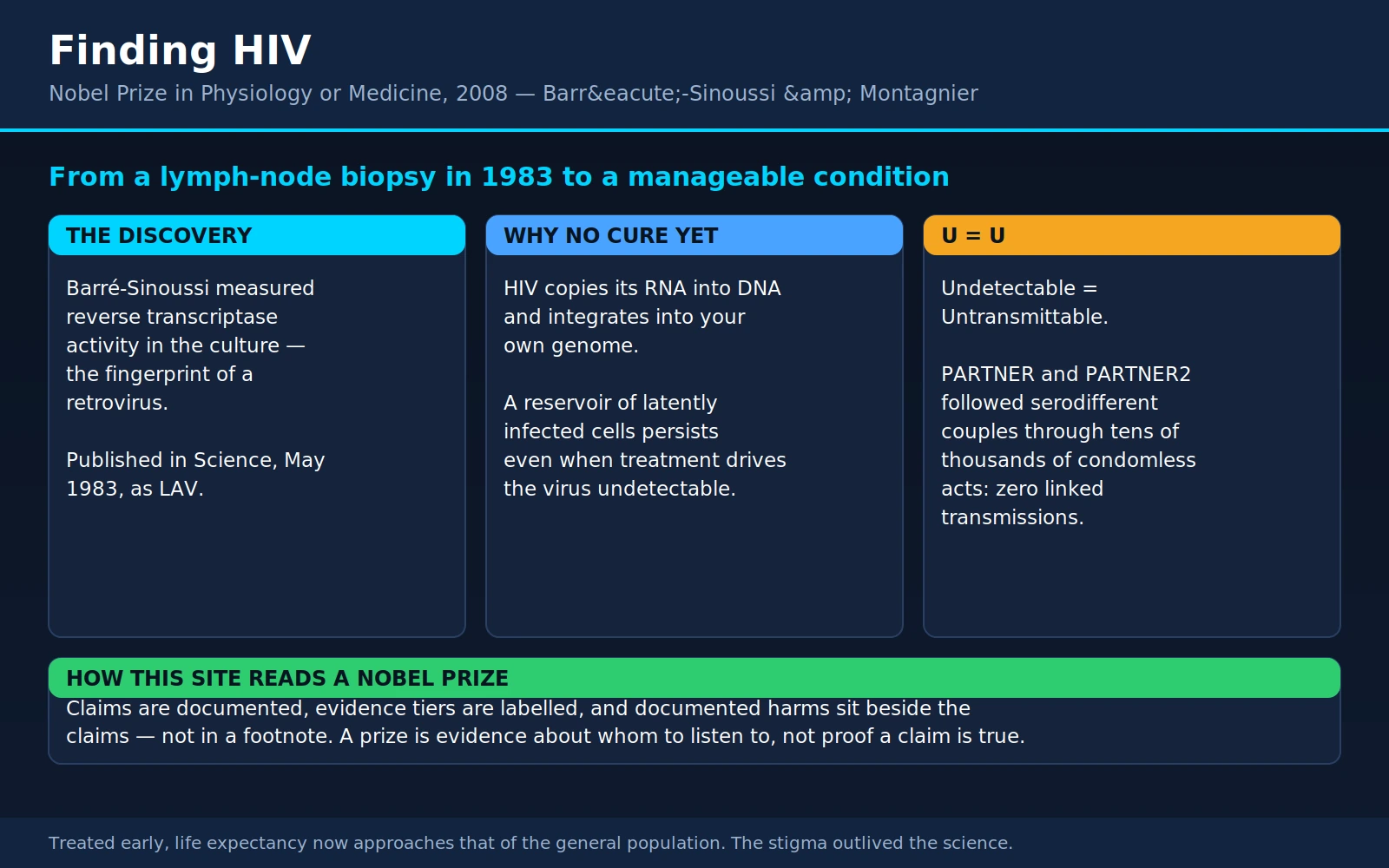
Table of Contents
- The Prize and the Two Scientists
- 1981: A Disease With No Name
- January 1983: A Lymph Node, and a Retrovirus
- The Dispute With Gallo
- What HIV Actually Does
- The Tests, and the Blood Supply
- From Death Sentence to Chronic Condition
- U=U: Undetectable Equals Untransmittable
- Prevention Today
- The Cures That Exist — and Why They Don't Generalise
- Denialism and Unproven "Cures"
- Where Mainstream Medicine Agrees / What Remains Hard
- Key Research Papers
- Connections
- Featured Videos
1. The Prize and the Two Scientists
In October 2008 the Nobel Assembly split the Prize in Physiology or Medicine between two discoveries about viruses that cause human disease. One half went to Harald zur Hausen, for showing that human papillomavirus causes cervical cancer. The other half went jointly to Françoise Barré-Sinoussi and Luc Montagnier of the Pasteur Institute, "for their discovery of human immunodeficiency virus."
Françoise Barré-Sinoussi (born 1947 in Paris) did the bench work. She spent the rest of her career on HIV, led a Pasteur research unit until 2015, presided over the International AIDS Society, and became one of the world's most forceful advocates for treatment access in poor countries, arguing to heads of state that the science is useless if the medicines do not reach people.
Luc Montagnier (1932–2022) was her laboratory head, who set the research direction, secured the clinical collaboration behind the crucial sample, and carried the finding into the scientific press against considerable scepticism. His later career is a different matter, and this site does not launder records: after the Nobel he promoted claims the scientific community examined and rejected — most notably that DNA emits electromagnetic signals detectable in extremely high aqueous dilutions, a claim structurally adjacent to homeopathy that no independent group reproduced, and that such signals could effectively "teleport" DNA — and during the pandemic he made assertions about SARS-CoV-2's origin and about vaccination that virologists, including former colleagues, rejected. We state that plainly and then set it down, because the 1983 discovery is not diminished by what came afterwards: it was made with rigorous methods, verified independently within months, and confirmed since by every subsequent line of evidence. Later errors do not retroactively unmake a correct result — the discovery is right because the data are right.
2. 1981: A Disease With No Name
On June 5, 1981, the CDC published a short, dry item in its Morbidity and Mortality Weekly Report: five previously healthy young men in Los Angeles had been treated for Pneumocystis pneumonia, and two were already dead. All five were homosexual men — and this pneumonia was essentially unheard of outside transplant patients on immunosuppressive drugs and children with congenital immune defects. Within weeks New York physicians were reporting clusters of Kaposi's sarcoma, a slow skin cancer of elderly Mediterranean men, appearing as an aggressive disease in young men and killing them; then cryptococcal meningitis, CMV retinitis, cerebral toxoplasmosis, wasting.
The speed is what people remember: a young man could be well in the spring and dead by Christmas. There was no test, no treatment, no name — for a period the working label was GRID, "gay-related immune deficiency," which encoded a hypothesis into a diagnosis and did real harm before it was replaced in 1982 by acquired immune deficiency syndrome. Hospitals had no protocols; some staff refused to enter rooms, meals were left outside doors, funeral homes turned bodies away.
Then the epidemiology broke the story open. Cases appeared in people with hemophilia, who received clotting-factor concentrates pooled from thousands of donors; in transfusion recipients, including a twenty-month-old infant; in people who injected drugs; and in the infants of affected mothers. Those four groups have nothing in common socially and exactly one thing in common biologically: a route by which something in one person's blood reaches another person's bloodstream. That is the signature of a blood-borne infectious agent, and by 1982 it had displaced rival theories about recreational drugs and "lifestyle." Something was being passed from person to person and destroying the immune system.
3. January 1983: A Lymph Node, and a Retrovirus
Montagnier's group reasoned about where to look: in a patient with full-blown AIDS the cells the virus lived in would already be largely gone. The better target was someone early: clinicians had noticed that some at-risk patients developed persistent generalised lymphadenopathy, swollen lymph nodes lasting months without other explanation. In January 1983 the clinician Willy Rozenbaum took a lymph node biopsy from such a patient and sent it to the Pasteur, where Barré-Sinoussi and Jean-Claude Chermann put the cells into culture.
Reverse transcriptase does what no human cell needs to do: it reads RNA and writes DNA, running genetic information backwards, so measuring its activity in a culture detects a retrovirus almost as directly as seeing one — and Barré-Sinoussi had spent years perfecting exactly that assay. Within about two weeks the cultures showed reverse transcriptase activity, and then a problem that turned out to be the answer: the activity rose and collapsed, because the cultured cells were dying. The virus was killing the very T cells it grew in, so the team fed the culture fresh lymphocytes from healthy donors, and it infected those too. Electron microscopy showed retroviral particles budding from cell membranes, and testing showed it was not HTLV-I, the virus Robert Gallo's group had found earlier, which makes T cells proliferate; the Pasteur isolate destroyed them.
They named it LAV, lymphadenopathy-associated virus. On May 20, 1983, Science published "Isolation of a T-lymphotropic retrovirus from a patient at risk for acquired immune deficiency syndrome (AIDS)," Barré-Sinoussi first author, Montagnier senior author. The paper is careful: it reports a new human retrovirus and notes that its role in AIDS remains to be determined.
4. The Dispute With Gallo
Robert Gallo, at the U.S. National Cancer Institute, was the most prominent human retrovirologist alive in 1983: his lab had discovered HTLV-I and HTLV-II and the methods that made growing human T cells possible. His group published in the same May 1983 issue of Science, reporting HTLV-related sequences in AIDS patients and favouring an HTLV family member as the cause.
In April 1984 the U.S. Department of Health and Human Services announced that the cause of AIDS had been found: a retrovirus Gallo's lab called HTLV-III. His group had done something the Pasteur had not — developed a permanently infected cell line producing virus continuously in bulk, which is what made a mass-produced diagnostic test practical — a real and consequential contribution.
Then the genetics arrived. Sequenced, LAV and HTLV-III proved essentially identical — far more similar than independent isolates from different patients normally are, and HIV mutates fast. Investigations on both sides of the Atlantic, involving the U.S. Office of Research Integrity and archived-sample comparison, concluded that Gallo's isolate derived from a Pasteur sample sent to his laboratory — the French had shared their virus, as scientists do — and that the most plausible explanation was contamination of one culture by another rather than deliberate misconduct. Misconduct charges against Gallo were investigated and ultimately not sustained.
The fight was settled at head-of-state level: in 1987 Ronald Reagan and Jacques Chirac signed an agreement declaring Montagnier and Gallo co-discoverers and splitting the blood-test royalties, a year after an international committee replaced both LAV and HTLV-III with a neutral term, human immunodeficiency virus. The 2008 Nobel then went to Barré-Sinoussi and Montagnier and not to Gallo, which remains contested by some scientists who argue that his demonstration of causation, his production methods and the blood test were prize-worthy in their own right. What is established: the Pasteur team isolated and published first, the strains were near-identical, Gallo's isolate came from a French sample, and contamination is the accepted explanation. What is opinion: whether the prize should have been shared three ways — and well-informed people still disagree, not least because the Nobel is capped at three laureates and zur Hausen held a half.
5. What HIV Actually Does
HIV is a retrovirus, and that one word explains nearly everything else, including why there is still no simple cure. It enters cells by binding CD4 plus a co-receptor, usually CCR5 early in infection, and the main CD4-bearing cell is the helper T lymphocyte — the cell that recognises an invader and then tells B cells to make antibodies and killer T cells to attack. It is not a soldier; it is the officer issuing orders.
It writes itself into your chromosomes. The viral genome is RNA; inside the cell, reverse transcriptase copies it into DNA — the enzyme Barré-Sinoussi measured — and integrase splices that DNA into the host cell's own chromosome. From that moment the cell's genetic material contains HIV permanently, and when it divides both daughters carry it; there is no mechanism for cutting it back out. This is the single most important fact about HIV: it is why the infection cannot be cleared the way antibiotics clear bacteria, because you would have to eliminate every cell carrying that inserted sequence without harming the cells that do not.
Reverse transcriptase also does not proofread, so with billions of virions produced daily a patient carries not one virus but a swarm of variants — which is why the immune system cannot pin it down, why no vaccine has yet succeeded, and why single-drug therapy always fails. The decline is slow, then sudden. Two to four weeks after infection many people get an acute retroviral syndrome, easily mistaken for flu, during which viral load is enormous and transmissibility highest; the immune system then fights the virus to a partial standstill and the person may feel entirely well for years while the CD4 count grinds down from a normal 500–1,500 cells per microlitre. Below 200 cells/µL the diagnosis is AIDS — a stage, not a separate disease — and that is where Pneumocystis pneumonia becomes likely; below 100, cryptococcal meningitis and toxoplasmosis; below 50, CMV retinitis.
The reservoir is why there is no cure. Some infected CD4 cells go quiet — long-lived memory T cells holding a silent, integrated provirus, invisible to the immune system and untouchable by antiretrovirals, which block replication in cells that are not replicating. This latent reservoir is seeded within days of infection, before anyone knows they are infected; it persists for decades; and if treatment stops, those cells reactivate and viral load rebounds within weeks. Our HIV/AIDS pages cover the clinical picture in more detail.
6. The Tests, and the Blood Supply
The discovery's first practical yield was not a treatment but a test, and the test did more to stop transmission in the 1980s than anything else available. The first HIV antibody ELISA was licensed in the United States in March 1985 and adopted for donor screening almost immediately; universal screening of donated blood and plasma, plus donor deferral and heat treatment of clotting-factor concentrates, ended the great majority of transfusion-transmitted HIV in high-income countries within about two years.
That achievement rests on a catastrophe. People with hemophilia were devastated. Clotting-factor concentrate is made by pooling plasma from thousands of donors, so one infected donation contaminates an entire lot, and patients received it repeatedly. Before screening and viral inactivation, a very large fraction of people with severe hemophilia A in the United States and Europe — by many estimates more than half — became infected with HIV, many co-infected with hepatitis C from the same product. Thousands died. This was not an unavoidable natural disaster: decisions were made, delays occurred, and a patient community that depended entirely on a manufactured medicine paid for them.
Modern testing. Every HIV test has a window period — the interval after infection during which it cannot yet detect anything — and older antibody-only tests had windows up to three months, which is the source of the outdated "wait three months" advice many people still repeat. Today's standard laboratory test is a fourth-generation antigen/antibody assay, detecting HIV antibodies and the viral p24 antigen, which appears well before antibodies; it picks up most infections by around 18 to 45 days. A nucleic acid test (RNA), looking for viral genetic material directly, closes the window to roughly 10 to 33 days. Rapid fingerstick and oral-fluid tests, including pharmacy self-tests, are antibody-based with longer windows of about 23 to 90 days, but they are accurate, private, and invaluable for reaching people who would never go to a clinic.
7. From Death Sentence to Chronic Condition
If you take one thing from this page, take this section and the next. 1987: AZT. Zidovudine was a failed cancer drug from the 1960s, pulled off the shelf, found to block reverse transcriptase, and licensed in March 1987 after a placebo-controlled trial was stopped early because the treated group was surviving better — the fastest approval in the FDA's history to that point. It was also a hard drug: profound anemia and neutropenia, nausea, headaches, and a schedule of a capsule every four hours around the clock, at doses later understood to be far too high. And it did not last, because given alone AZT selected for resistant virus within months — monotherapy against a fast-mutating virus is a race the virus wins.
1996: the hinge. At the International AIDS Conference in Vancouver in July 1996 two things had arrived together: a new drug class, the protease inhibitors, blocking a second essential viral enzyme; and a viral load test that could count virus in blood and show quantitatively what a regimen was doing. Combining three drugs from at least two classes — combination antiretroviral therapy, then called HAART — suppressed the virus so completely that resistant mutants could not be selected, because a virus needing three simultaneous mutations to escape does not, in practice, escape. In the HIV Outpatient Study, mortality among patients with advanced HIV fell from 29.4 deaths per 100 person-years in early 1995 to 8.8 by mid-1997.
Modern first-line therapy is typically a single tablet, once a day, usually built around an integrase inhibitor such as dolutegravir or bictegravir plus two other agents; side effects for most people are minimal, and resistance on a modern regimen taken consistently is uncommon. Long-acting injectable treatment given every one or two months is now an option for people for whom daily tablets do not work.
And the outcome, stated plainly, because it is the most under-known fact about HIV among general readers: a person diagnosed early and treated effectively today has a life expectancy approaching that of the general population. That is not advocacy language, it is what the large multi-cohort survival analyses show — in the collaborative analysis by Trickey and colleagues, twenty-year-olds starting antiretroviral therapy in 2008–2010 had projected life expectancies close to those of uninfected peers, roughly a decade better than those who started in 1996–1999. The gap that remains is driven substantially by late diagnosis, injection-drug-related causes, smoking and interrupted access to care, not by an inherent limit of the treatment; someone who tests, starts treatment and stays on it can reasonably expect to grow old.
8. U=U: Undetectable Equals Untransmittable
A person living with HIV who is on effective treatment and has a sustained undetectable viral load does not transmit HIV to sexual partners. Not "low risk." Not "greatly reduced." Zero. This is settled science, endorsed by the CDC, UNAIDS and the world's HIV clinical bodies, and it is stated without hedging because the hedging is itself harmful.
HPTN 052 randomised more than 1,700 serodifferent couples — one partner with HIV, one without — to early or deferred antiretroviral therapy, and its monitoring board stopped the trial early in 2011: early treatment reduced linked HIV transmission by 96 percent, and in the final analysis no linked transmissions at all occurred while the partner with HIV was virally suppressed. PARTNER (JAMA, 2016) followed serodifferent couples — heterosexual and gay male — in whom the partner with HIV was on suppressive therapy with a viral load under 200 copies/mL and who were not using condoms. Across roughly 58,000 condomless sex acts, the number of HIV transmissions phylogenetically linked to the partner within the couple was zero.
PARTNER2 (The Lancet, 2019) ran the same design specifically in gay male couples, where anal sex carries the highest per-act transmission risk of any sexual route and the earlier data were thinnest; nearly 77,000 condomless anal sex acts were reported, and linked transmissions were zero. Together these studies recorded not one transmission traceable to a virally suppressed partner across well over a hundred thousand condomless sex acts, which is why every major health authority now calls the risk effectively zero. U=U describes sexual transmission, and does not protect against other sexually transmitted infections.
The practical terms matter: "undetectable" means a viral load below the assay's limit, typically under 50 copies/mL, and it takes up to about six months of consistent treatment to reach and confirm durable suppression, so U=U applies once suppression is established and sustained, confirmed by routine monitoring. Why a section of its own? Because the stigma this fact dissolves is still doing harm. People avoid testing because a positive result feels like a sentence of permanent untouchability; serodifferent couples are told, sometimes by clinicians who have not updated, that they can never have a normal sex life or conceive a child naturally; people living with HIV have been prosecuted under laws written when transmission was assumed. Every one of those harms rests on a factual premise that is no longer true.
9. Prevention Today
PrEP — pre-exposure prophylaxis. An HIV-negative person takes antiretroviral medication to avoid acquiring the virus. The landmark iPrEx trial (2010) showed a 44 percent reduction overall, but among participants with detectable drug in their blood protection exceeded 90 percent, which reframed the whole question as one of adherence rather than efficacy; the open-label PROUD study in England then measured real-world use and found an 86 percent reduction in HIV incidence. Taken consistently, daily oral PrEP reduces sexual acquisition of HIV by about 99 percent. Long-acting injectable PrEP — cabotegravir every two months — outperformed daily tablets in head-to-head trials, largely because an injection cannot be forgotten, and twice-yearly injectable options have since shown extraordinary efficacy.
PEP — post-exposure prophylaxis. After a possible exposure — a condom failure, a sexual assault, a needlestick, shared injecting equipment — a 28-day course of antiretrovirals started as soon as possible and within 72 hours substantially reduces the chance of infection; sooner is better, ideally within hours. Condoms remain highly effective when used consistently, and are the only method here that also prevents most other sexually transmitted infections and pregnancy.
Sterile injecting equipment is among the most thoroughly evidenced interventions in public health: reviews consistently find substantial reductions in HIV transmission among people who inject drugs, greatest where needle and syringe programmes are combined with opioid agonist therapy such as methadone. Just as consistently, the evidence does not find that they increase drug use — the objection most often raised against them. Preventing transmission to infants is one of the great quiet victories of modern medicine: without intervention roughly 15–45 percent of babies born to mothers with HIV acquire it, and the classic ACTG 076 trial in 1994 studied a population with about a 25 percent transmission rate and cut it by roughly two-thirds with zidovudine alone. With modern combination therapy for the mother throughout pregnancy, infant prophylaxis and feeding guided by local guidelines, the risk falls to under 1 percent. A woman with HIV, on treatment, can have a healthy HIV-negative baby, and that should be said in every clinic that sees a positive test in a woman of childbearing age.
The honest global picture. Roughly 40 million people are living with HIV worldwide, and the roughly one in four not on treatment are mostly people who do not know their status or cannot reliably reach a clinic. Around 630,000 people still died of HIV-related causes in a recent year, the great majority in low- and middle-income countries, with tuberculosis the leading cause of death among them, and sub-Saharan Africa carrying the heaviest burden. And this progress is funding-dependent in a way that is easy to forget: much of the treatment in the hardest-hit countries is paid for by international programmes, and a person who stops antiretrovirals rebounds within weeks and becomes infectious again.
10. The Cures That Exist — and Why They Don't Generalise
A small number of people — single digits — have been cured of HIV, and understanding why it worked, and why it cannot be offered to anyone else, is clarifying. The door was opened by a mutation: about 1 percent of people of northern European descent carry two copies of CCR5-Δ32, a deletion that leaves the CCR5 co-receptor missing from the cell surface, and since most HIV strains need CCR5 to get in, people homozygous for Δ32 are highly resistant to infection and appear otherwise healthy. Timothy Ray Brown, the Berlin patient, had HIV and then developed acute myeloid leukemia; his treatment required a bone-marrow transplant, and his physician, Gero Hütter, searched the donor registry specifically for a match who was also CCR5-Δ32 homozygous. Brown received the transplant in 2007, his immune system was replaced by donor cells the virus largely could not enter, his antiretrovirals were stopped, and the virus did not come back — he remained free of detectable HIV until his death from recurrent leukemia in 2020, thirteen years later. For a decade he was a solitary case, and a solitary case can be a fluke; then in 2019 Ravindra Gupta's group reported the London patient, Adam Castillejo, treated for Hodgkin lymphoma with a CCR5-Δ32 transplant and in sustained remission off antiretrovirals, proving the Berlin result reproducible.
Why this cannot be scaled, and it is not a matter of cost or will. An allogeneic stem-cell transplant requires destroying a person's bone marrow and rebuilding it from a donor, and carries a mortality risk in the range of 10 percent or higher, plus graft-versus-host disease and months of serious illness.
What these cases do prove is enormously important: HIV cure is biologically possible, because the latent reservoir can be eliminated, or reduced below the threshold at which it can rebound. The work now is to reach the same endpoint without the transplant, and several lines are in early human trials: gene editing to disable CCR5 in a patient's own cells or excise the integrated provirus, with safe delivery the unsolved part, and broadly neutralising antibodies, isolated from the minority of people who make them, which can suppress virus and may help clear infected cells.
11. Denialism and Unproven "Cures"
The claim, stated fairly: HIV/AIDS denialism holds that HIV does not cause AIDS — that the virus is a harmless passenger, and that the immune collapse called AIDS is caused instead by recreational drug use, malnutrition, poverty, or by the antiretroviral drugs themselves. Its best-known proponent was the molecular biologist Peter Duesberg, a genuinely accomplished retrovirologist and a member of the U.S. National Academy of Sciences, who argued that no retrovirus had been shown to cause a fatal disease this way, that Koch's postulates had not been satisfied, and that AZT's toxicity could account for the deaths.
The evidence tier: refuted. Not "disputed," not "controversial" — refuted, comprehensively, by evidence that did not exist in 1987 and does now. HIV can be isolated from patients and its genome sequenced; transmission has been traced through blood products and by phylogenetic sequencing matching donor and recipient virus; the virus infects and kills CD4 cells in culture; and occupational needlestick infections have produced HIV followed by AIDS in people with none of the proposed alternative exposures. Decisively, drugs that specifically block HIV enzymes restore CD4 counts and prevent AIDS, with an effect proportional to how completely they suppress the virus — a harmless passenger virus does not behave that way, and drugs targeting a harmless passenger do not save lives.
The documented harm. From 1999, South Africa's government under President Thabo Mbeki, with health minister Manto Tshabalala-Msimang, adopted denialist positions in national policy: the state restricted the public-sector rollout of antiretrovirals — including drugs to prevent mother-to-child transmission that were being offered at no cost — while officials publicly promoted garlic, beetroot, lemon and olive oil as responses to HIV. The peer-reviewed modelling by Chigwedere and colleagues at the Harvard School of Public Health, (2008) compared what was delivered against what was feasible with drugs and funding available at the time, and estimated that more than 330,000 lives were lost and roughly 35,000 infants infected who need not have been.
Unproven "cures." A long list of herbal, mineral and megavitamin protocols has been sold as an alternative to antiretroviral therapy: high-dose vitamin C, proprietary micronutrient formulations, herbal preparations marketed across Africa, colloidal silver, ozone therapy, industrial bleach sold as "miracle mineral solution." The evidence tier for all of them, as treatment for HIV infection, is the same — no credible evidence of efficacy, and several are directly toxic.
The distinction that actually matters. Nutrition is not a fringe concern in HIV — it is genuine supportive care. Advanced untreated HIV causes wasting; micronutrient deficiencies are common where food insecurity is present; food support measurably improves adherence, because these are drugs many people will not take if the household has no food; and nutritional status affects tuberculosis outcomes, which matters given how many HIV deaths are TB deaths. Alongside, always; instead of, never. The correction is not contempt for anyone persuaded otherwise — it is being clear, once, about which of those two sentences is true.
12. Where Mainstream Medicine Agrees / What Remains Hard
Settled, and not seriously disputed by anyone working in the field:
- HIV causes AIDS. Isolation, sequencing, animal models, transmission tracing and the response to virus-specific drugs all converge.
- Antiretroviral therapy works, should start immediately at diagnosis regardless of CD4 count, and turns HIV into a manageable chronic condition.
- Undetectable = Untransmittable for sexual transmission, endorsed by every major health authority.
- PrEP prevents HIV at roughly 99 percent effectiveness taken consistently, with long-acting injectables removing the adherence problem.
- Mother-to-child transmission is preventable, falling from roughly 25 percent to under 1 percent with treatment.
- Cure is biologically possible — the transplant cases prove it — but is not currently achievable safely for people whose HIV is controlled.
Genuinely hard, and honestly unresolved:
- The latent reservoir. No strategy has cleared it safely at scale; this is the central obstacle to a cure.
- A vaccine. Four decades of effort and a long list of failed efficacy trials; the mutation rate and the shielded envelope make HIV a uniquely difficult target.
- Reaching everyone. Roughly a quarter of people with HIV are not on treatment — not a scientific failure but testing gaps, stigma, criminalisation, conflict, distance and money.
13. Key Research Papers
- Barré-Sinoussi F, Chermann JC, Rey F, et al. Isolation of a T-lymphotropic retrovirus from a patient at risk for acquired immune deficiency syndrome (AIDS). Science 1983;220(4599):868-71
- Gallo RC, Salahuddin SZ, Popovic M, et al. Frequent detection and isolation of cytopathic retroviruses (HTLV-III) from patients with AIDS and at risk for AIDS. Science 1984;224(4648):500-3
- Palella FJ Jr, Delaney KM, Moorman AC, et al. Declining morbidity and mortality among patients with advanced human immunodeficiency virus infection. N Engl J Med 1998;338(13):853-60
- Chigwedere P, Seage GR 3rd, Gruskin S, et al. Estimating the lost benefits of antiretroviral drug use in South Africa. J Acquir Immune Defic Syndr 2008;49(4):410-5
- Hütter G, Nowak D, Mossner M, et al. Long-term control of HIV by CCR5 Delta32/Delta32 stem-cell transplantation. N Engl J Med 2009;360(7):692-8
- Grant RM, Lama JR, Glidden DV, et al. Preexposure chemoprophylaxis for HIV prevention in men who have sex with men. N Engl J Med 2010;363(27):2587-99
- Cohen MS, Chen YQ, McCauley M, et al. Prevention of HIV-1 infection with early antiretroviral therapy. N Engl J Med 2011;365(6):493-505
- Rodger AJ, Cambiano V, Bruun T, et al. Sexual activity without condoms and risk of HIV transmission in serodifferent couples when the HIV-positive partner is using suppressive antiretroviral therapy. JAMA 2016;316(2):171-81
- Trickey A, May MT, Vehreschild JJ, et al. Survival of HIV-positive patients starting antiretroviral therapy between 1996 and 2013: a collaborative analysis of cohort studies. Lancet HIV 2017;4(8):e349-e356
- Gupta RK, Abdul-Jawad S, McCoy LE, et al. HIV-1 remission following CCR5Δ32/Δ32 haematopoietic stem-cell transplantation. Nature 2019;568(7751):244-248
- Rodger AJ, Cambiano V, Bruun T, et al. Risk of HIV transmission through condomless sex in serodifferent gay couples with the HIV-positive partner taking suppressive antiretroviral therapy (PARTNER): final results. Lancet 2019;393(10189):2428-2438
Live PubMed Searches
- HIV discovery 1983
- Undetectable untransmittable HIV
- PrEP efficacy
- HIV life expectancy on antiretroviral therapy
- CCR5-delta32 stem cell transplant HIV
14. Connections
- All Notable Doctors
- Nobel Prize in Medicine — the complete roll of laureates, 1901 to the present
- Harald zur Hausen — their 2008 co-laureate, awarded the other half of that year's prize for HPV and cervical cancer
- Alter, Houghton & Rice — hepatitis C: the other blood-borne virus of the same era, with the same arc from contaminated blood supply to cure
- Allison & Honjo — checkpoint immunotherapy; the flip side of T-cell biology
- Élie Metchnikoff — a Pasteur Institute forerunner, and the origin of cellular immunity
- Karikó & Weissman — mRNA vaccine technology, now aimed at the unsolved HIV vaccine problem
- HIV/AIDS — the clinical page: transmission, staging, testing, treatment
- History of HIV/AIDS — the epidemic decade by decade
- Immunology — how the immune system works, and the conditions in which it fails
- Infectious Disease — the full category index
- Tuberculosis — still the leading cause of death among people living with HIV worldwide
- Pneumonia — including the Pneumocystis pneumonia that opened the epidemic in 1981
- Lymphoma — the cancer that brought two cured patients to the transplant that cleared their HIV