 — April 29, 2026
· The Largest Genetic Study of Endometriosis Yet
— April 29, 2026
· The Largest Genetic Study of Endometriosis Yet
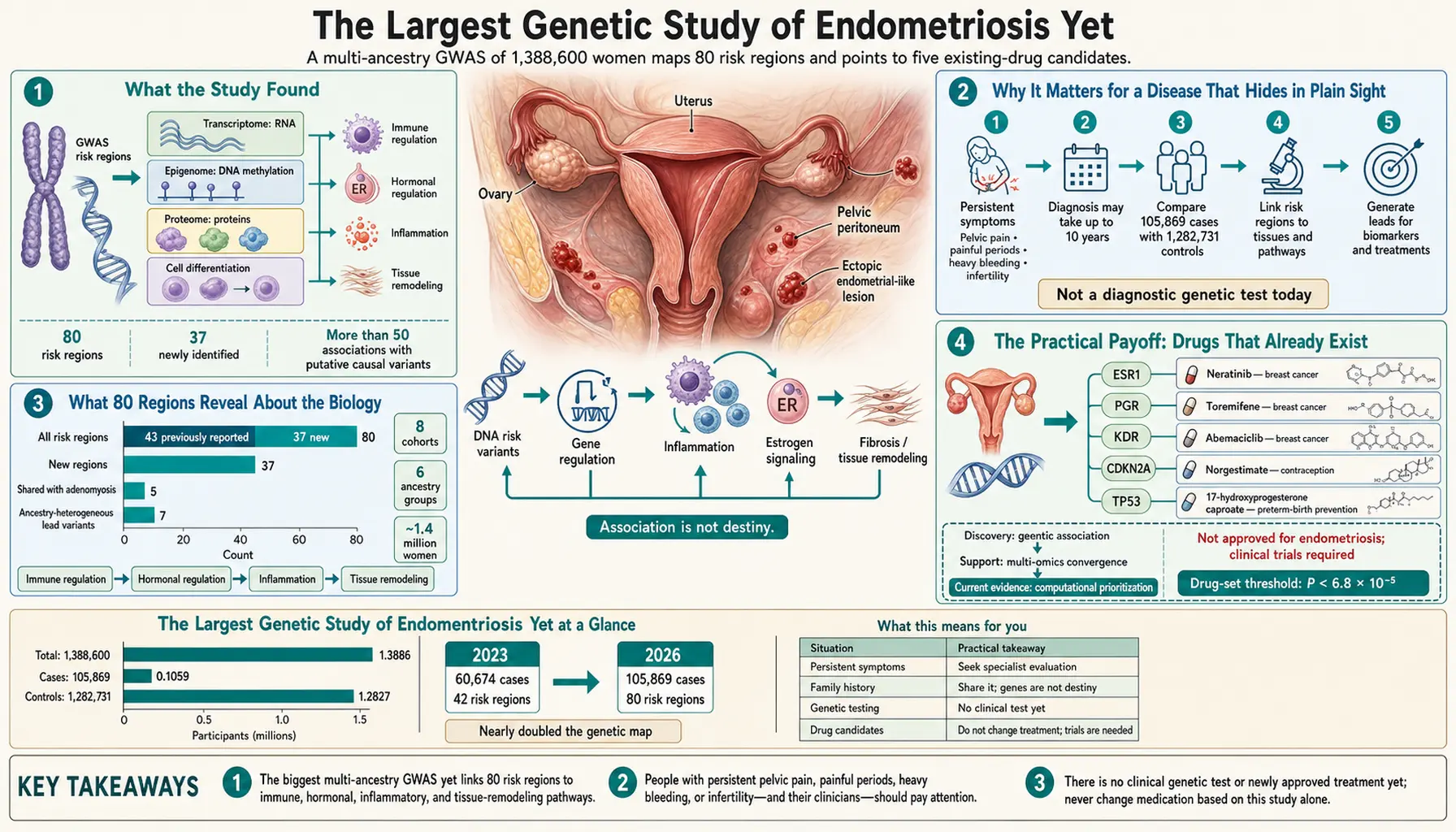
On April 29, 2026, the journal Nature Genetics published what its authors describe as the largest multi-ancestry genome-wide association study of endometriosis to date — an analysis of the DNA of about 1.4 million women, including 105,869 with the disease. The work mapped 80 regions of the genome associated with a woman’s risk of endometriosis, 37 of them new. The paper reports genetic associations, not a new test or treatment. It describes endometriosis as “a chronic systemic disease,” links its genetic risk to several biological pathways, and flags drugs already in use for other conditions as candidates for study.
Table of Contents
- What the Study Found
- Why It Matters for a Disease That Hides in Plain Sight
- What 80 Regions Reveal About the Biology
- Drug-Repurposing Leads Among Existing Medicines
- Limits of the Findings
- What the Findings Show
- Sources
- Key Research Papers
- Connections
- Featured Videos
What the Study Found
The study, led by Dr. Dora Koller of the Sant Pau Research Institute and the Universitat de Barcelona together with senior author Dr. Renato Polimanti of the Yale School of Medicine, is a genome-wide association study (GWAS). In plain terms, the researchers compared the genomes of women with and without endometriosis and looked for the tiny spelling differences in DNA — single-letter variants — that show up more often in women who have the disease. The meta-analysis combined 105,869 cases and 1,282,731 controls from eight cohorts and, in its cross-ancestry analysis, six ancestry groups (African, Admixed American, Central/South Asian, East Asian, European and Middle Eastern). The authors write that this nearly doubles the number of cases included in previous GWAS.
The headline number is 80 genomic regions linked to endometriosis risk, of which 37 are newly discovered. The authors set this against the two most recent earlier endometriosis GWAS, which, they write, “identified up to 45 loci”; one of them, a 2023 Nature Genetics meta-analysis of 60,674 cases and 701,926 controls of European and East Asian descent, reported 42 genome-wide significant loci. Within the new study, adding the non-European data raised the count from 63 loci in the European-only analysis to 80. The team also layered in multi-omics data — gene activity (transcriptomic), DNA methylation (epigenetic) and protein (proteomic) data across tissues — so they could move from “this stretch of DNA matters” toward “this specific gene, acting in this specific way, matters.”
Why It Matters for a Disease That Hides in Plain Sight
Endometriosis — in which tissue similar to the lining of the uterus grows outside it, driving inflammation, scarring, and often severe pain — affects roughly 1 in 10 women of reproductive age, and diagnosis is often slow. The study’s press release (via EurekAlert!) puts the average delay between first symptoms and diagnosis at 7 to 10 years and attributes it in part to the lack of more precise diagnostic tools; definitive confirmation has historically relied on laparoscopic surgery. A 2025 scoping review of 23 studies found an average reported delay of 6.8 years (range 1.5 to 11.4 years), with very wide differences between countries. Current treatments — hormonal suppression, surgery to remove lesions, and pain medication — do not cure the disease, and each carries trade-offs for fertility or quality of life.
Each of the 80 regions is a candidate clue about why the disease starts and progresses, and the authors conclude that the study “provides molecular support for several hypotheses on its pathogenesis.” In the press release, Dr. Koller notes that treatments do not work the same in all patients and that there are not enough tools to anticipate which option will suit each case.
What 80 Regions Reveal About the Biology
One clear message from the paper is that there is no single “endometriosis gene”: the authors conclude that the disease may arise from the interplay of several biological mechanisms rather than a single causal pathway. The press release lists the processes involved as inflammation, altered immune response, tissue remodeling, cell proliferation and differentiation, and the formation of new blood vessels (angiogenesis); the paper’s abstract also names hormonal regulation. As Dr. Koller put it, “there is probably not a single cause, but many possible pathways that can contribute to the disease, and these likely vary between women.”
The paper also found genetic differences between ways of defining the disease: five loci reached genome-wide significance only in clinically confirmed endometriosis, and some loci showed effect-size differences across definitions that the authors say could reflect disease severity or diagnostic heterogeneity. In the release, Dr. Koller calls for a more biologically based classification, similar to the subtypes now distinguished in cancer. The analysis also found genetic overlap with adenomyosis, a related condition in which similar tissue invades the muscular wall of the uterus: the abstract reports 80 regions “including 37 new loci, of which 5 are also associated with adenomyosis.” The overlap is partial. The genetic correlation between endometriosis and adenomyosis (rg = 0.79) was lower than that between clinically diagnosed and self-reported endometriosis (rg = 0.85), which the authors read as support for differences between the two conditions, and only adenomyosis was genetically correlated with endometrial cancer.
Across other traits, genetic correlations were strongest with menstrual irregularities, infertility, ovarian cysts, uterine fibroids (leiomyoma), major depression and anxiety. Genetically informed causal analyses supported an effect of endometriosis on reproductive traits, pain and infertility, and an effect of chronic fatigue on endometriosis, which the authors describe as a novel finding.
Drug-Repurposing Leads Among Existing Medicines
The paper also ran drug-repurposing analyses. When a risk gene codes for a protein that an existing medication already targets, that drug becomes a candidate to test against endometriosis without starting drug development from scratch. One method (DRUGSETS) flagged five drugs at the strictest (Bonferroni) significance level: three breast-cancer oncology drugs — neratinib, toremifene and abemaciclib — and two progestins, norgestimate, used in contraception, and 17-hydroxyprogesterone caproate, used to prevent preterm birth (the U.S. Food and Drug Administration withdrew the drug’s approval for reducing the risk of preterm birth on April 6, 2023). These signals were driven by the estrogen-receptor gene ESR1 and the progesterone-receptor gene PGR. A second method (Gene2drug) produced only suggestive results, none of which survived that correction; among them was nortriptyline, an antidepressant also used in chronic pain management — off-label for chronic pelvic pain, the authors note. The press release describes nortriptyline as possibly having a dual effect on chronic pain and depression, two conditions frequently associated with the disease.
The list is a set of hypotheses, not a treatment finding. A 2024 analysis of drug-development programs in Nature estimated that the probability of success for drug mechanisms with human genetic support is 2.6 times greater than for those without.
Limits of the Findings
Several limits apply. First, a GWAS finds common variants that each nudge risk only slightly. No single one of these 80 regions determines whether a woman gets endometriosis; together they explain only part of the heritable risk, and heritability itself is only part of the story — the paper cites earlier estimates of 50% twin-based heritability and 8% heritability captured by common variants (SNP-heritability). The press release states that “genetics only partly explain the development and progression of endometriosis,” and that diet, exposure to certain chemical compounds and many other factors may modulate its development and progression.
Second, this is not a clinical test. In the study, women in the highest quartile of the polygenic risk score had higher odds of endometriosis than those in the lowest (odds ratio 2.19 among European-ancestry participants in the All of Us cohort), but the authors state that the score’s predictive power “is currently insufficient for diagnostic use.” Third, the drug-repurposing candidates are computational predictions from gene-target and gene-expression overlap, not trial results; the paper cites animal-model evidence for one compound (thiostrepton) and notes that the two progestins are not currently used to treat endometriosis. Genetic association is not proof of cause. Finally, although the study was multi-ancestry, most of its data came from participants of European ancestry: the European-ancestry analysis held 99,407 cases and 1,093,534 controls, against 2,481 cases in the African, 1,752 in the Admixed American and 2,044 in the East Asian analyses. No genome-wide significant variant was found in the African or Admixed American analyses, some analyses were run only in European-ancestry data because of the low sample size of the others, and the authors call for ancestry-informed risk models.
What the Findings Show
The study reports genetic associations and computational drug leads; it does not report any change to current endometriosis treatment, and it reports no trial results for any of the drug leads. Its findings describe endometriosis as a systemic disease shaped by many biological pathways and only partly by genetics: 80 risk regions, 37 of them new; genetic links to adenomyosis and to reproductive, pain-related and psychiatric traits; five existing drugs flagged at the strictest significance level as candidates for study; and genetic differences between clinically diagnosed and self-reported disease that bear on how the condition is classified.
Sources
- Koller D, He J, Løkhammer S, Aranda S, Qiu D, Davtian D, Chen Q, Xu Z, et al. Multi-ancestry genome-wide association and integrated multi-omics analyses of endometriosis and its clinical manifestations. Nature Genetics. April 29, 2026. doi:10.1038/s41588-026-02582-2
- Yale School of Medicine. “Largest-Ever Genetic Study of Endometriosis Uncovers 80 Risk Regions and New Avenues for Treatment.” April 2026. medicine.yale.edu
- EurekAlert! (AAAS). “A study in 1.4 million women expands knowledge on endometriosis and its biological complexity.” April 30, 2026. eurekalert.org/news-releases/1126434
- Medical Xpress. “A study in 1.4 million women expands knowledge on endometriosis and its biological complexity.” April 2026. medicalxpress.com
- U.S. Food and Drug Administration. Press announcement withdrawing the approval of hydroxyprogesterone caproate for reducing the risk of preterm birth. April 6, 2023. fda.gov
Key Research Papers
The primary papers behind the figures above, each checked against its PubMed record.
- Koller D, He J, Løkhammer S, Aranda S, Qiu D, Davtian D, et al. (2026). Multi-ancestry genome-wide association and integrated multi-omics analyses of endometriosis and its clinical manifestations. Nature Genetics 58(5):1051-1061. — PubMed PMID: 42056605
- Rahmioglu N, Mortlock S, Ghiasi M, Møller PL, Stefansdottir L, Galarneau G, et al. (2023). The genetic basis of endometriosis and comorbidity with other pain and inflammatory conditions. Nature Genetics 55(3):423-436. — PubMed PMID: 36914876
- Fryer J, Mason-Jones AJ, Woodward A (2025). Understanding diagnostic delay for endometriosis: a scoping review using the social-ecological framework. Health Care for Women International 46(3):335-351. — PubMed PMID: 39418593
- Minikel EV, Painter JL, Dong CC, Nelson MR (2024). Refining the impact of genetic evidence on clinical success. Nature 629(8012):624-629. — PubMed PMID: 38632401