 — April 2, 2026
· Baxdrostat and a New Blood-Pressure Drug Class: Aldosterone Synthase Inhibitors
— April 2, 2026
· Baxdrostat and a New Blood-Pressure Drug Class: Aldosterone Synthase Inhibitors
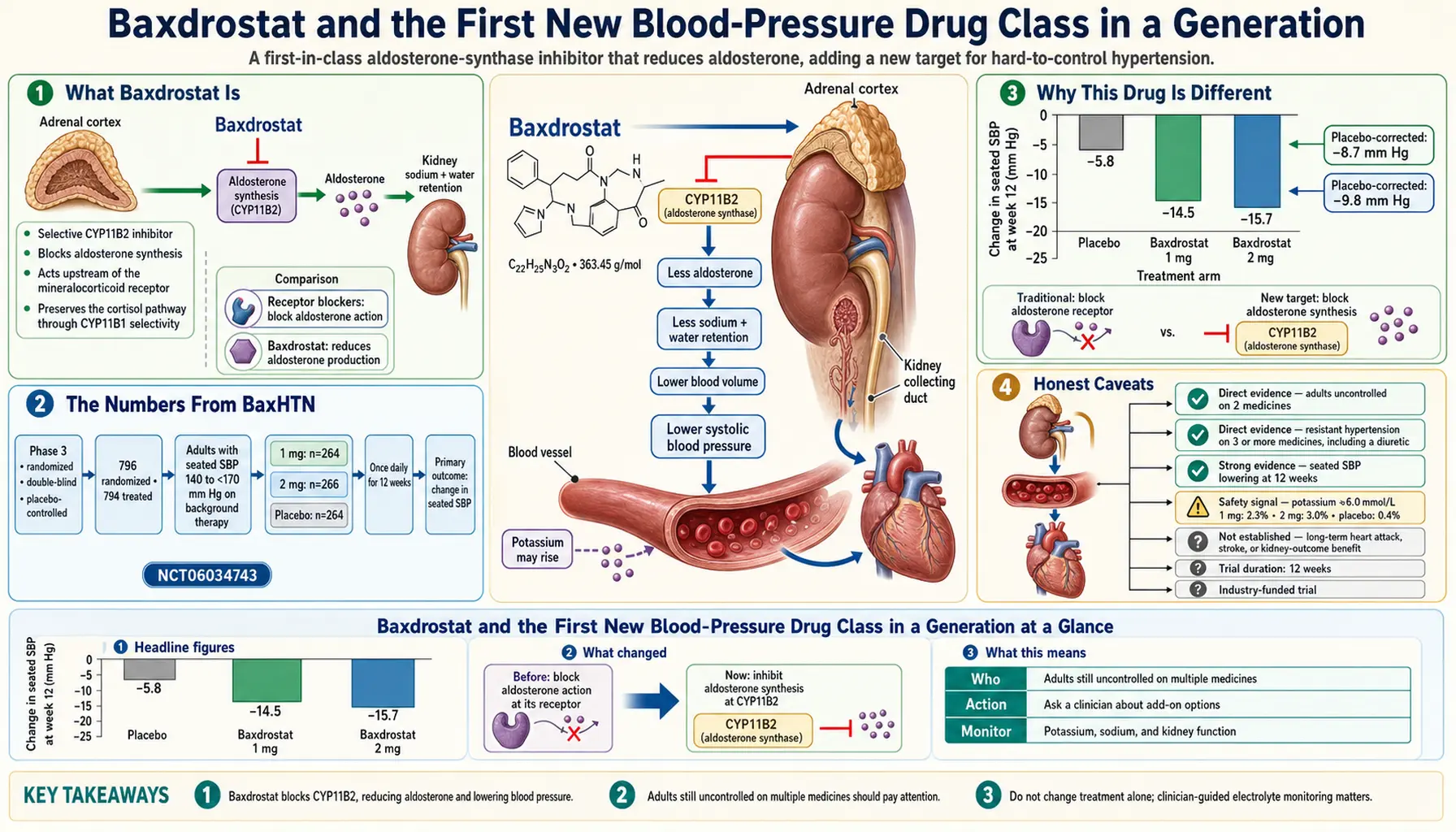
For millions of people, high blood pressure simply refuses to come down. They take two, three, sometimes four different pills every day and their numbers still sit in the danger zone. This spring, a first-in-class drug called baxdrostat is drawing renewed attention as it awaits a United States regulatory decision under FDA Priority Review, on the strength of phase 3 trial data in resistant hypertension. (Update: the FDA approved baxdrostat on 15 May 2026; see the caveats below.) Here is what the evidence shows, and what it does not.
Table of Contents
- What Baxdrostat Is
- The Numbers From BaxHTN
- Why This Drug Is Different
- Honest Caveats
- Key Points
- Sources
- Key Research Papers
- Connections
- Featured Videos
What Baxdrostat Is
Baxdrostat is an oral, once-daily aldosterone synthase inhibitor. Aldosterone is a hormone made in the adrenal glands that tells the kidneys to hold onto salt and water; too much of it drives up blood volume and, with it, blood pressure. In a substantial share of people whose hypertension does not respond to standard drugs, excess aldosterone is an under-recognized contributor — a 2020 study at four US academic centers that tested aldosterone production directly found a continuum running from overt primary aldosteronism to milder aldosterone excess, with overt primary aldosteronism in an estimated 22% of people with resistant hypertension. Baxdrostat works by blocking the enzyme that manufactures the hormone in the first place, turning the tap down at the source rather than mopping up downstream.
The pivotal evidence comes from the international BaxHTN Phase III trial. Its principal investigator, Professor Bryan Williams of the University College London Institute of Cardiovascular Science, presented the results at the European Society of Cardiology Congress on 30 August 2025, and they were published online the same day in the New England Journal of Medicine. With the drug under United States Food and Drug Administration Priority Review, that dataset kept baxdrostat in the headlines through early 2026.
The Numbers From BaxHTN
BaxHTN randomized 796 patients at 214 clinical sites in multiple countries; 794 received treatment. Everyone in the trial already had hard-to-treat high blood pressure: a seated systolic reading of at least 140 and below 170 mmHg despite stable treatment with two antihypertensive medications (uncontrolled hypertension, about 27% of patients) or three or more (resistant hypertension, about 73%), including a diuretic. Mean blood pressure at baseline was about 149/87 mmHg. Participants were randomly assigned to add baxdrostat 1 mg, baxdrostat 2 mg or placebo once daily to their existing regimen for 12 weeks.
After 12 weeks, seated systolic blood pressure — the top number — had fallen by 14.5 mmHg on the 1 mg dose, 15.7 mmHg on the 2 mg dose and 5.8 mmHg on placebo. Compared with placebo, that is an additional 8.7 mmHg on the 1 mg dose (95% CI 5.8 to 11.5) and 9.8 mmHg on the 2 mg dose (95% CI 7.0 to 12.6), P<0.001 for both. At week 12, 39.4% of patients on 1 mg and 40.0% on 2 mg had a seated systolic pressure below 130 mmHg, versus 18.7% on placebo. These reductions came on top of the two or more drugs the patients were already taking.
For perspective: a 2016 meta-analysis of 123 blood-pressure-lowering trials (613,815 participants) found that every 10 mmHg reduction in systolic blood pressure was linked to a lower risk of stroke (relative risk 0.73), heart failure (0.72) and coronary heart disease (0.83). Those trials tested older drugs; whether baxdrostat’s blood-pressure reduction brings the same outcome benefit has not yet been tested, as the caveats below explain.
Why This Drug Is Different
What sets baxdrostat apart is where it acts. Two enzymes in the adrenal gland are nearly identical twins, sharing about 94% of their amino-acid sequence: aldosterone synthase (CYP11B2), which makes aldosterone, and 11-beta-hydroxylase (CYP11B1), which makes the stress hormone cortisol. Earlier drugs designed to block aldosterone production also suppressed cortisol; one of them, osilodrostat, was first developed as an aldosterone synthase inhibitor and is now used instead to treat Cushing’s syndrome because of that cortisol-lowering effect. Baxdrostat is highly selective for aldosterone synthase, with little effect on cortisol production, and BaxHTN recorded no cases of adrenal insufficiency. Reviews describe the difficulty of achieving that selectivity as the obstacle that had long kept direct suppression of aldosterone production out of the clinic. It is not the only new class in recent years: aprocitentan, an endothelin receptor antagonist, was approved in the United States in March 2024 for hypertension not adequately controlled on other drugs.
It also works differently from spironolactone and eplerenone, older drugs many patients already take. Those drugs block aldosterone's receptor after the hormone is made; baxdrostat reduces how much of the hormone is made in the first place. Researchers are studying the newer aldosterone-synthase inhibitors in overlapping but not identical populations, including people with chronic kidney disease: in a phase 2 trial of 195 people with chronic kidney disease and uncontrolled hypertension, baxdrostat lowered systolic pressure by 8.1 mmHg more than placebo at 26 weeks, and hyperkalemia was recorded as an adverse event in 41% of baxdrostat recipients versus 5% on placebo.
Honest Caveats
The evidence has several limits.
This trial measured blood pressure, not outcomes. BaxHTN ran for months, not years. It showed that baxdrostat lowers the number on the cuff; it did not show that patients who take it go on to have fewer heart attacks, strokes, or deaths. Lower blood pressure is a well-established surrogate marker, but a surrogate is not the same as a hard outcome. That evidence would come from larger, longer outcome trials.
The main safety signal is potassium. Because aldosterone normally helps the body excrete potassium, blocking it can let potassium rise — a condition called hyperkalemia that, at the extreme, can disturb heart rhythm. In BaxHTN, hyperkalemia was among the most common adverse events, and a potassium level above 6.0 mmol per liter was reported in 2.3% of patients on 1 mg and 3.0% on 2 mg, versus 0.4% on placebo; the trial’s authors reported a low rate of hyperkalemia leading to discontinuation. Across the class, a 2025 meta-analysis of four randomized trials (1,838 patients) found a markedly higher risk of hyperkalemia with aldosterone synthase inhibitors than with placebo (risk ratio 7.97), and its authors concluded that this risk requires monitoring.
It was tested as an add-on, not as a first treatment. Baxdrostat was tested on top of existing therapy in people with uncontrolled or resistant hypertension — not as a first pill for someone newly diagnosed. The average placebo-corrected reduction was about 9 to 10 mmHg.
It was not yet approved in early April 2026. At that point baxdrostat was under FDA Priority Review and was not available by prescription. Update: on 15 May 2026 the FDA approved baxdrostat to treat hypertension in combination with other antihypertensive drugs, in adults whose blood pressure is not adequately controlled on other agents. Cost, insurance coverage, and real-world access remain open questions that trial data cannot answer.
Key Points
BaxHTN was a large, placebo-controlled phase 3 trial in which a new class of drug lowered blood pressure in patients already taking two or more antihypertensive medications. With its approval on 15 May 2026, baxdrostat became the first aldosterone synthase inhibitor approved in the United States for hypertension. The trial measured blood pressure on a cuff over 12 weeks, rises in potassium were the main safety signal, and any long-term benefit on heart attacks, strokes and deaths has yet to be demonstrated. Separately, research on aldosterone excess itself finds it common and often missed: the 2025 Endocrine Society guideline describes primary aldosteronism as markedly underdiagnosed and undertreated despite effective methods of diagnosis and treatment, and suggests that all individuals with hypertension be screened for it by measuring aldosterone and renin. Decisions about blood-pressure treatment belong with a clinician.
Sources
- Flack JM, Azizi M, Brown JM, et al. Efficacy and Safety of Baxdrostat in Uncontrolled and Resistant Hypertension (BaxHTN). New England Journal of Medicine. 2025;393(14):1363-1374. doi:10.1056/NEJMoa2507109
- The drug’s maker. Baxdrostat demonstrated statistically significant and clinically meaningful reduction in systolic blood pressure in the BaxHTN Phase III trial. Press release, 2025. Manufacturer’s press release
- Azizi M, Brown JM, Dwyer JP, et al. Effect of baxdrostat on ambulatory blood pressure in patients with resistant hypertension (Bax24): a phase 3, randomised, double-blind, placebo-controlled trial. The Lancet. 2026;407(10532):988-999. Lancet Bax24 trial
- BaxAsia Phase III study record, a companion baxdrostat trial (BaxHTN itself is registered as NCT06034743). ClinicalTrials.gov NCT06344104. clinicaltrials.gov/study/NCT06344104
- Gao Y, Mu X, Pang X. Efficacy and safety of aldosterone synthase inhibitors for uncontrolled hypertension: a meta-analysis of randomized controlled trials and systematic review. Frontiers in Pharmacology. 2025;16:1664810. PMC12497756
- American College of Cardiology. BaxHTN and KARDIA-3 Trials Explore Efficacy of HTN Treatments (ESC 2025). acc.org ESC 2025 summary
- ScienceDaily (University College London). Scientists reveal new blood pressure treatment that works when others fail. April 3, 2026. sciencedaily.com/releases/2026/04
Key Research Papers
The primary papers behind the figures above, each checked against its PubMed record and Crossref before it was written down.
- Flack JM, Azizi M, Brown JM, Dwyer JP, Fronczek J, Jones ESW, et al. (2025). Efficacy and Safety of Baxdrostat in Uncontrolled and Resistant Hypertension. New England Journal of Medicine 393(14):1363-1374. — PubMed PMID: 40888730
- Azizi M, Brown JM, Dwyer JP, Flack JM, Jones ESW, Kurlyandskaya R, et al. (2026). Effect of baxdrostat on ambulatory blood pressure in patients with resistant hypertension (Bax24): a phase 3, randomised, double-blind, placebo-controlled trial. Lancet 407(10532):988-999. — PubMed PMID: 41794437
- Dwyer JP, Maklad N, Vedin O, Monyak J, Myte R, Chertow GM, et al. (2026). Efficacy and Safety of Baxdrostat in Participants with CKD and Uncontrolled Hypertension: A Randomized, Double-Blind, Placebo-Controlled Trial. Journal of the American Society of Nephrology 37(2):299-311. — PubMed PMID: 40913594
- Gao Y, Mu X, Pang X (2025). Efficacy and safety of aldosterone synthase inhibitors for uncontrolled hypertension: a meta-analysis of randomized controlled trials and systematic review. Frontiers in Pharmacology 16:1664810. — PubMed PMID: 41059210
- Blair HA (2026). Baxdrostat: First Approval. Drugs 86(10):1761-1768. — PubMed PMID: 42625106
- Capriello I, Dömling A (2026). Baxdrostat: A First-in-Class Aldosterone Synthase Inhibitor for Resistant Hypertension. ACS Pharmacology & Translational Science 9(4):764-770. — PubMed PMID: 41988370
- Sato A, Nishimoto M (2026). Aldosterone synthase inhibitors: a new option for antihypertensive, cardio-renal protection. Hypertension Research 49(7):2190-2200. — PubMed PMID: 42162198
- Dhillon S (2024). Aprocitentan: First Approval. Drugs 84(7):841-847. — PubMed PMID: 38833193
- Ettehad D, Emdin CA, Kiran A, Anderson SG, Callender T, Emberson J, et al. (2016). Blood pressure lowering for prevention of cardiovascular disease and death: a systematic review and meta-analysis. Lancet 387(10022):957-967. — PubMed PMID: 26724178
- Brown JM, Siddiqui M, Calhoun DA, Carey RM, Hopkins PN, Williams GH, Vaidya A (2020). The Unrecognized Prevalence of Primary Aldosteronism: A Cross-sectional Study. Annals of Internal Medicine 173(1):10-20. — PubMed PMID: 32449886
- Adler GK, Stowasser M, Correa RR, Khan N, Kline G, McGowan MJ, et al. (2025). Primary Aldosteronism: An Endocrine Society Clinical Practice Guideline. Journal of Clinical Endocrinology and Metabolism 110(9):2453-2495. — PubMed PMID: 40658480
PubMed Topic Searches
Connections
- Hypertension
- Cardiology
- Primary Aldosteronism
- Endocrinology
- Chronic Kidney Disease
- Heart Failure
- Stroke
- Coronary Artery Disease
- Potassium
- Sodium
- Lab Tests
- May 28, 2026 — Active Forms and Reversible Biology