Oyster Mushroom for Cholesterol & Heart Health
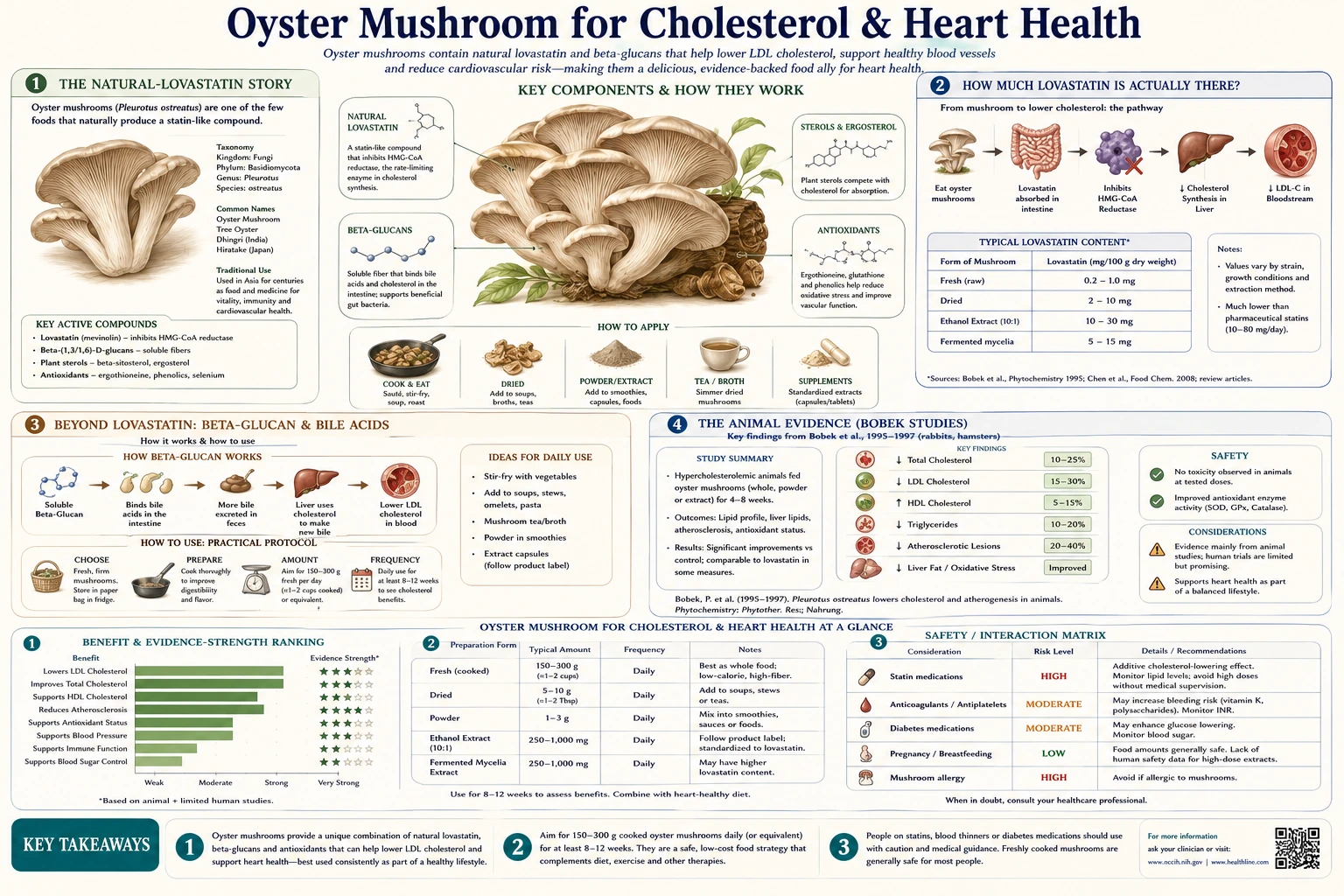
The oyster mushroom holds a genuinely unusual place in nutrition: it is a common grocery-store food that naturally contains lovastatin — the very molecule Merck developed into Mevacor, the first prescription statin. It is an irresistible headline, and it is true. But the honest version has important limits. The amount of lovastatin in an oyster mushroom is small, highly variable, concentrated in the caps, and partly destroyed by cooking, so the cholesterol benefit measured in real studies is modest and owes at least as much to the mushroom's beta-glucan fiber as to its statin content. This page lays out what the animal and human evidence actually shows — and states plainly that oyster mushrooms are a healthy food, not a replacement for a prescribed statin.
Table of Contents
- The Natural-Lovastatin Story
- How Much Lovastatin Is Actually There?
- Beyond Lovastatin: Beta-Glucan & Bile Acids
- The Animal Evidence (Bobek Studies)
- The Human Evidence
- Honest Comparison to a Prescribed Statin
- Broader Cardiovascular Effects
- How to Use Oyster Mushrooms for Heart Health
- Cautions & Interactions
- Key Research Papers
- PubMed Topic Searches
- External Resources
- Connections
- Featured Videos
The Natural-Lovastatin Story
Lovastatin — originally called mevinolin — is a fungal metabolite. It was first isolated from the mold Aspergillus terreus and independently from Monascus ruber (the fungus behind red yeast rice), and it became the founding molecule of the statin drug class in 1987. Statins work by inhibiting HMG-CoA reductase, the rate-limiting enzyme in the liver's cholesterol-synthesis pathway. Block that enzyme and the liver makes less cholesterol internally, then compensates by pulling more LDL cholesterol out of the blood — which is why serum LDL falls.
In the early 1990s, Slovenian researchers Nina Gunde-Cimerman and colleagues discovered that oyster mushrooms (Pleurotus ostreatus and related Pleurotus species) also biosynthesize lovastatin in their fruiting bodies. Their 1993 and 1995 papers confirmed both the identity of the compound and its HMG-CoA-reductase-inhibiting activity — the mushroom is genuinely making a real statin, not a look-alike. The lovastatin is concentrated in the caps (pileus) rather than the stems, and its concentration varies widely between strains, growing substrates, and maturity.
This is the kernel of truth behind every "oyster mushrooms lower cholesterol" claim. The task from here is to size the effect honestly.
How Much Lovastatin Is Actually There?
This is where enthusiasm has to meet arithmetic. A prescription lovastatin dose is 10 to 80 mg per day of pure, standardized, well-absorbed drug. The oyster mushroom's lovastatin content, by contrast, is:
- Small and highly variable — reported values span a wide range depending on strain, part of the mushroom, growth substrate, and analytical method. Caps carry more than stems; different Pleurotus species differ severalfold.
- Partly present as the inactive lactone — lovastatin exists in an inactive closed-ring lactone form and an active open-ring hydroxy-acid form. Only the acid form inhibits the enzyme, and the ratio in food is not standardized.
- Reduced by cooking — heat and prolonged cooking degrade a meaningful fraction of the lovastatin, and almost nobody eats oyster mushrooms raw (nor should they).
- Of uncertain bioavailability — lovastatin bound within a fibrous fungal cell-wall matrix is absorbed differently from a formulated tablet.
The practical consequence: the effective, absorbed statin dose from a normal culinary serving is far below a therapeutic pharmaceutical dose, and it cannot be relied upon or measured at home. This is the single most important honest caveat on this page. It is also why the red-yeast-rice comparison is instructive — red yeast rice supplements are essentially unregulated, variable-dose lovastatin, and health authorities repeatedly warn that consumers cannot know the dose they are getting. The oyster mushroom is a gentler, more dilute version of the same uncertainty, delivered as food.
Beyond Lovastatin: Beta-Glucan & Bile Acids
If lovastatin were the whole story, the cholesterol effect would be trivial. It is not trivial — and the reason is that the mushroom is simultaneously delivering a second, well-established cholesterol-lowering mechanism: soluble beta-glucan fiber.
The cell walls of Pleurotus are rich in beta-(1,3/1,6)-D-glucans and chitin. The soluble glucan fraction behaves like the beta-glucan in oats and barley, which has an authorized health claim for cholesterol lowering. The mechanism is bile-acid sequestration:
- The liver makes bile acids from cholesterol and secretes them into the gut to digest fat.
- Normally about 95% of those bile acids are reabsorbed in the ileum and recycled.
- Viscous soluble fiber binds bile acids in the gut and carries them out in the stool, interrupting that recycling.
- To replace the lost bile acids, the liver must convert more cholesterol into new bile acids — and it upregulates LDL receptors to pull the needed cholesterol out of the blood. Serum LDL falls.
Controlled human studies of oat and barley beta-glucan have mapped this mechanism precisely, showing reduced circulating bile acids and lower blood cholesterol when beta-glucan is present in the gut. Oyster-mushroom beta-glucan plausibly acts through the same route. So the honest framing is that the oyster mushroom lowers cholesterol through two modest, additive mechanisms — a little natural statin plus soluble fiber — neither of which is individually powerful, but which together make it a legitimately heart-friendly food.
The Animal Evidence (Bobek Studies)
The most systematic animal work came from Pavel Bobek and colleagues in Slovakia across the 1990s. Feeding oyster mushroom (as dried powder or extract) to rats and rabbits on high-cholesterol diets, they reported consistent findings:
- Lower plasma total and LDL cholesterol in hypercholesterolemic rats, with the mechanism traced to reduced cholesterol absorption and increased removal of cholesterol from plasma — a dual action consistent with both fiber and statin effects.
- Reduced hepatic cholesterol accumulation and lower cholesterol turnover.
- In rabbits, oyster mushroom in the diet prevented the development of atherosclerotic changes in the aorta.
Later rodent work by other groups (for example, Alam and colleagues) confirmed hypolipidemic effects of dietary Pleurotus in hypercholesterolemic rats, including reductions in total cholesterol, LDL, and triglycerides alongside a rise in HDL. These are real, reproducible findings — but they are animal studies, usually at mushroom doses (as a fraction of total diet) far higher than a person would eat, and in animals deliberately made hypercholesterolemic. They establish plausibility and mechanism; they do not, by themselves, tell you what a few servings a week will do for a human.
The Human Evidence
Human data are thinner, which is the crux of the honesty problem. The most-cited human study is by Khatun and colleagues (2007), who gave oyster mushroom to diabetic subjects and reported reductions in both blood glucose and total cholesterol, with the effects reversing after the mushroom was stopped and returning when it was resumed — a repeat-challenge design that strengthens the signal. A handful of other small trials and case series have reported modest lipid improvements.
What the human evidence supports:
- Oyster mushrooms, eaten regularly and in reasonable quantity, are associated with small reductions in total and LDL cholesterol in some people, especially those starting with elevated levels.
- The effect is in the range you would expect from a fiber-rich food swap, not the 30–55% LDL reduction of a therapeutic statin.
What it does not support: any claim that oyster mushrooms reliably normalize high cholesterol, treat familial hypercholesterolemia, or substitute for statin therapy in someone who needs it. The trials are few, small, and heterogeneous. A person with a clinical indication for a statin should not read this page as permission to skip medication — see the honest comparison below.
Honest Comparison to a Prescribed Statin
This section exists to be unambiguous. Prescription statins are among the most rigorously validated drugs in medicine, with large randomized trials showing they lower LDL cholesterol by roughly 30 to 55% and reduce heart-attack and stroke rates in people at risk. That evidence base rests on standardized, measured doses taken daily.
An oyster mushroom cannot match that, for the reasons already covered: the statin dose is small, unmeasured, variable, and partly degraded by cooking. Treating a plate of mushrooms as equivalent to a prescribed statin would mean swapping a precisely dosed, trial-validated therapy for an uncontrolled, sub-therapeutic amount of the same molecule. Do not stop or reduce a prescribed statin to eat mushrooms instead. If you would prefer to manage cholesterol with diet, that is a legitimate conversation — but it is one to have with the clinician who knows your cardiovascular risk, lipid numbers, and family history, not a decision to make from a food label.
Where the oyster mushroom fits honestly: as one component of a heart-healthy dietary pattern — alongside oats, legumes, nuts, olive oil, and vegetables — that can modestly improve lipids and that complements, rather than replaces, whatever medical therapy is appropriate.
Broader Cardiovascular Effects
Cholesterol is only one lever on heart health, and the oyster mushroom touches several others through its overall profile:
- Blood pressure — the Khatun-type studies in hypertensive diabetic subjects reported reductions in blood pressure alongside the lipid and glucose changes. The mushroom is naturally very low in sodium and a reasonable source of potassium, both favorable for blood pressure.
- Antioxidant protection of LDL — oxidation of LDL particles is a key step in plaque formation. The mushroom's ergothioneine and other antioxidants may help limit LDL oxidation, a mechanism suggested by the Bobek atherosclerosis-prevention findings in rabbits.
- Weight and metabolic load — as a low-calorie, high-satiety food that displaces fattier options, oyster mushrooms support the weight and metabolic-health factors that drive cardiovascular risk.
None of these is a stand-alone treatment, but together they are consistent with the general finding that regular mushroom consumption is associated with favorable cardiometabolic markers in large observational studies.
How to Use Oyster Mushrooms for Heart Health
- Eat them regularly, as a food. A few servings a week, used as a savory swap for some of the meat in stir-fries, pasta, tacos, or grain bowls, is the realistic way to capture the modest benefit. Their meaty texture makes them a natural partial substitute for beef or sausage, which improves the meal's saturated-fat profile at the same time.
- Cook them — but do not incinerate them. Oyster mushrooms should always be cooked (never eaten raw), but gentle sauteing preserves more of the heat-sensitive compounds than prolonged high-heat frying.
- Keep the fat honest. The heart benefit is easily erased by cooking the mushrooms in large amounts of butter or deep-frying them. Saute in a modest amount of olive oil.
- Pair with other cholesterol-active foods. Combine with oats, beans, and vegetables in an overall pattern — the effects of soluble fibers are additive.
- Don't rely on supplements for this. Standardized "oyster mushroom statin" supplements are not well-characterized; whole cooked mushrooms are the sensible form.
Cautions & Interactions
- Not a statin substitute — restated because it is the most important point: never replace prescribed lipid therapy with mushrooms.
- Already on a statin? Eating culinary amounts of oyster mushroom while taking a prescription statin is generally fine — the added natural lovastatin is tiny relative to your dose. Raise it with your clinician if you eat very large quantities or take red-yeast-rice supplements, since those are a more concentrated source.
- Always cook them. Raw Pleurotus can cause gastrointestinal upset; cooking also improves digestibility of the fiber and chitin.
- Mushroom allergy or sensitivity. Some people react to Pleurotus spores (a known occupational allergen for growers) or to eating the mushroom; introduce a small amount first.
- Gout / high uric acid. Mushrooms contain moderate purines; very large intakes may not suit people managing gout.
- Wild harvesting. Only eat oyster mushrooms from a reliable food source or an expert forager — several toxic look-alikes exist.
Key Research Papers
- Gunde-Cimerman N, Cimerman A (1995). Pleurotus fruiting bodies contain the inhibitor of 3-hydroxy-3-methylglutaryl-coenzyme A reductase—lovastatin. Experimental Mycology. — PMID 7614366
- Gunde-Cimerman N, Plemenitas A, Cimerman A (1993). Pleurotus fungi produce mevinolin, an inhibitor of HMG CoA reductase. FEMS Microbiology Letters. — PMID 8270199
- Bobek P, Ozdin L, Kuniak L (1994). Mechanism of hypocholesterolemic effect of oyster mushroom (Pleurotus ostreatus) in rats: reduction of cholesterol absorption and increase of plasma cholesterol removal. Z Ernahrungswiss. — PMID 8197787
- Bobek P, Ozdin L, Galbavy S (1996). Effect of oyster mushroom and its ethanolic extract on cholesterol absorption and turnover in hypercholesterolemic rat. Nahrung. — PMID 8810086
- Bobek P, Galbavy S (1999). The oyster mushroom (Pleurotus ostreatus) effectively prevents the development of atherosclerosis in rabbits. — PMID 10566243
- Alam N, Yoon KN, Lee TS, Lee UY (2011). Hypolipidemic activities of dietary Pleurotus ostreatus in hypercholesterolemic rats. Mycobiology. — PMID 22783072
- Khatun K, Mahtab H, Khanam PA, Sayeed MA, Khan KA (2007). Oyster mushroom reduced blood glucose and cholesterol in diabetic subjects. Mymensingh Medical Journal. — PMID 17344789
- Wang Y, Ames NP, Tun HM, et al. (2017). Barley beta-glucan reduces blood cholesterol levels via interrupting bile acid metabolism. British Journal of Nutrition. — PMID 29115200
- Gunness P, Michiels J, Vanhaecke L, et al. (2016). Reduction in circulating bile acid and restricted diffusion across the intestinal epithelium associated with a decrease in blood cholesterol in the presence of oat beta-glucan. FASEB Journal. — PMID 27630168
- Lee DH, Yang M, Giovannucci EL, et al. (2019). Mushroom consumption, biomarkers, and risk of cardiovascular disease and type 2 diabetes: a prospective cohort study of US women and men. American Journal of Clinical Nutrition. — PMID 31172167
PubMed Topic Searches
- PubMed: Pleurotus ostreatus lovastatin cholesterol
- PubMed: oyster mushroom hypocholesterolemic lipid
- PubMed: mushroom beta-glucan bile acid cholesterol
- PubMed: Pleurotus atherosclerosis cardiovascular
External Resources
- NHLBI — Blood Cholesterol (what LDL/HDL mean and evidence-based management)
- American Heart Association — Cholesterol
- StatPearls — Lovastatin (mechanism and pharmacology)
- PubMed — Pleurotus ostreatus & cholesterol
Connections
- Oyster Mushroom (Main Page)
- Oyster Mushroom Benefits Hub
- Antioxidant & Ergothioneine
- Blood Sugar & Metabolic Health
- Cholesterol Management
- Atherosclerosis
- Cardiovascular Disease
- Coronary Artery Disease
- Hypertension
- King Oyster Mushroom
- Shiitake Mushroom
- Potassium
- All Mushrooms