Cordyceps for Exercise Performance and Endurance
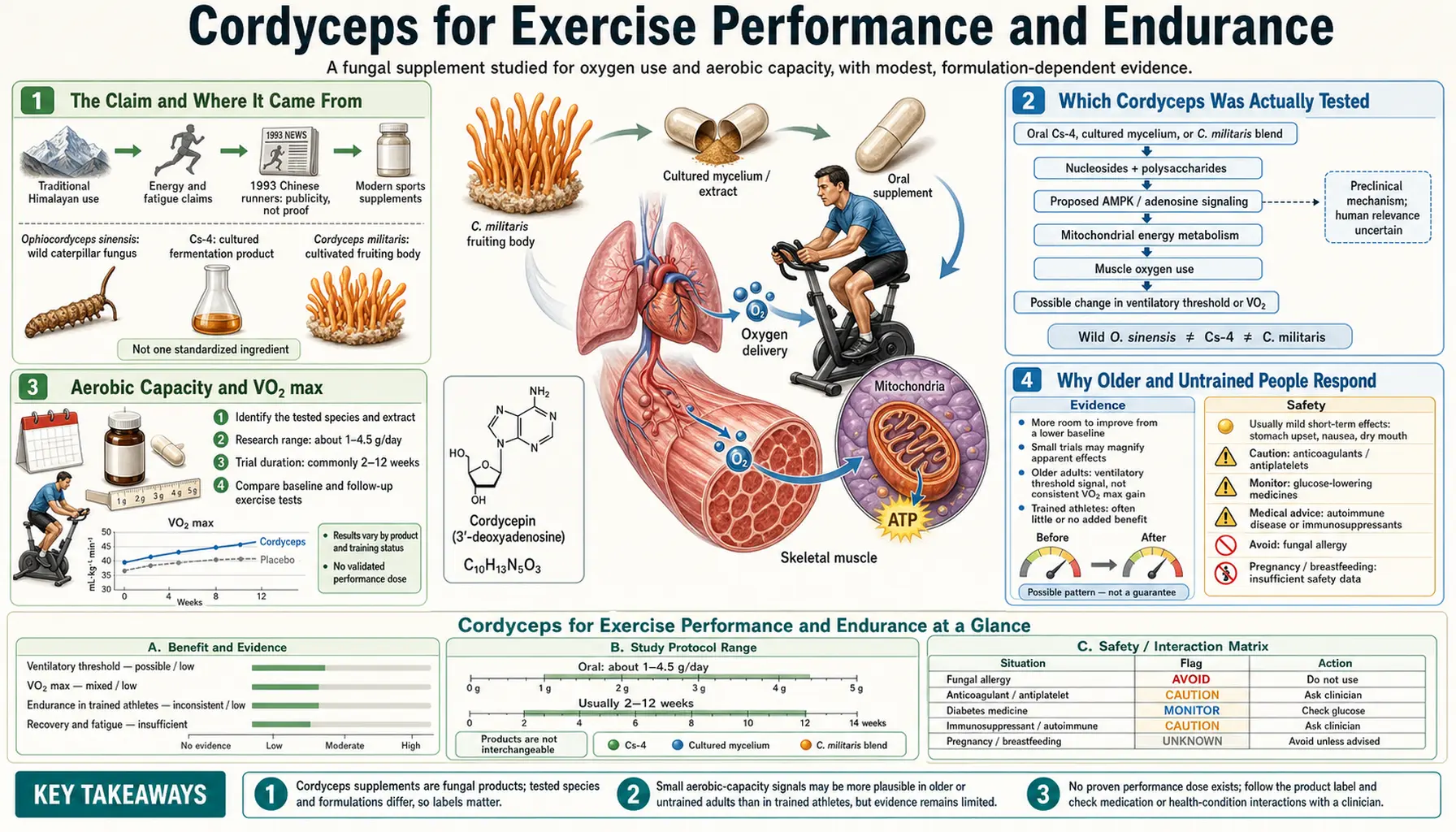
The single most famous claim about Cordyceps is that it boosts stamina and aerobic capacity — a reputation supercharged in 1993 when Chinese runners set world records and their coach credited a Cordyceps tonic. Three decades of controlled trials have produced a more sober picture: the benefit is real but modest, it shows up mainly in older or untrained people, it requires weeks of use rather than a single dose, and it depends heavily on which Cordyceps was tested. Well-designed studies in trained cyclists have repeatedly found no benefit at all. This page walks through exactly what the trials measured, in whom, and how to set realistic expectations.
Table of Contents
- The Claim and Where It Came From
- Which Cordyceps Was Actually Tested
- Aerobic Capacity and VO2max
- Why Older and Untrained People Respond
- High-Intensity Tolerance and Chronic Dosing
- The Negative Trials in Trained Athletes
- Proposed Mechanisms
- Practical Use and Realistic Expectations
- Cautions
- Key Research Papers
- Connections
- Featured Videos
The Claim and Where It Came From
Cordyceps entered Western sports culture almost overnight in 1993, when a group of Chinese distance runners coached by Ma Junren shattered several world records at the National Games. Their coach attributed the performances partly to a tonic containing Cordyceps (alongside turtle blood and other ingredients). The records were later shadowed by doping suspicions, and no Cordyceps supplement was ever shown to be responsible — but the association stuck, and Cordyceps has been marketed as an endurance aid ever since.
Underneath the folklore is a plausible physiological question: can a fungus improve the body's ability to take in, transport, and use oxygen during exercise? Traditional Chinese Medicine had used Cordyceps as a "kidney and lung" tonic for centuries, indications that map loosely onto stamina and breathing. The modern task has been to test that reputation with the tools of exercise physiology — VO2max, ventilatory threshold, time-to-exhaustion, and lactate — rather than anecdote.
Which Cordyceps Was Actually Tested
Before reading any Cordyceps exercise study, the first question is always: which Cordyceps? The three forms behave differently and are not interchangeable.
- Cs-4 (fermented Ophiocordyceps sinensis mycelium) — a standardized fermentation product (also sold as CordyMax). Much of the more credible human exercise research used Cs-4, because it is reproducible from batch to batch.
- Cordyceps militaris (cultivated fruiting body) — the bright-orange club fungus grown on grain. It typically contains far more cordycepin than wild O. sinensis, and is the form used in several newer trials.
- Wild O. sinensis (caterpillar fungus) — the scarce, extremely expensive Himalayan specimen. Almost no rigorous exercise trials use authentic wild material, partly because of cost and partly because of rampant adulteration.
This matters because a positive Cs-4 trial does not automatically validate a C. militaris capsule, and neither validates a wild-harvest product of unknown potency. Many commercial "Cordyceps for athletes" blends also combine the fungus with Rhodiola, cordyceps-unrelated stimulants, or beetroot — so a benefit seen with a blend cannot be pinned on Cordyceps alone.
Aerobic Capacity and VO2max
VO2max — the maximum rate at which the body can consume oxygen during intense exercise — is the headline number in endurance science. The Cordyceps VO2max literature is genuinely mixed:
- In a double-blind, placebo-controlled trial in healthy older adults, Chen and colleagues (2010) found that Cs-4 modestly improved the metabolic (ventilatory) threshold — the exercise intensity at which lactate begins to accumulate — suggesting a small improvement in aerobic efficiency, even though peak VO2max itself did not change dramatically.
- Some short crossover studies in younger, fitter subjects found no measurable change in VO2max at all.
- Reviews consistently note that when an effect appears, it tends to be a shift in the submaximal efficiency of oxygen use rather than a large jump in the ceiling of VO2max.
The honest reading is that Cordyceps is not a reliable VO2max booster in already-fit people. Where it seems to help, the effect is on how comfortably you work below your maximum — a meaningful but undramatic difference that a recreational exerciser might feel as "less winded" without it changing a stopwatch by much.
Why Older and Untrained People Respond
A recurring pattern across the Cordyceps exercise literature is that benefits cluster in older adults and deconditioned or untrained subjects, not elite athletes. There is a straightforward physiological reason: people who start with lower aerobic fitness have more "headroom" to improve, and any intervention that nudges oxygen efficiency, reduces oxidative stress, or improves recovery will show up more clearly against a lower baseline.
The Chen 2010 trial is the cleanest example — it deliberately studied healthy older subjects and found a measurable ventilatory-threshold benefit. This population is arguably where Cordyceps is most defensible: an older person trying to walk farther or climb stairs with less breathlessness is more likely to notice a real difference than a competitive cyclist chasing a 1% edge. If you are middle-aged or older and returning to exercise, this is the evidence most relevant to you. For general guidance on building an aerobic base, see our page on Exercise.
High-Intensity Tolerance and Chronic Dosing
One of the better-controlled modern studies is Hirsch and colleagues (2017), who tested a C. militaris-containing mushroom blend on tolerance to high-intensity exercise. The design has two important lessons baked in:
- Chronic beat acute. A single dose did little; the meaningful improvement in high-intensity exercise tolerance and time-to-exhaustion appeared only after one to three weeks of daily supplementation. This fits the traditional use pattern — Cordyceps was taken as a sustained tonic, not a pre-workout shot.
- It was a blend. The supplement contained multiple mushrooms, so the study supports the product more than it isolates Cordyceps as the single active agent.
The practical takeaway that generalizes across trials: if you are going to try Cordyceps for performance, judge it after several weeks of consistent daily use, not after one dose before a race. The compound's plausible mechanisms (antioxidant enzyme upregulation, adaptive signaling) are the kind that accrue over time, not acutely.
The Negative Trials in Trained Athletes
Honesty requires giving the negative results equal weight, because they are among the best-designed studies in the field:
- Parcell et al. (2004) ran a five-week, double-blind, placebo-controlled trial of CordyMax Cs-4 in endurance-trained cyclists. The result was unambiguous: Cs-4 did not improve aerobic capacity or endurance performance. The title of the paper says so outright.
- Earnest et al. (2004) tested a commercial herbal formula containing Cordyceps in trained cyclists and likewise found no ergogenic benefit on performance measures.
These trials do not "debunk" Cordyceps so much as define its boundary: in fit, endurance-trained athletes with little room to improve, Cordyceps did nothing measurable. Combined with the positive older-adult data, the overall picture is a ceiling effect — the more trained you already are, the less Cordyceps has to offer. Anyone selling Cordyceps as a proven edge for competitive athletes is overstating the evidence.
Proposed Mechanisms
Several mechanisms are offered to explain how Cordyceps could aid endurance. All are supported mainly by cell and animal work, so treat them as plausible hypotheses rather than proven pathways in exercising humans:
- Improved oxygen utilization — animal studies suggest Cordyceps may increase the efficiency of oxygen use and raise tissue ATP-to-inorganic-phosphate ratios, which would delay the point at which working muscle runs short of energy.
- Antioxidant defense — extracts consistently raise endogenous antioxidant enzymes (superoxide dismutase, glutathione peroxidase) and lower markers of exercise-induced oxidative stress in rodents, which could aid recovery.
- Vasodilation — some data point to nitric-oxide-mediated relaxation of blood vessels, which would improve blood flow to working muscle.
- Anti-fatigue signaling — rodent "forced swim" and treadmill studies show longer time-to-exhaustion and lower lactate and blood-urea-nitrogen after Cordyceps, a classic anti-fatigue signature (see the companion Energy & ATP page).
Practical Use and Realistic Expectations
- Form: choose a product that names the species and form — standardized Cs-4 (the most-studied for exercise) or cultivated C. militaris fruiting body reporting beta-glucan and/or cordycepin content. Avoid vague "Cordyceps" labels and cheap wild-sinensis claims.
- Dose: human trials commonly used roughly 1–3 grams per day of extract. There is no single official dose.
- Timing: take it daily and consistently. Do not expect a single pre-workout dose to work — the benefits in trials appeared after weeks.
- Who is most likely to benefit: older adults, people returning to exercise, and the deconditioned. Trained competitive athletes should expect little to nothing.
- What to measure: give any trial 4–6 weeks and track something concrete — perceived breathlessness on a fixed route, submaximal heart rate, or how many stairs you can climb comfortably — rather than relying on feel alone.
Cautions
- Not a substitute for training. No supplement replaces progressive aerobic conditioning; Cordyceps at best adds a small margin on top of consistent training.
- Blood sugar and blood thinners. Cordyceps may have mild glucose-lowering and anti-platelet effects in preclinical work; use caution if you take diabetes medication or anticoagulants, and monitor accordingly.
- Autoimmune disease and immunosuppressants. Because Cordyceps can stimulate immune activity, people on immunosuppressant drugs or with autoimmune conditions should consult a clinician (see the Immune & Inflammation page).
- Product quality. Wild O. sinensis is heavily adulterated and sometimes contaminated with heavy metals; third-party-tested cultivated products are safer and more consistent.
- Anti-doping. Athletes subject to testing should verify that any blend is free of banned stimulants; some "energy" formulas that include Cordyceps also contain other, prohibited ingredients.
Key Research Papers
- Chen S, Li Z, Krochmal R, et al. (2010). Effect of Cs-4 (Cordyceps sinensis) on exercise performance in healthy older subjects: a double-blind, placebo-controlled trial. J Altern Complement Med. — PMID 20804368
- Hirsch KR, Smith-Ryan AE, Roelofs EJ, et al. (2017). Cordyceps militaris improves tolerance to high-intensity exercise after acute and chronic supplementation. J Diet Suppl. — PMID 27408987
- Parcell AC, Smith JM, Schulthies SS, et al. (2004). Cordyceps sinensis (CordyMax Cs-4) supplementation does not improve endurance exercise performance. Int J Sport Nutr Exerc Metab. — PMID 15118196
- Earnest CP, Morss GM, Wyatt F, et al. (2004). Effects of a commercial herbal-based formula on exercise performance in cyclists. Med Sci Sports Exerc. — PMID 15076794
- Anti-fatigue property of the extruded product of cereal grains mixed with Cordyceps militaris (2017). J Int Soc Sports Nutr. — PMID 28588427
- Radhi M, et al. (2021). A systematic review of the biological effects of cordycepin. Molecules. — PMID 34641429
- Tuli HS, Sandhu SS, Sharma AK (2014). Pharmacological and therapeutic potential of Cordyceps with special reference to cordycepin. 3 Biotech. — PMID 28324458
- Zhu JS, Halpern GM, Jones K (1998). The scientific rediscovery of an ancient Chinese herbal medicine: Cordyceps sinensis, Part I. J Altern Complement Med. — PMID 9764768
PubMed Topic Searches
- Cordyceps exercise performance
- Cordyceps VO2max / aerobic capacity
- Cordyceps endurance / ventilatory threshold
- Cordyceps militaris athletes
Connections
- Cordyceps Mushroom (Main Page)
- Cordyceps Benefits Hub
- Cordyceps, Cordycepin & ATP
- Cordyceps for Respiratory Support
- Exercise
- Rhodiola Rosea
- Rhodiola for Stress & Fatigue
- Creatine
- CoQ10
- Iron (Oxygen Transport)
- Magnesium
- Cardiology
- Chronic Fatigue Syndrome
- All Mushrooms