Cordyceps, Cordycepin, and Cellular Energy (ATP)
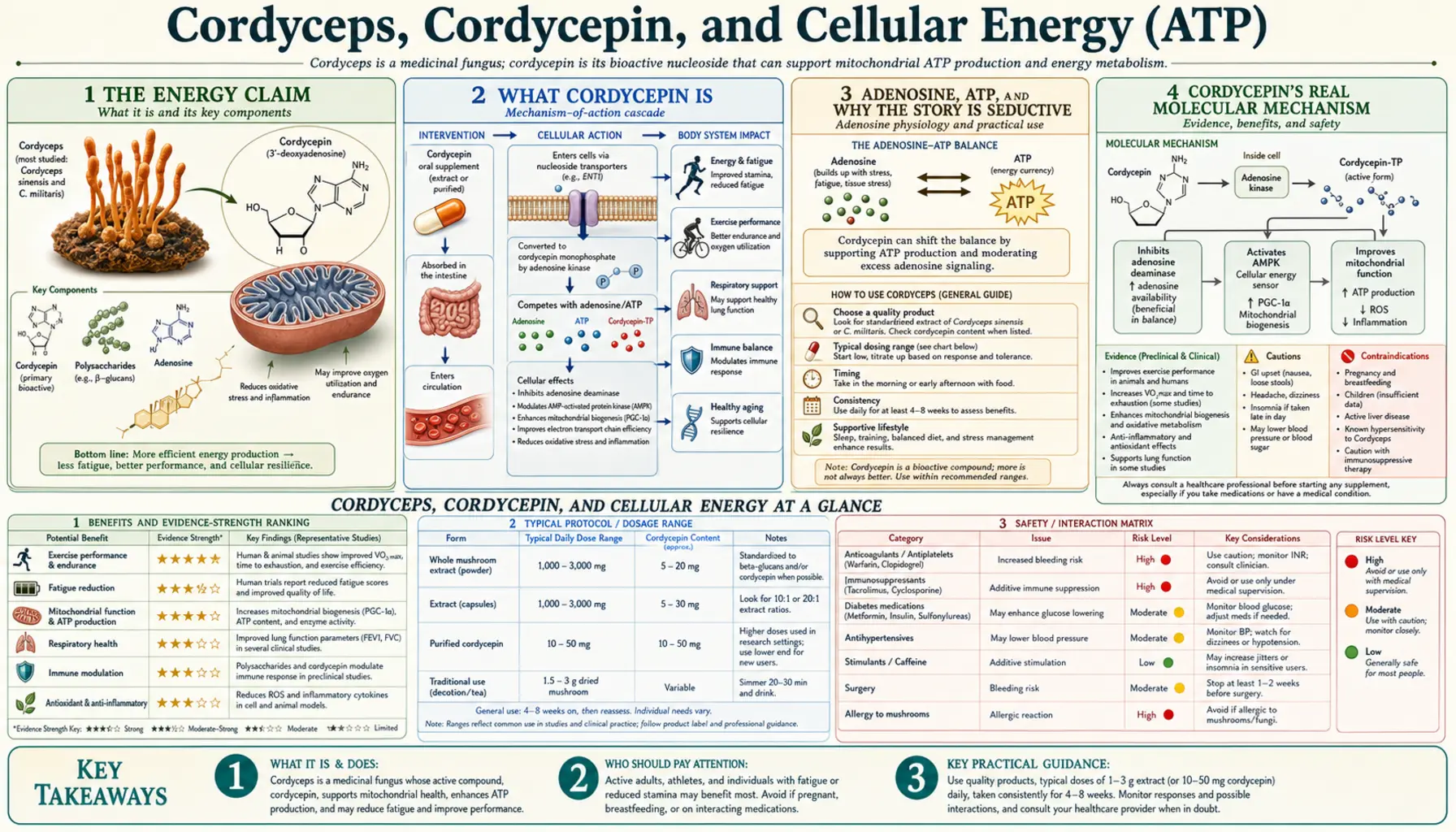
Cordyceps is sold as a "cellular energy" supplement, and the pitch usually invokes ATP — the body's energy currency. The reason the story sounds so convincing is chemistry: the fungus's signature compound, cordycepin, is 3′-deoxyadenosine — adenosine with one oxygen atom removed, and adenosine sits at the very center of ATP. But structural resemblance is not the same as an energy boost. This page explains what cordycepin actually does at the molecular level, where the anti-fatigue evidence is genuinely strong (cell and animal studies), where it is thin (humans), and why cordycepin is chemically fragile in the body — a fact that complicates the simple "take Cordyceps, make more ATP" narrative.
Table of Contents
- The Energy Claim
- What Cordycepin Is
- Adenosine, ATP, and Why the Story Is Seductive
- Cordycepin's Real Molecular Mechanism
- AMPK and Metabolic Signaling
- Anti-Fatigue Studies
- What Human Energy Evidence Exists
- The Adenosine-Deaminase Problem
- Practical Takeaways
- Cautions
- Key Research Papers
- Connections
- Featured Videos
The Energy Claim
Search any supplement store and Cordyceps is filed under "energy" alongside caffeine and B-vitamins. The marketing language typically claims it "increases ATP production," "improves oxygen utilization," and "fights fatigue at the cellular level." Unlike caffeine, Cordyceps is not a stimulant — it does not block adenosine receptors to make you feel wired. The proposed mechanism is metabolic: that it helps cells make or use energy more efficiently. This is a testable claim, and the evidence for it is a mix of strong preclinical signals and disappointingly sparse human data.
What Cordycepin Is
Cordycepin was first isolated from Cordyceps militaris in 1950 and was one of the earliest nucleoside analogs ever described. Chemically it is 3′-deoxyadenosine: the nucleoside adenosine, but missing the hydroxyl group at the 3′ position of its ribose sugar. That single missing oxygen is the source of both its biological activity and its instability.
Two facts about cordycepin matter for consumers:
- It is concentrated in cultivated C. militaris and is often low or nearly absent in wild Ophiocordyceps sinensis. A product's cordycepin content therefore depends heavily on species and cultivation, not just on the word "Cordyceps" on the label.
- Most of what is known about cordycepin comes from cell and animal experiments using purified compound at controlled doses — not from swallowing a mushroom extract, where the delivered dose is uncertain and absorption is poor.
Adenosine, ATP, and Why the Story Is Seductive
Adenosine triphosphate (ATP) is the molecule cells spend to power almost everything — muscle contraction, nerve signaling, biosynthesis. ATP is built on an adenosine backbone: adenosine plus three phosphate groups. Because cordycepin is adenosine with a tiny modification, it is easy to imagine it slotting into energy metabolism and topping up the ATP tank.
The reality is more nuanced. Cordycepin's resemblance to adenosine means it can interfere with adenosine-dependent processes as much as support them — it can be mistaken for adenosine by enzymes and by RNA-building machinery. So the very feature that makes the ATP story marketable is also why cordycepin behaves as a biological disruptor in many experiments (which is exactly why it is studied as an anti-cancer and anti-inflammatory agent). The leap from "looks like adenosine" to "makes more ATP in your muscles" is not supported by direct human measurement.
Cordycepin's Real Molecular Mechanism
The best-characterized action of cordycepin has nothing to do with topping up ATP. Because it lacks the 3′-hydroxyl group, when cordycepin is incorporated into a growing RNA strand it acts as a chain terminator — the next nucleotide cannot attach, so RNA synthesis stops. In particular, cordycepin interferes with polyadenylation, the addition of the poly-A tail that stabilizes messenger RNA. This is a genuine, well-documented mechanism and explains cordycepin's antiproliferative and anti-inflammatory effects: it dampens the production of proteins that drive cell division and inflammation.
Reviews such as Radhi et al. (2021) and Tuli et al. (2013, 2014) catalog these actions across cancer, inflammation, and metabolic models. The important reframing for a consumer is that cordycepin is best understood as a signaling and gene-expression modulator, not a fuel. Its most robust benefits — where they exist — come from turning certain molecular programs down (inflammation, unchecked proliferation), not from pouring energy in. The overlap with inflammation is covered on the Immune & Inflammation page.
AMPK and Metabolic Signaling
One pathway that does connect cordycepin to energy metabolism is AMP-activated protein kinase (AMPK) — the cell's master "low-fuel" sensor. When cellular energy runs low, AMPK switches on programs that burn fat, take up glucose, and build mitochondria, while switching off energy-expensive synthesis. Because cordycepin can be metabolized to a compound resembling AMP (the signal AMPK detects), several studies report that cordycepin activates AMPK.
In animal models this has produced meaningful metabolic effects: cordycepin has attenuated high-fat-diet-induced fatty liver, improved lipid handling, and enhanced glucose uptake — all consistent with AMPK activation. This is scientifically interesting and is the strongest mechanistic bridge between Cordyceps and "energy metabolism." But note the direction of the effect: AMPK activation improves how cells manage fuel under stress; it is not the same as the subjective "more energy" a tired person is hoping to buy. And these results are in rodents at controlled cordycepin doses, not in humans taking capsules.
Anti-Fatigue Studies
The anti-fatigue evidence for Cordyceps is real but concentrated in animals. The classic rodent paradigms — forced-swim and weight-loaded swim tests — repeatedly show that Cordyceps extracts and polysaccharides extend time-to-exhaustion and lower biochemical fatigue markers such as blood lactate and blood-urea-nitrogen, while raising liver and muscle glycogen stores. These are reproducible findings across many labs and are the physiological basis for the fatigue claims.
On the human side, the evidence thins dramatically. One study of an extruded cereal product containing C. militaris reported anti-fatigue benefits in people, but such trials are few, small, and often test blends rather than isolated Cordyceps. The rodent anti-fatigue signature is strong enough to justify continued research; it is not strong enough to promise a tired adult that a capsule will fix their fatigue. If persistent, unexplained fatigue is the real problem, it deserves a medical workup — see Chronic Fatigue Syndrome — not a supplement-first approach.
What Human Energy Evidence Exists
Pulling the human literature together honestly:
- There is no well-powered human trial demonstrating that Cordyceps raises muscle or whole-body ATP.
- The closest human data are the exercise-performance trials, which show a modest, population-dependent benefit to aerobic efficiency — and even those are contradicted by negative trials in trained athletes.
- Human immune trials (Jung 2019; a 2015 trial in healthy men) measured immune markers, not energy, and cannot be repurposed as evidence of an energy effect.
The fair conclusion: the "cellular energy / ATP" claim is currently a mechanistic hypothesis dressed up as a proven benefit. The molecular story is plausible and partly demonstrated in cells and rodents; the human confirmation is not there yet. That does not make Cordyceps useless — it makes the specific ATP claim unproven.
The Adenosine-Deaminase Problem
A crucial and under-advertised wrinkle: cordycepin is rapidly degraded in the body by adenosine deaminase (ADA), the same enzyme that clears adenosine. Because cordycepin looks like adenosine, ADA chops it up quickly, so orally ingested cordycepin has a short half-life and low systemic exposure. In pharmacology research, cordycepin is often co-administered with an ADA inhibitor (such as pentostatin) specifically to keep it around long enough to act.
This has two honest implications for supplements:
- The impressive cell-culture doses of cordycepin are difficult to reproduce in a living human from an oral capsule, because ADA is dismantling it as fast as it is absorbed.
- It is one more reason the gap between "cordycepin does X in a dish" and "a Cordyceps supplement does X in you" is wide. Formulation science aimed at protecting cordycepin (analogs, delivery systems, ADA-resistant derivatives) is an active research area precisely because the natural compound is so short-lived.
Practical Takeaways
- If you want cordycepin, choose C. militaris. Wild O. sinensis may contain very little. Look for products that actually report cordycepin content.
- Do not expect a stimulant effect. Cordyceps is not caffeine; any benefit is slow and metabolic, judged over weeks.
- Treat "boosts ATP" claims skeptically. The phrase is mechanistic marketing, not a demonstrated human outcome.
- Work up real fatigue medically. Iron deficiency, thyroid disease, sleep apnea, depression, and B12 deficiency are common, treatable causes; a mushroom extract should not be the first move.
- Dose: trials commonly used ~1–3 g/day of extract; there is no established cordycepin dose for humans.
Cautions
- Blood sugar: cordycepin's AMPK and glucose effects mean people on diabetes medication should monitor for additive lowering.
- Bleeding risk: possible mild anti-platelet activity; use caution with anticoagulants and around surgery.
- Autoimmune / immunosuppression: Cordyceps modulates immunity; consult a clinician if you take immunosuppressants or have an autoimmune disease.
- Pregnancy and breastfeeding: not enough safety data; cordycepin's antiproliferative action argues for avoidance.
- Quality: favor third-party-tested cultivated products; wild caterpillar fungus is costly, frequently adulterated, and can carry heavy-metal contamination.
Key Research Papers
- Radhi M, et al. (2021). A systematic review of the biological effects of cordycepin. Molecules. — PMID 34641429
- Tuli HS, Sandhu SS, Sharma AK (2014). Pharmacological and therapeutic potential of Cordyceps with special reference to cordycepin. 3 Biotech. — PMID 28324458
- Tuli HS, Sharma AK, Sandhu SS, Kashyap D (2013). Cordycepin: a bioactive metabolite with therapeutic potential. Life Sci. — PMID 24121015
- Cordycepin attenuates high-fat-diet-induced non-alcoholic fatty liver disease via AMPK (2021). Int Immunopharmacol. — PMID 33352441
- Anti-fatigue property of the extruded product of cereal grains mixed with Cordyceps militaris (2017). J Int Soc Sports Nutr. — PMID 28588427
- Cordycepin in anticancer research: molecular mechanism of therapeutic effects (2020). Curr Med Chem. — PMID 30277143
- The anticancer properties of cordycepin and their underlying mechanisms (2018). Int J Mol Sci. — PMID 30287757
- Zhu JS, Halpern GM, Jones K (1998). The scientific rediscovery of a precious ancient Chinese herbal regimen: Cordyceps sinensis, Part II. J Altern Complement Med. — PMID 9884180
PubMed Topic Searches
- Cordycepin (3′-deoxyadenosine) mechanism
- Cordycepin & AMPK metabolism
- Cordyceps anti-fatigue models
- Cordycepin & adenosine deaminase stability
Connections
- Cordyceps Mushroom (Main Page)
- Cordyceps Benefits Hub
- Cordyceps for Exercise Performance
- Cordyceps for Immune & Inflammation
- CoQ10 (Mitochondrial Energy)
- Creatine (ATP Regeneration)
- Chronic Fatigue Syndrome
- Rhodiola for Stress & Fatigue
- Iron (Fatigue & Oxygen)
- Magnesium (ATP Cofactor)
- Antioxidants
- Exercise
- All Mushrooms