Cordyceps — Benefits Deep Dive
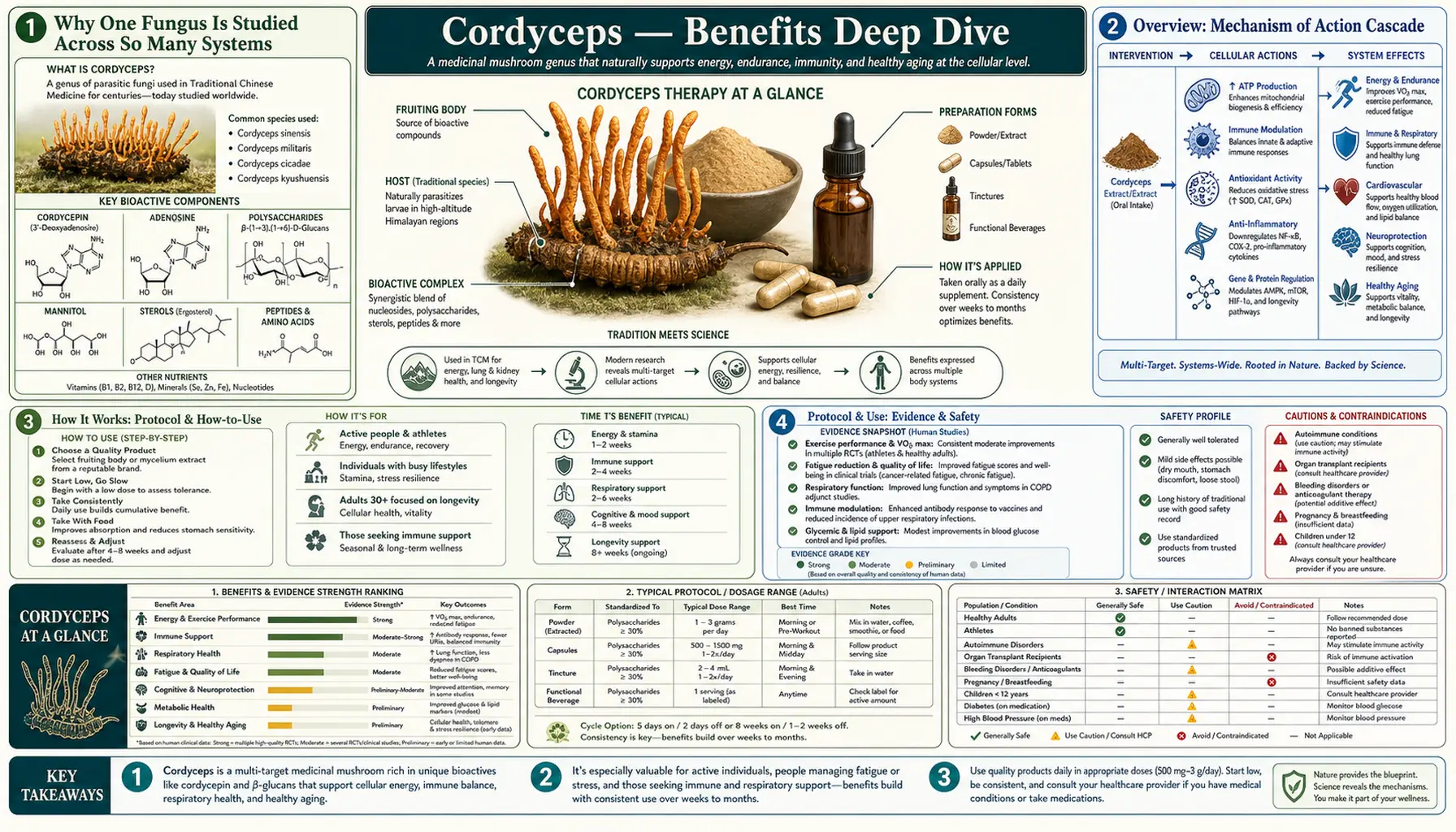
Cordyceps is marketed above all as an energy, stamina, and lung tonic — but "Cordyceps" is really two different fungi with different chemistry. The wild Himalayan caterpillar fungus Ophiocordyceps sinensis is scarce and expensive; most modern research and products instead use the cultivated club fungus Cordyceps militaris or a fermented mycelial strain of O. sinensis called Cs-4. The four deep-dive pages below separate what controlled human trials actually show from what laboratory and animal studies merely suggest. The honest summary up front: the traditional reputation is ancient and the preclinical science is genuinely interesting, but for several headline claims — especially the "instant ATP and VO2max boost" — the human evidence is still modest, mixed, and strain-dependent.
Deep-Dive Articles
Exercise Performance & Endurance
VO2max, aerobic capacity, and stamina. Why the encouraging trials (Chen 2010 in older adults; Hirsch 2017 for high-intensity tolerance) used Cs-4 or C. militaris with weeks of dosing — and why well-controlled trials in trained cyclists (Parcell 2004, Earnest 2004) found no benefit at all. A realistic read of who, if anyone, gets an ergogenic effect.
Energy & ATP (Cordycepin)
The signature compound cordycepin (3′-deoxyadenosine) is an adenosine analog, which is why the "cellular energy / ATP" story is so seductive. What cordycepin actually does at the molecular level (RNA chain termination, AMPK signaling), where the anti-fatigue evidence is strong (cells and mice) and where it is thin (humans), and the adenosine-deaminase problem that limits oral cordycepin.
Respiratory & Lung Support
Cordyceps is a classic Traditional Chinese Medicine "lung and kidney" tonic. Animal asthma and COPD models show real anti-inflammatory and anti-airway-remodeling effects (NF-κB, TGF-β/Smad), and one small human trial reported improved asthma quality of life — but Cordyceps is a supplement, not a rescue inhaler. Honest limits throughout.
Immune Function & Inflammation
Beta-glucan polysaccharides activate macrophages and NK cells; cordycepin dampens NF-κB-driven inflammation. Two small human RCTs (Jung 2019; a 2015 trial in healthy Korean men) measured genuine shifts in immune markers. What "immunomodulation" does and does not mean — and why people on immunosuppressants or with autoimmune disease should be cautious.
Table of Contents
- Deep-Dive Articles
- Why One Fungus Is Studied Across So Many Systems
- Research Papers: Exercise & Endurance
- Research Papers: Cordycepin, Energy & Fatigue
- Research Papers: Respiratory & Lung
- Research Papers: Immune & Inflammation
- Research Papers: Cross-Cutting (Reviews & Safety)
- External Authoritative Resources
- Connections
- Featured Videos
Why One Fungus Is Studied Across So Many Systems
Cordyceps has an unusually broad list of proposed benefits for a single organism. That breadth is not marketing invention — it traces to a small number of real chemical actors that each touch several body systems at once. Understanding the three main mechanisms explains why the same fungus shows up in the exercise, energy, respiratory, and immune literature, and also why the human evidence is stronger for some claims than others.
- Nucleoside signaling (cordycepin / 3′-deoxyadenosine) — cordycepin is structurally almost identical to adenosine, the molecule at the center of cellular energy currency (ATP) and of purinergic signaling. Because it can be incorporated into RNA and can influence AMPK and adenosine-receptor pathways, it plausibly touches cellular energy metabolism and, through NF-κB suppression, inflammation. Cordycepin is concentrated in cultivated C. militaris and is often low or absent in wild O. sinensis.
- Beta-glucan and polysaccharide immunomodulation — like other medicinal mushrooms, Cordyceps is rich in beta-glucans and other polysaccharides that are recognized by pattern-recognition receptors (Dectin-1, TLRs) on macrophages, dendritic cells, and natural killer cells. This is the mechanistic basis for its immune-stimulating reputation and overlaps with its anti-inflammatory and airway effects.
- Antioxidant and vascular effects — extracts consistently scavenge free radicals and raise endogenous antioxidant enzyme activity in cell and animal models, and some data suggest improved oxygen utilization and vasorelaxation. This is the proposed thread behind the stamina and aerobic-capacity claims, though it is precisely here that human trials are most mixed.
The recurring caveat across all four pages is species and strain. A product that simply says "Cordyceps" without naming the species (C. militaris vs O. sinensis), the form (fruiting body, mycelium, or the fermented Cs-4 strain), and how it is standardized (cordycepin for C. militaris; adenosine for O. sinensis) tells you almost nothing about its chemistry. Much of the better human research used the standardized Cs-4 fermentation, which is why its results do not automatically transfer to a random capsule on a shelf. Cultivated C. militaris is generally the more sustainable and analytically consistent choice, because authentic wild caterpillar fungus is scarce, extremely expensive, and a frequent target of adulteration.
Research Papers: Exercise & Endurance
- Chen S, et al. (2010). Effect of Cs-4 (Cordyceps sinensis) on exercise performance in healthy older subjects: a double-blind, placebo-controlled trial. J Altern Complement Med. — PMID 20804368
- Hirsch KR, et al. (2017). Cordyceps militaris improves tolerance to high-intensity exercise after acute and chronic supplementation. J Diet Suppl. — PMID 27408987
- Parcell AC, et al. (2004). Cordyceps sinensis (CordyMax Cs-4) supplementation does not improve endurance exercise performance. Int J Sport Nutr Exerc Metab. — PMID 15118196
- Earnest CP, et al. (2004). Effects of a commercial herbal-based formula on exercise performance in cyclists. Med Sci Sports Exerc. — PMID 15076794
- Anti-fatigue property of an extruded cereal product mixed with Cordyceps militaris (2017). J Int Soc Sports Nutr. — PMID 28588427
- PubMed topic search — Cordyceps exercise performance / VO2max
Research Papers: Cordycepin, Energy & Fatigue
- Radhi M, et al. (2021). A systematic review of the biological effects of cordycepin. Molecules. — PMID 34641429
- Tuli HS, Sandhu SS, Sharma AK (2014). Pharmacological and therapeutic potential of Cordyceps with special reference to cordycepin. 3 Biotech. — PMID 28324458
- Tuli HS, et al. (2013). Cordycepin: a bioactive metabolite with therapeutic potential. Life Sci. — PMID 24121015
- Cordycepin attenuates high-fat-diet-induced NAFLD via AMPK (2021). Int Immunopharmacol. — PMID 33352441
- PubMed topic search — Cordycepin, AMPK & energy metabolism
Research Papers: Respiratory & Lung
- Wang N, et al. (2016). Herbal medicine Cordyceps sinensis improves health-related quality of life in moderate-to-severe asthma. Evid Based Complement Alternat Med. — PMID 28050193
- Effects of the immunomodulatory agent Cordyceps militaris on airway inflammation in a mouse asthma model (2008). Pediatr Neonatol. — PMID 19133568
- Cordycepin alleviates airway hyperreactivity in a murine model of asthma (2015). Int Immunopharmacol. — PMID 25912153
- Cordyceps sinensis inhibits airway remodeling in rats with COPD (2018). Exp Ther Med. — PMID 29456676
- Extract of Cordyceps sinensis inhibited airway inflammation by blocking NF-κB activity (2012). Inflammation. — PMID 22068667
- PubMed topic search — Cordyceps, asthma & COPD
Research Papers: Immune & Inflammation
- Jung SJ, et al. (2019). Immunomodulatory effects of a mycelium extract of Cordyceps (Paecilomyces hepiali; CBG-CS-2): a randomized and double-blind clinical trial. BMC Complement Altern Med. — PMID 30925876
- Kang HJ, et al. (2015). Cordyceps militaris enhances cell-mediated immunity in healthy Korean men. J Med Food. — PMID 26284906
- Kim HG, et al. (2006). Cordycepin inhibits lipopolysaccharide-induced inflammation by suppression of NF-κB. Eur J Pharmacol. — PMID 16899239
- Anti-inflammatory effects of cordycepin in LPS-stimulated RAW 264.7 macrophages (2014). Drug Des Devel Ther. — PMID 25342887
- Radhi M, et al. (2020). Anti-inflammatory effects of cordycepin: a review. Phytother Res. — PMID 33090621
- Cordyceps spp.: a review of immune-stimulatory and other biological potentials (2020). Front Pharmacol. — PMID 33628175
Research Papers: Cross-Cutting (Reviews & Safety)
- Zhu JS, Halpern GM, Jones K (1998). The scientific rediscovery of an ancient Chinese herbal medicine: Cordyceps sinensis, Part I. J Altern Complement Med. — PMID 9764768
- Zhu JS, Halpern GM, Jones K (1998). The scientific rediscovery of a precious ancient Chinese herbal regimen: Cordyceps sinensis, Part II. J Altern Complement Med. — PMID 9884180
- Zhang HW, et al. (2014). Cordyceps sinensis (a traditional Chinese medicine) for treating chronic kidney disease. Cochrane Database Syst Rev. — PMID 25519252
- Cordyceps polysaccharides: a review of their immunomodulatory effects (2024). Molecules. — PMID 39519748
- Cordycepin in anticancer research: molecular mechanism of therapeutic effects (2020). Curr Med Chem. — PMID 30277143
- PubMed topic search — Cordyceps / cordycepin reviews
External Authoritative Resources
- Memorial Sloan Kettering Cancer Center — About Herbs: Cordyceps — an evidence-graded professional monograph covering purported uses, mechanisms, and interactions
- Examine.com — Cordyceps — independent, citation-heavy analysis of the human trial evidence
- Drugs.com — Cordyceps (Professional Natural Products monograph)
- NIH NCCIH — Dietary and Herbal Supplements (general safety guidance)
- PubMed — all research on Cordyceps
Connections
- Cordyceps Mushroom (Main Page)
- Cordyceps for Exercise Performance
- Cordyceps, Cordycepin & ATP
- Cordyceps for Respiratory Support
- Cordyceps for Immune & Inflammation
- All Mushrooms
- Reishi Mushroom
- Lion's Mane Mushroom
- Chaga Mushroom
- Turkey Tail Mushroom
- Rhodiola Rosea (Endurance Adaptogen)
- CoQ10 (Mitochondrial Energy)
- Creatine
- Exercise
- Immune Boosting
- Pulmonology (Lung Health)