Tin and Organotin Toxicity: From Food Cans to Neurotoxic Compounds
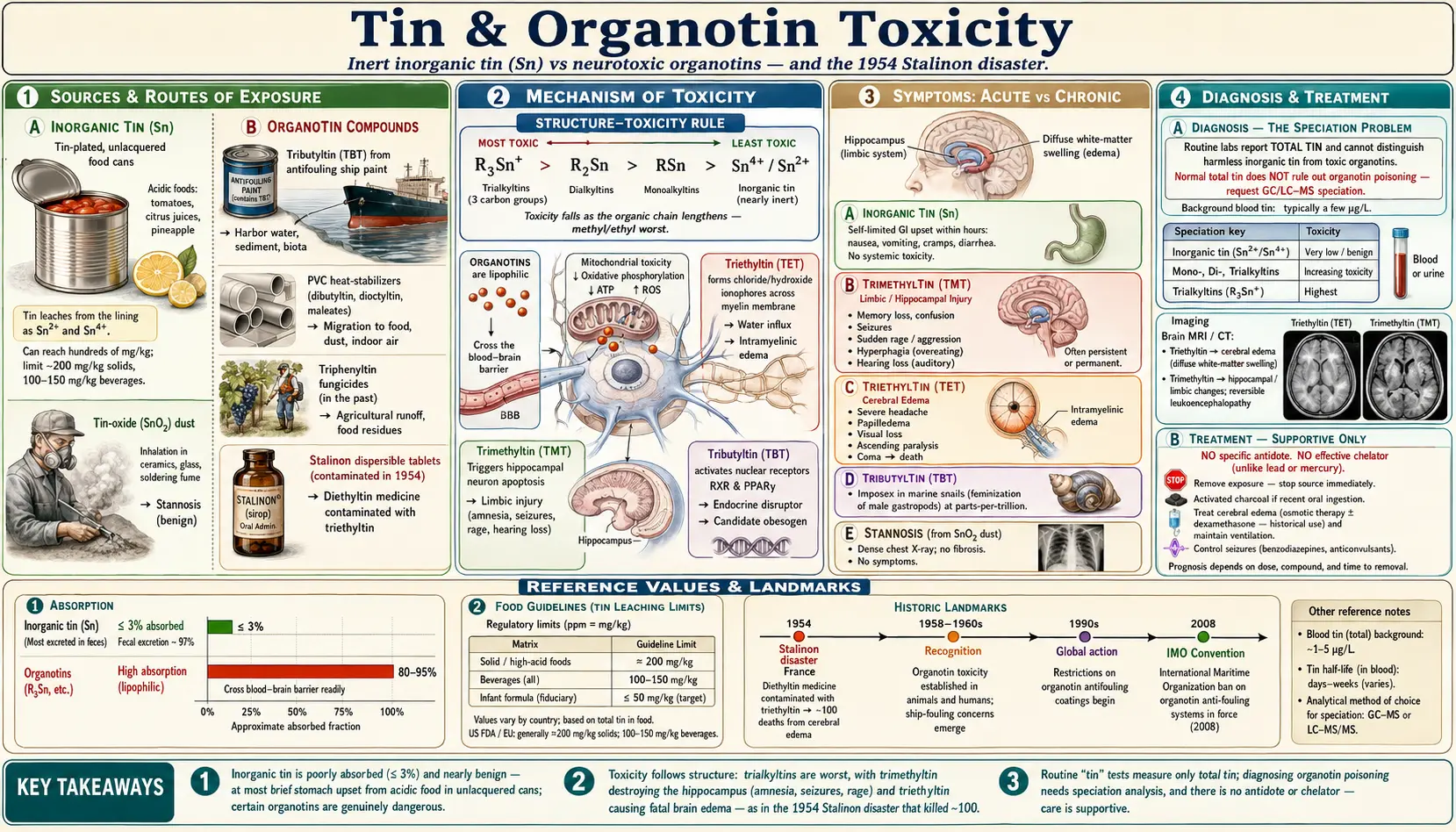
Table of Contents
1. Overview
Tin (chemical symbol Sn, from the Latin stannum) is a soft, silvery metal humans have used for thousands of years — in bronze, in solder, and as the shiny inner coating of the "tin can." This everyday metallic and inorganic tin has low toxicity. The story of tin's toxicity is really a story of two completely different chemistries that happen to share the same element and could hardly differ more in how dangerous they are.
The first form is inorganic tin — the metal itself and simple tin salts (such as stannous chloride). It is poorly absorbed by the body and has low systemic toxicity; the effect most often reported is a short-lived bout of stomach upset after eating food with a high tin content from tin-plated cans. Tin is not established as an essential nutrient: the 2005 ATSDR Toxicological Profile states that there is no evidence that tin is essential for humans (some evidence exists for growth in rats). Inorganic tin compounds are also used in consumer products — stannous fluoride (tin(II) fluoride) is an approved fluoride source in toothpastes, where ATSDR cites a concentration of 0.41%.
The second form is organotin compounds — molecules in which tin is bonded directly to carbon (for example trimethyltin, triethyltin, and tributyltin). These synthetic compounds are an entirely different hazard class. Some are potent neurotoxins that can injure specific regions of the brain or cause fatal brain swelling; tributyltin disrupts sexual development in marine snails at concentrations of a few nanograms per litre; and the federal health-guidance values ATSDR derived for dibutyltin and tributyltin are based on immune effects in rats. The central idea on this page is this distinction: inorganic tin has low toxicity; certain organotins are genuinely dangerous.
This difference is not academic. In the Stalinon disaster in France in 1954, an oral medicine made with an organotin caused about 100 deaths among an estimated 1,000 people treated, according to the ATSDR profile; the deaths have been attributed to triethyltin iodide, a far more toxic organotin present as a manufacturing impurity. Both are "tin" compounds, yet their toxicity differs enormously.
2. Sources & Routes of Exposure
Because inorganic and organotin compounds are used so differently, the people exposed to each, and the way they are exposed, are also different. The source of an exposure usually indicates which chemistry — and therefore which risk — is involved.
Inorganic Tin from Food Cans
The classic inorganic-tin exposure is dietary; ATSDR identifies tin-lined food cans as the most important contributor to dietary tin. Steel cans are plated with a thin layer of tin to resist corrosion. When the can is unlacquered (no protective interior coating), food reacts with the tin and some of it dissolves into the contents; acidic foods attack the coating more, and tin levels rise with storage time and temperature and when food is stored in an opened can. ATSDR reports that food from lacquered cans contains less than 25 ppm tin and food from unlacquered cans up to about 100 ppm, and that more than 90% of food cans are lacquered; light-coloured fruit and fruit juices are still packed in unlacquered cans because tin helps preserve their colour. A UK survey summarized by Blunden and Wallace (2003) found that almost 4% of plain (unlacquered) tinplate food cans contained over 150 mg/kg.
Regulatory limits. The Codex Alimentarius General Standard for Contaminants and Toxins in Food and Feed (CXS 193-1995, 2015 edition) sets maximum levels for tin of 250 mg/kg in canned foods other than beverages and 150 mg/kg in canned beverages. In the European Union, Regulation (EC) No 1881/2006 set 200 mg/kg for canned foods other than beverages, 100 mg/kg for canned beverages including fruit and vegetable juices, and 50 mg/kg for canned baby foods and canned infant formulae; that regulation was replaced in 2023 by Regulation (EU) 2023/915. The Codex standard records a provisional tolerable weekly intake (PTWI) of 14 mg/kg body weight set by the FAO/WHO expert committee (JECFA).
Tributyltin (TBT) in Marine Paint
For decades, tributyltin (TBT) was added to ship-hull "antifouling" paints to kill barnacles, algae, and other organisms that foul hulls. As the paint releases TBT into the water it repels these organisms — and the compound accumulated in harbors and coastal sediments. The International Maritime Organization describes TBT as proven to cause deformations in oysters and sex changes in whelks, effects that led to an international ban (see Symptoms and Prevention). ATSDR identifies seafood from contaminated coastal waters and contact with household products containing organotins as the main routes of general-population exposure; workers can also be exposed occupationally.
Other Organotins: PVC, Agriculture, Wood, and Catalysts
- PVC heat stabilizers: Mono- and di-organotins (dibutyltin, dioctyltin) keep polyvinyl chloride plastic from degrading when heated. These mono- and di-substituted compounds are considerably less toxic than the tri-substituted organotins; ATSDR notes that the U.S. FDA regulates the use of some organotin compounds in coatings and plastic food packaging.
- Agricultural fungicides: Triphenyltin acetate and triphenyltin hydroxide (fentin compounds) are used as fungicides, algicides, and molluscicides.
- Wood preservatives, biocides, and catalysts: Tributyltin compounds have been used in timber treatment, as slimicides and disinfectants, and as biocides in cooling systems, pulp and paper mills, leather processing and textile mills; organotins are also used as catalysts, and household polyurethane, plastic and silicone products can contain butyltins in the parts-per-million range.
Pharmaceutical Contamination and Inhaled Dust
Historically, the most lethal human organotin exposure came not from industry but from medicine: the Stalinon preparation (discussed below) was taken by mouth for osteomyelitis, anthrax, and acne, and contained triethyltin iodide as an impurity. It remains the defining example of an organotin reaching — and killing — people directly. Separately, workers exposed to stannic (tin) oxide dust or fumes over many years (15 to 20 years in the early case reports) can develop a distinct and benign lung condition called stannosis, covered under Symptoms.
3. Toxicokinetics
"Toxicokinetics" describes what the body does to a substance — how much gets in, where it goes, and how it leaves. Here again, inorganic tin and organotins behave very differently, and that difference explains the gap in their toxicity.
Inorganic Tin: Poorly Absorbed, Quickly Gone
ATSDR describes inorganic tin compounds as not readily absorbed, with fractional absorption falling as the dose rises. In a balance study of eight healthy men, net absorption was about 3% on a diet supplying 50 mg tin/day (as stannous chloride) but about 45% on a basal diet supplying 0.1 mg/day; in another study, no net absorption could be detected at intakes of 10 to 163 mg/day from fresh and canned food, with fecal tin matching intake. In rats, less than 5% of single oral doses of several tin salts was absorbed. Most ingested tin therefore leaves in the feces. In animal studies, absorbed tin deposits mainly in bone, kidney, and liver and is excreted in urine and bile; it clears from blood within days (half-time 1–3 days in monkeys) but is retained in bone for months (half-time 2–3 months).
Organotins: Lipophilic Compounds That Cross Membranes
Organotin compounds are lipophilic (fat-loving) because of their carbon–tin bonds, which lets them dissolve into and pass through the fatty membranes around cells. ATSDR states that organotins are more readily absorbed than inorganic tin by the oral, inhalation, and dermal routes; they distribute widely, and — critically — the smaller trialkyltins can cross the blood–brain barrier, the filter that normally keeps many toxins out of the brain. Once inside, they reach the very tissues (brain, immune organs, endocrine glands) that make them harmful.
Metabolism by Dealkylation
The body slowly breaks organotins down by dealkylation — stripping off carbon groups one at a time (triethyltin → diethyltin → monoethyltin), heading toward inorganic tin. Human liver microsomes dealkylate tributyltin, and dealkylation has been shown for ethyl-, methyl- and butyltins in animals. Because toxicity falls as carbon groups are removed, this metabolism is partly a detoxification pathway. In animal studies, alkyltins clear from blood in days (half-times of 2–15 days in rats), and triethyltin is secreted into bile.
4. Mechanism of Toxicity
Why are certain organotins so damaging while inorganic tin is nearly harmless, and why does the danger depend so precisely on the molecule's structure? Several overlapping mechanisms are responsible, and they help explain the very specific syndromes seen in poisoned people.
The Structure–Toxicity Rule
A consistent finding across organotin toxicology is that toxicity is governed by how many carbon groups are attached to the tin and how long those chains are. Trialkyltins (three carbon groups, as in trimethyltin and triethyltin) are the most toxic to mammals; di- and mono-substituted compounds are far less so. Among the trialkyltins, toxicity decreases as the chain lengthens — the small methyl and ethyl compounds are the most dangerous. This pattern is consistent with trimethyltin and triethyltin causing severe brain injury while the bulkier tributyltin is studied mainly as an endocrine disruptor and immunotoxicant.
Mitochondrial Poisoning, Ion Disruption, and Calcium
Organotins interfere with mitochondria, the structures that generate cellular energy, disrupting oxidative phosphorylation (the production of ATP, the cell's energy currency), partly by acting as ionophores. Cells with high energy demands, such as neurons, are especially vulnerable when their power supply fails. Triethyltin and related compounds act specifically as chloride/hydroxide ionophores — ferrying chloride (Cl−) and hydroxide (OH−) ions across membranes that normally control those flows tightly. The result is a breakdown of ion and water balance: chloride and water are pulled into the layers of myelin (the insulation around nerve fibers), producing the intramyelinic edema — fluid-filled swelling within the brain's white matter — that is the hallmark of triethyltin injury. Organotins also disturb calcium homeostasis, and abnormal intracellular calcium is a well-known trigger for cell death.
Triggering Neuronal Apoptosis
Trimethyltin, in particular, drives vulnerable neurons into apoptosis (programmed cell death). It shows a striking preference for the limbic system, especially the hippocampus — the brain's memory hub — where it destroys specific populations of neurons. This selective, region-specific killing is what produces the distinctive memory loss, behavioral changes, and seizures of trimethyltin poisoning, and it is the focus of much of the modern research described below.
Endocrine Disruption (TBT)
Tributyltin has a separate mechanism: Grün and colleagues (2006) showed that it binds and activates two nuclear hormone receptors, the retinoid X receptor (RXR) and peroxisome proliferator-activated receptor gamma (PPARγ), with nanomolar affinity. These receptors regulate fat-cell development. In that study TBT promoted fat-cell formation in a mouse cell line, and exposure in the womb raised fat accumulation in newborn mice and epididymal fat mass in adult mice; the authors described TBT as the first environmental endocrine disruptor shown to promote fat-cell formation through RXR and PPARγ. Kirchner and colleagues (2010) found that TBT also pushed human and mouse adipose-derived stem cells toward becoming fat cells in culture, and that stem cells from mice exposed before birth were more prone to do so. TBT is therefore studied as an "obesogen," a chemical hypothesized to promote fat accumulation; these are animal and cell findings, not established human effects. TBT also masculinizes female marine snails at very low concentrations (see Symptoms).
5. Symptoms & Health Effects
The symptoms of tin exposure depend almost entirely on which form is involved, and on whether exposure is sudden (acute) or sustained (chronic). The most important and distinctive effects are the organotin neurological syndromes, so they receive the most attention here.
Inorganic Tin: Mostly Gastrointestinal Upset
ATSDR summarizes several accounts of people who developed diarrhea, abdominal pain, nausea, or gastroenteritis after eating food stored in tin cans; in one, all five members of a family reported nausea and vomiting, and headache was also described. Boogaard and colleagues (2003) note that a limited number of case reports describe acute gastrointestinal effects after food containing 100–500 mg/kg tin, but that these reports have many insufficiencies, and that earlier controlled studies suggested a threshold above 730 mg/kg for tin migrated from packaging. In their two double-blind crossover studies, canned tomato soup with up to 267 mg/kg tin migrated from the can caused no clinically significant adverse effects in 24 volunteers, whereas tin added as tin(II) chloride to tomato juice showed a clear dose–response in 20 volunteers — the chemical form of tin, not the total concentration alone, determined the effect. A review by Blunden and Wallace (2003) found no reports of acute effects attributable to tin at 100–200 ppm in the preceding 25 years. Serious systemic poisoning from dietary inorganic tin is not described, consistent with its poor absorption.
Trimethyltin Syndrome (Limbic / Hippocampal Injury)
Trimethyltin (TMT) produces one of the most striking toxic syndromes in clinical toxicology, reflecting its destruction of limbic and hippocampal neurons. Features reported in exposed workers (summarized by ATSDR from case series published between 1978 and 1993) include:
- Memory loss and confusion (consistent with hippocampal damage);
- Disorientation and impaired concentration;
- Seizures;
- Rage and aggression — Ross and colleagues (1981) found cycles of depression and destructive rage, each lasting a few hours, significantly more often in the most heavily exposed of 22 chemical workers; ATSDR describes aggressive behavior as one typical manifestation of trimethyltin intoxication in both humans and animals;
- Tinnitus and hearing loss (animal studies show a lasting high-frequency hearing loss);
- Headache, insomnia, loss of appetite, cycles of depression, and in severe cases syncope and loss of consciousness.
Symptoms can be delayed (one young man developed delirium and memory loss 72 hours after inhaling trimethyltin vapor), and outcomes vary: in a series of six exposed workers one died and the two most heavily exposed survivors still had neurological effects more than 6 years later, while two chemists in another report recovered completely after removal from exposure. Du (2021) described central nervous system damage together with low blood potassium (hypokalemia) and metabolic acidosis in severe cases among 8 workers poisoned in PVC production. Clinical reports associate the combination of amnesia, seizures, and abrupt aggression after organotin exposure with trimethyltin specifically.
Triethyltin Syndrome (Cerebral Edema)
Triethyltin (TET) causes a different picture — not selective neuron killing but diffuse swelling of the brain. By driving fluid into the myelin and white matter (intramyelinic edema), it raises pressure inside the skull (increased intracranial pressure). In the Stalinon poisonings, as summarized by ATSDR, symptoms appeared suddenly about 4 days after taking the drug and included:
- Vertigo and intense headache;
- Photophobia and visual impairment;
- Altered consciousness and convulsions;
- Sensory disturbances, reduced reflexes, and loss of sphincter control;
- Nausea and vomiting, reported in more than 70% of those poisoned.
Deaths occurred after 4–10 days, from deep coma or, more often, acute intracranial hypertension; autopsies showed diffuse edema of the white matter of the central nervous system.
This is the syndrome that killed and disabled the victims of the Stalinon disaster.
The Stalinon Disaster (France, 1954)
"Stalinon" was a French oral medication given for osteomyelitis, anthrax, and acne. According to the ATSDR profile, each capsule contained diethyltin diiodide (15 mg) and linoleic acid (100 mg), with an undetermined amount of triethyltin iodide, the far more toxic relative, present as a manufacturing impurity and proposed as the cause of the poisoning. Of an estimated 1,000 people treated, about 100 died, from cerebral edema and raised intracranial pressure. ATSDR notes that many confounding variables weaken the published estimates of the toxic dose. A historical review by Bonah (2007) traces the scandal and its consequences for drug regulation in France from 1954 to 1959.
Tributyltin: "Imposex" and Endocrine Effects
Tributyltin's signature effect appears in marine snails. TBT causes imposex — literally "imposed sex" — in which female snails develop male sex organs (a penis and vas deferens). In one laboratory study, adult female dogwhelks exposed to TBT at 2–128 nanograms per litre progressed through the stages of imposex, faster at higher concentrations (Davies 2000). Imposex in species such as the dog whelk became a widely used biomarker of TBT pollution. These effects led to the International Maritime Organization's Anti-fouling Systems (AFS) Convention, adopted on 5 October 2001 and in force since 17 September 2008, under which ships may not apply or re-apply organotin antifouling systems and must either not bear them or bear a barrier coating that stops them leaching. Monitoring in the English Channel shows recovery from imposex at many sites, slower near ports where contaminated sediments persist (Langston 2015). In mammals, TBT is studied as an endocrine disruptor, an immunotoxicant (ATSDR's oral health-guidance value for tributyltin oxide is based on immune effects in rats), and a candidate obesogen, with increased fat accumulation in mice exposed before birth.
Stannosis: A Benign Lung Condition
Years of inhaling stannic oxide dust or fumes can cause stannosis, a form of pneumoconiosis (dust-related lung disease). ATSDR describes stannosis as benign: in the reported cases, chest X-rays showed discrete opaque shadows throughout the lungs, attributed to tin oxide deposits, but there was no impairment of lung function and no systemic disease. More than 150 cases among tin foundry workers had been confirmed by X-ray by 1959. Its main clinical significance is that the X-ray appearance resembles more serious dust diseases.
6. Diagnosis & Laboratory Testing
Diagnosing tin-related illness rests on two pillars: a careful exposure history and, where appropriate, laboratory measurement of tin — with one crucial caveat about what the lab is actually measuring.
The Speciation Problem: Total Tin vs. Organotin
This is the single most important laboratory concept on this page. A routine "tin level" measured in blood or urine reports total tin — it does not distinguish harmless inorganic tin from a dangerous organotin. ATSDR notes that inorganic tin clears from blood within a few days, so an acute exposure may show up as raised blood tin only briefly, and that models for turning blood or urine tin levels into exposure estimates have not been developed. Detecting exposure to a specific organotin requires measuring that compound and its metabolites, ideally within a few days of an acute exposure. This is done by speciation analysis — specialized techniques (such as gas or liquid chromatography coupled to mass spectrometry or atomic-emission/absorption detection) that separate and measure the specific organotin compounds (trimethyltin, triethyltin, tributyltin, and so on). Speciation is a specialized test and is not part of routine bloodwork.
Units and Interpretation
Tin concentrations in biological samples are typically reported in micrograms per liter (µg/L) of blood or urine, or as micrograms per gram of tissue; environmental and food levels are given as milligrams per kilogram (mg/kg) or micrograms per liter for water and beverages. Reference ranges vary between laboratories and methods. In a 2023 case report of a worker exposed to trimethyltin and dimethyltin, total tin was 344 µg/L in blood and 3,050 µg/L in urine, both described as elevated.
Neuroimaging in Organotin CNS Poisoning
When the nervous system is involved, brain imaging is central to diagnosis and monitoring. The Stalinon poisonings predated modern brain imaging, but autopsies showed diffuse white-matter edema, the change imaging is designed to detect. A 2023 case report (Dang and colleagues) describes a 38-year-old PVC-factory worker exposed to trimethyltin and dimethyltin with two weeks of worsening memory, balance, apathy, tinnitus and slowed movement; MRI showed diffuse white-matter lesions on both sides of the brain (leukoencephalopathy), which improved together with his symptoms and laboratory values after removal from exposure.
Putting It Together
The reported cases fall into contrasting patterns: brief gastrointestinal upset after canned food, associated with inorganic tin; and, after occupational or medicinal organotin exposure, either headache, visual disturbance and signs of raised intracranial pressure (the triethyltin pattern) or amnesia, seizures and aggression (the trimethyltin pattern), where case reports describe neuroimaging and tin measurement as part of the workup.
7. Treatment & Management
For organotin poisoning there is no established specific antidote. ATSDR located no specific method for reducing the body burden of tin compounds. Dimercaprol (BAL) has been suggested for dialkyltins on the basis of animal studies, but it was not effective against trialkyltins or tetraalkyltins; DMPS and DMSA reduced bile-duct, pancreas and liver lesions in rats given an organotin. In the 2023 leukoencephalopathy case, the patient improved after removal from exposure and treatment with succimer (DMSA), and the authors wrote that the contribution of chelation to his recovery is uncertain. Treatment is therefore described as mainly supportive: maintaining vital functions while the body clears and metabolizes the compound, and treating each complication as it arises.
Removal from Exposure and Decontamination
The measures ATSDR summarizes (from the Hazardous Substances Data Bank) begin with ending exposure: moving the person to fresh air after inhalation, removing contaminated clothing and washing the skin after skin contact, and irrigating the eyes for at least 15 minutes after eye exposure. After ingestion, the summary lists dilution with milk or water and activated charcoal; induced vomiting is described as usually unnecessary for inorganic tin, potentially dangerous after caustic tin compounds such as stannic chloride, and contraindicated after trimethyltin; gastric lavage is listed as an option only for a potentially life-threatening amount, generally within 1 hour.
Managing the Neurological Emergencies
- Cerebral edema (triethyltin type): Raised intracranial pressure is a medical emergency managed with the standard measures of neurocritical care. Corticosteroids have an experimental history in triethyltin edema: Studer and colleagues (1973) studied dexamethasone therapy in experimental triethyltin-induced cerebral edema.
- Seizures (trimethyltin type): Seizures are managed with standard anticonvulsant medications.
- Potassium and acid–base balance (trimethyltin type): In the 8-case series by Du (2021), severe trimethyltin poisoning was accompanied by hypokalemia and metabolic acidosis, and the author reported that early potassium supplementation and symptomatic treatment were associated with improvement.
- Airway and breathing: Patients with depressed consciousness or progressive weakness/paralysis may require airway protection and ventilatory support.
Supportive Care and Recovery
Beyond the acute emergencies, management is general intensive and supportive care: fluids and electrolytes, monitoring of vital organs, and rehabilitation. Because trimethyltin destroys neurons outright, some deficits — memory problems, behavioral change, hearing loss — can be long-lasting; in one series, neurological effects persisted more than 6 years in the two most heavily exposed survivors. Severe triethyltin edema was often fatal in the Stalinon poisonings. For inorganic tin, the reported gastrointestinal upset is brief and treated by symptom relief and fluids.
8. Prevention & Risk Reduction
Because the hazards of inorganic and organotin compounds are so different, so are the measures that limit exposure to them. The most dangerous exposures are now governed by international and national regulation.
For Inorganic Tin (Food)
- Lacquered (enamel-lined) cans: ATSDR reports that the lacquer keeps tin in canned food below 25 ppm and that more than 90% of food cans are lacquered.
- Opened cans: ATSDR reports that tin concentrations rise when food is stored in an opened can; its public health statement lists eating fewer canned products and storing unused portions in a separate container as ways exposure can be reduced.
- Food limits: Codex maximum levels are 250 mg/kg for canned foods other than beverages and 150 mg/kg for canned beverages; the EU limits set in 2006 are 200 mg/kg and 100 mg/kg, with 50 mg/kg for canned baby foods and infant formulae. The 2003 studies by Boogaard and colleagues were presented as supporting levels of this order as safe for adults.
For Organotins (the Real Hazard)
- The TBT marine-paint ban: Under the IMO Anti-fouling Systems Convention (adopted 2001, in force 2008), ships may not apply or re-apply organotin antifouling systems and must either not bear them or bear a barrier coating; this is the central international measure against TBT pollution.
- Workplace limits: In the United States, OSHA's workplace exposure limit is 0.1 mg/m3 of air for organotin compounds and 2 mg/m3 for inorganic tin compounds other than oxides, and NIOSH recommends the same values; organotins are absorbed through the skin and lungs as well as the gut.
- Pharmaceutical safety: The Stalinon disaster had lasting consequences for drug regulation in France (Bonah 2007).
- Health-guidance values: ATSDR derived oral minimal risk levels of 0.3 mg/kg/day for inorganic tin, 0.005 mg/kg/day for dibutyltin chloride, and 0.0003 mg/kg/day for tributyltin oxide, and the EPA set the same 0.0003 mg/kg/day reference dose for tributyltin oxide.
9. Related Topics
- Toxic Minerals — overview of the toxic metals and metalloids
- Heavy Metals — shared ideas of absorption, body burden, and chelation
- Lead — a neurotoxic metal where chelation, unlike for organotins, works
- Mercury — whose organic (methylmercury) form is far more neurotoxic than the inorganic, a close parallel to tin
- Arsenic — a metalloid with strongly species-dependent toxicity
- Cadmium — a toxic metal with a long biological half-life
- Aluminum — a low-toxicity but ubiquitous metal
- Manganism — a metal-induced movement disorder
- Parkinson's Disease — a movement disorder with toxic risk factors
- Selenium — an essential mineral that is also toxic in excess
- Zinc — an essential mineral and target of metal toxicity
- Iron — an essential metal central to oxygen transport
- Lab Tests — metal testing and the importance of speciation
- All Minerals — the full mineral library
Key Research Papers
- Fait A, Ferioli A, Barbieri F. Organotin compounds. Toxicology. 1994;91(1):77–82. — doi:10.1016/0300-483x(94)90244-5 (Concise review of organotin toxicology and the structure–toxicity relationship.)
- "Stalinon": a Therapeutic Disaster. British Medical Journal. 1958;1(5069):515. — doi:10.1136/bmj.1.5069.515 (Contemporary account of the landmark French organotin mass poisoning.)
- Studer RK, Siegel BA, Morgan J, Potchen EJ. Dexamethasone therapy of triethyltin-induced cerebral edema. Experimental Neurology. 1973;38(3):429–437. — doi:10.1016/0014-4886(73)90165-9 (Classic study of triethyltin cerebral edema and an attempted corticosteroid treatment.)
- Harry GJ, McPherson CA, Wine RN, Atkinson K, Lefebvre d'Hellencourt C. Trimethyltin-induced neurogenesis in the murine hippocampus. Neurotoxicity Research. 2003;5(8):623–627. — doi:10.1007/bf03033182 (Mouse study: a single trimethyltin injection destroyed dentate granule neurons of the hippocampus within 72 hours, followed by regenerating neurogenesis.)
- Liu Z, Wang L, Wang Y, Wu S, et al. Quantitative proteomics reveals the neurotoxicity of trimethyltin chloride on mitochondria in the hippocampus of mice. NeuroToxicology. 2023;99:162–176. — doi:10.1016/j.neuro.2023.10.006 (Modern mechanistic work linking trimethyltin to mitochondrial injury in the hippocampus.)
- Antizar-Ladislao B. Environmental levels, toxicity and human exposure to tributyltin (TBT)-contaminated marine environment. A review. Environment International. 2008;34(2):292–308. — doi:10.1016/j.envint.2007.09.005 (Comprehensive review of TBT in the marine environment and human exposure.)
- Grün F. The obesogen tributyltin. Vitamins and Hormones. 2014;94:277–325. — doi:10.1016/b978-0-12-800095-3.00011-0 (Reviews TBT's RXR/PPARγ endocrine mechanism and the obesogen hypothesis.)
- Robertson AJ, Whitaker PH. Radiological changes in pneumoconiosis due to tin oxide. Journal of the Faculty of Radiologists. 1955;6(4):224–233. — doi:10.1016/s0368-2242(55)80032-2 (Early description of stannosis, the benign tin-dust pneumoconiosis.)
- Dang TQ, Doan UV, Nguyen TD, Nguyen TV, Nguyen TB. Reversible leukoencephalopathy associated with organotin poisoning. Clinical Toxicology. 2023;61(6):476–478. — PubMed PMID: 37358038 (Modern human organotin case.)
- Fent K. Ecotoxicology of organotin compounds. Critical Reviews in Toxicology. 1996;26(1):1–117. — PubMed PMID: 8833456 (Major review of organotin ecotoxicology.)
- Hirano A, Zimmerman HM, Levine S. Intramyelinic and extracellular spaces in triethyltin intoxication. Journal of Neuropathology and Experimental Neurology. 1968;27(4):571–580. — PubMed PMID: 5687754 (Classic neuropathology of triethyltin intramyelinic edema.)
- Kirchner S, Kieu T, Chow C, Casey S, Blumberg B. Prenatal exposure to the environmental obesogen tributyltin predisposes multipotent stem cells to become adipocytes. Molecular Endocrinology. 2010;24(3):526–539. — PubMed PMID: 20160124 (Cell and mouse evidence for TBT as an obesogen.)
- Agency for Toxic Substances and Disease Registry (ATSDR). Toxicological Profile for Tin and Tin Compounds. U.S. Department of Health and Human Services. 2005. ATSDR ToxProfile (PDF).
- World Health Organization / International Programme on Chemical Safety (IPCS). Environmental Health Criteria 116: Tributyltin Compounds. WHO/IPCS INCHEM.
- International Maritime Organization (IMO). International Convention on the Control of Harmful Anti-fouling Systems on Ships (AFS Convention; in force 2008). IMO Anti-fouling Systems.
- Grün F, Watanabe H, Zamanian Z, Maeda L, Arima K, Cubacha R, Gardiner DM, Kanno J, Iguchi T, Blumberg B. Endocrine-disrupting organotin compounds are potent inducers of adipogenesis in vertebrates. Molecular Endocrinology. 2006;20(9):2141–2155. — PubMed PMID: 16613991 (TBT as a dual RXR/PPARγ ligand; cell, mouse and frog findings.)
- Blunden S, Wallace T. Tin in canned food: a review and understanding of occurrence and effect. Food and Chemical Toxicology. 2003;41(12):1651–1662. — PubMed PMID: 14563390
- Boogaard PJ, Boisset M, Blunden S, Davies S, Ong TJ, Taverne JP. Comparative assessment of gastrointestinal irritant potency in man of tin(II) chloride and tin migrated from packaging. Food and Chemical Toxicology. 2003;41(12):1663–1670. — PubMed PMID: 14563391
- Ross WD, Emmett EA, Steiner J, Tureen R. Neurotoxic effects of occupational exposure to organotins. American Journal of Psychiatry. 1981;138(8):1092–1095. — PubMed PMID: 7258389
- Du Y. Acute trimethyltin poisoning caused by exposure to polyvinyl chloride production: 8 cases. American Journal of the Medical Sciences. 2021;362(1):92–98. — PubMed PMID: 33587910
- Davies IM. Kinetics of the development of imposex in transplanted adult dogwhelks, Nucella lapillus. Environmental Pollution. 2000;107(3):445–449. — PubMed PMID: 15092990
- Langston WJ, Pope ND, Davey M, Langston KM, O' Hara SC, Gibbs PE, Pascoe PL. Recovery from TBT pollution in English Channel environments: a problem solved? Marine Pollution Bulletin. 2015;95(2):551–564. — PubMed PMID: 25733081
- Bonah C. [The Stalinon scandal and its regulatory consequences, 1954–1959. Drug safety and therapeutic innovation in France fifty years back]. La Revue du Praticien. 2007;57(13):1501–1505. (In French.) — PubMed PMID: 18018550
- Codex Alimentarius Commission. General Standard for Contaminants and Toxins in Food and Feed (CXS 193-1995), 2015 edition; tin maximum levels. FAO/WHO Codex (PDF).
- European Commission. Commission Regulation (EC) No 1881/2006 setting maximum levels for certain contaminants in foodstuffs, Annex section 3.4, Tin (inorganic); replaced by Commission Regulation (EU) 2023/915. EUR-Lex.