Selenium: Food Sources & Daily Intake
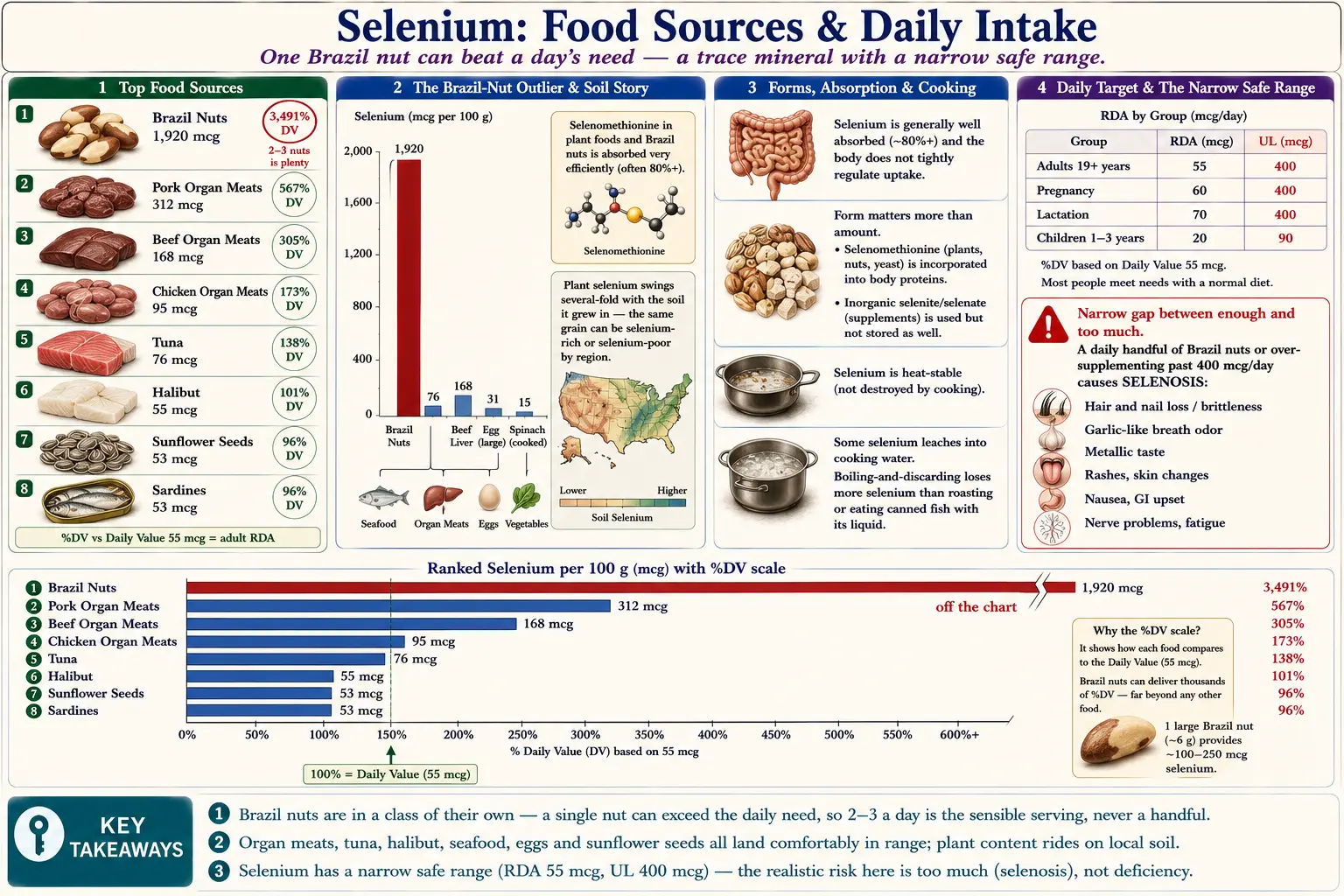
Selenium is a trace mineral — the body needs only tiny amounts, measured in micrograms — but it is essential. It is built into a small family of proteins called selenoproteins, most famously the enzyme glutathione peroxidase, which acts as one of the body’s front-line antioxidant defenses, mopping up the reactive molecules that damage cells. Selenium is also indispensable to the thyroid: the enzymes that activate thyroid hormone depend on it, and the thyroid gland holds more selenium per gram than any other tissue. You get it from a wide range of foods — Brazil nuts, seafood, meat, eggs and to a lesser extent dairy and whole grains — though how much any plant food contains depends heavily on the selenium in the soil where it grew.
| Selenium: Food Sources & Daily Intake | ||||||
|---|---|---|---|---|---|---|
| Rank | Food (serving) | Per 100 g | %DV / 100g | Glucose | Fructose | Notes |
| 1 | Brazil Nuts 1 nut / 5 g | 1,920 mcg | 🟢 3,491% | 0 | 0 | By far the richest food source — a single nut can exceed the daily need, so 2–3 per day is plenty and a daily handful can risk toxicity. |
| 2 | Pork Organ Meats 3 oz / 85 g | 312 mcg | 🟢 567% | — | — | Nutrient-dense organ meat. |
| 3 | Beef Organ Meats 3 oz / 85 g | 168 mcg | 🟢 305% | 0 | 0 | Nutrient-dense organ meat. |
| 4 | Chicken Organ Meats 3 oz / 85 g | 95 mcg | 🟢 173% | — | — | Nutrient-dense organ meat (giblets). |
| 5 | Tuna 3 oz / 85 g | 76 mcg | 🟢 138% | 0 | 0 | An inexpensive, selenium-dense fish. |
| 6 | Halibut 3 oz / 85 g | 55 mcg | 🟢 101% | 0 | 0 | |
| 7 | Sunflower Seeds 1 oz / 28 g | 53 mcg | 🟢 96% | — | — | A good plant source for those eating little meat or fish. |
| 8 | Sardines 3 oz / 85 g | 53 mcg | 🟢 96% | 0 | 0 | Also a notable source of calcium and vitamin D. |
| 9 | Shrimp 3 oz / 85 g | 42 mcg | 🟢 76% | — | — | |
| 10 | Oysters 3 oz / 85 g | 40 mcg | 🟢 72% | 1.2 | 0 | |
| 11 | Cod 3 oz / 85 g | 38 mcg | 🟢 68% | 0 | 0 | A lean white fish. |
| 12 | Beef Liver 3 oz / 85 g | 36 mcg | 🟢 66% | 0 | 0 | An especially nutrient-dense organ meat. |
| 13 | Salmon 3 oz / 85 g | 36 mcg | 🟢 65% | 0 | 0 | An oily fish that is also rich in omega-3s. |
| 14 | Pork 3 oz / 85 g | 33 mcg | 🟢 61% | 0 | 0 | |
| 15 | Eggs 1 large / 50 g | 31 mcg | 🟢 56% | — | — | |
| 16 | Turkey 3 oz / 85 g | 30 mcg | 🟢 55% | 0 | 0 | |
| 17 | Brown Rice 1 cup / 195 g | 5.8 mcg | 🟡 11% | 0 | 0 | Common staple. |
Table of Contents
- How to Read These Tables
- Recommended Intakes & Upper Limits
- Bioavailability & Absorption
- Cooking & Storage
- Vegetarian & Vegan Sources
- Who Needs to Pay Attention
- Data Sources & References
- Connections
- Featured Videos
How to Read These Tables
- Brazil nuts are in a class of their own. No other common food comes close. A single Brazil nut can supply more selenium than a whole day’s requirement, which is why the table puts it at the top — and why the sensible serving is just two or three nuts, not a handful. Eating Brazil nuts by the bowlful, every day, is the one realistic way to get too much selenium from food alone.
- %DV vs RDA. The %DV column compares a serving against the FDA Daily Value of 55 mcg. Your personal target (the RDA) is also 55 mcg for adults, a little higher in pregnancy (60 mcg) and lactation (70 mcg) — see the second table, which also lists the upper limit (UL) of 400 mcg for adults.
- Per 100 g vs per serving. Per-100 g lets you compare foods fairly; the serving size shown beside each food is what you actually eat. Note that most seafood, meat and eggs land comfortably in range, while Brazil nuts are off the scale — always read the serving size for nuts.
Recommended Intakes & Upper Limits
Your personal target depends on age, sex and pregnancy. The Daily Value used for the %DV column above is a single label figure; the table below is the age-specific guidance.
| Life stage | RDA / AI (mcg/day) | Upper limit (mcg/day) |
|---|---|---|
| Infants 0–6 mo | 15* (AI) | 45 |
| Infants 7–12 mo | 20* (AI) | 60 |
| Children 1–3 y | 20 | 90 |
| Children 4–8 y | 30 | 150 |
| Children 9–13 y | 40 | 280 |
| Teens 14–18 y | 55 | 400 |
| Adults 19+ y | 55 | 400 |
| Pregnancy | 60 | 400 |
| Lactation | 70 | 400 |
Bioavailability & Absorption
Selenium is generally well absorbed — the gut takes up most of what you eat, often 80% or more, and the body does not tightly regulate uptake the way it does for some minerals. The form matters more than the amount absorbed: the selenomethionine found in plant foods, Brazil nuts and yeast is taken up very efficiently and can be stored in body proteins, while the inorganic forms (selenite, selenate) used in some supplements are handled differently. Because plant foods build selenium from what is in the soil, where a food was grown can change its selenium content several-fold — the same vegetable or grain may be selenium-rich from one region and selenium-poor from another.
Cooking & Storage
Selenium is a mineral, so it does not break down with heat the way fragile vitamins like C and folate do — ordinary cooking does not destroy it. The main way to lose some is through water: because part of the selenium can leach into cooking liquid, boiling and then discarding the water sheds more than roasting, steaming or eating foods (like canned fish) with their liquid. In practical terms the cooking method makes only a modest difference; which foods you choose, and the soil they came from, matter far more.
Vegetarian & Vegan Sources
Selenium is one of the easier nutrients to cover without animal foods, but it takes a little attention because plant levels swing with the soil. The standout is Brazil nuts — just one or two a day reliably covers the requirement (and three or four is already plenty; do not treat them as a snack to eat by the handful). Sunflower seeds and mushrooms are useful additions, and whole grains, beans and lentils contribute variable amounts depending on where they were grown. Because that soil dependence makes plant content unpredictable, the most dependable plant-based strategy is to keep a small, fixed number of Brazil nuts in the daily routine rather than relying on grains alone.
Who Needs to Pay Attention
In the United States, where the soil is relatively selenium-rich, outright deficiency is rare — it shows up mainly with severe malabsorption, long-term tube feeding without adequate selenium, or in regions of the world with very low-selenium soil (where it has been linked to a heart-muscle disorder and a form of joint disease). The more relevant risk for most people here is the opposite: too much. Selenium has a comparatively narrow safe range, and chronic intakes above the adult upper limit of 400 mcg/day — usually from over-supplementing or eating many Brazil nuts every day — can cause selenosis. Its hallmarks are hair and nail loss or brittleness, a persistent garlic-like odor on the breath, a metallic taste, skin rashes, nausea, irritability and, in serious cases, nerve problems. The reassuring news is that selenosis comes from sustained overload, not an occasional serving — the simple safeguard is to enjoy Brazil nuts in moderation (a few, not a fistful) and to skip standalone selenium supplements unless a clinician has advised one.
Data Sources & References
- NIH Office of Dietary Supplements — Selenium Fact Sheet for Health Professionals (DV, RDA/AI, UL, deficiency and toxicity)
- Linus Pauling Institute — Selenium Micronutrient Information Center
- PubMed — selenium, selenoproteins and human health
- PubMed — selenium toxicity (selenosis) and Brazil-nut intake
Connections
- All Minerals
- Selenium (Main Page)
- Selenium Benefits
- Selenium History
- Zinc — another trace mineral with a narrow safe range
- Iodine — partners with selenium in thyroid hormone metabolism
- Vitamin E — works alongside selenium as an antioxidant
- Endocrinology — thyroid and hormone health