Selenium: History and Discovery
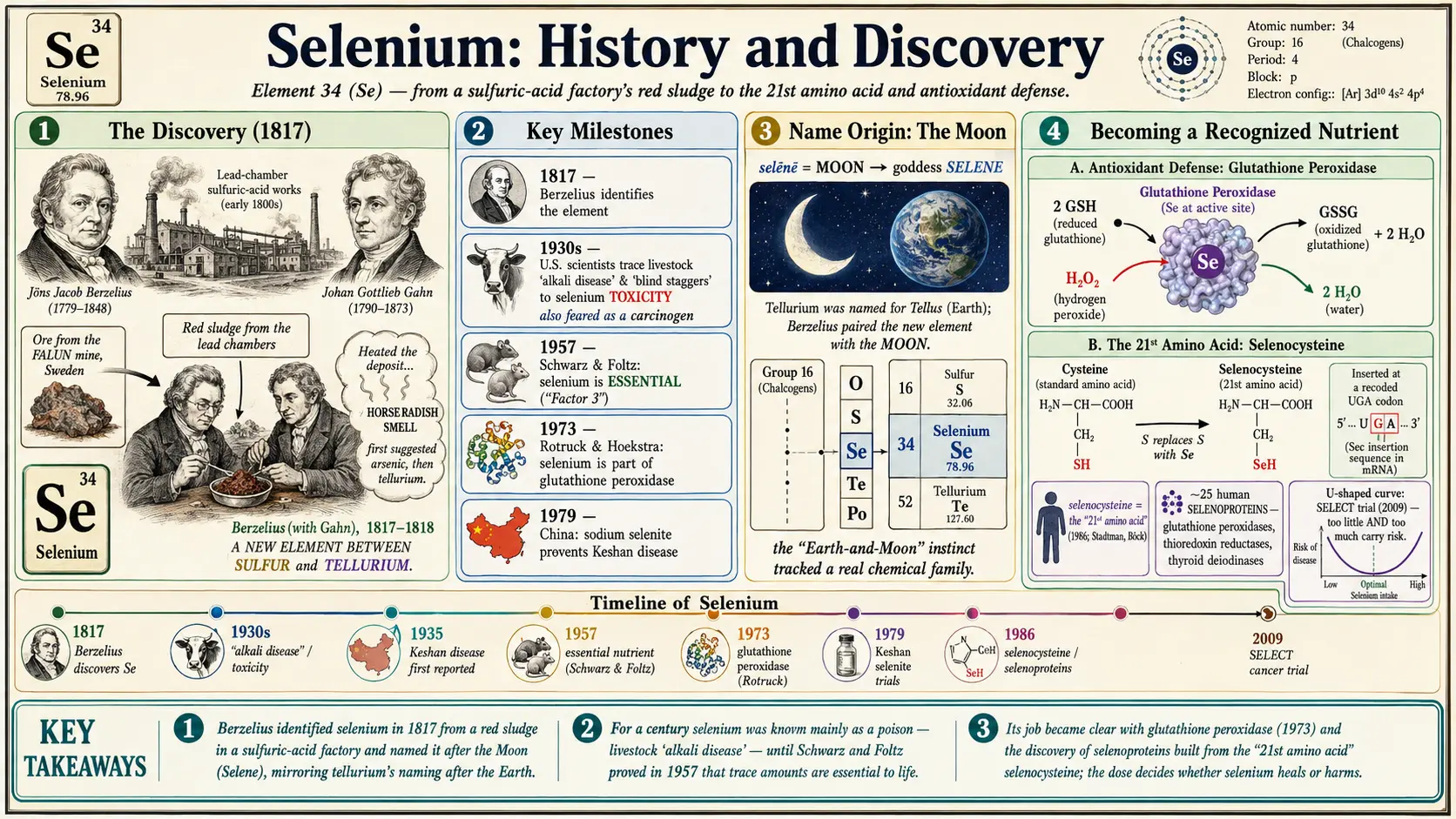
Selenium has one of the most unusual life stories of any element. It was first identified in 1817 by the Swedish chemist Jöns Jacob Berzelius, who teased it out of a reddish sludge left at the bottom of a sulfuric-acid factory and named it after the Moon. For more than a century afterward it was studied chiefly as a curiosity and then feared as a poison — livestock that grazed on selenium-rich plants sickened, and selenium was even suspected of causing cancer. Then, in 1957, two researchers at the U.S. National Institutes of Health, Klaus Schwarz and Calvin Foltz, made the discovery that turned the whole picture upside down: in tiny amounts selenium was not a poison but a nutrient the body cannot do without. This article tells both halves of that story — the chemistry of the element's discovery, and the much later realization of its essential role in human health — naming the people and dates the record actually supports, and flagging the points that are still debated.
Table of Contents
- The Discovery of the Element (1817)
- Why It Is Named After the Moon
- A Century as a Poison: Livestock and "Alkali Disease"
- The Turning Point: Selenium Becomes Essential (1957)
- Finding the Mechanism: Glutathione Peroxidase (1973)
- Keshan Disease and the China Trials
- The 21st Amino Acid and the Selenoproteins
- From Deficiency Disease to Modern Research
- Research Papers and References
- Connections
- Featured Videos
The Discovery of the Element (1817)
Selenium was discovered in 1817 by the Swedish chemist Jöns Jacob Berzelius, one of the towering figures of early chemistry, together with his friend and collaborator Johan Gottlieb Gahn. The two men held shares in a chemical works near Gripsholm, Sweden, that produced sulfuric acid by the old "lead chamber" process. At the bottom of the lead chambers a reddish-brown deposit kept collecting, and the question of what it was is what led, almost by accident, to a new element.
The raw material feeding the process was iron pyrite from the Falun mine. When the suspicious red sludge was burned it gave off a sharp smell — often described as resembling horseradish — and the factory workers assumed the deposit was an arsenic compound, which would have made the pyrite dangerous to use. Berzelius investigated. The horseradish-like odour was not quite that of arsenic; it was closer to the smell of tellurium, an element discovered a few decades earlier. But further analysis showed the Falun ore did not actually contain tellurium, which deepened the puzzle. Re-examining the red precipitate, Berzelius concluded in 1817–1818 that he was looking at a previously unknown element — one chemically intermediate between sulfur and tellurium. He laid out his findings in correspondence and a published paper, and the new element entered the scientific record.
This is a well-documented, firmly dated discovery with named discoverers, which is why it can be stated plainly. Sources sometimes give the year as 1817 (the recognition) or 1818 (the fuller written announcement and naming); the difference is simply how one dates the two stages of the same work. Both Berzelius and Gahn are credited; Berzelius is the chemist usually named first because the identification and naming were his.
Why It Is Named After the Moon
The name selenium comes from the Greek selēnē, meaning "Moon," and behind it stands Selene, the Greek goddess of the Moon. The choice was a deliberate piece of chemical wit on Berzelius's part. The element selenium most closely resembled was tellurium, which had been named after Tellus, the Roman goddess of the Earth. Since the two elements clearly belonged together — just as the Earth and the Moon belong together — Berzelius paired the new earth-companion element with the Moon, naming it after Selene to mirror tellurium's naming after the Earth.
It is a small detail, but a telling one: it captures how Berzelius thought about chemical relationships, grouping elements by family resemblance long before the periodic table made those families explicit. Today selenium and tellurium do indeed sit one above the other in the same column (group 16, the chalcogens), alongside oxygen and sulfur — so the "Earth and Moon" instinct that guided the naming turned out to track a real chemical kinship.
A Century as a Poison: Livestock and "Alkali Disease"
For more than a hundred years after its discovery, selenium was known mainly as a troublemaker. Because the line between "too little" and "too much" selenium is unusually narrow, the element first made its mark on human attention through poisoning, not nutrition. In parts of the American Great Plains and other regions with selenium-rich soils, certain plants accumulate the element to high levels, and animals that grazed on them fell ill.
The result was a set of livestock disorders that ranchers came to call "alkali disease" and "blind staggers" — conditions marked by hair and hoof loss, lameness, weight loss, and neurological signs. By the 1930s, agricultural scientists in the United States had traced these problems to selenium toxicity from the soil and forage. Around the same period, selenium acquired a darker reputation still: it was investigated as a possible cause of cancer. For a time, in other words, the scientific consensus treated selenium as something living things needed protection from.
This history matters because it makes the later reversal so striking. The same element that agriculture had filed under "poison" was, within a generation, recognized as an essential nutrient — a reminder that for selenium the dose really does make the poison, and that both deficiency and excess remain genuine concerns today.
The Turning Point: Selenium Becomes Essential (1957)
The decisive moment in selenium's rehabilitation came in 1957. Working at what is now the U.S. National Institutes of Health, the biochemists Klaus Schwarz and Calvin M. Foltz were studying a liver disease they could induce in rats by feeding them a deficient diet — dietary necrotic liver degeneration. They had found that something they called "Factor 3", present in certain natural foods, protected the animals' livers. The question was what Factor 3 actually contained.
The answer was selenium. In a now-classic short paper, "Selenium as an Integral Part of Factor 3 against Dietary Necrotic Liver Degeneration," published in the Journal of the American Chemical Society in 1957, Schwarz and Foltz showed that adding a tiny amount of a selenium compound (sodium selenite) to the rats' diet completely protected them from the fatal liver damage. This was the first solid evidence that selenium is essential for mammalian life — that animals need it, in trace amounts, to stay healthy.
It is worth dwelling on how surprising this was. Selenium had spent a century being studied as a toxin and a suspected carcinogen; Schwarz and Foltz showed that in the right (very small) quantity it was a nutrient the body could not do without. Their discovery is often described as accidental in the sense that they were chasing a dietary protective factor rather than setting out to prove selenium essential — but the experiment itself was deliberate and clean, and it opened the entire field of selenium nutrition. (Earlier hints existed: the biochemist Jane Pinsent had reported a biological role for selenium in bacteria in 1954. The 1957 work is what established essentiality in mammals.)
Finding the Mechanism: Glutathione Peroxidase (1973)
Knowing that selenium was essential was one thing; understanding how it worked inside the body was another, and that answer arrived in 1973. A team at the University of Wisconsin — John T. Rotruck and colleagues, working in the laboratory of W. G. Hoekstra — demonstrated that selenium is a built-in component of the enzyme glutathione peroxidase, and is required for that enzyme to function.
Their paper, "Selenium: Biochemical Role as a Component of Glutathione Peroxidase," appeared in Science in February 1973. Glutathione peroxidase is one of the body's key antioxidant enzymes: it neutralizes hydrogen peroxide and other damaging peroxides before they can harm cells. Showing that this enzyme depended on selenium gave the trace element a concrete job description. It explained, at the level of molecules, why selenium-deficient animals suffered oxidative tissue damage — and it connected selenium nutrition to the broader science of antioxidant defense, where it remains central today.
From this point on, selenium ceased to be a mystery nutrient with an unknown function. It became, specifically, the element at the heart of an antioxidant enzyme — the first of many selenium-dependent enzymes that would be discovered in the decades that followed.
Keshan Disease and the China Trials
The most dramatic human chapter in selenium's history unfolded in China. Keshan disease — named for Keshan County in Heilongjiang Province, where it was first reported in 1935 — is a form of cardiomyopathy, a disease of the heart muscle that can cause heart failure and sudden death. It struck mainly children and women of childbearing age, and it followed a striking geographic pattern: it appeared in a belt of regions across China where the soil, and therefore the food, was extremely low in selenium.
Building on the discovery that selenium was essential, Chinese researchers tested whether selenium deficiency lay behind the disease. In 1979, they reported that supplementing at-risk populations with sodium selenite dramatically reduced the occurrence of Keshan disease. Large public-health programs followed; from the 1970s into the 1990s, selenium supplementation helped bring the disease under control in the endemic areas. This stands as one of the clearest real-world demonstrations that a trace-mineral deficiency can cause a serious human disease — and that correcting the deficiency can prevent it.
One honest nuance belongs here. Selenium deficiency is necessary for Keshan disease but does not appear to be the whole story: researchers have long noted that an infection (a strain of Coxsackievirus) seems to act as a cofactor, with the deficiency setting the stage and the virus helping to trigger the heart damage. The picture is best described as selenium deficiency plus a viral trigger, rather than selenium deficiency alone. Around the same era, a separate selenium-deficiency disorder of the bones and joints, Kashin–Beck disease, was also studied in overlapping regions, though its causes are more tangled and may involve other factors as well.
The 21st Amino Acid and the Selenoproteins
The discovery of glutathione peroxidase raised a deeper question: how exactly does selenium get built into a protein? The answer, worked out in the 1980s, was one of the genuine surprises of molecular biology. Selenium enters proteins as part of a special amino acid called selenocysteine — essentially the amino acid cysteine with its sulfur atom replaced by selenium — and selenocysteine is now widely called the 21st amino acid, an addition to the twenty that the genetic code was thought to spell out.
In 1986, research groups (including those of Thressa Stadtman and, working on the genetic mechanism, August Böck) established how the cell does this: selenocysteine is inserted at a codon — UGA — that normally tells the ribosome to stop, recoded by special machinery into an instruction to add selenium instead. Proteins that contain selenocysteine are called selenoproteins, and the human body makes a couple dozen of them. They include the glutathione peroxidases (antioxidant defense), the thioredoxin reductases (redox balance and DNA synthesis), and the iodothyronine deiodinases (which switch thyroid hormones on and off) — the molecular reasons selenium matters for so many different aspects of health, covered in detail on the main Selenium page.
From Deficiency Disease to Modern Research
Once selenium was established as essential and its selenoproteins were being catalogued, attention turned to a harder question: beyond preventing outright deficiency, does extra selenium protect against chronic disease — cancer in particular? The history here is a cautionary one. Early observational data and a celebrated American trial, the Nutritional Prevention of Cancer (NPC) study, raised hopes that selenium supplements might lower cancer risk. But the much larger Selenium and Vitamin E Cancer Prevention Trial (SELECT), reported in 2009, found no such benefit for prostate cancer in well-nourished men — and signalled possible harms. The lesson the field drew is that selenium follows a U-shaped curve: both too little and too much carry risk, and supplementing people who already have enough is not helpful and may be unwise. The detailed evidence is discussed in the Selenium and Cancer Prevention article.
So the arc of selenium's history bends back on itself in a fitting way. The element was discovered as a chemical curiosity in 1817, feared as a poison for a century, revealed as a life-sustaining nutrient in 1957, given a mechanism in 1973, and vindicated as the cure for a real human disease in the Keshan trials — only for modern research to circle back to the very caution the livestock ranchers understood first: selenium is essential in small amounts and harmful in large ones. Two centuries on, it remains one of the best examples in all of nutrition of why dose, not the substance alone, decides whether a mineral heals or harms.
Research Papers and References
The list below combines the landmark primary papers in selenium's history with modern reviews and curated PubMed topic-search links. Author names, titles, and journals are given as plain text; only the stable DOI, PMID, or archive link is hyperlinked, and each opens in a new tab. Berzelius's original early-nineteenth-century reports are named in the article as historical sources rather than as modern citations.
- Schwarz K, Foltz CM. Selenium as an integral part of Factor 3 against dietary necrotic liver degeneration. Journal of the American Chemical Society. 1957;79(12):3292-3293. — doi:10.1021/ja01569a087
- Rotruck JT, Pope AL, Ganther HE, Swanson AB, Hafeman DG, Hoekstra WG. Selenium: biochemical role as a component of glutathione peroxidase. Science. 1973;179(4073):588-590. — Search PubMed
- Tsuji PA, Santesmasses D, Lee BJ, Gladyshev VN, Hatfield DL. Historical roles of selenium and selenoproteins in health and development: the good, the bad and the ugly. International Journal of Molecular Sciences. 2022;23(1):5. — doi:10.3390/ijms23010005
- Zhou H, Wang T, Li Q, Li D. Prevention of Keshan disease by selenium supplementation: a systematic review and meta-analysis. Biological Trace Element Research. 2018;186(1):98-105. — PMID: 29627894
- Selenium — discovery, history, and the essential trace element PubMed: selenium history and discovery
- Keshan disease and selenium deficiency PubMed: Keshan disease and selenium deficiency
External Authoritative Resources
- NIH Office of Dietary Supplements — Selenium
- NCBI Bookshelf — Keshan Disease (StatPearls)
- PubMed — All research on selenium and selenoprotein history