Magnesium Glycinate Bioavailability
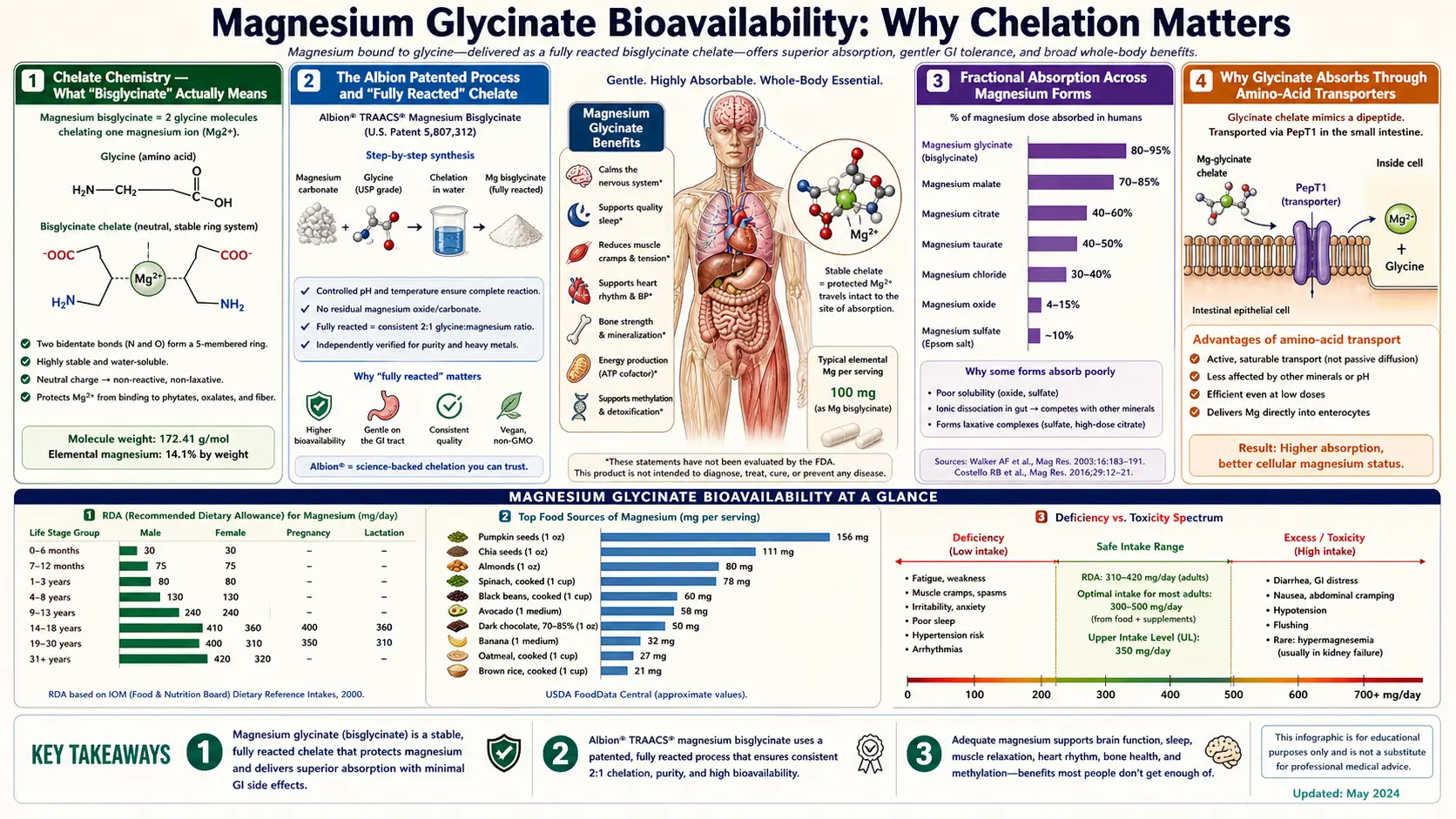
Magnesium glycinate (bisglycinate) is magnesium bound to the amino acid glycine. Because glycine makes up most of the compound's weight, it carries less magnesium per gram than inorganic salts such as magnesium oxide — and the question that matters is how much of that magnesium is absorbed. The human evidence is smaller and more mixed than supplement marketing suggests. Magnesium oxide does absorb poorly in several studies (one measured a fractional absorption of 4%), and organic salts and amino-acid chelates generally do better. But the only isotope trial of magnesium diglycinate against oxide found no overall difference in absorption, with an advantage only in the patients who absorbed oxide worst; and in the one randomised trial that compared an amino-acid chelate head to head with citrate, citrate gave the higher serum magnesium. This page sets out what the chelate is, what the absorption studies measured, what is known about dose size and absorption, what the terms on a magnesium glycinate label mean, and what independent testing and a Certificate of Analysis do and do not show.
Interactive Visualization Magnesium — the mineral that makes ATP work Bare ATP is useless and enzymes reject it. Watch magnesium clamp the phosphates and switch it on, plug the NMDA channel, and let a cramping muscle finally let go. Launch →
Table of Contents
- Chelate Chemistry — What "Bisglycinate" Means
- Patented Chelate Processes and "Fully Reacted" Chelate
- What the Absorption Studies Measured
- How the Chelate May Be Absorbed
- Saturation Kinetics and Dose Size
- Buffered Products — Glycinate Blended With Oxide
- Independent Third-Party Testing
- What Label Terms Do and Do Not Tell
- What a Certificate of Analysis Contains
- Price and Quality — What Is Known
- Regulatory and Market Context
- Key Research Papers
- Connections
- Featured Videos
Chelate Chemistry — What "Bisglycinate" Means
The term "chelate" comes from the Greek chele, meaning "claw" — a metaphor for the geometry. In a metal-amino-acid chelate, the metal ion sits at the center while one or more amino-acid molecules bind it through more than one bond each, forming a ring that includes the metal.
Magnesium bisglycinate (also written magnesium glycinate, magnesium diglycinate, or magnesium glycinate chelate) is a 1:2 metal-to-amino-acid compound: one Mg2+ ion with two glycine molecules. Each glycine can bind through two points — its amine nitrogen and one carboxylate oxygen — so each glycine closes a five-membered ring made of the magnesium ion, the nitrogen, the two carbon atoms of the glycine backbone, and the oxygen.
Rings of this kind are more stable than single-point binding, which coordination chemists call the "chelate effect." How much of a magnesium glycinate dose stays intact through stomach acid and the small intestine is not well measured in people. The authors of the one human isotope trial (Schuette 1994) concluded that "some portion" of magnesium diglycinate is absorbed intact, probably through a dipeptide transport pathway.
Because the two glycine molecules make up most of the compound's weight, magnesium glycinate carries much less magnesium per gram than magnesium oxide. Supplement labels in the US state the elemental magnesium content ("Magnesium (as magnesium bisglycinate) … mg"), not the weight of the whole compound, so two labels showing the same magnesium figure can hold very different amounts of powder. A 2019 review-and-trial paper (Blancquaert 2019) summarises the trade-off: inorganic salts such as oxide provide a high loading of elemental magnesium but have very limited bioavailability because they dissolve poorly, while organic salts dissolve well but carry less elemental magnesium; the authors concluded that a supplement's solubility is of greater relevance for absorption than its elemental loading.
Patented Chelate Processes and "Fully Reacted" Chelate
Manufacturing processes for "fully reacted" amino-acid chelates have been patented, and some of those patents have since expired. Such processes react a magnesium source with glycine in solution under controlled conditions so that the product is the chelate rather than a physical mixture of the starting materials.
"Fully reacted" is a marketing term, not a regulated one. It is used for a chelate in which most of the magnesium is bound to glycine rather than present as unreacted magnesium oxide mixed with free glycine. Laboratory methods that can characterise a chelate include infrared spectroscopy (FTIR) and other structural tests. Some finished products name a specific branded chelate ingredient on the label; that name identifies the ingredient's supplier, and is not in itself an independent test of the finished product.
Products in which glycinate is blended with oxide are described in the Buffered Products section below.
What the Absorption Studies Measured
Studies measure magnesium absorption in different ways — the rise in urinary magnesium after a dose, the rise in serum magnesium, or the fate of a stable-isotope label — and their figures are not interchangeable. Widely circulated single-number "absorption percentages" for each magnesium form (for example "80% for glycinate") were not found in the studies below, and none of them measured magnesium glycinate alongside all the other forms. What the cited studies report:
- Magnesium oxide versus citrate (Lindberg 1990) — in laboratory solubility tests, magnesium oxide was virtually insoluble in water and only 43% soluble in a solution mimicking peak stomach-acid secretion, while magnesium citrate was 55% soluble even in water. In healthy volunteers, the rise in urinary magnesium after an oral load was significantly higher after citrate than after oxide.
- Four US commercial preparations (Firoz and Graber 2001) — measured by the rise in urinary magnesium in healthy volunteers, magnesium oxide showed relatively poor bioavailability (fractional absorption 4%), while magnesium chloride, magnesium lactate and magnesium aspartate showed significantly higher and equivalent bioavailability. The authors concluded that inorganic salts, depending on the preparation, may be as bioavailable as organic ones.
- Amino-acid chelate, citrate and oxide (Walker 2003) — a randomised, double-blind, placebo-controlled trial in 46 healthy adults taking 300 mg of elemental magnesium a day for 60 days. Both the amino-acid chelate and citrate gave greater absorption than oxide by 24-hour urinary magnesium at 60 days. Citrate gave the highest mean serum magnesium after both the first dose and 60 days, and the highest salivary magnesium at 60 days; oxide did not differ from placebo. The authors concluded that citrate showed superior bioavailability to the other preparations studied.
- Magnesium diglycinate versus oxide (Schuette 1994) — a double-blind, randomised crossover trial in 12 patients who had had ileal resections, using a 100 mg dose labelled with the stable isotope 26Mg. For the group as a whole, absorption was low and did not differ between the two (23.5% for the chelate vs 22.8% for oxide). In the four patients who absorbed oxide worst, absorption was substantially greater from the chelate (23.5% vs 11.8%). The chelate was better tolerated by all patients, its peak isotope enrichment came on average 3.2 hours earlier, and the area under the enrichment curve was greater.
- Fifteen commercial products (Blancquaert 2019) — laboratory models of digestion showed a very wide variation in how much magnesium the 15 products released. In the full text, a magnesium glycinate–lysinate chelate tablet was among the products with efficient absorption in the intestinal simulator. The in-vivo part of the study (30 people) compared two other products — a combined oxide and glycerophosphate tablet predicted best, and an oxide-only product predicted worst — and found a significantly greater serum response to the first (maximal serum rise +6.2% vs +4.6%; area under the curve 6.87 vs 0.31 mM·min). Glycinate itself was not tested in people in this study.
- Ten salts in rats (Coudray 2005) — in magnesium-depleted rats given ten organic and inorganic salts (glycinate was not among them), absorption ranged from 50% to 67%; organic salts were slightly more available than inorganic ones, and magnesium gluconate was highest. This is an animal study.
Other forms sold as supplements — magnesium sulfate (Epsom salt, also given intravenously in hospital), magnesium hydroxide (milk of magnesia, used as an antacid and laxative), magnesium L-threonate, taurate and malate — were not measured against magnesium glycinate in these studies, and no comparative absorption figures for them are given here.
Taken together, the human studies agree that magnesium oxide is poorly absorbed in healthy people and that soluble organic salts and amino-acid chelates absorb better than oxide. They do not establish that magnesium glycinate absorbs better than citrate, chloride or lactate: the one isotope trial of diglycinate found no overall difference from oxide in its patient group, and the one trial that set an amino-acid chelate against citrate found citrate ahead on serum magnesium. Schuette 1994 reported better tolerability for the chelate.
How the Chelate May Be Absorbed
Magnesium ions are absorbed in the intestine by two routes: a passive route between the lining cells (paracellular), and an active route through the cells that uses the TRPM6 and TRPM7 channels. Mutations in TRPM6 cause one of the hereditary forms of low blood magnesium, which shows how much the channel route matters (de Baaij 2015). In a study that fed healthy volunteers increasing amounts of magnesium with a meal, total absorption fitted a mechanism that reaches a maximum plus a second mechanism that keeps absorbing a fixed fraction (7%) of the magnesium taken (Fine 1991).
For magnesium glycinate, earlier in-vitro and in-situ studies summarised by Schuette and colleagues indicated that the chelate is absorbed in part as an intact dipeptide-like molecule in the upper small intestine, and their 1994 trial results led them to conclude that some portion is absorbed intact, probably via a dipeptide transport pathway. How large that portion is in people, and how much the route adds to total absorption, has not been measured; the earlier and higher isotope peak seen with the chelate in that trial is consistent with the idea but does not measure it.
Claims that the chelate is protected from phytates and oxalates in food, that it is absorbed equally well with or without food, or that the amino-acid transporters are never saturated at supplement doses were not found in the studies cited here.
Saturation Kinetics and Dose Size
The share of a magnesium dose that is absorbed falls as the dose rises. In Fine 1991, healthy volunteers ate a standard meal with 0, 10, 20, 40 or 80 mEq of added magnesium acetate; total absorption rose with each step, but fractional absorption fell progressively, from 65% at the lowest intake to 11% at the highest. The same study found magnesium from almonds as bioavailable as soluble magnesium acetate, while an enteric-coated magnesium chloride product was much less well absorbed.
Whether splitting a daily dose into smaller doses raises absorption has not been tested for magnesium glycinate in people in the studies cited here. In a mouse study comparing several organic magnesium compounds including glycinate (Ates 2019), dividing a high daily dose into two doses 12 hours apart did not sufficiently raise tissue magnesium levels; the authors pointed to passive paracellular absorption as the main route. The doses used in the human trials above were 100 mg as a single labelled dose (Schuette 1994) and 300 mg of elemental magnesium a day (Walker 2003).
For context on amounts, the full text of Blancquaert 2019 notes that the tolerable upper intake level for supplemental magnesium is set at 350 mg a day in the US and 250 mg a day in Europe, and that some products they tested contained more elemental magnesium per tablet than that.
Buffered Products — Glycinate Blended With Oxide
Some products sold as magnesium glycinate also contain magnesium oxide. These are often described on the label as "buffered" magnesium glycinate, and the oxide appears in the ingredient list. Mixing in oxide raises the magnesium per capsule, because oxide carries far more magnesium per gram than the chelate; it also means part of the dose is in the form that the studies above found poorly absorbed in healthy people.
No published analysis of how often products labelled magnesium glycinate contain oxide, or how much, was found for this page. What a label can and cannot show is set out below:
- The ingredient list — when magnesium oxide is present it is normally listed as an ingredient alongside the glycinate.
- "Magnesium complex" or "magnesium blend" — these terms indicate a mixture of forms; the label's ingredient list names the forms but not their proportions.
- High elemental magnesium per capsule — because the chelate carries comparatively little magnesium per gram, a capsule with a high stated magnesium content and a small capsule size may include a denser form such as oxide. The label alone does not settle this.
- Loose stools — diarrhoea is a known effect of oral magnesium; in Schuette 1994 the chelate was better tolerated than oxide. A digestive effect does not by itself identify which form a product contains.
Independent Third-Party Testing
In the US, dietary supplements are not approved before sale (see Regulatory and Market Context). Several independent programs test or certify supplements; their scope differs:
- Pharmacopeial verification programs check that a product contains the listed ingredients in the listed amounts, that named contaminants (such as lead, arsenic, cadmium, mercury and microbes) are below set limits, and that the product was made under good manufacturing practice.
- Standards-based supplement certification, including programs for sport, checks label content and contaminant limits, and in the sport programs screens for substances banned in competition.
- Independent retail-testing services buy products from shelves and test label accuracy, contaminants and disintegration, publishing the results.
- cGMP (Current Good Manufacturing Practice) is the basic regulatory requirement for supplement manufacturing in the US; a cGMP statement on its own does not mean the finished product was independently tested.
None of these programs, as described here, tests specifically how much of the magnesium in a "glycinate" product is bound as chelate rather than present as oxide; that is an identity question answered by laboratory characterisation of the ingredient.
What Label Terms Do and Do Not Tell
What the common terms on a magnesium glycinate label mean, and what they leave out:
- "Magnesium … mg (as magnesium bisglycinate)" — the figure is elemental magnesium, not the weight of the compound.
- "Fully reacted" or "chelate" — describes how the ingredient was made; the term is not regulated and is not a test result.
- A named branded chelate ingredient — identifies the ingredient supplier; it does not show that the finished product was independently tested.
- "Buffered," "complex" or "blend" — indicates more than one magnesium form; the proportions are not stated.
- Magnesium oxide in the ingredient list — part of the magnesium is oxide.
- Excipients — fillers, flow agents and colourants. One colourant, titanium dioxide (E171), was judged by the European Food Safety Authority in 2021 to be no longer considered safe as a food additive, because a concern for genotoxicity could not be ruled out (EFSA 2021).
- A certification mark — indicates which independent program, if any, tested the product (see above).
What a Certificate of Analysis Contains
A Certificate of Analysis (COA) is a laboratory document reporting what was measured in a specific batch. Some manufacturers publish COAs by lot number or supply them on request. The sections a COA usually contains:
- Lot number — ties the results to one batch; a COA not tied to a lot describes no particular bottle.
- Assay — the measured elemental magnesium per serving compared with the label claim.
- Heavy metals — lead, arsenic, cadmium and mercury, reported against a stated limit.
- Microbial tests — aerobic plate count, yeast and mould, and named pathogens such as E. coli and Salmonella.
- Identity — tests such as FTIR that characterise the ingredient; this is the section that bears on chelate versus oxide.
- Disintegration or dissolution — whether the tablet or capsule breaks down in simulated gut conditions. Blancquaert 2019 found very wide variation in dissolution among 15 commercial products, and poor dissolution translated into poor absorption in people.
- Testing date and laboratory — when and where the batch was tested, and whether the laboratory is independent or the manufacturer's own; ISO/IEC 17025 is the international accreditation standard for testing laboratories.
Price and Quality — What Is Known
Retail prices for products labelled magnesium glycinate vary widely. No study cited here links price to chelate content, contaminant levels or absorption, so price on its own says little about any of them.
No brand list is given here; ownership, contract manufacturers and ingredient suppliers change without the label changing. The checkable facts about a given product are those set out above: the forms named in the ingredient list, the elemental magnesium per serving, whether an independent program tested it, and whether a lot-specific Certificate of Analysis is available. Decisions about supplements belong with a clinician.
Regulatory and Market Context
- Regulatory landscape — in the US, dietary supplements are regulated under the Dietary Supplement Health and Education Act of 1994 (DSHEA), which is less strict than prescription-drug regulation. The FDA does not approve supplements before they are sold or check their labels before market entry.
- "Structure / function" claims — supplement labels may claim that a product "supports" a body function, such as relaxation or sleep, but may not claim to treat, cure or prevent a disease without drug approval.
- Imported products — supplements made for other markets follow those countries' rules, which differ from US labelling rules.
- Online marketplaces — counterfeit and adulterated supplements have been reported on large online marketplaces where third-party sellers list stock.
- Topical magnesium — how much magnesium passes through the skin from sprays, oils and bath salts is debated; the absorption studies on this page concern oral forms.
- Powders and liquids — magnesium glycinate is also sold as powders and liquids; the same label and testing questions apply.
- Storage and dates — manufacturers list storage conditions and a "best by" date on the label.
Key Research Papers
- Blancquaert L, Vervaet C, Derave W (2019). Predicting and testing bioavailability of magnesium supplements. Nutrients 11(7):1663. — PubMed PMID: 31330811
- Schuette SA, Lashner BA, Janghorbani M (1994). Bioavailability of magnesium diglycinate vs magnesium oxide in patients with ileal resection. JPEN Journal of Parenteral and Enteral Nutrition 18(5):430-5. — PubMed PMID: 7815675
- Walker AF, Marakis G, Christie S, Byng M (2003). Mg citrate found more bioavailable than other Mg preparations in a randomised, double-blind study. Magnesium Research 16(3):183-91. — PubMed PMID: 14596323
- Lindberg JS, Zobitz MM, Poindexter JR, Pak CY (1990). Magnesium bioavailability from magnesium citrate and magnesium oxide. Journal of the American College of Nutrition 9(1):48-55. — PubMed PMID: 2407766
- Firoz M, Graber M (2001). Bioavailability of US commercial magnesium preparations. Magnesium Research 14(4):257-62. — PubMed PMID: 11794633
- Coudray C, Rambeau M, Feillet-Coudray C et al. (2005). Study of magnesium bioavailability from ten organic and inorganic Mg salts in Mg-depleted rats using a stable isotope approach. Magnesium Research 18(4):215-23. — PubMed PMID: 16548135
- Ashmead HD (1989). Conversations on Chelation and Mineral Nutrition. New Canaan, CT: Keats Publishing (book; not indexed in PubMed). — Open Library OL2195814M
- Ranade VV, Somberg JC (2001). Bioavailability and pharmacokinetics of magnesium after administration of magnesium salts to humans. American Journal of Therapeutics 8(5):345-57. — PubMed PMID: 11550076
- Workinger JL, Doyle RP, Bortz J (2018). Challenges in the diagnosis of magnesium status. Nutrients 10(9):1202. — PubMed PMID: 30200431
- Costello RB, Elin RJ, Rosanoff A et al. (2016). Perspective: the case for an evidence-based reference interval for serum magnesium: the time has come. Advances in Nutrition 7(6):977-993. — PubMed PMID: 28140318
- Rosanoff A, Weaver CM, Rude RK (2012). Suboptimal magnesium status in the United States: are the health consequences underestimated? Nutrition Reviews 70(3):153-64. — PubMed PMID: 22364157
- Schwalfenberg GK, Genuis SJ (2017). The importance of magnesium in clinical healthcare. Scientifica 2017:4179326. — PubMed PMID: 29093983
- Fine KD, Santa Ana CA, Porter JL, Fordtran JS (1991). Intestinal absorption of magnesium from food and supplements. Journal of Clinical Investigation 88(2):396-402. — PubMed PMID: 1864954
- de Baaij JH, Hoenderop JG, Bindels RJ (2015). Magnesium in man: implications for health and disease. Physiological Reviews 95(1):1-46. — PubMed PMID: 25540137
- Ates M, Kizildag S, Yuksel O, et al. (2019). Dose-dependent absorption profile of different magnesium compounds. Biological Trace Element Research 192(2):244-251. — PubMed PMID: 30761462
- EFSA Panel on Food Additives and Flavourings (FAF), Younes M, Aquilina G, et al. (2021). Safety assessment of titanium dioxide (E171) as a food additive. EFSA Journal 19(5):e06585. — PubMed PMID: 33976718
PubMed Topic Searches
Connections
- All Minerals
- Magnesium: The Mineral That Makes ATP Work — interactive animation
- Magnesium Glycinate Overview
- Magnesium Glycinate Benefits Hub
- Magnesium Glycinate for Sleep
- Magnesium Glycinate for Anxiety
- Magnesium Glycinate for Muscle Relaxation
- Magnesium (Overview)
- Magnesium for Sleep
- Magnesium for Heart Health
- Glycine
- Calcium
- Zinc (Chelate Comparison)
- Iron (Chelate Comparison)
- Lab Tests
- Heavy Metals
- Cramp Prevention
- History