Magnesium: History and Discovery
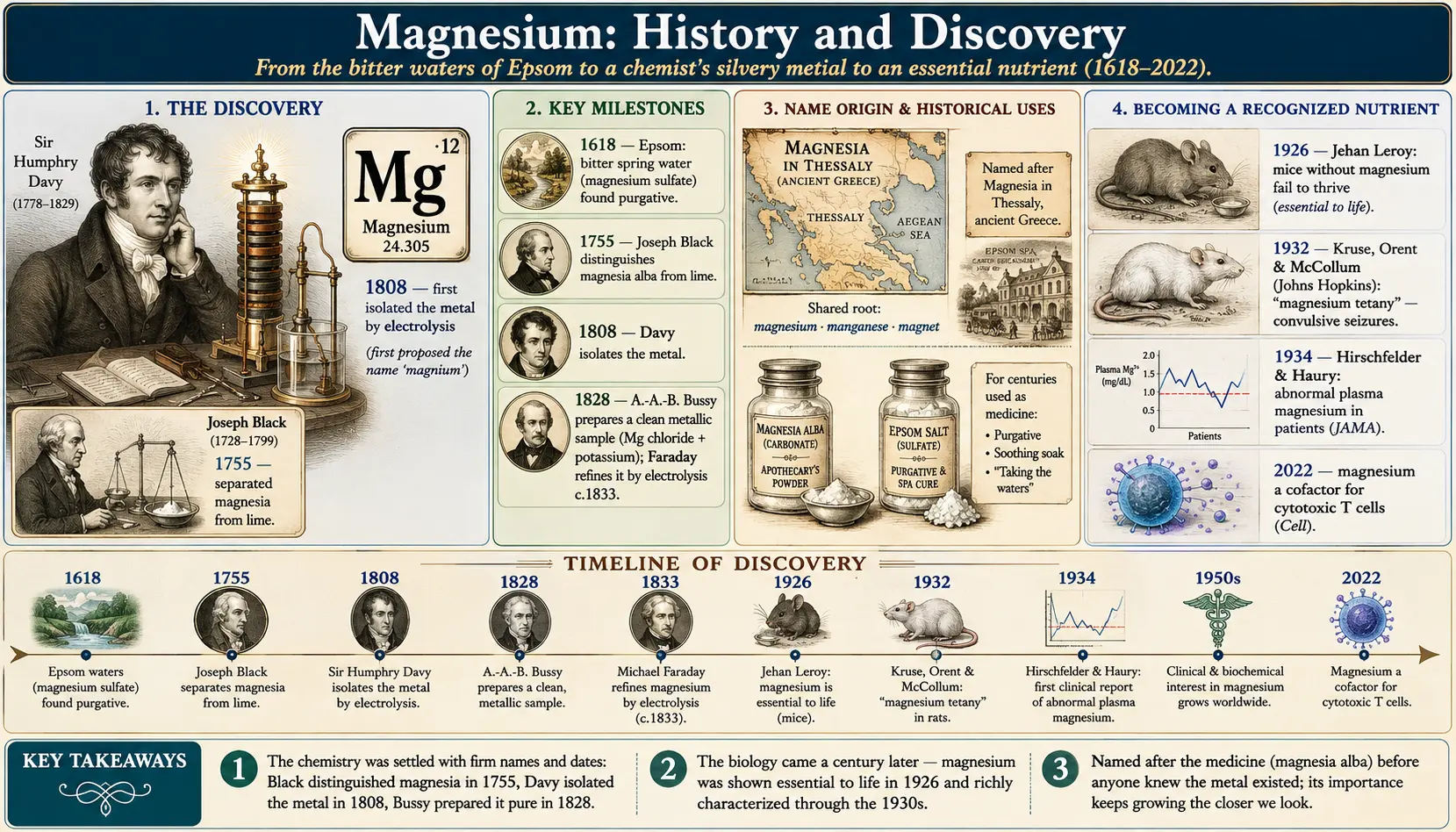
Magnesium has one of the most clearly documented histories of any nutrient, because its story divides neatly into two parts. The first is a chemistry story: who realized that the white powders and bitter spring-salts long used as medicines were a distinct substance, and who first pulled the silvery metal itself out of those compounds. The second is a biology story: who proved, more than a century later, that this same element is not just a useful mineral but a substance no animal can live without. This article traces both, naming the people and the dates the record actually supports — the Scottish physician who in 1755 separated magnesia from lime, the celebrated chemist who first isolated the metal in 1808 and even gave it a different name, the French pharmacist who first prepared a clean metallic sample in 1828, and the early-twentieth-century nutritionists who finally showed that magnesium is essential to life. Where a claim is firm we state it plainly; where priority is genuinely shared or disputed, we say so.
Interactive Visualization Magnesium — the mineral that makes ATP work Bare ATP is useless and enzymes reject it. Watch magnesium clamp the phosphates and switch it on, plug the NMDA channel, and let a cramping muscle finally let go. Launch →
Table of Contents
- Where the Name Comes From: The District of Magnesia
- Before the Element: Epsom Salt and the Bitter Waters
- Joseph Black Separates Magnesia from Lime (1755)
- Humphry Davy Isolates the Metal (1808)
- Bussy, Faraday, and a Cleaner Metal (1828–1833)
- Discovering That Magnesium Is Essential to Life (1926–1934)
- From the Laboratory to the Clinic
- The Modern Era: A Nutrient Rediscovered
- Research Papers and References
- Connections
- Featured Videos
Where the Name Comes From: The District of Magnesia
The word magnesium traces back to Magnesia, a district of Thessaly in ancient Greece. The region's name attached itself to several different minerals found there or traded through it, which is the source of a small but real historical tangle: the same root gave us magnesium, the closely related manganese, and even magnet (from the Greek magnes lithos, the "stone of Magnesia," an old name for the naturally magnetic mineral lodestone). For centuries these names were used loosely, and untangling which "magnesia" meant which substance was part of the work of early chemistry.
The specific thread that leads to our element runs through a white powder. By the seventeenth and eighteenth centuries a soft white mineral powder was sold in Rome and elsewhere as magnesia alba — "white magnesia" — and used as a mild medicine and cosmetic. We now know magnesia alba as a form of magnesium carbonate. It was this everyday apothecary's powder, rather than any rare or exotic material, that chemists eventually recognized as containing a new element, and it is from magnesia alba that the element magnesium ultimately takes its name. The naming is therefore a fossil of the substance's long medical use: magnesium was named after the medicine before anyone knew the metal existed.
Before the Element: Epsom Salt and the Bitter Waters
Long before magnesium was understood as an element, people were swallowing and bathing in its compounds. The most famous example is Epsom salt, which we now know to be magnesium sulfate. The traditional account, widely repeated and broadly accepted, dates its discovery to 1618 at Epsom, a town in Surrey, England. As the story goes, a local cowherd — often named as Henry Wicker — noticed during a drought that his cattle refused to drink from a particular pool on the common, because the water was strangely bitter. The bitter water, it turned out, had a powerful purgative effect, and Epsom grew into a fashionable spa town where visitors came to "take the waters."
The bitter salt that could be crystallized from those waters became a celebrated remedy across Europe. Its commercial value led to one of the early disputes in the history of pharmacy: the English physician and botanist Nehemiah Grew (1641–1712), a Fellow of the Royal Society, studied the Epsom waters and obtained a patent to prepare the salt, which set off a quarrel with rival apothecaries over the right to manufacture it. This history is documented in scholarly accounts of Grew and the Epsom salts. The key point for our purposes is that magnesium compounds had a centuries-long medical career — as purgatives, antacids, and spa cures — well before chemistry could explain what gave them their effects. The science, when it came, was catching up with the medicine.
Joseph Black Separates Magnesia from Lime (1755)
The first decisive step toward recognizing magnesium as something distinct was taken by the Scottish physician and chemist Joseph Black (1728–1799). In 1755 he presented to the Philosophical Society of Edinburgh his landmark paper, "Experiments upon Magnesia Alba, Quicklime, and Some Other Alcaline Substances." Until then, the white powder magnesia alba (magnesium carbonate) had often been confused with ordinary lime substances. Black's careful, quantitative experiments showed that magnesia behaved differently from lime — that it was, chemically, its own thing.
Black is best remembered for what these same experiments revealed about gases: by heating magnesia alba he showed that it lost weight as it gave off a gas he called "fixed air" (carbon dioxide), and that the weight returned when the gas was reabsorbed. That discovery helped overturn the old idea that air was a single elemental substance, and it is a cornerstone of the history of chemistry. But the same work also established magnesia as a distinct earth — a separate chemical identity — which is exactly the foundation on which the later isolation of the metal would rest. Black did not isolate metallic magnesium, and it would be wrong to credit him with discovering the element itself; what he established was that there was a genuinely new substance here to be discovered.
Humphry Davy Isolates the Metal (1808)
The isolation of the metal is credited to the great English chemist Sir Humphry Davy (1778–1829), and the year is 1808. Davy had recently pioneered the use of the powerful new voltaic battery to tear apart compounds that no chemist had ever broken down before. In 1807 he had used electrolysis to isolate potassium and sodium; in 1808 he turned the same method on the alkaline earths and, in a remarkable burst, obtained the metals we now call calcium, strontium, barium, and magnesium. He reported this work to the Royal Society in his paper "Electro-chemical researches, on the decomposition of the earths," read on 30 June 1808 and published in the Philosophical Transactions of the Royal Society.
There is a genuine naming curiosity here that the record fully supports. Davy first proposed to call the new metal "magnium," not magnesium. His reasoning was that the obvious name "magnesium" was, at the time, being used by some for a metal obtained from manganese, and he wanted to avoid an ambiguous term — he himself acknowledged that "magnium" was an awkward choice. The name magnesium nonetheless won out and is what we use today, while Davy's original "magnium" survives only as a footnote.
One honest qualification belongs to Davy's achievement. The magnesium he produced in 1808 was not a clean lump of pure metal; his electrochemical method yielded the element in an impure, amalgamated, or poorly separated form, and isolating it was notoriously difficult. For that reason some histories describe Davy as the one who first obtained or demonstrated the element while reserving the credit for the first genuinely pure metallic sample for a later chemist — the subject of the next section. What is not disputed is that Davy is the chemist who first broke magnesia down to its metal and showed the element to exist.
Bussy, Faraday, and a Cleaner Metal (1828–1833)
The first preparation of a coherent sample of reasonably pure metallic magnesium is generally credited to the French chemist and pharmacist Antoine-Alexandre-Brutus Bussy (1794–1882), in 1828. Rather than electrolysis, Bussy used a chemical-reduction route: he heated molten magnesium chloride with metallic potassium, which stripped the chlorine away and left the magnesium behind as a metal. This is why credit for "discovering" magnesium is sometimes split in the literature — Davy (1808) for first isolating the element and proving it existed, Bussy (1828) for first obtaining it as a clean metallic substance. Both attributions are defensible, and good histories mention both names; this page presents the division rather than pretending there is a single tidy answer.
A few years later the method was refined further. The English scientist Michael Faraday — once Davy's own laboratory assistant — is reported to have produced metallic magnesium by the electrolysis of fused (molten) magnesium chloride around 1833, an approach much closer in spirit to the industrial electrolytic methods that would later make magnesium a commercial metal. The thread running through Davy, Bussy, and Faraday is a steady improvement in technique: from a difficult, impure first glimpse of the element, to a clean chemical preparation, to an electrolytic route that pointed toward mass production. Magnesium would eventually become important far beyond medicine — as a lightweight structural metal and in flares and flashbulbs for its brilliant white flame — but those industrial chapters grew out of this early-nineteenth-century chemistry.
Discovering That Magnesium Is Essential to Life (1926–1934)
Knowing that magnesium is an element is one thing; knowing that you will die without it is another, and that second discovery came much later. For most of the nineteenth and early twentieth centuries magnesium was regarded as a useful drug and a constituent of bone, but not necessarily as a dietary essential. That changed in the first decades of the twentieth century, when the new science of nutrition began testing, one by one, which minerals an animal truly cannot do without.
The widely cited milestone is 1926, when the French researcher Jehan Leroy reported that mice fed a diet deficient in magnesium failed to thrive — evidence that magnesium is essential for life. This date, 1926, is the one given in authoritative modern reviews as marking the recognition of magnesium as an essential nutrient. The finding was then put on a much firmer footing by work in the United States: in 1932, H. D. Kruse, E. R. Orent, and E. V. McCollum, working at the Johns Hopkins School of Hygiene and Public Health, published detailed studies showing that rats deprived of magnesium developed a striking, reproducible syndrome — including vasodilation, hyperexcitability, and convulsive seizures they termed magnesium tetany. Their paper, "Studies on Magnesium Deficiency in Animals," in the Journal of Biological Chemistry, became the foundational experimental description of what magnesium deficiency does to a mammal.
It is worth pausing on how different this kind of "discovery" is from Davy's. No single person invented magnesium's biological role — the element had been doing its job in every living cell for as long as life has existed. What Leroy, and then Kruse, Orent, and McCollum, did was demonstrate that role: they proved by controlled deprivation that magnesium is not optional. This is the moment magnesium crossed over from being a chemist's element and a druggist's salt to being a recognized essential nutrient.
From the Laboratory to the Clinic
Once animal experiments had defined magnesium deficiency, the obvious question was whether it occurred in people. The first clinical report is usually credited to A. D. Hirschfelder and V. G. Haury, who in 1934 published "Clinical Manifestations of High and Low Plasma Magnesium" in JAMA — an early description of what abnormal blood-magnesium levels look like in human patients. For some years afterward, human magnesium deficiency was treated as a medical curiosity, something rarely looked for. It was not until the 1950s that interest in clinical magnesium deficiency grew rapidly, as physicians began recognizing low magnesium in alcoholism, malabsorption, and patients on intravenous feeding, and as better laboratory methods made the deficiency easier to detect.
Alongside this story of deficiency ran a parallel story of magnesium as a treatment. Intravenous magnesium sulfate — the soluble salt — was taken up in obstetric medicine for the prevention and treatment of the dangerous seizures of eclampsia and preeclampsia, a use that, refined over the twentieth century, remains one of the genuinely consequential drug therapies in modern obstetrics. (The large modern trials underpinning that use, along with magnesium's roles in heart rhythm and migraine, are covered on the main Magnesium page and in the Benefits articles.) So by the middle of the twentieth century magnesium occupied an unusual dual position: a salt doctors gave as a powerful medicine, and a nutrient whose quiet absence could itself make people ill.
The Modern Era: A Nutrient Rediscovered
The final chapter of magnesium's history is, in a sense, a rediscovery. For decades after its essentiality was established, magnesium was often called the "forgotten" or "neglected" nutrient, overshadowed in the public mind by calcium and the vitamins. That began to change as research accumulated — through the second half of the twentieth century and into the twenty-first — showing how broadly magnesium is involved in human biochemistry and how common inadequate intake is in modern diets. Where early estimates put magnesium at the catalytic core of a few hundred enzyme reactions, modern proteomic work has pushed that figure far higher, and population surveys have repeatedly found that a large share of adults in developed countries fall short of recommended intakes.
One striking thread of recent science returns magnesium, unexpectedly, to the cutting edge: in 2022, researchers reporting in the journal Cell identified magnesium as a required cofactor for the proper function of cytotoxic T cells, tying magnesium status directly to the immune system's ability to attack infected and cancerous cells. That a substance Davy first wrestled out of a lump of magnesia in 1808 should, more than two centuries later, turn up as a regulator of cancer-fighting immune cells is a fitting illustration of the arc of this history — an old element whose importance keeps growing the more closely we look.
The honest summary of magnesium's history is that it has two clear discoverers' tales and one long rediscovery. The chemistry was settled, with names and dates we can stand behind: Black distinguished magnesia in 1755, Davy isolated the metal in 1808, Bussy prepared it pure in 1828. The biology was settled later and more diffusely: magnesium was shown to be essential to life in 1926 and richly characterized through the 1930s, recognized in human patients from 1934, and taken seriously in clinical medicine only from the 1950s onward. Everything since has been the slow, continuing work of measuring just how much this ancient element does. The mechanisms, the modern clinical evidence, and the practical questions of intake and supplementation are taken up on the companion Magnesium and Magnesium Benefits pages; this history is concerned only with how we came to know the element at all.
Research Papers and References
The list below combines peer-reviewed and historical sources documenting magnesium's discovery and the recognition of its essential role. Historical primary sources — Joseph Black's 1755 paper, Humphry Davy's 1808 Royal Society paper, and the early-twentieth-century nutrition studies — are named in the article and cited below; author names, titles, and journals are given as plain text, and only a stable DOI, PMID, or archive link is hyperlinked, each opening in a new tab. Several of the foundational nineteenth-century papers predate modern digital identifiers and are cited in print form.
- de Baaij JH, Hoenderop JG, Bindels RJ. Magnesium in man: implications for health and disease. Physiological Reviews. 2015;95(1):1-46. (Authoritative modern review; documents the 1926 recognition of magnesium as essential and the early chemistry.) — doi:10.1152/physrev.00012.2014
- Kubena KS, Durlach J. Historical review of the effects of marginal intake of magnesium in chronic experimental magnesium deficiency. Magnesium Research. 1990;3(3):219-226. (States that magnesium was discovered as an essential nutrient in 1926.) — PMID: 2132753
- Davy H. Electro-chemical researches, on the decomposition of the earths; with observations on the metals obtained from the alkaline earths, and on the amalgam procured from ammonia. Philosophical Transactions of the Royal Society of London. 1808;98:333-370. (First isolation of magnesium; the metal originally proposed as "magnium.") — doi:10.1098/rstl.1808.0023
- Black J. Experiments upon magnesia alba, quicklime, and some other alcaline substances. Philosophical Society of Edinburgh, 1755. (Distinguished magnesia from lime; foundational to recognizing magnesium as a distinct substance.) — Internet Archive (reprint of the 1755 original)
- Kruse HD, Orent ER, McCollum EV. Studies on magnesium deficiency in animals. I. Symptomatology resulting from magnesium deprivation. Journal of Biological Chemistry. 1932;96:519-539. (Foundational experimental description of magnesium-deficiency "tetany" in rats.)
- Hirschfelder AD, Haury VG. Clinical manifestations of high and low plasma magnesium. Journal of the American Medical Association. 1934;102(14):1138-1141. (First clinical report of abnormal plasma magnesium in human patients.)
- Sakula A. Doctor Nehemiah Grew (1641-1712) and the Epsom salts. Clio Medica. 1984;19(1-2):1-21. (History of Epsom salt — magnesium sulfate — and the patent dispute over its preparation.) — PMID: 6085985
- Magnesium — history of its discovery and essentiality — PubMed: magnesium history and discovery
- Magnesium deficiency — historical and experimental literature — PubMed: magnesium-deficiency history
External Authoritative Resources
- NIH Office of Dietary Supplements — Magnesium Fact Sheet for Health Professionals
- Encyclopædia Britannica — Sir Humphry Davy
- Encyclopædia Britannica — Joseph Black
Connections
- All Minerals
- Magnesium Replenishment (Root Cause Protocol) — the practical modern counterpart to this history — Morley Robbins’s case that deficiency is near-universal, which forms actually absorb, topical magnesium, and the magnesium-vitamin D-calcium triangle.
- Magnesium: The Mineral That Makes ATP Work — interactive animation
- Magnesium
- Magnesium Benefits
- Magnesium Glycinate
- Calcium
- Potassium
- Zinc