Iodine Excess (Too Much Iodine): Symptoms, Causes, and Risks
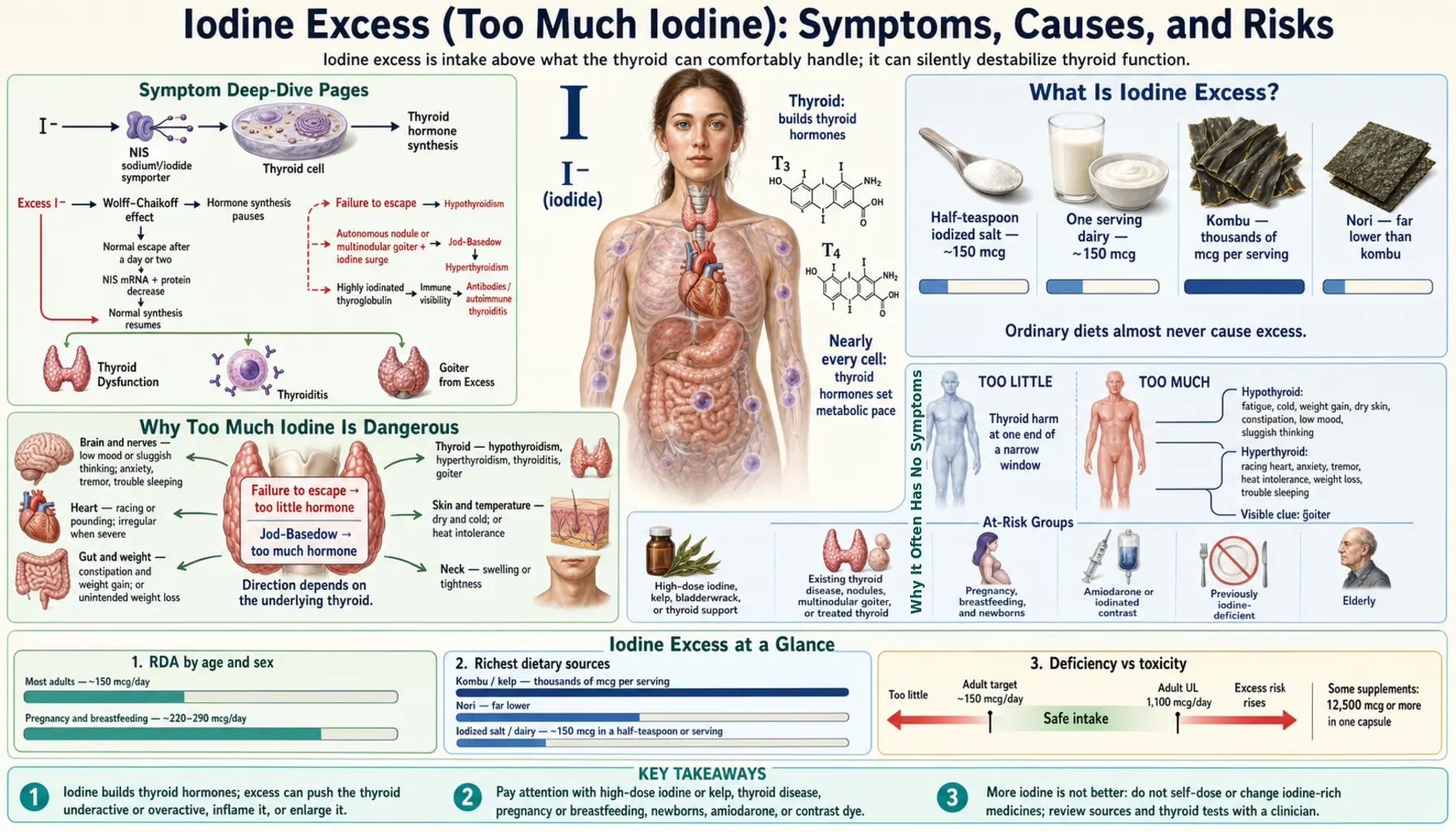
Iodine is one of the few minerals where both too little and too much cause harm — and the harm sits at opposite ends of a surprisingly narrow window. Iodine excess means taking in far more iodine than the thyroid was built to handle, usually from supplements, kelp and seaweed products, certain medicines, or medical contrast dyes — almost never from an ordinary diet. Here is the counter-intuitive part: a healthy thyroid can briefly defend itself against a flood of iodine by temporarily shutting down hormone production (the Wolff–Chaikoff effect), so a single big dose often causes nothing at all. The trouble comes when the excess is sustained, or when the thyroid is already vulnerable — then too much iodine can tip a person into an underactive thyroid, an overactive one, inflammation of the gland, or a goiter, and in some people it can quietly stoke autoimmune thyroid disease. Most iodine-excess problems are uncommon, are driven by a supplement or drug rather than food, and show up not as a dramatic poisoning but as an abnormal thyroid blood test. This hub explains what counts as too much iodine, why excess endangers the thyroid, why it is so often silent, what causes it, and how it is diagnosed and managed — with deep-dive pages on thyroid dysfunction, thyroiditis, and iodine-induced goiter. More iodine is not better; if you are taking high-dose iodine or kelp, talk to a clinician rather than self-dosing.
Symptom Deep-Dive Pages
Thyroid Dysfunction
How too much iodine can push the thyroid in either direction — into an underactive (hypothyroid) state by failing to escape the Wolff–Chaikoff effect, or into an overactive (hyperthyroid) state through the Jod-Basedow phenomenon — and who is most at risk of each.
Thyroiditis
Why a sustained iodine excess can inflame the thyroid gland and, in susceptible people, trigger or worsen autoimmune thyroiditis such as Hashimoto's — how the inflammation works, and why rising antibody levels can be the first clue.
Goiter from Excess
The paradox that the same swollen thyroid (goiter) caused by iodine deficiency can also be caused by iodine excess — how a flood of iodine can enlarge the gland, who is vulnerable, and why the cause matters for treatment.
Table of Contents
- Symptom Deep-Dive Pages
- What Is Iodine Excess?
- Why Too Much Iodine Is Dangerous
- Why It Often Has No Symptoms
- Common Causes of Iodine Excess
- How Iodine Excess Is Diagnosed
- How Iodine Excess Is Managed
- When to Seek Care / Red Flags
- Key Research Papers
- Connections
- Featured Videos
What Is Iodine Excess?
Iodine is an essential trace mineral your thyroid gland needs to build thyroid hormones — the chemical messengers that set the pace of metabolism in nearly every cell. The catch is that the thyroid needs only a tiny amount, and it works best inside a narrow range. Iodine excess simply means an iodine intake well above what the thyroid needs and can comfortably handle. Unlike most nutrients, where the gap between "too little" and "too much" is wide, iodine has one of the tightest safe windows of any mineral, which is exactly why excess is a real and recognized problem rather than a theoretical one.
It helps to anchor the numbers. The recommended daily intake for most adults is about 150 micrograms (mcg) of iodine — roughly the amount in a half-teaspoon of iodized salt or a serving of dairy. Pregnancy and breastfeeding raise the need to around 220–290 mcg. At the other end, the U.S. Institute of Medicine sets a Tolerable Upper Intake Level of 1,100 mcg (1.1 mg) per day for adults — the ceiling above which the risk of thyroid problems begins to climb in the general population. To put that in perspective, many over-the-counter "thyroid support" and kelp supplements deliver several thousand micrograms — sometimes 12,500 mcg (12.5 mg) or more — in a single capsule, dozens of times the daily requirement and many times the upper limit. This is the heart of the issue: the human diet almost never provides too much iodine, but a supplement bottle easily can.
Because iodine intake is hard to feel, doctors think about excess in terms of source and duration rather than a single dramatic dose:
- A one-time large dose — for example, a single high-dose kelp tablet or a dose of iodinated contrast dye for a CT scan. In a person with a healthy thyroid, this is usually shrugged off entirely, because the gland has a built-in defense (described below).
- Sustained high intake — taking a high-dose iodine or kelp supplement every day for weeks or months, or being on a long-term iodine-containing medicine. This is where the thyroid is most likely to be pushed out of balance, because the defense mechanism can either fail to engage or fail to switch off.
- Excess landing on an already-vulnerable thyroid — the same intake that a healthy gland ignores can destabilize a thyroid that already has nodules, autoimmune disease, or a history of thyroid problems. The dose that matters is partly about the person, not just the milligrams.
Two facts are worth holding together from the start. First, true iodine excess is overwhelmingly a supplement, seaweed, or medication story — not a food story. A normal diet, even one rich in iodized salt, fish, and dairy, does not deliver toxic amounts. Second, the danger of excess is not a classic "poisoning" with a clear set of symptoms; it is a disturbance of thyroid function that is usually detected on a blood test, not felt. That makes iodine excess much more like the silent thyroid disorders than like, say, an acute overdose — a theme that runs through this whole page.
Why Too Much Iodine Is Dangerous
If a healthy thyroid can brush off a big iodine dose, why is excess taken seriously at all? The answer is that the thyroid's defenses are not foolproof, and when they fail the gland can be pushed in either direction — toward too little hormone or too much. Both directions cause real disease, and which one happens depends on the person's underlying thyroid.
Start with the remarkable protective trick. When the thyroid is suddenly flooded with iodine, it briefly slams the brakes on hormone production — a self-protective shutdown called the Wolff–Chaikoff effect. Think of it as a circuit breaker: too much current trips the switch, and hormone synthesis pauses so the gland is not driven into overdrive. In a normal thyroid, this pause lasts only a day or two; the gland then "escapes" by turning down the protein that pumps iodine into thyroid cells (the sodium/iodide symporter, or NIS), so it can resume normal hormone-making even while iodine stays high. Eng and colleagues showed in 1999 that this escape works precisely by reducing NIS at the messenger-RNA and protein level — the gland dials down its own iodine intake to protect itself. The danger appears at the two ways this circuit breaker can malfunction:
- Failure to escape → underactive thyroid (hypothyroidism). In some people — especially those with autoimmune thyroid disease such as Hashimoto's, a previously treated thyroid, or certain other vulnerabilities — the circuit breaker stays tripped. The gland never resumes normal production, hormone levels fall, and the person becomes hypothyroid. This is the most common way sustained iodine excess harms a susceptible thyroid, and it is well documented in the medical literature (Markou and colleagues, 2001).
- Too much fuel → overactive thyroid (hyperthyroidism). In others — classically people with a long-standing iodine deficiency, an autonomous "hot" nodule, or a multinodular goiter — a surge of iodine acts like throwing fuel on a smoldering fire. Thyroid tissue that has been operating without enough raw material suddenly has plenty and overproduces hormone, causing iodine-induced hyperthyroidism. This is the Jod-Basedow phenomenon ("Jod" is German for iodine), described by Roti and Uberti (2001).
Beyond pushing hormone levels up or down, sustained iodine excess does a third, slower kind of harm: it can inflame the gland and stoke thyroid autoimmunity. High iodine intake increases the production of highly iodinated thyroglobulin, which appears to be more visible to the immune system; in populations and in studies, rising iodine intake is associated with more autoimmune thyroiditis and higher levels of anti-thyroid antibodies. The landmark prospective study by Teng and colleagues in China (2006), published in the New England Journal of Medicine, followed three regions with different iodine intakes and found that more-than-adequate or excessive iodine intake was associated with a higher incidence of subclinical hypothyroidism and autoimmune thyroiditis — the clearest population evidence that, for the thyroid, more iodine is not simply better. A 2017 systematic review and meta-analysis (Katagiri and colleagues) likewise found that excess iodine intake raises the risk of hypothyroidism and thyroid autoimmunity.
The deeper mechanics of each outcome live on the deep-dive pages: how excess swings the gland either way on Thyroid Dysfunction, the inflammatory and autoimmune side on Thyroiditis, and gland enlargement on Goiter from Excess. The overarching point for this hub is simple: the threat of iodine excess is not a single illness but a destabilized thyroid, and the direction it tips depends largely on the gland it lands on.
Why It Often Has No Symptoms
One of the most important things to understand about iodine excess is also one of the easiest to miss: most of the time it does not feel like anything in particular. There is no reliable "too-much-iodine" sensation. When a high intake does disturb the thyroid, what a person experiences are the ordinary symptoms of an underactive or overactive thyroid — and those are vague, slow to appear, and easily blamed on something else.
If excess tips someone toward hypothyroidism, the symptoms are the familiar ones of a slow metabolism: fatigue, feeling cold, weight gain, dry skin, constipation, low mood, and sluggish thinking. If it tips them toward hyperthyroidism, the symptoms run the other way: a racing or pounding heart, anxiety or irritability, tremor, heat intolerance, unintended weight loss, and trouble sleeping. Either set develops gradually and overlaps with dozens of unrelated causes — stress, aging, other illnesses, ordinary tiredness — so the iodine connection is rarely obvious from feelings alone. A swelling in the neck (goiter) may be the one visible sign, but it too is non-specific.
Why is iodine excess so quiet? Largely because of the thyroid's own buffering. The Wolff–Chaikoff escape means a healthy gland absorbs a great deal of iodine punishment without any change the person can detect. The disturbances that do occur often start as subclinical changes — the thyroid blood tests drift out of range while hormone levels are still nearly normal and the person feels fine. In the Teng study, much of the excess-iodine effect showed up as subclinical hypothyroidism: detectable on a test, but below the threshold of obvious illness. The calm is real, but it is not the same as safety.
This is exactly why monitoring and history-taking, not symptoms, are the dependable way to catch iodine-related thyroid trouble. Because you cannot feel your iodine intake, the practical safeguards are to know what you are taking and to check thyroid function when there is reason to. People who should be especially alert include:
- Anyone taking high-dose iodine, kelp, bladderwrack, or "thyroid support" supplements — the single most common avoidable cause, and one people often do not think of as "a drug."
- People with existing thyroid disease — autoimmune thyroiditis (such as Hashimoto's), nodules, a multinodular goiter, or a previously treated thyroid — whose glands are far more easily destabilized.
- Pregnant and breastfeeding women and newborns, whose iodine needs and sensitivities are different and in whom both deficiency and excess matter.
- People starting iodine-rich medicines such as amiodarone, or receiving iodinated contrast dye for imaging, especially if they already have thyroid disease.
- Populations and individuals moving from a previously iodine-deficient state to a high intake, in whom the Jod-Basedow risk is greatest.
The take-home is the opposite of reassuring quiet: feeling fine on a high-dose iodine product does not mean the dose is fine for your thyroid. For people in these groups, the truth is told by a thyroid blood test and an honest review of what is being swallowed — not by how the day feels.
Common Causes of Iodine Excess
Iodine excess almost always traces back to a deliberate or hidden source of extra iodine, not to ordinary eating. The body excretes most surplus dietary iodine in the urine, so for someone with a normal thyroid and normal kidneys, balanced food simply does not push iodine into the danger zone. The real culprits are supplements, seaweed, certain medicines, and medical iodine. Here are the causes worth knowing.
- High-dose iodine and kelp supplements — the number-one avoidable cause. Stand-alone iodine drops (Lugol's solution, potassium iodide), kelp and bladderwrack capsules, and "thyroid support" blends frequently contain milligram-level doses — 1,000 to 12,500 mcg or more per serving — that is, many times the 1,100 mcg daily upper limit. Because supplements are marketed as healthy and "natural," people rarely suspect them, and they are by far the most common source of genuine excess in everyday practice. The dose on a kelp label can vary widely and is often not what the body needs.
- Seaweed-heavy diets. Certain seaweeds, especially kombu (a kelp used in Japanese broth), are extraordinarily iodine-dense — a single serving can contain thousands of micrograms. Regular, heavy seaweed consumption (as in some traditional diets or among enthusiastic home cooks and seaweed-snack eaters) can push intake well above the safe range. Nori, the sheet used for sushi, is far lower; kombu and some kelp powders are the high-risk ones.
- Iodine-containing medicines. Several drugs are rich in iodine:
- Amiodarone — a heart-rhythm medicine that is roughly 37% iodine by weight; a single daily dose can deliver dozens of times the daily iodine requirement, and it commonly disturbs thyroid function in both directions (Martino and colleagues, 2001). See Arrhythmia for the rhythm conditions it treats.
- Iodinated contrast dye — used for CT scans, angiograms, and some other imaging. A single study delivers a large iodine load; in most people it is cleared without harm, but it can trigger thyroid dysfunction, particularly in those with underlying thyroid disease (Rhee and colleagues, 2012).
- Topical iodine antiseptics (povidone-iodine) and certain expectorants, supplements, and old-fashioned tonics that contain iodine — usually minor, but a contributor with heavy or prolonged use, especially on broken skin or mucous membranes.
- Excess on a vulnerable thyroid. Strictly this is a susceptibility rather than a source, but it is so important it belongs on the list. The same intake a healthy gland ignores can destabilize a thyroid with autoimmune disease, nodules, a multinodular goiter, or a history of treatment. In people coming from long-standing iodine deficiency, a sudden increase is the classic setup for iodine-induced hyperthyroidism (Jod-Basedow). The cause, in other words, is often the meeting of an ordinary dose and an extraordinary gland.
- Iodine prophylaxis and water/food fortification — rarely. Large public-health doses of potassium iodide (for example after a radiation emergency) or, historically, over-iodization of salt or water have caused population-level shifts in thyroid disease. For an individual eating a normally iodized diet, this is not a concern; it is listed for completeness because it shows that population iodine excess is real and measurable, not hypothetical.
A practical note that mirrors the deficiency side of iodine: causes often combine. A person with a quiet multinodular goiter who starts a kelp supplement, eats kombu broth several times a week, and then has a contrast CT scan may tip into thyroid dysfunction from the sum of several iodine sources — none of which alone might have done it. When iodine trouble is suspected, the first and most useful step is a careful inventory of everything that could be adding iodine.
How Iodine Excess Is Diagnosed
Because iodine excess shows itself as a thyroid disturbance rather than a distinct illness, it is usually uncovered the same way other thyroid problems are: with a blood test of thyroid function combined with a careful history of iodine intake. There is no single "iodine toxicity" test that a doctor orders in a crisis; instead, the diagnosis is pieced together from how the thyroid is behaving and what the person has been exposed to.
The cornerstone is the thyroid panel — chiefly thyroid-stimulating hormone (TSH), usually with free T4 (and sometimes free T3). TSH is the pituitary's message to the thyroid and is the single most sensitive screen: a high TSH points toward an underactive thyroid (iodine-induced hypothyroidism), while a low or suppressed TSH points toward an overactive thyroid (iodine-induced hyperthyroidism). Because much of the early effect of excess is subclinical, the panel often catches it before the person feels anything. (For what each value means and how the hormones relate, see the Thyroid Panel page.) When the picture suggests autoimmunity, the doctor may add:
- Thyroid antibodies — anti-thyroid peroxidase (anti-TPO) and anti-thyroglobulin antibodies. Elevated or rising antibodies suggest the immune system is involved, the pattern most associated with sustained iodine excess inflaming a susceptible gland (see Hashimoto's Thyroiditis).
- A urinary iodine measurement — iodine is excreted in the urine, so a spot or 24-hour urinary iodine can confirm that intake is genuinely high. It is used more in research and population surveys than in routine clinics, but it can be informative when the source is unclear.
- A thorough medication and supplement review — arguably the most important "test" of all. The doctor will look specifically for kelp and iodine supplements, "thyroid support" products, amiodarone, recent contrast imaging, and heavy seaweed intake. Iodine excess is frequently diagnosed at the moment someone is finally asked what is in their supplement bottle.
- Imaging when needed — a thyroid ultrasound to look at nodules or a goiter, or in hyperthyroidism a radioactive iodine uptake scan to distinguish iodine-induced overactivity from other causes. (Note: recent iodine exposure can itself blunt an uptake scan, which is part of the diagnostic puzzle.)
An important honesty point: because everyday food does not cause iodine excess, a clinician will not blame an ordinary diet for an abnormal thyroid test. The diagnosis of iodine-induced thyroid trouble specifically requires identifying a high-iodine source — which is why the history matters as much as the labs, and why bringing the actual supplement bottles to the appointment is genuinely useful.
How Iodine Excess Is Managed
The good news about iodine excess is that its single most powerful treatment is also the simplest: stop the excess. Because the problem is driven by an external source far more than by the body itself, removing that source is the foundation of management, and in many people it is enough on its own. This is genuine thyroid territory, though — do not start or stop iodine-containing medicines on your own, and do not try to "flush" iodine; let a clinician guide it. The approach depends on what the excess has done to the thyroid.
- Remove the source. The first step is almost always to stop the offending supplement, kelp product, or seaweed-heavy habit. For a healthy thyroid that has only drifted into a subclinical abnormality, withdrawing the excess often allows thyroid function to normalize over weeks to months as the gland resets. Where the source is a needed medicine (such as amiodarone) or an unavoidable medical iodine load (such as contrast dye), the decision is more nuanced and is made with the prescribing doctor — sometimes the drug is continued and the thyroid managed around it.
- Treat iodine-induced hypothyroidism. If excess has tipped the thyroid into an underactive state, treatment follows the usual path for an underactive thyroid: removing the iodine source and, if the gland does not recover or the person is symptomatic, replacing the missing hormone with levothyroxine (see Hypothyroidism). In someone with underlying Hashimoto's, the hypothyroidism may be lasting and warrant ongoing treatment.
- Treat iodine-induced hyperthyroidism (Jod-Basedow). If excess has driven the thyroid into overactivity, the management mirrors that of other hyperthyroid states — stopping the iodine, and using medicines that calm symptoms (beta-blockers) and reduce hormone production (antithyroid drugs) as needed (see Hyperthyroidism). Iodine-induced hyperthyroidism, especially the kind triggered by amiodarone, can be challenging to treat and is handled by specialists.
- Address inflammation and autoimmunity. Where excess has provoked or worsened autoimmune thyroiditis, the iodine source is reduced and thyroid function is monitored and treated according to whether the gland ends up under- or over-active. The autoimmune process itself is managed as it would be otherwise.
- Manage a goiter from excess. An enlarged gland is evaluated for the underlying thyroid state and, where appropriate, the iodine source is removed; persistent or compressive goiters are assessed by a specialist. The mechanism and approach are covered on Goiter from Excess.
- Watch and recheck. Because the thyroid takes time to settle, management almost always includes repeat thyroid panels over the following weeks and months to confirm recovery or to guide treatment. Many subclinical, supplement-driven cases simply resolve on monitoring once the iodine stops.
The reassuring theme is that supplement-driven iodine excess is largely preventable and, caught in time, often reversible. The most important practical message is the same one that opens this page: with iodine, more is not better. Sticking to recommended amounts — iodized salt, a normal diet, and a prenatal supplement during pregnancy if advised — meets the body's needs without courting the risks of excess. The contrast with the Deficiency side is a perfect illustration of why iodine decisions belong with a clinician who knows your thyroid: the right answer can be "more" for one person and "much less" for another.
When to Seek Care / Red Flags
Because iodine excess is usually silent and slow, the most important "red flag" is often a situation rather than a sudden symptom: if you are taking high-dose iodine, kelp, or a "thyroid support" supplement, or eating seaweed heavily, that alone is a reason to talk with a clinician and have your thyroid checked — even if you feel perfectly well. That said, certain symptoms suggest the thyroid has been pushed significantly out of balance and should prompt medical attention. Contact a healthcare professional promptly if you develop:
- Signs of an overactive thyroid — a persistently racing or pounding heart, marked anxiety or tremor, unexplained weight loss, heat intolerance, or trouble sleeping, especially after starting a high-iodine product or medicine.
- Signs of an underactive thyroid — new or worsening fatigue, feeling cold, weight gain, constipation, dry skin, or low mood that does not have another clear explanation.
- A new or enlarging lump or swelling in the neck (goiter), or any neck tightness, trouble swallowing, or a change in your voice.
- A clearly excessive intake — if you realize you have been taking far more iodine than recommended (for example, a milligram-dose kelp or Lugol's product daily), have your thyroid function checked rather than waiting for symptoms.
Seek urgent care if iodine-induced overactivity becomes severe — a very fast or irregular heartbeat with chest pain, fainting, high fever, or confusion can signal a dangerous thyroid storm and is a medical emergency. People at higher risk — those with existing thyroid disease (autoimmune thyroiditis, nodules, or goiter), those on amiodarone, the elderly, and pregnant or breastfeeding women — should have a low threshold for getting checked, because in these settings even a modest iodine excess can destabilize the thyroid. For related conditions, see Thyroid Disorders, Graves' Disease, and the irregular-heartbeat overview at Arrhythmia. When in doubt, a simple thyroid blood test and an honest review of what you are taking settle the question.
Key Research Papers
- Leung AM, Braverman LE (2014). Consequences of excess iodine. Nature Reviews Endocrinology;10(3):136-142. — DOI: 10.1038/nrendo.2013.251
- Bürgi H (2010). Iodine excess. Best Practice & Research Clinical Endocrinology & Metabolism;24(1):107-115. — DOI: 10.1016/j.beem.2009.08.010
- Teng W, Shan Z, Teng X, et al. (2006). Effect of Iodine Intake on Thyroid Diseases in China. New England Journal of Medicine;354(26):2783-2793. — DOI: 10.1056/NEJMoa054022
- Markou K, Georgopoulos N, Kyriazopoulou V, Vagenakis AG (2001). Iodine-Induced Hypothyroidism. Thyroid;11(5):501-510. — DOI: 10.1089/105072501300176462
- Roti E, Uberti ED (2001). Iodine Excess and Hyperthyroidism. Thyroid;11(5):493-500. — DOI: 10.1089/105072501300176453
- Katagiri R, Yuan X, Kobayashi S, Sasaki S (2017). Effect of excess iodine intake on thyroid diseases in different populations: A systematic review and meta-analyses. PLOS ONE;12(3):e0173722. — DOI: 10.1371/journal.pone.0173722
- Eng PHK, Cardona GR, Fang SL, et al. (1999). Escape from the Acute Wolff-Chaikoff Effect Is Associated with a Decrease in Thyroid Sodium/Iodide Symporter Messenger RNA and Protein. Endocrinology;140(8):3404-3410. — DOI: 10.1210/endo.140.8.6893
- Sun X, Shan Z, Teng W (2014). Effects of Increased Iodine Intake on Thyroid Disorders. Endocrinology and Metabolism;29(3):240-247. — DOI: 10.3803/EnM.2014.29.3.240
- Martino E, Bartalena L, Bogazzi F, Braverman LE (2001). The Effects of Amiodarone on the Thyroid. Endocrine Reviews;22(2):240-254. — DOI: 10.1210/edrv.22.2.0427
- Rhee CM, Bhan I, Alexander EK, Brunelli SM (2012). Association Between Iodinated Contrast Media Exposure and Incident Hyperthyroidism and Hypothyroidism. Archives of Internal Medicine;172(2):153-159. — DOI: 10.1001/archinternmed.2011.677
- Pearce EN, Pino S, He X, et al. (2004). Sources of Dietary Iodine: Bread, Cows' Milk, and Infant Formula in the Boston Area. Journal of Clinical Endocrinology & Metabolism;89(7):3421-3424. — DOI: 10.1210/jc.2003-032002
PubMed Topic Searches
- PubMed — Iodine excess and thyroid dysfunction
- PubMed — Wolff-Chaikoff effect and escape
- PubMed — Iodine-induced hyperthyroidism (Jod-Basedow)
- PubMed — Excess iodine intake and thyroid autoimmunity
- PubMed — Kelp supplements, iodine, and thyroid toxicity
Connections
- All Minerals
- Iodine Excess: Thyroid Dysfunction
- Iodine Excess: Thyroiditis
- Iodine Excess: Goiter from Excess
- Iodine Overview
- Iodine Deficiency Hub
- Iodine Benefits Hub
- Iodine and Thyroid Function
- Thyroid Panel
- Thyroid Disorders
- Hypothyroidism
- Hyperthyroidism
- Hashimoto's Thyroiditis
- Graves' Disease
- Selenium