Copper: History and Discovery
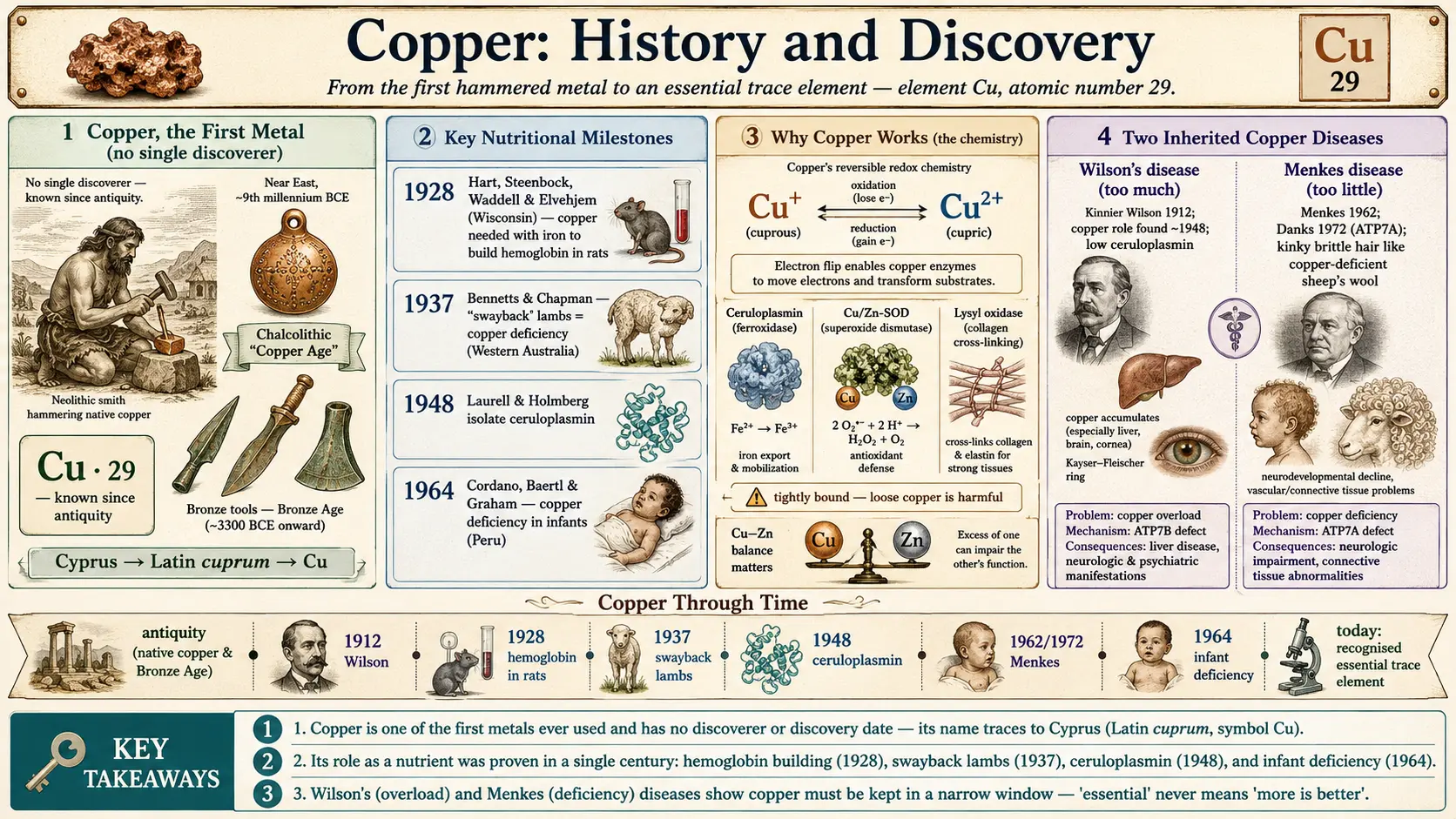
Copper has one of the longest human stories of any element on the periodic table. People were shaping it into beads and tools many thousands of years before anyone knew what an “element” was, so — unlike phosphorus or iodine — copper has no single discoverer and no isolation date; it was simply one of the first metals humanity ever used. But copper has a second, much more recent history that is just as important: the slow, hard-won discovery that this familiar metal is also a nutrient our bodies cannot live without. That second story has real names and real dates — rats fed milk in Wisconsin in 1928, staggering lambs in Western Australia in 1937, malnourished infants in Peru in 1964 — and it is the one most people have never heard. This article tells both: the ancient metal and the essential nutrient, keeping firmly to what the historical and scientific record actually supports and marking clearly where a claim is tradition, interpretation, or still debated.
Table of Contents
- Copper, the First Metal
- The Name “Copper” and the Symbol Cu
- Copper as a Chemical Element
- The Nutritional Discovery: Copper and Anemia (1928)
- Staggering Lambs: Copper Deficiency in Animals (1937)
- Ceruloplasmin: The Blue Copper Protein (1948)
- Copper Deficiency in People (1964)
- Wilson and Menkes: Two Inherited Copper Diseases
- From Ancient Metal to Modern Micronutrient
- Research Papers and References
- Connections
- Featured Videos
Copper, the First Metal
Copper holds a special place in human history because it is widely regarded as the first metal that people worked on any meaningful scale. The reason is simple chemistry: copper sometimes occurs in nature as native copper — lumps of the pure, reddish metal that need no smelting — so early people could find it, hammer it, and shape it long before they understood furnaces or ores. Some of the oldest known copper objects are small ornaments and beads from the Near East dating back many thousands of years; one frequently cited example is a copper pendant from what is now northern Iraq, often dated to roughly the ninth millennium BCE. Exact dates for the very earliest items are debated by archaeologists, so this page treats copper’s use as reaching deep into the Neolithic without fixing a single “first” year.
Over time, people learned not just to hammer native copper but to smelt it from ore — heating coloured rocks until the metal ran out — a major technological leap that scholars place in regions such as Anatolia and the surrounding Near East several thousand years BCE. Copper mattered so much to early civilisation that an entire archaeological age is named after it: the Chalcolithic, or Copper Age, a transitional period between the Stone Age and the Bronze Age. The word itself comes from the Greek khalkos (copper) and lithos (stone), capturing a time when people used copper tools alongside stone ones.
The next great step was alloying. When copper is combined with tin, the result is bronze — harder, easier to cast, and far more useful for weapons and tools than soft pure copper. The Bronze Age that followed was, in effect, built on copper. The point worth holding onto is that copper’s human history is one of gradual, anonymous mastery by countless metalworkers across many cultures, not a single moment of discovery. That makes copper fundamentally different from the elements isolated by named chemists in the 1700s and 1800s — and it is why the genuinely datable discoveries in copper’s story belong not to its metallurgy but to its biology.
The Name “Copper” and the Symbol Cu
The name of the metal carries its own history, and it points to a single island in the Mediterranean. In the ancient world, the island of Cyprus was a major source of copper. The Romans called the metal aes cyprium — literally “metal of Cyprus” — which in Late Latin was shortened to cuprum. From cuprum came Old English coper and, in time, the modern English word copper. The metal’s chemical symbol, Cu, is taken directly from that Latin cuprum.
There is a small but real subtlety in this story that is worth getting right. The older Latin word aes originally meant copper itself, but because copper’s alloy bronze became so much more widely used, aes drifted toward meaning the alloy, and a fresh word — the Cyprus-derived cuprum — came to stand for the pure metal. In other words, copper was important enough, and traded widely enough, that a whole island lent its name to it. As with many things people have used for a very long time, the etymology is itself a kind of record of how central the metal was to ancient economies.
Copper as a Chemical Element
In modern chemistry, copper is the element with the symbol Cu and atomic number 29. It is a transition metal, prized for being an excellent conductor of heat and electricity — the reason it fills the wiring in our walls and the pipes in our homes. Because copper was already known and worked since antiquity, it is classed among the elements known since ancient times, rather than one that was discovered and isolated by a particular chemist on a particular date. No discovery year and no discoverer can honestly be assigned to the metal copper, and this page does not invent one.
What modern science did add was an understanding of why copper behaves as it does. The single most important fact for biology is that copper readily switches between two charged states — cuprous (Cu⁺) and cupric (Cu²⁺) — gaining and losing an electron with ease. This ability to flip back and forth makes copper an outstanding partner for the body’s electron-shuffling chemistry: it lets copper sit at the heart of enzymes that move electrons around to make energy, build connective tissue, defend against damaging molecules, and load iron for transport. That same reactivity is double-edged — loose, unregulated copper can also drive harmful reactions — which is exactly why the body wraps its copper tightly in proteins and controls it so carefully. The story of how scientists uncovered that hidden biological life of copper is the subject of the rest of this article.
The Nutritional Discovery: Copper and Anemia (1928)
For all the millennia people spent mining and shaping copper, the idea that we must also eat a little of it is barely a century old. The landmark moment is well documented and well dated. In 1928, a team of nutrition scientists at the University of Wisconsin — Edwin B. Hart, Harry Steenbock, James Waddell, and Conrad A. Elvehjem — published a paper with the unglamorous title “Iron in nutrition. VII. Copper as a supplement to iron for hemoglobin building in the rat,” in the Journal of Biological Chemistry.
What they found changed nutrition. Working with rats kept anemic on a milk-based diet, they showed that iron alone was not enough to rebuild the red blood pigment hemoglobin. Only when a small amount of copper was added alongside the iron did the animals recover properly. In other words, copper was revealed to be essential for the body to use iron correctly and to make healthy blood — the first clear demonstration that copper is a required nutrient, not merely an industrial metal. This 1928 study is generally credited as the starting point of the entire field of copper–iron nutrition. Historians of the subject, such as Paul L. Fox in his detailed review of the “copper–iron chronicles,” note that several nineteenth-century investigators had earlier hints while chasing the common anemia called chlorosis, but it was the Wisconsin group’s controlled experiment that nailed the point.
This discovery is the historical root of one of the most important themes on this site: that what looks like stubborn iron-deficiency anemia can sometimes be a copper problem in disguise, because copper is needed to put iron to work. That relationship — first glimpsed in those 1928 rats — is explored in depth in the companion Hemoglobin and Ceruloplasmin article and on the Relationship Between Hemoglobin and Ceruloplasmin page.
Staggering Lambs: Copper Deficiency in Animals (1937)
The next major chapter came not from a laboratory but from a sheep pasture. In 1937, two researchers in Western Australia, H. W. Bennetts and F. E. Chapman, published findings in the Australian Veterinary Journal on a baffling disease of lambs known as enzootic ataxia, or “swayback” — newborn lambs that could not stand or walk properly, with damage to the nervous system. The condition had earlier been suspected to be lead poisoning. Bennetts and Chapman showed instead that it was caused by copper deficiency: the affected lambs came from ewes grazing on copper-poor pastures, and analysis of their livers pointed to a lack of copper, not a poison.
This was a turning point because it proved copper deficiency was a real, naturally occurring disease in the field — in living, grazing animals — and it linked copper specifically to the health of the nervous system and the development of the young. Swayback in lambs became one of the classic textbook examples of a trace-mineral deficiency, and the same underlying problem (often called enzootic ataxia in sheep and goats) remains a recognised veterinary condition today. Importantly, this animal discovery later helped doctors understand a human disease: as the next section on Menkes disease describes, a physician noticing how a child’s odd, brittle hair resembled the wool of copper-deficient Australian sheep was a genuine clue that helped crack the case. Copper’s role in nerves and brain development, first dramatized by staggering lambs, is taken up for people in the Neurological Health article.
Ceruloplasmin: The Blue Copper Protein (1948)
If copper is essential, where does the body keep it? A key part of the answer arrived in 1948, when the Swedish biochemists Carl-Bertil Laurell and (C. G.) Holmberg isolated a deep-blue, copper-containing protein from blood plasma and named it ceruloplasmin — a name that simply means “a blue substance from plasma.” This protein turned out to carry the large majority of the copper circulating in human blood, and it also acts as an enzyme (a “ferroxidase”) that helps prepare iron for transport — tying copper and iron together once again, just as the 1928 rat experiments had hinted.
Ceruloplasmin became central to copper medicine for a very practical reason: it is measurable. Doctors could now estimate a person’s copper status by measuring ceruloplasmin and copper in the blood, and abnormal levels became diagnostic clues. As the next section describes, a low ceruloplasmin level soon emerged as a hallmark of one inherited copper disease (Wilson’s disease), while the protein’s role in handling iron made it a recurring character in the copper–iron story this site returns to often. The discovery and biology of ceruloplasmin is discussed further in the Ceruloplasmin and Bioavailable Copper article.
Copper Deficiency in People (1964)
Proving that copper is essential for humans — not just rats and sheep — took until the 1960s. The clearest early description came in 1964, when Angel Cordano, Juan M. Baertl, and George G. Graham published “Copper Deficiency in Infancy” in the journal Pediatrics. Studying severely malnourished infants in Peru who were being nursed back to health on milk-based, low-copper diets, they documented a recognisable syndrome of copper deficiency: a stubborn anemia that did not respond to iron, a sharp drop in a type of white blood cell (neutropenia), and bone changes — all of which improved when copper was given.
This work, expanded in later reviews by Cordano summarising cases in infants and children, established nutritional copper deficiency as a real and treatable human condition. It mattered enormously once medicine began feeding patients intravenously: people kept alive entirely on intravenous nutrition could, if their feeds lacked copper, develop exactly this deficiency — which is why copper is now a standard ingredient in such formulas. The recognisable picture of human copper deficiency — anemia that iron will not fix, low white cells, and neurological problems — traces directly back to those malnourished infants and remains the clinical signature clinicians watch for today.
Wilson and Menkes: Two Inherited Copper Diseases
Two rare inherited diseases did more than almost anything else to teach scientists how the body handles copper — one a disease of copper overload, the other of copper deficiency — and together they bracket the whole story.
Wilson’s disease. In 1912, the American-born British neurologist Samuel Alexander Kinnier Wilson described a familial disease combining liver cirrhosis with degeneration of part of the brain, in his prize-winning thesis “Progressive lenticular degeneration,” published in the journal Brain. The condition still carries his name (Wilson’s disease, or hepatolenticular degeneration). At the time, Wilson did not know copper was the culprit — that came decades later. Around 1948, investigators showed that the tissues of these patients were overloaded with copper, and shortly afterward low blood ceruloplasmin was recognised as a feature of the disease. Wilson’s disease is now understood as an inherited inability to clear copper, leading to toxic copper build-up in the liver and brain.
Menkes disease. The mirror image was described in 1962 by the physician John H. Menkes and colleagues, who reported a fatal X-linked disorder in baby boys marked by failure to thrive, neurological deterioration, and strikingly peculiar, brittle “kinky” hair. The copper connection again came later: about a decade afterward, in 1972, David Danks and colleagues identified abnormal copper metabolism as the cause — reportedly prompted in part by noticing that the children’s odd hair resembled the brittle wool of the copper-deficient Australian sheep from the swayback story. Menkes disease is now known to result from a faulty copper-transport protein (encoded by the gene ATP7A) that leaves the body unable to absorb and distribute copper, producing severe copper deficiency.
Taken together, Wilson’s disease (too much copper) and Menkes disease (too little) framed copper as an element the body must keep within a narrow window — a theme of careful balance that runs through all of copper’s modern nutrition science.
From Ancient Metal to Modern Micronutrient
Put the two halves of copper’s history side by side and the contrast is striking. For most of the human past, copper was a material — the stuff of tools, coins, wires, and pipes — mastered gradually by anonymous metalworkers over thousands of years, with no discoverer and no discovery date. Then, in a single century, copper was revealed to be a nutrient: essential for making blood (1928), for healthy nerves and development (the 1937 swayback lambs), carried in the blood by ceruloplasmin (1948), genuinely deficient in malnourished and intravenously fed people (1964), and held in a delicate balance whose failures cause the inherited diseases of Wilson (described 1912; copper’s role found around 1948) and Menkes (described 1962; copper’s role found in 1972).
Today copper is recognised as an essential trace element and a required component of human nutrition by national and international health authorities, with established dietary intake recommendations. Modern research has filled in the molecular detail — the copper-dependent enzymes that generate energy, build collagen and elastin, defend cells against oxidative damage, and process key neurotransmitters — all of which are covered in detail in the Copper Benefits articles and on the main Copper overview page. This history article is concerned with how we came to know all of this in the first place.
Two honest cautions close the story. First, copper’s history is a reminder that “essential” does not mean “more is better”: the same elegant chemistry that makes copper indispensable also makes excess copper harmful, which is precisely why the body guards it so tightly and why both deficiency and overload cause disease. Second, copper does not act alone — its long-studied partnership with iron, and its balance with zinc, mean that copper status is best understood in the context of the whole diet. Knowing the history is the surest guard against the two opposite errors the science itself warns about: ignoring a nutrient we genuinely need, and treating a tightly regulated trace metal as though more could only help.
Research Papers and References
The list below combines the key primary papers in copper’s nutritional and medical history with curated PubMed topic-search links into the wider literature. Historical clinical descriptions (Kinnier Wilson’s 1912 thesis, Menkes’s 1962 report) are named in the article as historical sources. Author names, titles, and journals are given as plain text; only the stable DOI, PMID, or archive link is hyperlinked, and each opens in a new tab.
- Hart EB, Steenbock H, Waddell J, Elvehjem CA. Iron in nutrition. VII. Copper as a supplement to iron for hemoglobin building in the rat. Journal of Biological Chemistry. 1928;77(2):797-812. — doi:10.1016/S0021-9258(20)74028-7 (reprinted as a Nutrition Classic, PMID: 12243126)
- Bennetts HW, Chapman FE. Copper deficiency in sheep in Western Australia: a preliminary account of the ætiology of enzootic ataxia of lambs and an anæmia of ewes. Australian Veterinary Journal. 1937;13(4):138-149. — doi:10.1111/j.1751-0813.1937.tb04108.x
- Cordano A, Baertl JM, Graham GG. Copper deficiency in infancy. Pediatrics. 1964;34:324-336. — doi:10.1542/peds.34.3.324 ( — Search PubMed)
- Cordano A. Clinical manifestations of nutritional copper deficiency in infants and children. American Journal of Clinical Nutrition. 1998;67(5 Suppl):1012S-1016S. — PMID: 9587144
- Fox PL. The copper-iron chronicles: the story of an intimate relationship. BioMetals. 2003;16(1):9-40. — PMID: 12572662
- De Feyter S, et al. ATP7A-related copper transport disorders: a systematic review and definition of the clinical subtypes. Journal of Inherited Metabolic Disease. 2023;46(2):163-173. — PMID: 36692329
- Copper in nutrition — history and essentiality PubMed: copper as an essential trace element
- Copper deficiency — anemia and neurological manifestations PubMed: copper deficiency anemia and neuropathy
External Authoritative Resources
- Linus Pauling Institute — Copper
- NIH Office of Dietary Supplements — Copper Fact Sheet
- PubMed — All research on copper as an essential nutrient