Chromium: History and Discovery
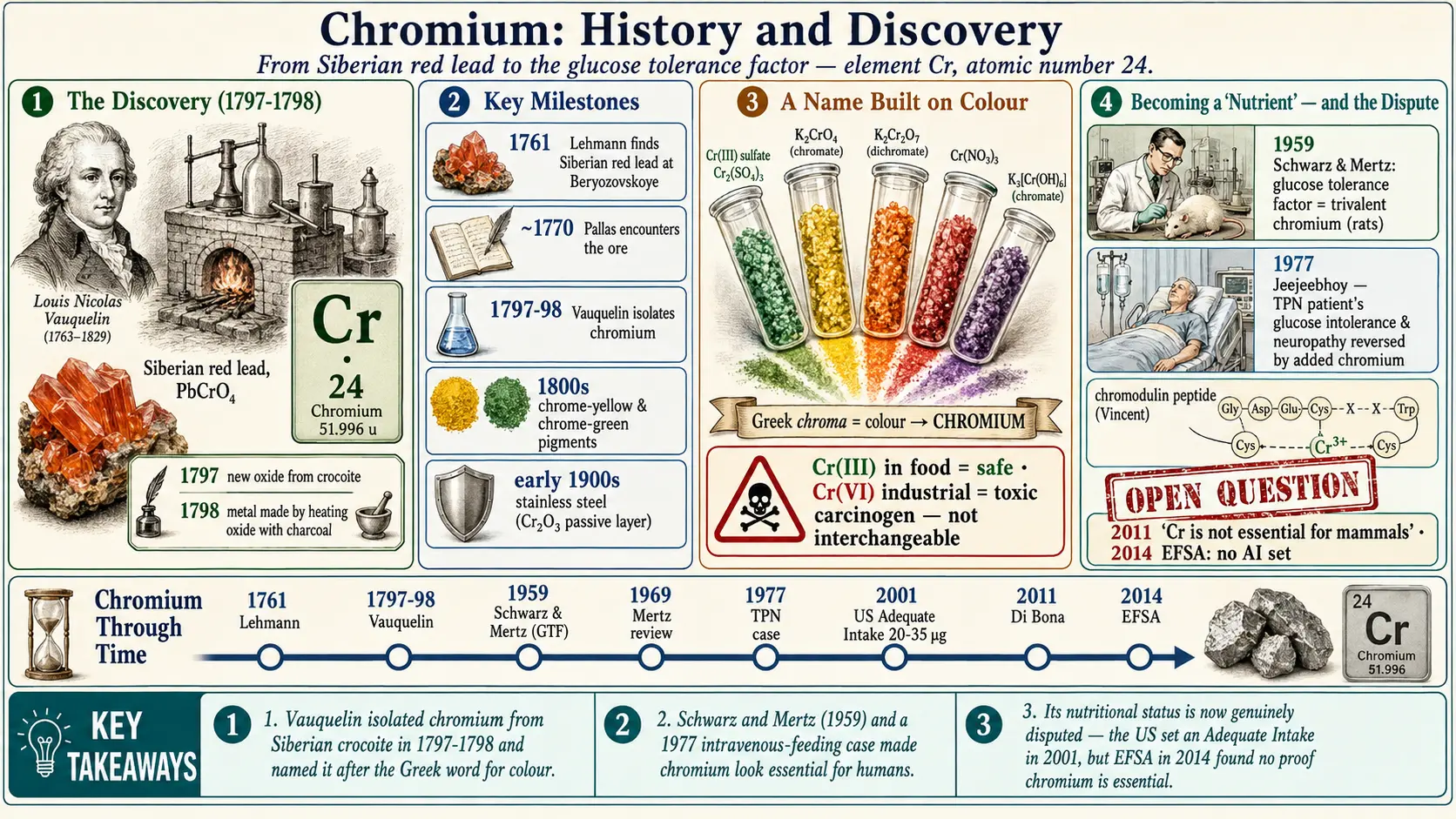
Chromium has two quite separate discovery stories, and it helps to keep them apart from the start. The first belongs to chemistry: in the late 1790s a French chemist named Louis Nicolas Vauquelin pulled a brand-new metallic element out of a brilliant orange-red Siberian mineral, and named it after the Greek word for "colour" because almost everything it formed was vividly coloured. The second story belongs to nutrition, and did not begin until the late 1950s, when Klaus Schwarz and Walter Mertz showed that a tiny amount of one form of chromium — the trivalent form — helped rats handle sugar normally. This article tells both stories honestly: who isolated the element and when, who proposed its role in the body and how that idea has held up, the famous hospital case that seemed to prove humans need it, and a real and ongoing scientific argument about whether chromium is an essential nutrient at all. Where the record is firm we say so; where a point is still debated, we say that too.
Table of Contents
- Before the Element: Siberian Red Lead
- Vauquelin Isolates Chromium (1797–1798)
- A Name Built on Colour
- From Pigments to Stainless Steel
- The Nutrition Story Begins: Schwarz and Mertz (1959)
- The Patient Who Seemed to Prove It (1977)
- Chromodulin and the Search for a Mechanism
- Is Chromium Really Essential? An Open Dispute
- Research Papers and References
- Connections
- Featured Videos
Before the Element: Siberian Red Lead
Long before anyone knew chromium existed, people were admiring a mineral that contained it. In the mid-eighteenth century a strikingly coloured ore was found in gold mines in the Ural Mountains of Siberia, near Yekaterinburg. It came in long, glassy crystals of an intense orange to scarlet-red colour, and it became known as Siberian red lead. We now call this mineral crocoite, and we know it is lead chromate (PbCrO₄) — a compound of lead, chromium, and oxygen — but at the time its makeup was a mystery.
The mineral drew the attention of the naturalists who were then cataloguing the Russian Empire's riches. The German mineralogist Johann Gottlob Lehmann first encountered the Siberian red lead at the Beryozovskoye mines in 1761, studied it, and published his formal description of it ("Nova minera Plumbi") in 1766; the German-born naturalist Peter Simon Pallas, leading a great scientific expedition across Siberia for the Russian academy, encountered the same ore around 1770. Its glorious colour made it valuable as a paint pigment, and crushed Siberian red lead found its way west into the hands of European chemists who wanted to know what it actually was. That curiosity is what eventually led to the element — the ore was the clue, and the chemists who chased the clue are the people in the next section.
One honest note about names: these early naturalists described and prized the mineral, but they did not isolate or identify the element chromium hidden inside it. The leap from "a beautiful red ore" to "a previously unknown metal" was a chemical one, and it was made by someone else.
Vauquelin Isolates Chromium (1797–1798)
The discovery of the element is firmly credited to the French chemist and pharmacist Louis Nicolas Vauquelin (1763–1829). Working with a sample of the Siberian red lead, Vauquelin set about taking it apart chemically. He treated the powdered mineral so as to separate out the lead, and was left with a new substance — an oxide of an element that no one had named before. In 1797 he reported this new "earth" (oxide), and in 1798 he went a step further, heating the oxide with charcoal in a furnace to drive off the oxygen and produce, for the first time, a sample of the metal itself. This is why reference sources commonly date the discovery of the oxide to 1797 and the preparation of metallic chromium to 1798.
Vauquelin was one of the most productive chemists of his era, and chromium was not his only contribution to the periodic table's early history — he is also credited with the discovery of the element beryllium, which he identified in the gemstone beryl at almost the same time. (As an aside that connects to other parts of this site, Vauquelin and a collaborator are also credited with first isolating the amino acid asparagine, an early milestone in biochemistry.) For chromium, though, the essential fact is simple and well documented: a single chemist, working with a single remarkable Siberian ore in the closing years of the eighteenth century, recognised and isolated a genuinely new element.
It is worth flagging a tiny, harmless inconsistency you may notice in the sources: his given names are written both as "Louis Nicolas" and "Nicolas-Louis." This is just a quirk of how his name has been recorded over two centuries, not a dispute about who he was or what he did.
A Name Built on Colour
The name chromium comes from the Greek word chrōma (χρῶμα), meaning "colour." The choice was deliberate and apt: Vauquelin and his contemporaries were struck by how many of chromium's compounds were brilliantly and variously coloured. Chromium salts and oxides can be green, yellow, orange, red, and violet, and this riot of colour is the most immediately obvious thing about the element's chemistry. Naming it after colour itself was a fitting tribute to the very property that had drawn attention to the Siberian ore in the first place.
That colourful chemistry is not just a historical curiosity — it is the same chemistry that gives many familiar things their colour today, from the green of certain glasses and glazes to the deep red of natural and synthetic rubies (where traces of chromium colour the otherwise colourless crystal). The Greek root also turns up in everyday English words such as "chromatic" and "monochrome," all sharing the same idea of colour. When you read the element's name, in other words, you are reading the first thing anyone noticed about it.
From Pigments to Stainless Steel
For more than a century after Vauquelin, chromium's story was an industrial one, with no hint that it had anything to do with the human body. Its first major use followed directly from the property it was named for: colour. Chromium compounds became the basis of important pigments — the bright "chrome yellow" (a lead chromate) and "chrome green" among them — that were prized by painters and manufacturers in the nineteenth century. The element that had been found in a coloured ore went straight back into the business of colour.
Chromium's second great industrial chapter is the one most people unknowingly rely on every day: stainless steel. Adding chromium to steel, generally above roughly a tenth of the alloy by weight, causes a thin, invisible, self-repairing layer of chromium oxide to form on the surface, which protects the metal underneath from rust and corrosion. The development of practical stainless steels in the early twentieth century transformed cutlery, kitchens, surgical instruments, and industry. Chromium is also what gives shiny "chrome" plating its name and its mirror finish, and chromium compounds are central to leather tanning. None of this is nutrition — but it explains why chromium became a household word long before anyone asked whether we need to eat it, and it sets up the sharp turn the story takes next.
A necessary word of caution belongs here, because it shaped the nutrition debate too. Chromium exists in more than one chemical form, and they are emphatically not interchangeable. The trivalent form, chromium(III) or Cr³⁺, is the form found in food and discussed in the nutrition story below. The hexavalent form, chromium(VI) or Cr⁶⁺, used in some industrial processes, is a recognised toxin and carcinogen with no nutritional role whatsoever. Keeping these two apart is essential to understanding everything that follows.
The Nutrition Story Begins: Schwarz and Mertz (1959)
Chromium's second, entirely separate discovery story began roughly a century and a half after Vauquelin, and it has a much more contested ending. In the mid-1950s, two researchers — Klaus Schwarz and Walter Mertz (1923–2002) — were studying rats fed a restricted, purified diet based on Torula yeast. The rats developed an impaired ability to clear sugar from the blood, and Schwarz and Mertz set out to find the missing dietary factor responsible. They called the active ingredient the glucose tolerance factor (GTF).
In 1959 they published the key result: the active part of this glucose tolerance factor was an organic compound containing trivalent chromium. Their paper, "Chromium(III) and the glucose tolerance factor," appeared in the journal Archives of Biochemistry and Biophysics. This was the moment chromium crossed over from being a purely industrial metal to a candidate nutrient — the first suggestion that this colourful element might have a job to do in living tissue, specifically in helping the hormone insulin do its work.
Mertz spent much of the following decades developing the case for chromium as a biologically important trace element, and his 1969 review in Physiological Reviews, "Chromium occurrence and function in biological systems," became the standard summary of the field for a generation. The broad picture he advanced — that trivalent chromium somehow potentiates the action of insulin — is the idea that the main Chromium page describes in modern molecular detail. It is important to be clear, though, about what the 1959 work did and did not establish: it showed an effect in a specific, artificially deprived rat model, and proposed that chromium was the responsible factor. Turning that proposal into a settled fact about human nutrition proved to be a long and, as the final section shows, still-unfinished task.
The Patient Who Seemed to Prove It (1977)
The single most influential piece of evidence that humans actually need chromium came not from a laboratory rat but from a hospital bed. In 1977, a team led by Khursheed N. Jeejeebhoy published a now-famous case report in the American Journal of Clinical Nutrition. It described a woman who had been kept alive for years on total parenteral nutrition — that is, fed entirely through a vein, bypassing the gut, with a formula that happened to contain essentially no chromium.
After several years on this chromium-free feeding, she developed problems that puzzled her doctors: unexplained weight loss, a disturbance of nerve function (peripheral neuropathy), and a glucose intolerance so severe that insulin could no longer control it properly. The striking part is what happened next. When chromium was added to her intravenous feeding, her glucose handling returned to normal, her need for insulin fell away, and her nerve symptoms and general well-being recovered. Because the only thing that had been corrected was the chromium deficit, this looked like a clean human demonstration that chromium is an essential nutrient — deprivation caused disease, repletion cured it.
This case, and a small number of similar reports in other long-term intravenous-feeding patients, became the cornerstone of the argument that chromium is essential, and it is the reason chromium was added to intravenous nutrition formulas thereafter. It is genuinely powerful evidence. But a handful of unusual clinical cases, however dramatic, are not the same as proof that the wider population needs supplemental chromium — and as the next decades showed, even this cornerstone came to be questioned.
Chromodulin and the Search for a Mechanism
If chromium really helped insulin work, scientists wanted to know how — what molecule in the body actually used the chromium. The pursuit of an answer ran from the 1980s into the 2000s. A chromium-binding substance of low molecular weight was first reported from animal tissue by a Japanese toxicology group led by Osamu Wada around 1981. Over the following years, the chemist John B. Vincent and his colleagues at the University of Alabama characterised this material in detail, describing a small, acidic oligopeptide — rich in the amino acids glutamate and aspartate — that binds several chromium ions. They gave it the name chromodulin (it is also called low-molecular-weight chromium-binding substance, or LMWCr).
Vincent's group proposed an elegant model, the one summarised on the main Chromium page: when insulin signals, chromium is delivered to cells bound to the iron-transport protein transferrin, loaded onto chromodulin, and the chromium-loaded chromodulin then binds to the activated insulin receptor and amplifies its signal. This gave the long-standing "chromium potentiates insulin" idea a concrete molecular character for the first time. Much of this work was published in mainstream biochemistry journals through the 1990s and 2000s, and chromodulin remains the leading candidate for chromium's proposed biological role.
Here honesty requires a careful line. That chromodulin exists, binds chromium, and can affect insulin-receptor activity in laboratory systems is well supported. Whether this amounts to chromium being a required nutrient — one that ordinary people must obtain from the diet to stay healthy — is a different and harder question, and it is precisely the question that drove the dispute described next. Strikingly, the same John Vincent who did so much to characterise chromodulin became one of the leading voices arguing that chromium may not be essential after all.
Is Chromium Really Essential? An Open Dispute
For decades after Schwarz and Mertz, chromium was widely listed as an essential trace element, and in 2001 the U.S. Food and Nutrition Board set an Adequate Intake for it — on the order of 20 to 35 micrograms a day for adults, depending on age and sex. Notably, the board could only set an "Adequate Intake" rather than a full Recommended Dietary Allowance, precisely because the data on how much people actually require were too thin to pin down a hard requirement. That caveat turned out to be a sign of trouble to come.
In 2011, a study from John Vincent's laboratory (Di Bona and colleagues) raised a serious challenge with the provocative title "Chromium is not an essential trace element for mammals." Feeding rats highly controlled diets with very different chromium levels under scrupulously metal-free conditions, the researchers found that even a markedly low-chromium diet did not produce the deficiency effects the older theory predicted. Then in 2014, the European Food Safety Authority reviewed the evidence and reached a blunt conclusion: it could not set even an Adequate Intake for chromium, because there was no convincing evidence that chromium is essential for humans at any level of intake. In short, two respected scientific bodies now disagree — the U.S. position has historically treated chromium as essential, while the European authority concluded it is not.
So the honest state of the story is this. Chromium's chemical discovery by Vauquelin is settled history. Its nutritional status is not. The trivalent form is clearly not toxic in the amounts found in food, the chromodulin mechanism is real and interesting, and a few intravenous-feeding cases remain genuinely suggestive — but whether chromium is a true dietary essential is, at the time of writing, an open scientific question rather than a closed one. Anyone who tells you flatly that "you need chromium" or, just as flatly, that "chromium does nothing" is overstating what the evidence supports. The detailed evidence on chromium supplements and metabolic health — what trials actually show for blood sugar, insulin sensitivity, and the rest — is covered on the main Chromium page and in the Chromium Benefits articles; this history is concerned only with how the science arrived at today's genuine uncertainty.
Research Papers and References
The list below gathers the primary, historically important papers in chromium's nutritional story together with curated PubMed topic-search links and authoritative reference pages. The eighteenth-century chemistry of Vauquelin, Lehmann, and Pallas is described in the article as historical record rather than as modern citations. Author names, titles, and journals are given as plain text; only the stable DOI, PMID, or archive link is hyperlinked, and each opens in a new tab.
- Schwarz K, Mertz W. Chromium(III) and the glucose tolerance factor. Archives of Biochemistry and Biophysics. 1959;85:292-295. — Search PubMed · doi:10.1016/0003-9861(59)90479-5
- Mertz W. Chromium occurrence and function in biological systems. Physiological Reviews. 1969;49(2):163-239. — PMID: 4888391 · doi:10.1152/physrev.1969.49.2.163
- Jeejeebhoy KN, Chu RC, Marliss EB, Greenberg GR, Bruce-Robertson A. Chromium deficiency, glucose intolerance, and neuropathy reversed by chromium supplementation, in a patient receiving long-term total parenteral nutrition. American Journal of Clinical Nutrition. 1977;30(4):531-538. — PMID: 192066 · doi:10.1093/ajcn/30.4.531
- Hatfield MJ, Gillespie S, Chen Y, Li Z, Cassady CJ, Vincent JB. Low-molecular-weight chromium-binding substance from chicken liver and American alligator liver. Comparative Biochemistry and Physiology Part B. 2006;144(4):423-431. — PMID: 16815060 · doi:10.1016/j.cbpb.2006.04.012
- Di Bona KR, Love S, Rhodes NR, et al. Chromium is not an essential trace element for mammals: effects of a "low-chromium" diet. Journal of Biological Inorganic Chemistry. 2011;16(3):381-390. — PMID: 21086001 · doi:10.1007/s00775-010-0734-y
- EFSA Panel on Dietetic Products, Nutrition and Allergies (NDA). Scientific Opinion on Dietary Reference Values for chromium. EFSA Journal. 2014;12(10):3845. — doi:10.2903/j.efsa.2014.3845
- Chromium — history, discovery, and nutritional role PubMed: chromium and the glucose tolerance factor
- Chromodulin and chromium essentiality — the modern debate PubMed: chromodulin and chromium essentiality
External Authoritative Resources
- NIH Office of Dietary Supplements — Chromium
- Linus Pauling Institute — Chromium
- PubMed — chromium, nutrition, and insulin