Mammogram
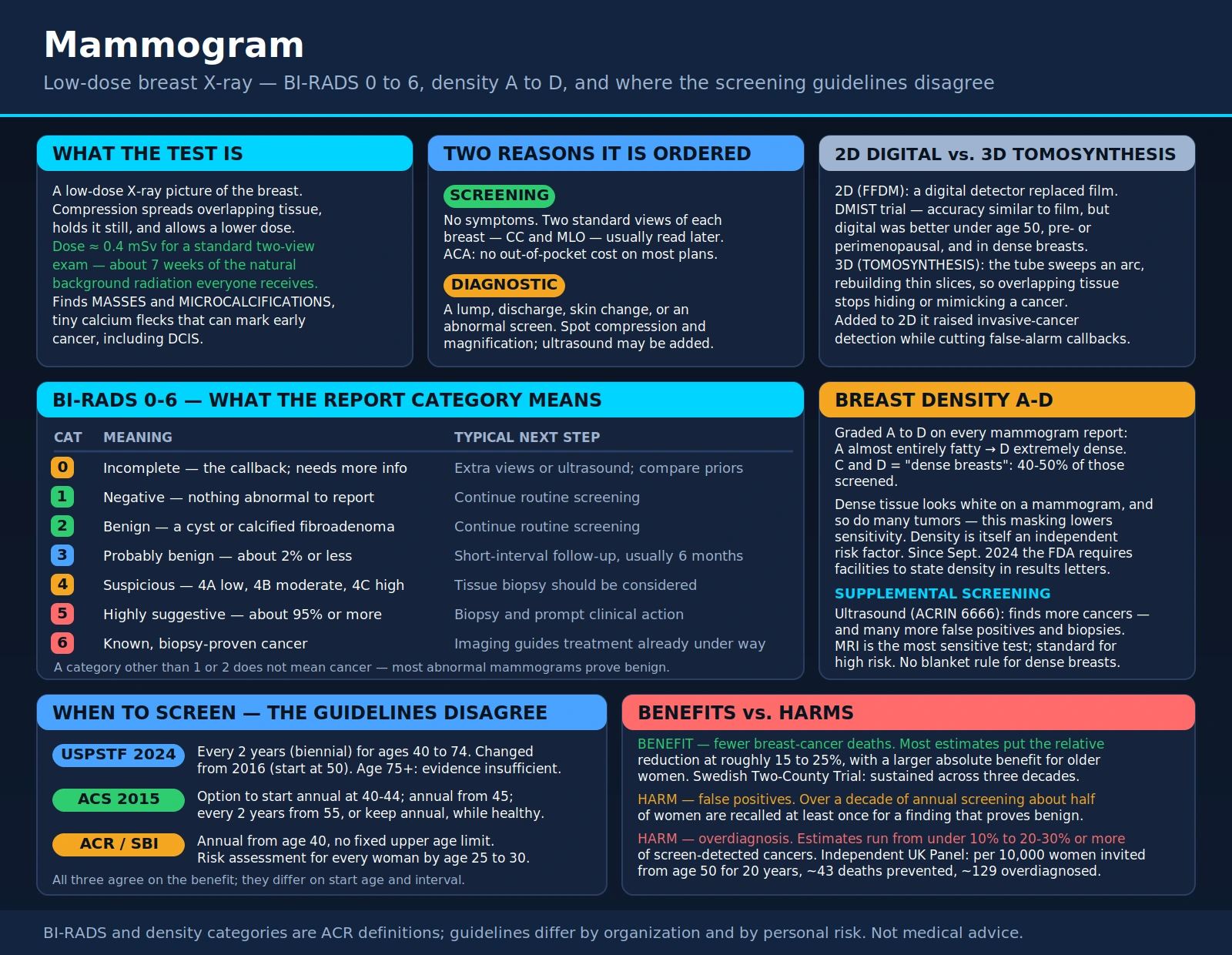
A mammogram is a low-dose X-ray picture of the breast, and it remains the single most studied and most widely used tool for finding breast cancer early — often years before a lump can be felt. For most women, a screening mammogram is a routine, quick appointment; for others it is the first step in following up a symptom or an earlier finding. This page explains what the test is, the different types available today, how the major medical organizations differ on when to start and how often to repeat it, what your results mean, and — honestly — both what mammography can do and where its limits lie. The goal is not to tell you what to decide, but to help you have a genuinely informed conversation with your own doctor.
Table of Contents
- What Is a Mammogram?
- Screening vs. Diagnostic Mammograms
- Types: 2D Digital vs. 3D Tomosynthesis
- Who Should Get One, and When (USPSTF, ACS, ACR)
- What to Expect and How to Prepare
- Understanding Your Results: BI-RADS Categories
- Dense Breasts and Supplemental Screening
- Benefits vs. Harms: An Honest Look
- Cost and Access
- Questions to Discuss With Your Doctor
- Key Research Papers
- Connections
- Featured Videos
What Is a Mammogram?
A mammogram is an X-ray image of the internal tissue of the breast, taken with a machine designed specifically for that purpose. During the exam, each breast is placed on a flat platform and gently compressed with a paddle for a few seconds while the image is captured. That compression does three useful things: it spreads overlapping tissue apart so small abnormalities are easier to see, it holds the breast still to prevent blur, and it lets the machine use a lower radiation dose to get a clear picture.
The dose is small. A standard screening mammogram — two views of each breast — delivers roughly 0.4 millisieverts (mSv) of radiation, comparable to about seven weeks of the natural background radiation everyone receives from the environment. For the overwhelming majority of women, the benefit of finding a cancer early far outweighs the very small theoretical risk from this exposure.
Mammograms detect breast cancer in two main ways. They can reveal a mass — a dense area with a shape or edges that look suspicious — and they can reveal microcalcifications, which are tiny flecks of calcium that sometimes cluster in a pattern associated with early cancer, including ductal carcinoma in situ (DCIS). Because these calcifications can appear before any lump forms, mammography can catch some cancers at a very early, highly treatable stage.
Screening vs. Diagnostic Mammograms
There are two distinct reasons a mammogram is ordered, and the difference matters — both clinically and for what you may pay.
A screening mammogram is performed on a woman with no breast symptoms. It is a routine check aimed at catching cancer before it produces any signs. A screening study uses a standard set of images — typically two views of each breast, one from top to bottom (the craniocaudal, or CC, view) and one angled from the side (the mediolateral oblique, or MLO, view). The images are usually read later by a radiologist, and results are mailed or posted to your patient portal.
A diagnostic mammogram is performed when there is a reason to look more closely: a lump you or your doctor felt, nipple discharge, skin thickening or dimpling, breast pain in one spot, or an abnormal or unclear screening result. Diagnostic studies use additional and more focused images — spot compression to press on a specific area, and magnification views to examine calcifications in detail. A radiologist often reviews the images while you are still there and may add breast ultrasound. Because a diagnostic mammogram is a workup rather than routine screening, it is frequently billed differently, which is an important point covered in the Cost and Access section.
Types: 2D Digital vs. 3D Tomosynthesis
Mammography technology has advanced considerably over the past two decades.
Film and Full-Field Digital Mammography (2D)
The oldest systems recorded images on X-ray film. These have been almost entirely replaced in the United States by full-field digital mammography (FFDM), in which a digital detector captures the image so it can be stored, enhanced, and magnified on a computer. The large DMIST trial found that digital and film mammography had similar overall accuracy, but digital was meaningfully better for three important groups: women under 50, women who were pre- or perimenopausal, and women with dense breasts.
Digital Breast Tomosynthesis (3D)
Tomosynthesis, often marketed as "3D mammography," takes the technology a step further. Instead of a single flat picture, the X-ray tube sweeps in a short arc and captures multiple low-dose images that a computer reconstructs into thin, stacked slices of the breast. This helps solve one of 2D mammography's biggest weaknesses: normal overlapping tissue that can either hide a real cancer or mimic one that is not there.
In a large U.S. study, adding tomosynthesis to standard digital mammography increased the detection of invasive cancers while reducing the number of women called back for a false alarm. Tomosynthesis has become the standard of care at many centers. When 3D is combined with a traditional 2D acquisition, the radiation dose is somewhat higher, but modern systems can generate a "synthesized" 2D image from the 3D data, keeping the total dose close to that of conventional mammography.
Who Should Get One, and When (USPSTF, ACS, ACR)
This is the area where women are most often confused, because the leading expert bodies genuinely disagree on the details. They agree on the big picture — regular screening reduces breast cancer deaths for average-risk women — but they differ on the best starting age and interval. None of these groups is "wrong"; they simply weigh the same evidence, and the tradeoff between finding more cancers and generating more false alarms, differently. Here is where each stands for women at average risk.
U.S. Preventive Services Task Force (USPSTF), 2024
The USPSTF is an independent panel of experts whose recommendations shape insurance coverage in the U.S. In its 2024 update, the Task Force recommends screening mammography every two years (biennial) for women aged 40 to 74. This was a notable change from its 2016 guidance, which had set the routine start age at 50 and framed screening in the 40s as an individual choice. For women 75 and older, the USPSTF says current evidence is insufficient to recommend for or against screening.
American Cancer Society (ACS), 2015
The ACS recommends that women at average risk:
- Have the option to begin annual screening at ages 40 to 44.
- Begin annual screening at age 45.
- Transition to every two years at age 55, or continue annually if they prefer.
- Continue screening as long as they are in good health and expected to live at least 10 more years.
American College of Radiology (ACR) and Society of Breast Imaging
The ACR takes the most intensive position, recommending annual screening beginning at age 40 for women of average risk, with no fixed upper age limit as long as a woman is in good health. The ACR also recommends that all women have a formal breast-cancer risk assessment by around age 25 to 30, so that those found to be at higher-than-average risk can start earlier and add supplemental imaging.
Putting the differences in plain terms
The practical disagreement comes down to two questions. On starting age, all three now include age 40, though the ACS treats the early 40s as optional. On interval, the split is real: the USPSTF favors every two years, while the ACR favors every year, and the ACS lands in between. Annual screening detects some cancers a bit sooner but produces more false-positive recalls over time; biennial screening reduces those false alarms at the cost of a slightly longer window between exams. There is no single correct answer for every woman — which is exactly why this is a decision to make with your doctor, informed by your own values and history.
Women at higher-than-average risk
Everything above applies to average-risk women. Those at elevated risk — for example, a known BRCA1 or BRCA2 mutation, a strong family history, prior chest radiation therapy in youth, or a personal history of certain high-risk breast lesions — are generally advised to start earlier and to add supplemental screening, most often annual breast MRI alongside mammography. If you have a first-degree relative with breast cancer or other risk factors, ask your doctor about a formal risk assessment and whether genetic counseling is appropriate.
What to Expect and How to Prepare
A screening mammogram is a short appointment, usually about 20 minutes from check-in to finish. A few simple steps make it go more smoothly:
- Timing: If you still menstruate, try to schedule the exam for the week after your period, when breasts tend to be less tender.
- Skip the products: On the day of the exam, do not wear deodorant, antiperspirant, powder, lotion, or perfume on your chest or underarms. Some of these contain particles that can show up on the image and be mistaken for calcifications.
- Dress in two pieces: You will undress from the waist up, so a separate top and bottom is more comfortable than a dress.
- Bring your history: If you are going to a new facility, bring or arrange to send your prior mammogram images and reports. Comparing this year's images with last year's is one of the most valuable things a radiologist can do.
- Speak up: Tell the technologist if you might be pregnant, are breastfeeding, have breast implants, or have any symptoms. Implants require extra "displacement" views to see the tissue around them.
During the exam, a technologist will position one breast at a time on the machine and compress it for several seconds while each image is taken. The pressure can feel tight and briefly uncomfortable, but it should not be truly painful; tell the technologist if it is, as positioning can often be adjusted. The compression lasts only moments, and you can breathe normally between views.
Understanding Your Results: BI-RADS Categories
Radiologists summarize mammogram findings using a standardized scale called BI-RADS — the Breast Imaging Reporting and Data System, developed by the American College of Radiology. Every report is assigned a single category from 0 to 6, which tells you and your doctor what the finding means and what should happen next. Receiving a category other than 1 or 2 does not mean you have cancer; most abnormal mammograms turn out to be benign.
| BI-RADS | Meaning | Typical Next Step |
|---|---|---|
| 0 | Incomplete — more information is needed | Additional imaging (extra views or ultrasound), or comparison with prior mammograms |
| 1 | Negative — nothing abnormal to report | Continue routine screening |
| 2 | Benign — a clearly non-cancerous finding (such as a cyst or calcified fibroadenoma) | Continue routine screening |
| 3 | Probably benign — very low chance of cancer (about 2% or less) | Short-interval follow-up imaging, usually in 6 months |
| 4 | Suspicious — may be subdivided 4A (low), 4B (moderate), 4C (high) | Tissue biopsy should be considered |
| 5 | Highly suggestive of cancer (about 95% likelihood or more) | Biopsy and prompt clinical action |
| 6 | Known, biopsy-proven cancer | Imaging used to guide treatment already underway |
A common source of anxiety is the callback, which corresponds to a BI-RADS 0. Being recalled after a screening mammogram is fairly common and usually just means the radiologist wants a clearer look at something. The large majority of callbacks end with a benign result and a return to routine screening.
Dense Breasts and Supplemental Screening
Breast density describes how much of the breast is made up of fibrous and glandular tissue versus fat, as seen on a mammogram. Radiologists grade it in four categories, from almost entirely fatty (A) to extremely dense (D). Women in the two densest categories (C and D) are said to have "dense breasts," and this describes roughly 40 to 50 percent of women who are screened.
Density matters for two reasons. First, dense tissue appears white on a mammogram — and so do many tumors. This "masking" effect makes cancers harder to see and lowers the sensitivity of mammography in dense breasts. Second, higher breast density is itself an independent risk factor for developing breast cancer. As of September 2024, the U.S. Food and Drug Administration requires all mammography facilities to include breast-density information in the results letter women receive, so more women now learn their density directly.
If you have dense breasts, your doctor may discuss supplemental screening in addition to mammography:
- Whole-breast ultrasound can find additional cancers that mammography misses in dense tissue. A large trial (ACRIN 6666) confirmed that adding ultrasound increases cancer detection — but it also substantially increases false positives and benign biopsies.
- Breast MRI is the most sensitive test available. It is the standard supplemental test for women at high risk, and there is growing evidence supporting its use in some women with extremely dense breasts. MRI, too, detects more cancers at the cost of more false alarms.
There is not yet a universal recommendation that every woman with dense breasts add these tests. The right choice depends on your overall risk, your density category, cost and coverage, and your own tolerance for the extra follow-up that supplemental screening tends to generate. This is a conversation worth having with your doctor rather than a decision to make alone.
Benefits vs. Harms: An Honest Look
Screening mammography is genuinely valuable, and it also has real downsides. A balanced picture requires holding both truths at once.
The benefits
The core benefit is a reduction in deaths from breast cancer. Randomized trials and long-term observational studies consistently show that inviting women to screening lowers breast cancer mortality, with most estimates of the relative reduction falling in the range of roughly 15 to 25 percent, and larger absolute benefits for older women, who have a higher baseline risk. The Swedish Two-County Trial, one of the longest-running studies, documented a sustained mortality reduction across three decades of follow-up. Finding cancer earlier can also allow less extensive surgery and, in some cases, avoidance of chemotherapy.
The harms
The most common harm is the false positive: an abnormal result that turns out, after more imaging or a biopsy, not to be cancer. Over a decade of screening, roughly half of women screened annually will be called back at least once for a finding that proves benign, and a smaller share will undergo a benign biopsy. Screening every two years reduces the cumulative number of these false alarms compared with annual screening — one of the tradeoffs behind the differing guidelines above.
The more subtle harm is overdiagnosis: the detection of a cancer — often DCIS — that would never have grown enough to cause symptoms or shorten a woman's life, yet is treated as if it would. Because we cannot yet reliably tell which early cancers are destined to progress, overdiagnosis leads to overtreatment, including surgery, radiation, or hormone therapy that a woman did not actually need. Estimates of how often this happens vary widely and remain genuinely debated, from under 10 percent of screen-detected cancers in some analyses to 20 to 30 percent or more in others. The 25-year follow-up of the Canadian National Breast Screening Study, an influential and much-debated trial, found no reduction in mortality from adding mammography to physical exam and estimated meaningful overdiagnosis, while other analyses attribute much of screening's apparent benefit to improvements in treatment.
One widely cited attempt to put both sides on the same scale comes from the Independent UK Panel. It estimated that for every 10,000 women in the UK invited to screening from age 50 for 20 years, about 43 breast cancer deaths would be prevented and about 129 cases of cancer would be overdiagnosed. Reasonable experts read numbers like these differently — some emphasize the lives saved, others the women overtreated — which is precisely why an informed, personal decision matters more than a one-size-fits-all rule. Smaller harms include the very low radiation exposure and the anxiety that a callback can cause.
Cost and Access
Cost should rarely be a barrier to a routine screening mammogram in the United States. Under the Affordable Care Act (ACA), most private health plans and Medicare are required to cover screening mammograms with no out-of-pocket cost — no copay, coinsurance, or deductible — for women in the recommended age groups. Medicare covers an annual screening mammogram for women age 40 and older.
An important and often misunderstood distinction: this no-cost protection applies to screening mammograms. A diagnostic mammogram — done to evaluate a symptom or to follow up an abnormal screening — may involve a copay or count toward your deductible, and the same is often true of supplemental ultrasound or MRI for dense breasts. A growing number of states have passed laws to eliminate or reduce cost-sharing for diagnostic and supplemental breast imaging, so coverage varies by where you live and by your specific plan. It is always reasonable to ask the facility in advance how a study will be billed.
For women who are uninsured or underinsured, help exists. The Centers for Disease Control and Prevention runs the National Breast and Cervical Cancer Early Detection Program (NBCCEDP), which provides free or low-cost mammograms and follow-up to eligible low-income women. Federally qualified community health centers, hospital charity-care programs, mobile mammography units, and nonprofit organizations such as Susan G. Komen also offer screening at reduced or no cost.
Questions to Discuss With Your Doctor
Because the guidelines differ and the benefit-and-harm tradeoff is personal, the most useful thing you can do is come to your visit with questions. Consider asking:
- Given my age, family history, and health, when should I start screening, and how often?
- Am I at average or higher-than-average risk — and should I have a formal risk assessment or genetic counseling?
- What is my breast density, and does it change what screening you would recommend?
- Would I benefit from supplemental ultrasound or MRI, and would my insurance cover it?
- Is 3D tomosynthesis available here, and is it right for me?
- What are the specific benefits and harms of screening for someone my age?
- If I am uninsured, where can I get a low-cost or free mammogram?
A mammogram is a tool, not a verdict. Used thoughtfully, and understood clearly, it can catch breast cancer at its most treatable stage while you stay in control of the decisions that are right for you.
Key Research Papers
The citations below are peer-reviewed sources for the guidelines, technologies, and benefit-and-harm estimates discussed above. Journal names are shown as plain text; the linked portion opens the article record via its DOI.
- US Preventive Services Task Force. Screening for breast cancer: US Preventive Services Task Force recommendation statement. JAMA. 2024;331(22):1918-1930.
- Siu AL; US Preventive Services Task Force. Screening for breast cancer: US Preventive Services Task Force recommendation statement. Annals of Internal Medicine. 2016;164(4):279-296.
- Nelson HD, Fu R, Cantor A, et al. Harms of breast cancer screening: systematic review to update the 2009 US Preventive Services Task Force recommendation. Annals of Internal Medicine. 2016;164(4):256-267.
- Oeffinger KC, Fontham ETH, Etzioni R, et al. Breast cancer screening for women at average risk: 2015 guideline update from the American Cancer Society. JAMA. 2015;314(15):1599-1614.
- Monticciolo DL, Malak SF, Friedewald SM, et al. Breast cancer screening recommendations inclusive of all women at average risk: update from the ACR and Society of Breast Imaging. Journal of the American College of Radiology. 2021;18(9):1280-1288.
- Pisano ED, Gatsonis C, Hendrick E, et al. Diagnostic performance of digital versus film mammography for breast-cancer screening. New England Journal of Medicine. 2005;353(17):1773-1783.
- Friedewald SM, Rafferty EA, Rose SL, et al. Breast cancer screening using tomosynthesis in combination with digital mammography. JAMA. 2014;311(24):2499-2507.
- Independent UK Panel on Breast Cancer Screening (Marmot MG, Altman DG, Cameron DA, et al.) The benefits and harms of breast cancer screening: an independent review. The Lancet. 2012;380(9855):1778-1786.
- Miller AB, Wall C, Baines CJ, et al. Twenty five year follow-up for breast cancer incidence and mortality of the Canadian National Breast Screening Study: randomised screening trial. BMJ. 2014;348:g366.
- Welch HG, Prorok PC, O'Malley AJ, Kramer BS. Breast-cancer tumor size, overdiagnosis, and mammography screening effectiveness. New England Journal of Medicine. 2016;375(15):1438-1447.
- Berg WA, Zhang Z, Lehrer D, et al. Detection of breast cancer with addition of annual screening ultrasound or a single screening MRI to mammography in women with elevated breast cancer risk. JAMA. 2012;307(13):1394-1404.
- Tabar L, Vitak B, Chen TH, et al. Swedish Two-County Trial: impact of mammographic screening on breast cancer mortality during 3 decades. Radiology. 2011;260(3):658-663.
Live PubMed Searches
- Mammography screening and breast cancer mortality — PubMed
- Digital breast tomosynthesis screening — PubMed
- Breast cancer overdiagnosis and mammography — PubMed
- Dense breasts and supplemental screening — PubMed
- BI-RADS mammography outcomes — PubMed
- Mammography false-positive recall rate — PubMed
- Breast cancer screening guidelines and age — PubMed
Connections
- All Lab Tests
- Breast Cancer
- Cancer (Overview)
- Oncology — All Cancers
- PSA Test
- Full-Body MRI
- CA-125 Test
- Coronary Calcium Score
- Complete Blood Count (CBC)
- Colorectal Cancer
- Ovarian Cancer
- Cervical Cancer
- HRT Risks: Breast Cancer, Clots, and Stroke
- Iodine and Breast Health
- Hormone Panel