Complement (C3, C4, CH50)
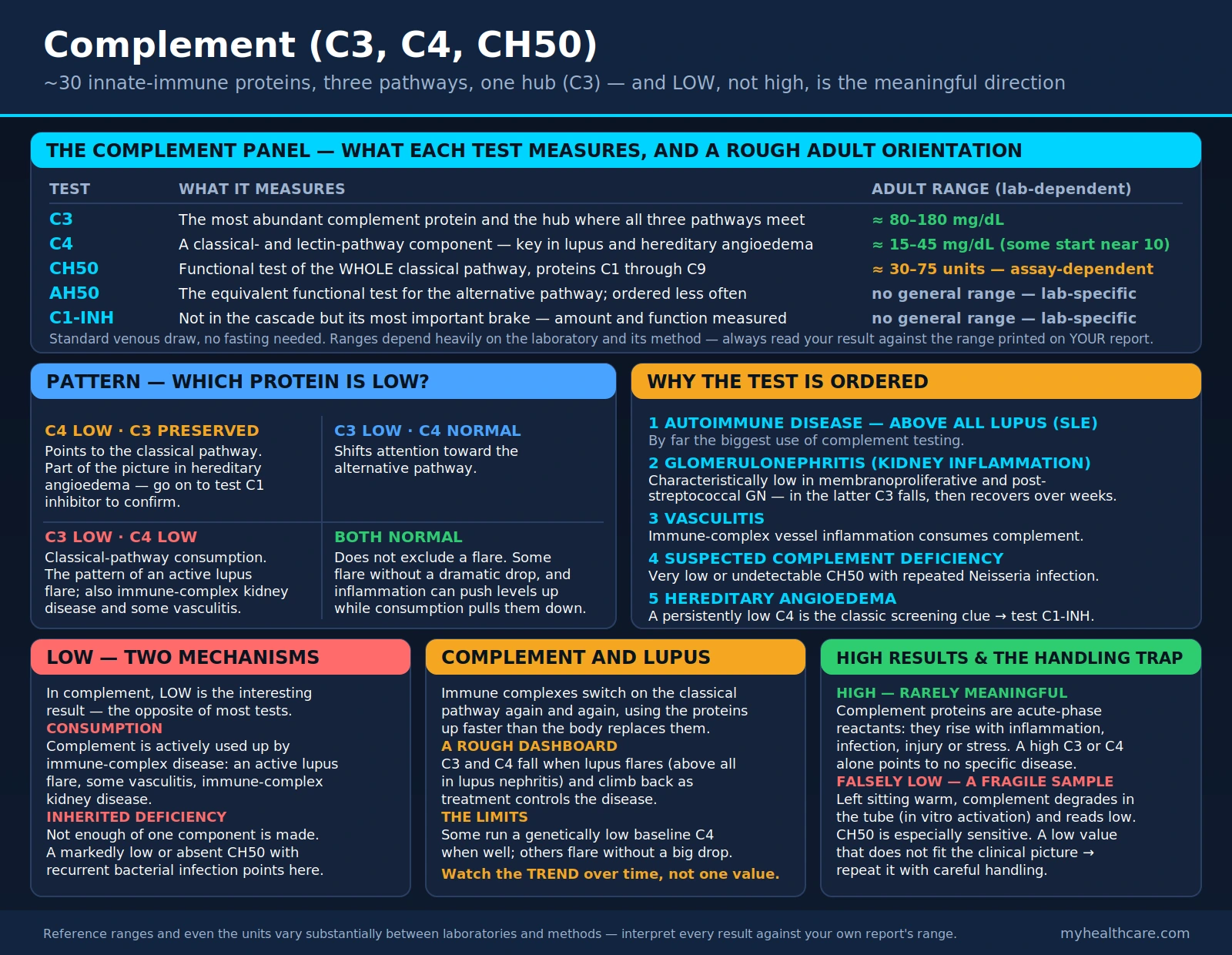
Complement tests measure a group of blood proteins that form one of the immune system's oldest defenses. The most commonly ordered are C3, C4, and a functional test called CH50 (sometimes written CH100), which checks whether the whole classical complement pathway is working. Doctors reach for these tests most often when they suspect an autoimmune disease — especially lupus, where the level of complement in the blood rises and falls in step with how active the disease is. They are also used to investigate certain kidney inflammations, some forms of vasculitis, unexplained recurrent infections, and a swelling condition called hereditary angioedema. This page explains, in plain language, what the complement system does, what each test looks at, why your doctor might order one, and how to make sense of a high or low result — including the quirk that these proteins are fragile and can read falsely low if the blood sample is not handled quickly.
Table of Contents
- What the Complement System Is
- What the Complement Tests Measure
- Why Complement Tests Are Ordered
- Complement and Lupus
- How to Interpret the Results
- Complement in Newer Contexts
- How the Test Is Done and Why Handling Matters
- Related Tests
- When to Talk to a Doctor
- Research Papers
- Connections
- Featured Videos
What the Complement System Is
The complement system is a cascade of roughly 30 proteins that circulate quietly in your blood, waiting. Together they are part of the innate immune system — the fast, built-in defense you are born with, as opposed to the slower, learned immunity of antibodies. The name comes from the early days of immunology, when scientists noticed these proteins "complemented" (helped) antibodies finish the job of killing microbes. More than a century later, we know they do far more than assist.
Complement has three main jobs, and it is easiest to remember them as three verbs:
- Tag — complement proteins coat the surface of bacteria and other invaders (a process called opsonization), marking them so that white blood cells recognize and swallow them.
- Alarm — small fragments released during the cascade (notably C3a and C5a) act as chemical distress signals, calling immune cells to the scene and driving inflammation.
- Punch — the final proteins assemble into a ring-shaped structure called the membrane attack complex (MAC), which bores holes in the outer wall of certain microbes so they leak and die.
These jobs can be switched on through three different starting routes, all of which funnel into the same central protein, C3:
The classical pathway
Triggered when antibodies latch onto a target and the complement protein C1 recognizes them. This is the antibody-linked route, and it is the one most relevant to autoimmune diseases like lupus, where antibody-based "immune complexes" set complement off.
The lectin pathway
Triggered when specialized proteins recognize sugar patterns on the surface of microbes — no antibody required. It works much like the classical pathway once it gets going.
The alternative pathway
Always simmering at a low level (a state called "tickover"), constantly probing surfaces. On your own healthy cells it is quickly shut down by protective proteins; on a foreign surface it amplifies rapidly. This built-in amplification is powerful, which is also why problems with the alternative pathway's brakes can cause serious disease.
What the Complement Tests Measure
"Complement testing" is not one test but a small family. Your doctor may order one piece or several, depending on the question:
- C3 — the most abundant complement protein and the hub where all three pathways meet. Because it sits at the center, a low C3 is a broad signal that complement is being heavily used up.
- C4 — a component of the classical and lectin pathways. C4 is particularly useful in lupus and is characteristically low in hereditary angioedema.
- CH50 (total hemolytic complement, also written CH100) — a functional test rather than a simple protein count. In the lab, your serum is mixed with antibody-coated red cells, and the technicians measure how well your complement can burst them. Because it depends on the whole classical pathway (proteins C1 through C9), a very low or zero CH50 is a red flag that one of those components may be missing or badly depleted.
- AH50 — the equivalent functional test for the alternative pathway, ordered less often and mainly when a specific deficiency is suspected.
- C1 inhibitor (C1-INH) — not a member of the cascade itself but its most important brake. It is measured (both the amount present and how well it works) when hereditary or acquired angioedema is suspected.
- Individual components — specific proteins such as C1q or C2 can be measured one at a time when a low CH50 points to a particular missing piece.
Reference ranges depend heavily on the laboratory and the method it uses, so always read your result against the range printed on your report. As a rough orientation only, many adult labs report values in the neighborhood of:
- C3: approximately 80–180 mg/dL.
- C4: approximately 15–45 mg/dL (some labs start near 10).
- CH50: highly assay-dependent — often reported roughly in the range of 30–75 units, but the numbers and units vary so much between labs that a bare number means little without its own reference range.
Why Complement Tests Are Ordered
Complement is not part of a routine checkup. It is ordered when a specific clinical picture raises a specific question. The main reasons include:
- Suspected or known autoimmune disease — by far the biggest use, and especially systemic lupus erythematosus (SLE), covered in its own section below.
- Certain kidney inflammations (glomerulonephritis) — low complement helps distinguish some causes of kidney inflammation from others. It is characteristically low in membranoproliferative glomerulonephritis and in post-streptococcal glomerulonephritis, the kidney inflammation that can follow a strep throat or skin infection (in which C3 falls and then recovers over weeks).
- Some forms of vasculitis — blood-vessel inflammation driven by immune complexes can consume complement, so levels sometimes help sort out the cause.
- Suspected complement deficiency — a person with unusually frequent or severe bacterial infections, particularly repeated Neisseria infections such as meningococcal disease, may be missing a complement component. A very low or undetectable CH50 is the screening clue that sends the workup toward measuring individual proteins.
- Hereditary angioedema — a condition of recurrent, sometimes dangerous swelling of the face, limbs, gut, or airway. Here a persistently low C4 is the classic screening abnormality, prompting direct testing of C1 inhibitor to confirm the diagnosis.
Complement and Lupus
If there is one story that explains why complement testing exists in everyday medicine, it is lupus. In active lupus, the immune system forms clumps of antibodies bound to the body's own material — immune complexes. These complexes switch on the classical pathway again and again, and the complement proteins get used up faster than the body can replace them. The result is a measurable drop in C3 and C4 in the blood.
Because of this, C3 and C4 act as a rough dashboard for disease activity. When lupus flares — particularly when it inflames the kidneys (lupus nephritis) — C3 and C4 tend to fall, and as treatment brings the disease under control, they tend to climb back toward normal. Watching the trend over time, alongside symptoms and other tests, is often more informative than any single reading.
It is important to be honest about the limits, though. Complement levels are useful but imperfect markers. Some people run a genetically low baseline C4 even when well, so their "normal" is lower than the textbook range. Others can flare without a dramatic complement drop. Research looking closely at C3 and C4 as biomarkers of lupus kidney flares has found the relationship real but noisy — which is exactly why doctors interpret them in context rather than treating a number in isolation.
How to Interpret the Results
The single most useful thing to understand is that, in complement, low is usually the interesting result. That is the opposite of many other blood tests, where high values raise the most concern.
Low complement
A low C3, low C4, or low CH50 generally points to one of two situations:
- Consumption — the complement is being actively used up by immune-complex disease. This is the pattern in an active lupus flare, in some vasculitis, and in the immune-complex kidney diseases mentioned above. The proteins are being spent faster than they are made.
- Inherited deficiency — the person simply does not make enough of a particular component. A markedly low or absent CH50 in someone with recurrent bacterial infections points this way, and the follow-up is to measure individual proteins to find the missing piece.
The pattern of which proteins are low can itself be a clue. A low C4 with a relatively preserved C3, for example, is a hint toward the classical pathway and is part of the picture in hereditary angioedema, whereas a low C3 with normal C4 shifts attention toward the alternative pathway.
High complement
A high complement level is usually far less exciting. Complement proteins are acute-phase reactants, meaning they naturally rise during inflammation, infection, injury, or stress — much like other markers your body pushes up when it is fighting something. A high C3 or C4 by itself rarely points to a specific disease and is generally not treated as a meaningful finding on its own.
The acute-phase nuance worth knowing
Because complement rises with general inflammation, there is a subtle trap in someone with an inflammatory disease like lupus. If a flare is pushing complement down through consumption while inflammation is simultaneously pushing it up, the two effects can partly cancel out. A result that reads "normal" might actually be relatively low for that person at that moment. This is another reason clinicians favor tracking the trend and pairing complement with more specific tests rather than judging a lone value against a fixed range.
Complement in Newer Contexts
Over the past two decades, complement has moved from a niche lab test into the center of some remarkable treatments, and it is worth mentioning these honestly and briefly because patients increasingly encounter them.
- Paroxysmal nocturnal hemoglobinuria (PNH) — a rare blood disorder in which red cells lose their normal complement-protective coating and are destroyed by the complement system.
- Atypical hemolytic uremic syndrome (aHUS) — a rare, serious condition in which the alternative pathway's brakes fail and unrestrained complement damages small blood vessels, harming the kidneys and other organs.
Both are now treated with complement-blocking drugs — the first was eculizumab, later joined by longer-acting ravulizumab — which switch off the terminal part of the cascade. These medicines were genuine breakthroughs for conditions that were once often fatal. Because shutting down terminal complement leaves a person vulnerable to Neisseria (meningococcal) infection, meningococcal vaccination is required before starting them. These are highly specialized therapies managed by hematologists and nephrologists; complement measurements around them are part of specialist care rather than something to interpret at home.
How the Test Is Done and Why Handling Matters
From your side, the test could not be simpler: it is a standard blood draw from a vein in the arm, and no fasting or special preparation is needed. The complexity is all in the laboratory, and there is one practical point every patient should know.
Complement proteins are fragile. They begin to break down (a process called in vitro complement activation) if the blood sample is left sitting at warm temperatures before it is processed. When that happens, the proteins are degraded in the tube rather than in your body — and the result comes back falsely low. For this reason, laboratories that run complement tests spin the sample and separate or freeze the serum promptly, and functional tests like CH50 are especially sensitive to sloppy handling. If a complement result looks surprisingly low but does not fit the clinical picture, a mishandled specimen is one of the first things a good clinician will consider, and the simplest next step is often to repeat the test with careful handling.
The other practical point is that reference ranges and even the units vary substantially between laboratories and methods. A number that is "low" at one lab might sit inside the range at another. Always interpret your result against the reference range printed on your own report, and be cautious about comparing values drawn at different labs.
Related Tests
Complement is almost never interpreted alone. It is usually one instrument in a small orchestra of tests chosen to answer the same question:
- ANA and anti-dsDNA — the antinuclear antibody test and the more specific anti–double-stranded-DNA antibody are core lupus tests; anti-dsDNA levels and complement levels are often followed together as a pair.
- C1 inhibitor — measured directly (amount and function) when a low C4 raises the question of hereditary or acquired angioedema.
- ANCA — antineutrophil cytoplasmic antibodies help sort out particular forms of vasculitis.
- Inflammatory markers (CRP, ESR) — give a general sense of how much inflammation is present, which helps put a complement value in context.
- Urinalysis and kidney function tests — essential when immune-complex kidney disease or lupus nephritis is on the table.
- Complete blood count and haptoglobin — used when complement-driven destruction of red cells (as in PNH or aHUS) is being considered.
When to Talk to a Doctor
Complement tests are not screening tests you would order for yourself, and their results are genuinely difficult to interpret without the clinical story that prompted them. A low value can mean a flare of a known autoimmune disease, a brand-new diagnosis, an inherited deficiency, or simply a sample that sat too long on the way to the lab — and only your doctor, seeing the whole picture, can tell which.
Reach out to your clinician promptly if you have a diagnosis such as lupus and your complement levels are falling, if you have unexplained recurrent serious infections, or if you have episodes of unexplained swelling of the lips, face, hands, or throat, which can be an emergency if breathing is affected. If you are handed a complement result, useful questions to ask include: Why did you order this? What does my result mean in the context of my symptoms? Should it be repeated or tracked over time? What other tests go with it? Understanding that "low is the meaningful direction," that the proteins are fragile in the tube, and that trends matter more than single numbers will help you have a more informed conversation.
Research Papers
- Walport MJ. Complement. First of two parts. New England Journal of Medicine. 2001;344(14):1058–1066. doi:10.1056/NEJM200104053441406 — the classic, accessible overview of how the complement system is built and activated.
- Walport MJ. Complement. Second of two parts. New England Journal of Medicine. 2001;344(15):1140–1144. doi:10.1056/NEJM200104123441506 — companion review covering complement's role in disease, including autoimmunity and deficiency.
- Ricklin D, Hajishengallis G, Yang K, Lambris JD. Complement: a key system for immune surveillance and homeostasis. Nature Immunology. 2010;11(9):785–797. doi:10.1038/ni.1923 — a widely cited modern synthesis of complement's many roles beyond simple defense.
- Merle NS, Church SE, Fremeaux-Bacchi V, Roumenina LT. Complement System Part I — Molecular Mechanisms of Activation and Regulation. Frontiers in Immunology. 2015;6:262. doi:10.3389/fimmu.2015.00262 — a clear open-access walk-through of the three pathways and their brakes.
- Sturfelt G, Truedsson L. Complement in the immunopathogenesis of rheumatic disease. Nature Reviews Rheumatology. 2012;8(8):458–468. doi:10.1038/nrrheum.2012.75 — reviews why complement is consumed in lupus and other rheumatic conditions.
- Pickering MC, Botto M, Taylor PR, Lachmann PJ, Walport MJ. Systemic lupus erythematosus, complement deficiency, and apoptosis. Advances in Immunology. 2000;76:227–324. doi:10.1016/S0065-2776(01)76021-X — explains the paradox that inherited complement deficiency actually predisposes to lupus.
- Birmingham DJ, Irshaid F, Nagaraja HN, et al. The complex nature of serum C3 and C4 as biomarkers of lupus renal flare. Lupus. 2010;19(11):1272–1280. doi:10.1177/0961203310371154 — an honest look at how well (and how imperfectly) C3 and C4 track lupus kidney flares.
- Zuraw BL. Hereditary angioedema. New England Journal of Medicine. 2008;359(10):1027–1036. doi:10.1056/NEJMcp0803977 — clinical review of the condition in which low C4 and C1-inhibitor testing are central.
- Cicardi M, Zuraw BL. Angioedema due to bradykinin dysregulation. Journal of Allergy and Clinical Immunology: In Practice. 2018;6(4):1132–1141. doi:10.1016/j.jaip.2018.04.022 — connects the complement brake C1 inhibitor to the mechanism of angioedema.
- Hillmen P, Young NS, Schubert J, et al. The complement inhibitor eculizumab in paroxysmal nocturnal hemoglobinuria. New England Journal of Medicine. 2006;355(12):1233–1243. doi:10.1056/NEJMoa061648 — the trial that launched complement-blocking therapy for PNH.
- Legendre CM, Licht C, Muus P, et al. Terminal complement inhibitor eculizumab in atypical hemolytic-uremic syndrome. New England Journal of Medicine. 2013;368(23):2169–2181. doi:10.1056/NEJMoa1208981 — established complement blockade as treatment for aHUS.
- Ling M, Murali M. Analysis of the complement system in the clinical immunology laboratory. Clinics in Laboratory Medicine. 2019;39(4):579–590. doi:10.1016/j.cll.2019.07.006 — a practical guide to how C3, C4, and CH50 are measured and interpreted, including handling pitfalls.
Connections
- All Lab Tests
- ANA Test
- Inflammatory Markers
- hs-CRP
- ESR Test
- ANCA Test
- Rheumatoid Factor
- Urinalysis
- Kidney Function
- Complete Blood Count
- Haptoglobin
- Lupus (SLE)
- Vasculitis
- Immunology
- Rheumatology