Basic Metabolic Panel (BMP)
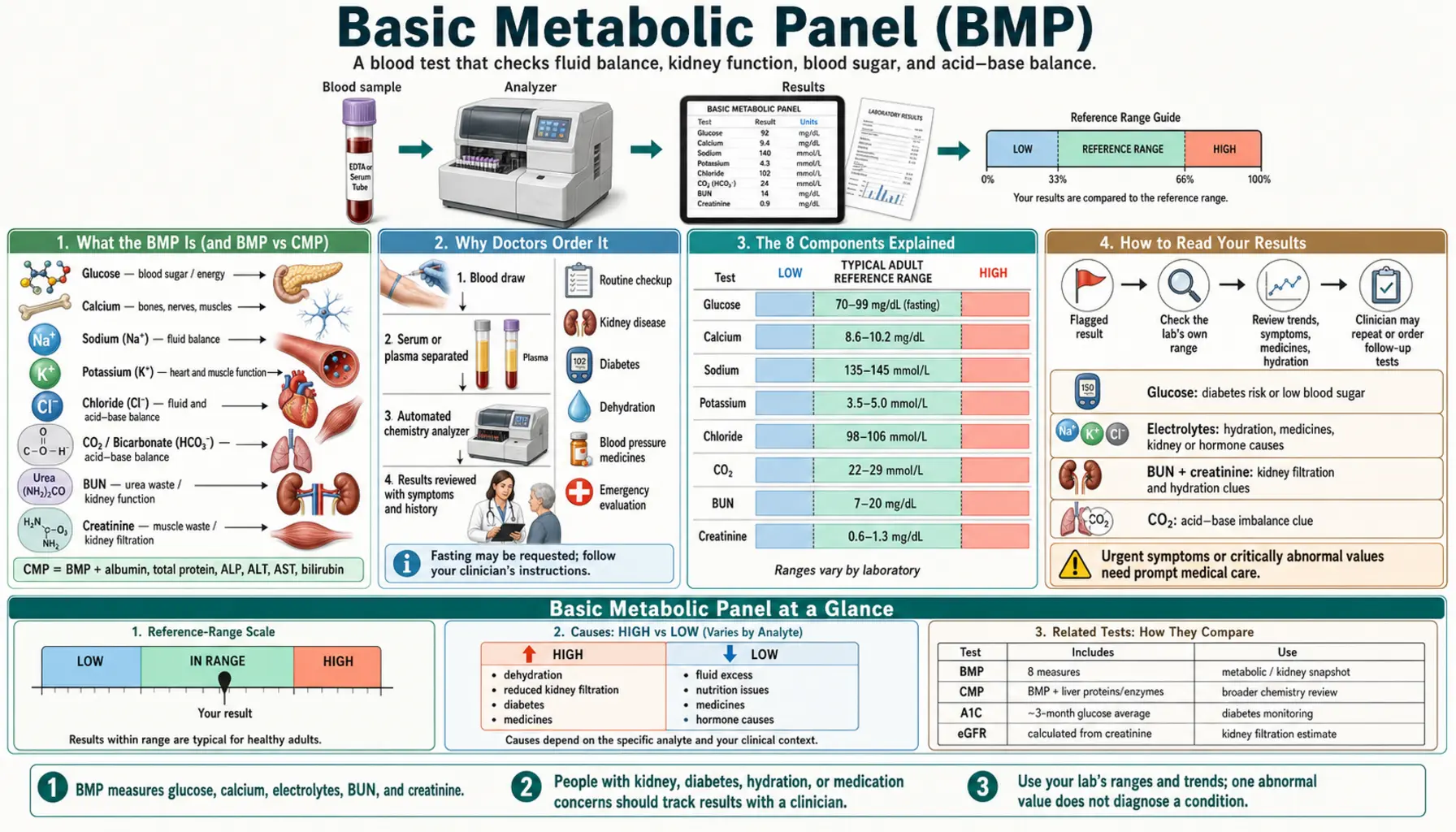
The Basic Metabolic Panel, usually written as BMP, is one of the most common blood tests in all of medicine. It is a small group of eight measurements drawn from a single tube of blood that together give your doctor a quick snapshot of your blood sugar, your body's mineral and fluid balance, and how well your kidneys are working. If you have just had this test ordered, or you are staring at a results printout full of numbers and abbreviations, this page walks you through what each value means in plain language. The BMP is a screening and monitoring tool, not a diagnosis by itself — a single number slightly outside the range is common and usually not an emergency. What matters is the overall pattern, how it compares to your past results, and how you are actually feeling. Below we cover what the panel measures, why doctors order it, how to read your own numbers, what high or low values can point to, and when a result is worth a phone call.
Interactive Visualization Kidney Nephron — watch blood become urine Follow blood into the glomerulus and see filtration and reabsorption turn 180 litres of filtrate into urine — then toggle dehydration or diabetes. Launch → Interactive Visualization The Sodium–Potassium Pump — why you have a voltage Run the pump that gives every cell its charge — three sodium out, two potassium in, on Mg-ATP — then drop the magnesium and see exactly why low potassium refuses to correct. Launch →
Table of Contents
- What the BMP Is (and BMP vs CMP)
- Why Doctors Order It
- The 8 Components Explained
- How to Read Your Results
- What High or Low Values Can Mean
- Fasting & Preparation
- The Anion Gap
- Related Tests & Next Steps
- When to Talk to Your Doctor
- Research Papers
- Connections
- Featured Videos
What the BMP Is (and BMP vs CMP)
A Basic Metabolic Panel is a bundled set of eight blood chemistry tests run together on one sample. You may also see it printed on lab reports as a Chem-7, SMA-7, or simply "metabolic panel." The eight results are your fasting or random glucose (blood sugar), your calcium, four electrolytes (sodium, potassium, chloride, and carbon dioxide/bicarbonate), and two markers of kidney function (blood urea nitrogen and creatinine). Most labs also automatically calculate an estimated glomerular filtration rate (eGFR) from your creatinine, and often an anion gap from the electrolytes, so your printout may list ten or more lines even though the panel is called an "eight-analyte" test.
The most common question people have is the difference between a BMP and a CMP. The Comprehensive Metabolic Panel (CMP) contains everything in the BMP plus six liver-related tests: total protein, albumin, bilirubin, and the liver enzymes ALT, AST, and alkaline phosphatase — fourteen analytes in all. In short, the CMP is the BMP with liver testing added. Doctors reach for the smaller BMP when they mainly want to check kidneys, electrolytes, and blood sugar — for example, monitoring someone on a blood-pressure medication — and choose the CMP when they also want a look at the liver. If your report has albumin and liver enzymes on it, you had a CMP, not a BMP. You can read more on the companion Comprehensive Metabolic Panel page.
Why Doctors Order It
The BMP is popular because it is inexpensive, fast, and answers several practical questions at once. It is ordered in many everyday situations:
- Routine check-ups and physicals — as a general screen of kidney function, hydration, and blood sugar.
- Monitoring long-term medications — drugs such as diuretics ("water pills"), ACE inhibitors and ARBs for blood pressure, and some diabetes medicines can shift potassium, sodium, or kidney numbers, so the BMP is repeated to keep an eye on them.
- Checking for or tracking diabetes — the glucose value flags high blood sugar (see Diabetes).
- Assessing kidney health — BUN, creatinine, and the calculated eGFR are core measures of how well the kidneys filter (see Kidney Function).
- Investigating symptoms — fatigue, confusion, muscle weakness, excessive thirst, nausea, irregular heartbeat, or swelling can all trace back to electrolyte or kidney problems the BMP can reveal.
- Before and during hospital care — including before surgery, when starting IV fluids, or when someone is dehydrated or vomiting.
Because the same eight numbers can be trended over months and years, the BMP is as valuable for watching a stable patient stay stable as it is for catching a new problem.
The 8 Components Explained
Here is each analyte in plain language — what it is, and why your body and your doctor care about it.
Glucose (blood sugar)
Glucose is the main sugar your cells burn for energy. Your body works hard to keep it in a fairly narrow band using the hormone insulin. A high fasting glucose is the classic early warning sign of prediabetes or diabetes, while a low glucose can cause shakiness, sweating, and confusion. Because eating raises glucose quickly, this value is most meaningful when you have fasted (more on that below).
Calcium
Calcium in the blood does far more than build bones — it is essential for your heartbeat, muscle contraction, nerve signaling, and blood clotting. The body guards this level tightly using the parathyroid glands, vitamin D, and the kidneys. An abnormal blood calcium can point to a parathyroid problem, a vitamin D issue, certain cancers, or kidney disease. (Note: the BMP measures total calcium, most of which rides on the protein albumin; a very low albumin can make calcium look falsely low.) See the mineral page on Calcium.
The Electrolytes: Sodium, Potassium, Chloride, and CO2/Bicarbonate
These four work as a team to manage your fluid balance, your acid-base chemistry, and the electrical signals that run your nerves and muscles.
- Sodium is the main mineral in the fluid outside your cells and the biggest driver of your body's water balance. Abnormal sodium usually reflects a problem with water — too much or too little — more than with salt intake. It affects the brain, so severe swings cause confusion or headache. See Sodium.
- Potassium is the main mineral inside your cells and is critical for a steady heartbeat. Both high and low potassium can cause dangerous heart-rhythm changes and muscle weakness, which is why doctors watch it closely in people on diuretics or kidney patients. See Potassium.
- Chloride travels with sodium and helps maintain fluid balance and blood acidity. It usually moves in step with sodium and bicarbonate and is interpreted alongside them. See Chloride.
- CO2 (carbon dioxide / bicarbonate) on a BMP mostly reflects bicarbonate, the body's main chemical buffer. It is a measure of acid-base balance: a low value can signal that acid is building up (metabolic acidosis), while a high value can signal the opposite (metabolic alkalosis). It is not a measure of the CO2 you breathe out.
The Kidney Markers: BUN and Creatinine
These two waste products tell your doctor how well your kidneys are filtering your blood.
- BUN (blood urea nitrogen) is a waste product from breaking down protein. The kidneys clear it, so it rises when kidney filtration falls — but it also rises with dehydration, a high-protein diet, or bleeding in the gut, so it is a less specific kidney marker on its own.
- Creatinine is a waste product from normal muscle activity, produced at a steady rate. Because the kidneys are its main exit route, a rising creatinine is one of the most reliable everyday signs that filtration is dropping. Labs feed your creatinine, age, and sex into a formula to report an estimated GFR (eGFR), which translates the number into a percentage-like measure of kidney function. Muscular people naturally run a bit higher, and very frail or low-muscle people a bit lower, which is worth keeping in mind.
Doctors often look at the BUN-to-creatinine ratio too: a high ratio can suggest dehydration, while both values rising together more often points to the kidneys themselves.
How to Read Your Results
The single most important habit when reading any lab report is to use the reference range printed next to your own result. Ranges differ from lab to lab because they depend on the exact machines and methods used, and they can vary with age, sex, and even altitude. The typical adult ranges below are for orientation only — they are not a substitute for your lab's own numbers, and results are always interpreted in the context of your health, not in isolation. Units also differ by country; US labs often use mg/dL for glucose, calcium, BUN, and creatinine, while many other countries use mmol/L or µmol/L.
Approximate adult reference ranges you may see on a BMP:
- Glucose (fasting): about 70–99 mg/dL (3.9–5.5 mmol/L). 100–125 mg/dL suggests prediabetes; 126 mg/dL or higher on more than one fasting test suggests diabetes.
- Calcium (total): about 8.5–10.2 mg/dL (2.1–2.5 mmol/L).
- Sodium: about 135–145 mmol/L (mEq/L).
- Potassium: about 3.5–5.0 mmol/L (mEq/L).
- Chloride: about 98–107 mmol/L (mEq/L).
- CO2 (bicarbonate): about 22–29 mmol/L (mEq/L).
- BUN: about 7–20 mg/dL (2.5–7.1 mmol/L).
- Creatinine: roughly 0.6–1.1 mg/dL in women and 0.7–1.3 mg/dL in men (about 53–115 µmol/L).
Calculated values you may also see:
- eGFR: 60 or above (mL/min/1.73 m²) is generally considered normal kidney function; values that stay below 60 for three months or more define chronic kidney disease.
- Anion gap: commonly around 8–12 mmol/L, though the "normal" figure depends on the lab's method.
- BUN:creatinine ratio: roughly 10:1 to 20:1.
Two reassuring points. First, a value flagged "H" or "L" that is only slightly outside the range is extremely common and is often not clinically important — the ranges are defined so that a small percentage of perfectly healthy people fall outside them by chance. Second, trends matter more than any single snapshot: a creatinine that has sat at the top of normal for years is far less concerning than one that has jumped since your last test.
What High or Low Values Can Mean
Below are the general directions each abnormal value can point. These are possibilities to discuss with your clinician, not diagnoses — many have benign explanations, and any one value is read together with the others and with your symptoms.
Kidney function (BUN, creatinine, eGFR)
A rising creatinine and falling eGFR suggest the kidneys are filtering less well — from long-standing conditions like diabetes or high blood pressure, from dehydration, from certain medications, or from an acute injury. A high BUN with normal creatinine often just means dehydration or a high-protein meal. Low BUN is rarely a problem and can reflect a low-protein diet or overhydration.
Electrolyte and fluid balance
Low sodium (hyponatremia) is one of the most common lab abnormalities and usually reflects too much water relative to salt — from certain medications, heart, liver, or kidney conditions, or a hormone imbalance. High sodium (hypernatremia) usually means water loss or not drinking enough, often in older or ill people. Potassium is the one to respect most: both high (hyperkalemia) and low (hypokalemia) potassium can disturb the heart's rhythm, so meaningful abnormalities are acted on promptly. A high potassium result is sometimes falsely elevated by red cells breaking during the blood draw — a "hemolyzed" sample — and is simply rechecked. Abnormal chloride and CO2/bicarbonate point to acid-base disturbances: a low bicarbonate suggests acid buildup (metabolic acidosis, as in kidney disease or uncontrolled diabetes), while a high bicarbonate suggests alkalosis (as in prolonged vomiting or heavy diuretic use).
Blood sugar
High glucose raises the question of prediabetes or diabetes, especially if it is high on more than one occasion or paired with a high Hemoglobin A1C. A single high random glucose after a meal is far less meaningful than a high fasting value. Low glucose (hypoglycemia) is less common on routine testing and, if real and symptomatic, deserves prompt evaluation.
Calcium
High calcium (hypercalcemia) most often traces to an overactive parathyroid gland, and less often to certain cancers or excess vitamin D or calcium supplements. Low calcium (hypocalcemia) can stem from low vitamin D, kidney disease, or a parathyroid problem — but always check whether a low albumin is making the total calcium look artificially low before treating it as real.
Fasting & Preparation
Whether you need to fast depends on why the test was ordered. The electrolytes, kidney markers, and calcium in a BMP are not strongly affected by a recent meal, so they can be drawn at any time. The glucose value is the exception: eating raises blood sugar for hours, so if your doctor wants a fasting glucose — the standard for screening for prediabetes and diabetes — you will usually be asked to have nothing but water for 8 to 12 hours beforehand. Many BMPs are ordered specifically as fasting tests, and if a lipid panel is being drawn at the same visit, fasting is often requested for that reason too.
Practical tips that make results cleaner and the draw easier:
- Follow the instructions you were given. If you were told to fast, fast; if not, you generally do not need to.
- Keep drinking water. Plain water is allowed during a fast and actually helps — being well hydrated makes veins easier to find and keeps BUN from rising from dehydration. Avoid coffee, tea, and juice during a fast.
- Ask about your medications. Do not stop any prescription without guidance, but tell the lab or your doctor what you take, since some drugs and supplements can shift these values.
- Time it thoughtfully. Morning draws are convenient for fasting and are when many reference ranges were established.
The Anion Gap
Many labs report an anion gap alongside the BMP. It is not separately drawn — it is a simple calculation from your electrolytes (roughly sodium minus the sum of chloride and bicarbonate) that helps doctors sort out the cause of an acid-base problem. The idea is that blood has to stay electrically balanced, so the "gap" represents unmeasured acids.
In practice, when the bicarbonate (CO2) is low, the anion gap tells the doctor which direction to look. A high anion gap points toward an excess of acids in the blood — seen in situations like uncontrolled diabetes (ketoacidosis), advanced kidney failure, or certain poisonings. A normal anion gap with low bicarbonate points instead toward a loss of bicarbonate, such as from prolonged diarrhea. You do not need to calculate this yourself — it is a clue clinicians use, and an isolated slightly-off anion gap in an otherwise normal panel is rarely significant.
Related Tests & Next Steps
The BMP is often a starting point. Depending on what it shows, your doctor may add or follow up with:
- Comprehensive Metabolic Panel (CMP) — the BMP plus liver tests, when the liver also needs a look.
- Complete Blood Count (CBC) — the other workhorse screening test, checking red cells, white cells, and platelets. A BMP and CBC together are a very common basic workup.
- Hemoglobin A1C and Fasting Insulin — to clarify blood sugar and diabetes risk when glucose is borderline or high.
- Kidney Function testing, including Microalbumin / Urine ACR — to look for early kidney damage when creatinine or eGFR is off.
- Lipid Panel — cholesterol testing, frequently drawn at the same fasting visit.
- Uric Acid — another kidney-cleared waste sometimes checked alongside metabolic labs.
Browse the full menu on the Lab Tests landing page.
When to Talk to Your Doctor
Your doctor will contact you about results that need action, but you are always entitled to ask questions about your own report. Reach out promptly if:
- Your report is flagged with a "critical" or "panic" value, or a result is far outside the range rather than just at the edge.
- A potassium, sodium, calcium, or glucose value is markedly abnormal, especially with symptoms like palpitations, severe weakness, confusion, seizures, or fainting — these can be urgent, so do not wait.
- Your creatinine has risen or eGFR has dropped compared with previous tests.
- Your fasting glucose is 126 mg/dL or higher, or repeatedly in the prediabetes range.
- You feel unwell — ongoing fatigue, excessive thirst or urination, swelling, nausea, or muscle cramps — even if the numbers look only mildly off.
And remember the flip side: a mild flag on one value, with no symptoms and a stable trend, is usually nothing to lose sleep over. The BMP is a conversation-starter with your clinician, not a verdict. This page is general health information and is not medical advice; use it to ask better questions, and let your own doctor interpret your results in the context of your health and history.
Research Papers
- Stevens PE, Ahmed SB, Carrero JJ, et al. KDIGO 2024 Clinical Practice Guideline for the Evaluation and Management of Chronic Kidney Disease. Kidney International. 2024;105(4S):S117–S314. doi:10.1016/j.kint.2023.10.018 — the current global guideline defining and staging chronic kidney disease from eGFR and albuminuria.
- Inker LA, Eneanya ND, Coresh J, et al. New Creatinine- and Cystatin C–Based Equations to Estimate GFR without Race. New England Journal of Medicine. 2021;385(19):1737–1749. doi:10.1056/NEJMoa2102953 — the race-free eGFR equations now used to calculate kidney function from BMP creatinine.
- Levey AS, Stevens LA, Schmid CH, et al. A New Equation to Estimate Glomerular Filtration Rate. Annals of Internal Medicine. 2009;150(9):604–612. doi:10.7326/0003-4819-150-9-200905050-00006 — the CKD-EPI equation that made eGFR reporting standard on chemistry panels.
- Adrogué HJ, Madias NE. Hyponatremia. New England Journal of Medicine. 2000;342(21):1581–1589. doi:10.1056/NEJM200005253422107 — a foundational review of low blood sodium, its causes, and careful correction.
- Sterns RH. Disorders of Plasma Sodium — Causes, Consequences, and Correction. New England Journal of Medicine. 2015;372(1):55–65. doi:10.1056/NEJMra1404489 — an accessible modern overview of both high and low sodium.
- Palmer BF. Regulation of Potassium Homeostasis. Clinical Journal of the American Society of Nephrology. 2015;10(6):1050–1060. doi:10.2215/CJN.08580813 — how the body keeps potassium in its narrow, heart-protecting range.
- Weisberg LS. Management of severe hyperkalemia. Critical Care Medicine. 2008;36(12):3246–3251. doi:10.1097/CCM.0b013e31818f222b — why high potassium is treated urgently and how it is managed.
- Kraut JA, Madias NE. Serum Anion Gap: Its Uses and Limitations in Clinical Medicine. Clinical Journal of the American Society of Nephrology. 2007;2(1):162–174. doi:10.2215/CJN.03020906 — a clear explanation of the anion gap calculated from BMP electrolytes.
- Kraut JA, Madias NE. Metabolic acidosis: pathophysiology, diagnosis and management. Nature Reviews Nephrology. 2010;6(5):274–285. doi:10.1038/nrneph.2010.33 — how a low bicarbonate (CO2) on a panel is interpreted.
- ElSayed NA, Aleppo G, et al.; American Diabetes Association. Diagnosis and Classification of Diabetes: Standards of Care in Diabetes—2024. Diabetes Care. 2024;47(Suppl 1):S20–S42. doi:10.2337/dc24-S002 — the fasting-glucose thresholds used to read the BMP sugar value.
- Cooper MS, Gittoes NJL. Diagnosis and management of hypocalcaemia. BMJ. 2008;336(7656):1298–1302. doi:10.1136/bmj.39582.589433.BE — how low blood calcium is evaluated, including the albumin correction.
- Minisola S, Pepe J, Piemonte S, et al. The diagnosis and management of hypercalcaemia. BMJ. 2015;350:h2723. doi:10.1136/bmj.h2723 — the workup of high blood calcium, most often a parathyroid cause.
Connections
- All Lab Tests
- The Sodium–Potassium Pump — interactive animation
- Kidney Nephron — interactive animation
- Comprehensive Metabolic Panel (CMP)
- Complete Blood Count (CBC)
- Kidney Function
- Hemoglobin A1C
- Fasting Insulin
- Microalbumin / Urine ACR
- Lipid Panel
- Uric Acid
- Potassium
- Sodium
- Calcium
- Chloride
- Diabetes