Willow Bark: History and Traditional Use
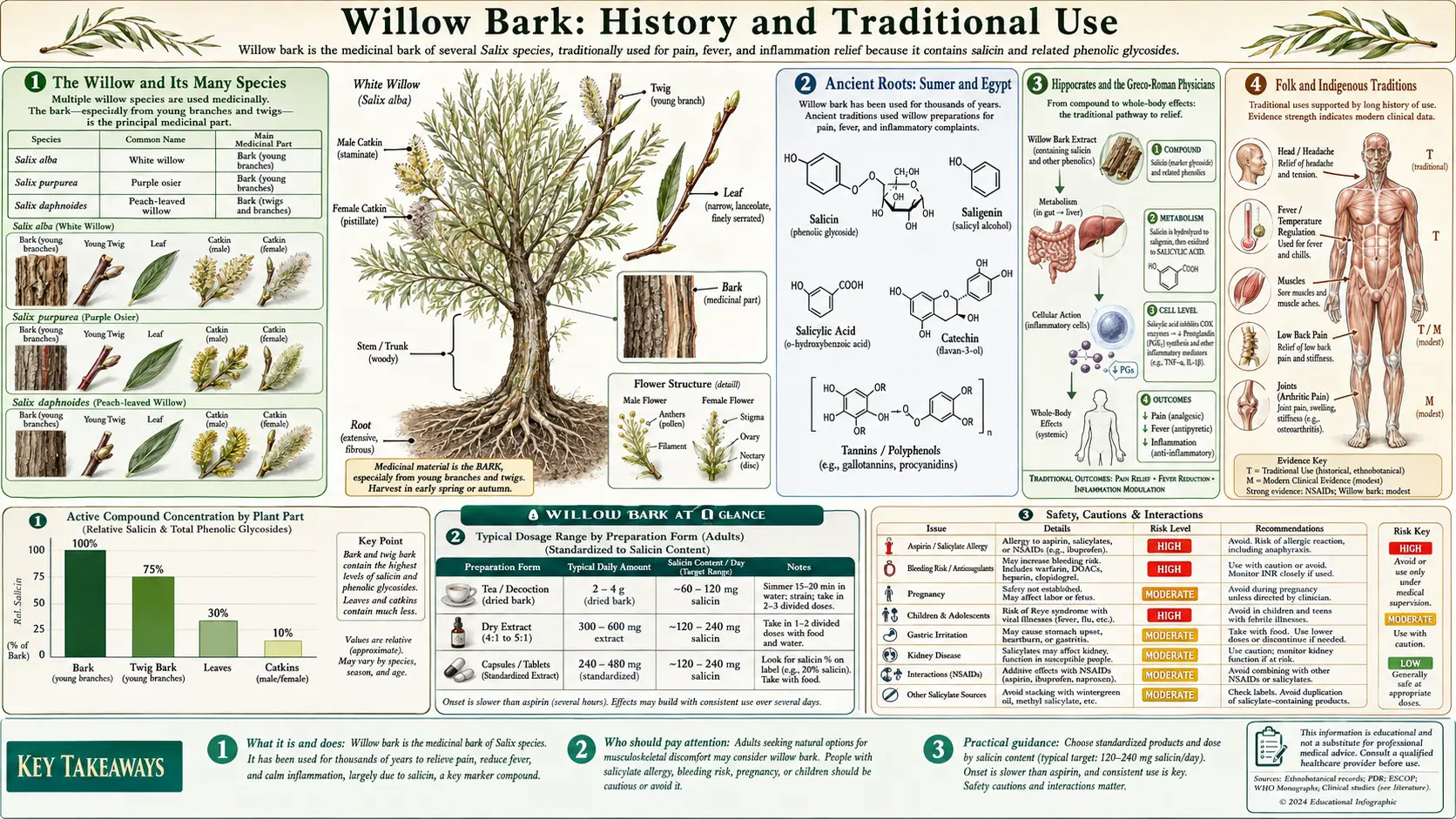
Willow bark is, quite literally, the original aspirin. For thousands of years people across many cultures chewed or brewed the bark of the willow tree (Salix species) to ease pain, bring down fever, and calm inflammation — long before anyone understood why it worked. Its story is one of the clearest examples of how careful observation of a traditional plant remedy, followed by patient laboratory chemistry, produced one of the most important medicines in human history. This page traces that journey: from Sumerian and Egyptian records, through Hippocrates and centuries of folk use, to a country clergyman's famous 1763 experiment, the isolation of salicin, and finally the creation of aspirin. Where the historical record is debated, this page says so plainly — the goal is what is true, not a tidy legend.
Table of Contents
- The Willow and Its Many Species
- Ancient Roots: Sumer and Egypt
- Hippocrates and the Greco-Roman Physicians
- Folk and Indigenous Traditions
- Reverend Edward Stone's 1763 Experiment
- Isolating Salicin and Salicylic Acid
- From Salicylic Acid to Aspirin
- Understanding How It Works: Vane and Prostaglandins
- From Willow Bark to the Modern Herb
- References
- Connections
- Featured Videos
The Willow and Its Many Species
"Willow bark" is not a single plant but the bark of several species in the genus Salix, fast-growing trees and shrubs found along rivers and in wet ground across the Northern Hemisphere. The kinds most often used medicinally include white willow (Salix alba), purple willow (Salix purpurea), and crack willow (Salix fragilis). The medicinal strength of the bark varies a great deal from species to species, because the key compound — salicin — is present in very different amounts; some species carry only a little, while others are comparatively rich in it.
This natural variability is an important part of the history. For most of the willow's long use as a remedy, no one could measure how much active compound a given piece of bark contained, so results were inconsistent. Much of the scientific story below is really the story of people slowly learning what in the bark was doing the work, and how to get a reliable amount of it.
Ancient Roots: Sumer and Egypt
Willow appears in some of the oldest surviving medical writings. Clay tablets from ancient Sumer (Mesopotamia) are often cited as referencing willow, and the ancient Egyptian Ebers Papyrus — a medical text usually dated to around 1500 BCE — lists willow among its plant materials.
A note of honesty is warranted here, because this is where popular histories often overreach. Many accounts say these ancient sources used willow specifically for pain and inflammation — but scholars who have gone back to the surviving translations find willow there mainly for other uses (such as ear complaints), and the often-repeated Sumerian "willow for pain" tablet has proven surprisingly hard to locate. Ancient texts are also fragmentary and hard to translate with certainty, and a plant named in a list is not the same as a demonstration that it worked. What can be said fairly is that willow was part of the earliest recorded materia medica — though exactly what it was used for is less certain than tidy histories suggest.
Hippocrates and the Greco-Roman Physicians
In the Greek world, willow is famously associated with Hippocrates (around 400 BCE), and many histories state that he recommended willow bark or leaves to ease pain and fever. Here precision matters: the surviving Hippocratic writings actually contain only a single clear willow reference — the burning of willow leaves in a gynecological treatment — so the popular "Hippocrates prescribed willow bark for pain and fever" story comes largely from later retellings rather than the original texts. What is solid is that willow entered the Greek medical tradition early. The Greek physician Dioscorides (1st century CE), whose De Materia Medica shaped Western herbal medicine for more than a thousand years, recommended willow leaves as a remedy for inflammation (he describes their use for gout); the Roman writer Pliny the Elder and the physician Galen also mention willow.
The throughline is real nonetheless: through Dioscorides especially, willow's reputation as a remedy for pain and inflammation was carried forward into medieval and early modern European medicine.
Folk and Indigenous Traditions
Willow grows across much of the world, and many cultures arrived at similar uses independently — a recurring pattern in herbal history that hints at a genuine effect. In European folk medicine, willow bark was a common household remedy for fevers and aches. Several Native American peoples used the bark and inner bark of local willows for pain, fever, and inflammation, taken as a tea or chewed; willow was also used in some traditions for headaches and sore joints. Traditional Chinese medicine likewise made use of willow.
No single person "invented" willow as a medicine. Like most traditional herbs, its use emerged independently in many places over a very long time, passed down through ordinary practice rather than discovered in a single moment. The named individuals in this story appear later — not as discoverers of the herb, but as the people who figured out, step by step, the chemistry behind it.
Reverend Edward Stone's 1763 Experiment
The turning point from folk remedy toward modern medicine is usually credited to Reverend Edward Stone, an English clergyman in Oxfordshire. In a letter read to the Royal Society in 1763, titled roughly "An account of the success of the bark of the willow in the cure of agues," Stone described drying and powdering white willow bark and giving it to about fifty parishioners suffering from "agues" — the intermittent fevers of the time — reporting that it reliably reduced their fever.
Stone's reasoning is a charming piece of history: he was partly guided by the old "doctrine of signatures" idea that a remedy might be found near the cause of an illness, reasoning that the willow, which grows in damp places where fevers seemed common, might hold a cure. The reasoning was mistaken, but the careful observation — collecting the bark, preparing it consistently, recording the results in many patients — was genuinely scientific in spirit, and his report brought willow bark to the attention of the scientific community.
A common point of confusion: the 1763 paper was actually published under the name "Edmund Stone," but the clergyman's correct name was Edward Stone (1702–1768). Modern historians treat "Edmund" as a printer's error and use Edward. It is an honest example of how even well-known stories carry small uncertainties.
Isolating Salicin and Salicylic Acid
Through the early nineteenth century, chemists worked to find the single substance in willow bark responsible for its effects — a major step, because isolating a pure compound means it can be measured, standardized, and studied. The active glycoside, eventually named salicin (from Salix), was isolated in increasingly pure form during the 1820s. Credit is genuinely shared and sometimes debated: the German pharmacist Johann Andreas Buchner is generally credited with obtaining salicin around 1828, and the French pharmacist Henri Leroux with extracting it in larger crystalline quantity around 1829.
In 1838, the Italian chemist Raffaele Piria converted salicin into a more potent acid he called salicylic acid — the compound directly responsible for much of willow's pain- and fever-relieving action. Salicylic acid worked, but in the doses needed it was harsh on the stomach and unpleasant to take, which set the stage for the final chemical step.
From Salicylic Acid to Aspirin
The problem with salicylic acid was tolerability. The solution was to chemically modify it into a gentler form: acetylsalicylic acid. The French chemist Charles Frédéric Gerhardt first prepared a form of acetylsalicylic acid in 1853, but his product was impure and unstable, and he did not pursue it.
The decisive work came at the German company Bayer. In 1897, the chemist Felix Hoffmann synthesized a stable, pure form of acetylsalicylic acid. Bayer brought it to market in 1899 under the name Aspirin — a name combining "a" for acetyl, "spir" for Spiraea (the meadowsweet plant, another natural source of salicylates), and the common "-in" drug ending. It went on to become one of the most widely used medicines in the world.
An honest footnote on credit: the question of who deserves primary credit at Bayer is genuinely disputed. Hoffmann is the traditional name attached to the 1897 synthesis, but his colleague Arthur Eichengrün later claimed he had directed the work, and some historians find his account persuasive; Eichengrün, who was Jewish, was written out of official histories during the Nazi era, which complicates the record. This page presents the standard account while noting the dispute, rather than pretending it is settled.
Understanding How It Works: Vane and Prostaglandins
For most of its history, no one knew how willow bark and aspirin actually relieved pain and fever — they simply did. That final piece arrived in 1971, when the British pharmacologist Sir John Vane showed that aspirin works by blocking the production of prostaglandins, signaling molecules involved in pain, fever, and inflammation. Vane shared the 1982 Nobel Prize in Physiology or Medicine for this discovery.
This closed a remarkable loop: a remedy used for thousands of years on the basis of observation alone was finally explained at the molecular level. It also explains willow bark itself — the salicin in the bark is converted in the body to salicylic acid, which acts through the same prostaglandin-blocking pathway, in a gentler and slower way than purified aspirin.
From Willow Bark to the Modern Herb
Today willow bark occupies an interesting place: the medicine it gave rise to — aspirin — is sold by the billions of tablets, while the bark itself continues to be used as a traditional herbal remedy, typically standardized to its salicin content. Modern interest focuses on whether whole willow bark extract offers benefits for low back pain and osteoarthritis, and whether its mix of compounds behaves differently from isolated aspirin. Those questions — what the evidence actually shows, how it is dosed, and the important safety cautions (including who should avoid it, and the same bleeding and stomach concerns that apply to aspirin) — are covered on the Willow Bark Benefits pages and the main Willow Bark page.
The throughline of the whole story is worth keeping in mind: willow bark is a case where tradition pointed to something real, and patient science confirmed and refined it. That is the best of what herbal history can offer — not a claim that "old means true," but a reminder that careful attention to traditional remedies has, more than once, changed medicine.
References
These references combine peer-reviewed history-of-medicine sources with the original historical record. Author names, titles, and journals are given as plain text; only stable identifiers are linked.
- Desborough MJR, Keeling DM. "The aspirin story — from willow to wonder drug." British Journal of Haematology. 2017;177(5):674–683 — doi:10.1111/bjh.14520
- Stone E. "An account of the success of the bark of the willow in the cure of agues." Philosophical Transactions of the Royal Society of London. 1763;53:195–200 — doi:10.1098/rstl.1763.0033
- Vane JR. "Inhibition of prostaglandin synthesis as a mechanism of action for aspirin-like drugs." Nature New Biology. 1971;231(25):232–235 — doi:10.1038/newbio231232a0
- Mahdi JG, et al. "The historical analysis of aspirin discovery, its relation to the willow tree and antiproliferative and anticancer potential." Cell Proliferation. 2006;39(2):147–155 — doi:10.1111/j.1365-2184.2006.00377.x
- Jeffreys D. Aspirin: The Remarkable Story of a Wonder Drug. Bloomsbury, 2004 (book) — a detailed popular history of the willow-to-aspirin story.
- Vlachojannis J, Magora F, Chrubasik S. "Willow species and aspirin: different mechanism of actions." Phytotherapy Research. 2011;25(7):1102–1104 — doi:10.1002/ptr.3386
- History of salicylates and willow bark — PubMed: history of salicylates and willow bark
- NCCIH — Herbs at a Glance — nccih.nih.gov/health/herbsataglance