Tribulus and Testosterone: The Claim Examined
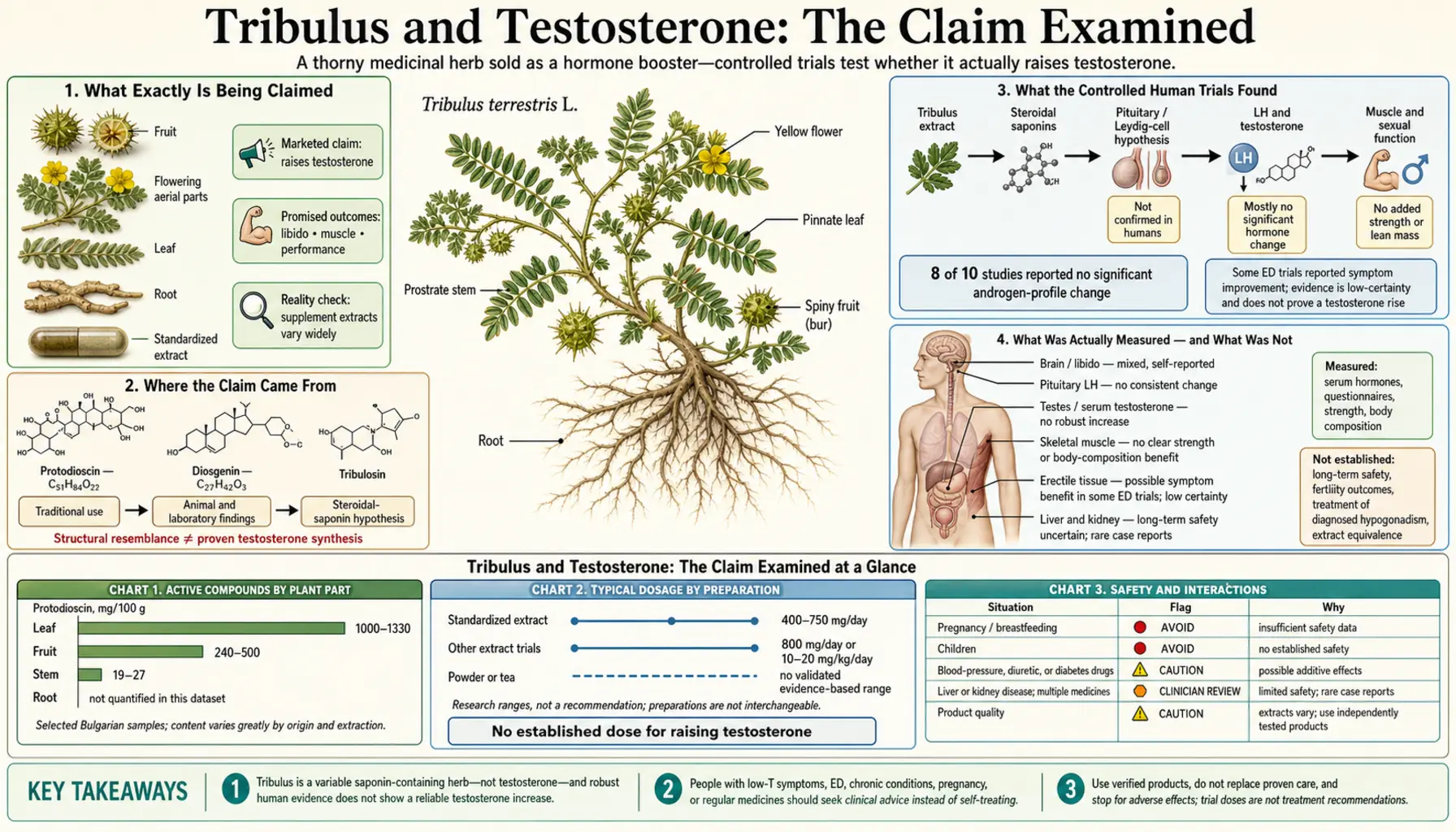
This page has one job, and it is worth stating in the first line so nobody has to hunt for it: in healthy men, tribulus does not raise testosterone. The claim is NOT SUPPORTED. This is not a cautious "more research is needed" hedge. The claim was tested in the populations that buy the product — healthy young men, resistance-trained men, elite athletes in real preseason training — with placebo controls and actual blood draws, and the hormones did not move.
That finding deserves a whole page because of how much rests on it. A large slice of the global sports-supplement market is organised around the sentence "raises your own testosterone, naturally." Tribulus is the ingredient that made that sentence sellable. Understanding precisely how a claim this popular came to be this wrong is more useful than the verdict alone — it teaches you how to read the next ingredient that arrives with the same pitch.
Table of Contents
- What Exactly Is Being Claimed
- Where the Claim Came From
- What the Controlled Human Trials Found
- What Was Actually Measured — and What Was Not
- The Animal-to-Human Gap
- The Infertile-Men Studies and the Conflation They Caused
- Older Men, Low Baselines, and the Subgroup Argument
- Proposed Mechanisms That Did Not Pan Out
- How to Read a “Test Booster” Label
- What Actually Moves Testosterone
- Verdict and Evidence Tier
- Key Research Papers
- Connections
What Exactly Is Being Claimed
Precision matters here, because the marketing claim is usually vague on purpose. Tribulus labels rarely say "this drug raises serum testosterone by X percent" — that would be a measurable, falsifiable, and in most jurisdictions legally risky statement. Instead they say things like "supports healthy testosterone levels," "promotes natural test production," or "supports male vitality and hormonal balance." Those phrasings are chosen because they sound like the strong claim while remaining unfalsifiable.
But the strong claim is what the consumer hears, and it is the strong claim that has been tested. In its testable form it has three parts:
- Tribulus increases circulating testosterone. Total testosterone, and ideally free testosterone — the fraction not bound to sex-hormone-binding globulin or albumin, which is the fraction usually considered biologically available.
- It does so through the body's own axis, meaning by increasing the pituitary drive (luteinizing hormone) onto the testes, rather than by supplying an outside androgen. This distinction is why tribulus is sold as a "booster" rather than a steroid, and it is a real, checkable prediction: if the mechanism is what the label implies, luteinizing hormone should move.
- The rise is large enough to matter — large enough to change muscle mass, strength, mood, or sexual function. A rise inside normal day-to-day variation would be a laboratory curiosity, not a benefit.
All three parts have been examined in human trials. All three fail. The remainder of this page is the detail.
Where the Claim Came From
Tribulus has been used medicinally for a very long time, but not for this. In Ayurveda it is gokshura, used chiefly for urinary and kidney complaints, oedema and general convalescence. In Traditional Chinese Medicine the fruit is bai ji li, used for an entirely different pattern set — headache, itching, eye complaints, liver-related presentations. Neither tradition treated it as an androgen drug for building muscle, for the straightforward reason that neither tradition had a concept of serum testosterone. The hormonal framing is modern, and it can be dated.
It arrives in the 1970s and 1980s with a standardized Bulgarian preparation marketed as Tribestan, developed and promoted around claims of effects on fertility and sexual function. Promotional material and conference abstracts referenced hormone changes, and a parallel folklore circulated that Eastern European weightlifters — a group with genuine, documented pharmacological sophistication in the era — were using it. That combination was commercially irresistible: an obscure plant, an Eastern-bloc origin story, hormone language, and an implied association with athletes who were visibly very strong.
Three features of that origin are worth noticing because they recur in every similar story since:
- Much of the foundational data was manufacturer-linked or never published in the peer-reviewed literature in a form that outsiders could scrutinise. Where studies exist, they are frequently small, in Bulgarian, in low-circulation journals, or presented as abstracts. That does not automatically make them wrong — but it does mean nobody could check them, and "nobody could check it" is exactly the condition under which a wrong result survives for forty years.
- The athlete association was never an efficacy study. Weightlifters in that era used many things. That some of them also used tribulus tells you nothing about what tribulus did, and everything about what marketing can do with an anecdote.
- The claim moved into English-language bodybuilding media before it moved into English-language science. By the time researchers ran controlled trials, tribulus was already a fixture in pre-workouts and "test boosters." The trials were therefore testing an established belief rather than an emerging hypothesis, which is a much harder position from which to change anyone's mind.
The Pro-sexual and androgen enhancing effects of Tribulus terrestris L.: Fact or Fiction review in the Journal of Ethnopharmacology (2016) traces this history in detail and reaches the same conclusion this page does. It is worth reading, not least because it was written by the same investigators who ran the key negative trial and had every professional incentive to find something.
What the Controlled Human Trials Found
Here is the human evidence, laid out by population. Every study below is a controlled trial in people, which is the only tier that can settle this question.
Healthy young men
The aphrodisiac herb Tribulus terrestris does not influence the androgen production in young men (Journal of Ethnopharmacology, 2005) is the study that put the claim on the record as a failure — the title alone is unusually blunt for a journal article. Healthy young men received tribulus for four weeks under controlled conditions, with hormone measurement before, during and after. Total testosterone did not change. Free testosterone did not change. Dihydrotestosterone did not change. The pituitary hormones that would have to move first if the "boosts your own production" mechanism were real did not move either.
That last point is the most damaging one and it is routinely skipped in summaries. If a compound genuinely stimulated endogenous testosterone production through the hypothalamic-pituitary-gonadal axis, you would expect a signal upstream. There was none. The mechanism the label describes was checked directly and was absent. Evidence tier: randomized/controlled human trial — negative.
Resistance-trained men
The effects of Tribulus terrestris on body composition and exercise performance in resistance-trained males (International Journal of Sport Nutrition and Exercise Metabolism, 2000) took the population most likely to buy the product and gave them tribulus alongside a supervised resistance-training programme, against placebo. Body composition did not differ meaningfully. Performance did not differ meaningfully. Trained men training hard, which is the exact scenario the marketing depicts, produced no advantage. Evidence tier: randomized controlled human trial — negative.
Elite athletes in real training
The effect of five weeks of Tribulus terrestris supplementation on muscle strength and body composition during preseason training in elite rugby league players (Journal of Strength and Conditioning Research, 2007) is arguably the most ecologically valid test that exists. These were professional athletes, in a genuine preseason block, for five weeks, with placebo control. Strength did not improve beyond placebo. Body composition did not improve beyond placebo. Androgen measures did not rise. Evidence tier: randomized controlled human trial — negative.
The pooled view
A systematic review on the herbal extract Tribulus terrestris and the roots of its putative aphrodisiac and performance enhancing effect (Journal of Dietary Supplements, 2014) gathered the human and animal literature and reached the conclusion that the plant's reputation is not matched by reliable hormonal or performance effects in humans, and that the supportive material is dominated by animal work. Insights into supplements with Tribulus terrestris used by athletes (Journal of Human Kinetics, 2014) reviewed the same ground from a sports-science angle and agreed.
Note what is not in this list: a well-powered, placebo-controlled trial in healthy men showing a testosterone increase. Not a trial that found a small increase, or an increase in a subgroup, or an increase that missed significance. There is no such trial to weigh against the negatives. That is why this page uses the label NOT SUPPORTED rather than "conflicting" — the libido claim genuinely is conflicting, and the contrast between the two is instructive.
What Was Actually Measured — and What Was Not
When a supplement defender says "the studies were flawed," it is worth knowing what the studies actually did, because the specific complaints tend not to survive contact with the methods.
- Total testosterone — measured. This is the number on a standard lab panel, comprising testosterone bound to sex-hormone-binding globulin, bound to albumin, and free.
- Free testosterone — measured in the key young-men study. This matters because a common rescue argument is "maybe total stayed flat but free went up." It was checked. It did not.
- Dihydrotestosterone (DHT) — measured. The more potent downstream androgen, produced from testosterone by 5-alpha-reductase. A shift toward DHT without a change in total testosterone would have been a genuinely interesting finding. It did not occur.
- Luteinizing hormone and follicle-stimulating hormone — measured. These are the pituitary signals to the testes. Their stability is the direct refutation of the "stimulates your own production" mechanism.
- Androstenedione and other precursors — assessed in some of this work, again without the pattern the claim predicts.
- Body composition and strength — measured in the trained-male and athlete trials, because a real androgen effect should eventually show up as tissue change even if a single blood draw missed it. It did not show up.
What was not done, in fairness, is worth stating too. Doses varied between studies and were generally in the range products actually sell (roughly a few hundred to around 1,500 mg of extract daily). Durations were weeks, not months or years. Extracts differed in origin and saponin content, which is a genuine limitation and the subject of the quality and safety page. Sample sizes were modest by pharmaceutical standards.
But notice the shape of that limitation list. Small, short, heterogeneous studies are prone to missing a real effect — they have limited power. They are not prone to conjuring a consistent zero across multiple independent groups, in three different populations, on four or five different hormone measures, plus tissue outcomes. When several underpowered studies all fail to find an effect and none finds one in the other direction, the honest reading is not "the effect is hiding." It is that the effect is not large enough to be worth the price of the bottle, and probably not there at all.
The Animal-to-Human Gap
The supportive literature for tribulus is real. It is just not human. Rat, rabbit and primate studies have reported changes in sexual behaviour, in erectile parameters in isolated tissue, and in some hormone measures — and it is those studies, plus in-vitro work, that populate the reference lists on supplement websites. Evidence tier for all of it: preliminary (animal and in-vitro).
Why did it not carry over? Several reasons, each of which is a general lesson rather than a tribulus quirk:
- Dose scaling. Animal studies frequently use milligram-per-kilogram doses that, converted to a human, would require far more extract than any capsule delivers — sometimes an order of magnitude more. A finding that only appears at ten times the human dose is not a finding about the human dose.
- Castrated and hormone-manipulated animals. A meaningful portion of the aphrodisiac animal literature was conducted in castrated rats, or in animals given exogenous androgens alongside the extract. Effects observed in an artificially androgen-depleted animal do not predict effects in an intact, hormonally normal adult man — and that is precisely the population the label targets.
- Behavioural endpoints are not hormone endpoints. Rodent mounting frequency is a behavioural measure. It can be shifted by things that have nothing to do with androgens — arousal, novelty, stress, even mild stimulant activity. Reading "increased mating behaviour in rats" as "raises testosterone" is a substitution of one claim for another.
- Species differences in steroid metabolism are substantial, particularly in the enzymes handling saponins and steroidal precursors. A plant steroid glycoside that is metabolised one way in a rat gut may be handled quite differently by human gut flora and liver.
- Extract identity. The animal studies used specific extracts of specific plant material. Human trials used other extracts. Given how much tribulus chemistry varies by plant part and region, some of the gap is genuinely a chemistry problem rather than a species problem — but that argument cuts against the retail product too, since the bottle on the shelf is not the animal-study extract either.
The lesson generalises: when an ingredient's evidence base is overwhelmingly animal and in-vitro, and the human trials that exist are negative, the correct summary is the human one. Preliminary evidence is a reason to run a trial, not a reason to make a claim. Tribulus is the textbook case because the trial was run, more than once, and the answer came back.
The Infertile-Men Studies and the Conflation They Caused
Here is where a great deal of the confusion is manufactured, and it is worth walking through slowly because the sleight of hand is subtle enough to fool careful readers.
There is a small and separate literature on tribulus in men with fertility problems — men presenting with abnormal semen parameters, often idiopathic infertility. Some of these studies report changes: shifts in sperm concentration or motility, occasionally accompanied by a change in a hormone measure. Examples include work published in the Journal of Dietary Supplements around 2017 on tribulus, serum testosterone and semen parameters in men with unexplained infertility, and a study in Andrologia in 2017 on oral tribulus extract, semen quality and body-fat index in infertile men. A later systematic review in Complementary Therapies in Medicine (2019) examined tribulus and sperm parameters in idiopathic male infertility. These are small studies with mixed and generally modest findings, and reviewers of this literature have been consistently unimpressed by its quality.
Nonetheless, they exist — and they are a legitimate, if preliminary, line of inquiry. Evidence tier: preliminary human evidence in a clinical population, not generalisable. There is a real question buried in there about whether a plant with plausible mild effects on the testicular environment does something useful for a man with a specific pathology. That question is open.
What is not legitimate is the move that follows. A supplement page cites the infertility work, drops the words "in men with unexplained infertility," and presents it as "clinical evidence that tribulus supports testosterone." That is three separate errors stacked:
- Population substitution. A man with a documented reproductive abnormality is not the same subject as a healthy 24-year-old lifter. Interventions frequently do something in a deficient or dysfunctional system and nothing in a normal one — this is one of the most reliable patterns in all of nutrition and endocrinology. Correcting a deficit is not the same as exceeding a normal.
- Outcome substitution. Semen parameters are not testosterone. Sperm concentration and motility depend on many things — temperature, oxidative stress, varicocele, infection, time since last ejaculation — and can move without any androgen change whatsoever.
- Direction-of-inference error. Even if a hormone change occurred in an infertile cohort, the direction of the marketing inference is backwards. You cannot use a positive finding in a clinical subgroup to overturn a negative finding in the exact population being sold to. The healthy-male trials are the relevant evidence for the healthy-male claim, and they are negative.
If you take one analytical tool away from this page, make it this one: whenever you see a supplement claim supported by a citation, check who was in the study. Population substitution is the most common and most effective trick in the entire category, and once you look for it you will find it everywhere.
Older Men, Low Baselines, and the Subgroup Argument
A related and slightly better-faith argument runs: "the negative trials used young men with normal testosterone; there was no room to improve. In older men with low baseline levels, tribulus might work."
This is a coherent hypothesis, and it deserves a straight answer rather than a dismissal. The straight answer is: it has not been established, and the trial that would establish it has not been done well enough. Some of the male sexual-dysfunction work has included middle-aged and older men, and the largest such trial — the 12-week study published in Maturitas in 2017 — is discussed on the libido page. What is notable is that even where symptom improvement was reported in older cohorts, a convincing, consistent testosterone rise was not the finding that drove it. The symptom scores and the hormone panels do not track together.
Three further points keep the subgroup argument honest:
- "Low testosterone" is a diagnosis, not a supplement indication. If your testosterone is genuinely low and symptomatic, that is a clinical situation with real causes to find — pituitary problems, obesity and insulin resistance, opioid or glucocorticoid use, sleep apnoea, primary testicular failure, iron overload. See Male Hypogonadism and Low Testosterone and TRT. Treating it with an unproven herb instead of investigating it is the expensive path to the same low number a year later.
- Regression to the mean will manufacture a fake result in any uncontrolled study that recruits men because their testosterone was low. Testosterone is highly variable within a day and between days; a cohort selected for a low reading will average higher on retest even if given nothing. This is why the placebo arm is not optional and why uncontrolled "before and after" data in this space should be treated as noise.
- The subgroup argument is not what the label claims. Bottles are not marketed as "possibly useful in older hypogonadal men pending trials." They are marketed to everyone. Even if the subgroup hypothesis eventually proved true, the mass-market claim would still have been unsupported at the time it was made.
Proposed Mechanisms That Did Not Pan Out
Several mechanisms have been proposed over the years to explain how tribulus would raise androgens. Each is worth knowing, if only to recognise the shape of the argument when it reappears attached to a different plant.
- Protodioscin as a testosterone precursor. The idea that the steroidal saponin protodioscin is chemically converted into DHEA and then testosterone in the body. Superficially plausible — protodioscin has a steroid skeleton — but humans do not possess an efficient pathway for converting plant furostanol saponins into androgens, and the human trials that would have shown the product of such a conversion found no product. NOT SUPPORTED.
- Increased luteinizing hormone release. The "boosts your own production" mechanism proper. Directly tested; luteinizing hormone did not rise in the controlled young-men study. NOT SUPPORTED.
- Aromatase inhibition. The suggestion that tribulus reduces conversion of testosterone to oestradiol, tilting the ratio. If this occurred meaningfully you would expect measurable changes in the testosterone-to-oestradiol relationship and, over time, in clinical signs. It has not been demonstrated in humans with tribulus alone. Some "test booster" products blend tribulus with genuine aromatase-inhibiting compounds, which is one reason blend studies must never be read as tribulus studies. Preliminary at best; not shown for tribulus.
- Increased androgen-receptor density. Animal work has suggested changes in androgen-receptor immunoreactivity in nervous and erectile tissue. This is an interesting hypothesis for the desire claim, and it is discussed on the libido page. It is not a testosterone claim — more receptors would not raise the hormone, and this mechanism, if real, would produce effects with a flat hormone panel. Preliminary (animal).
- Nitric oxide release. Protodioscin has been proposed to increase nitric-oxide-mediated relaxation in erectile tissue, the same broad pathway that phosphodiesterase-5 inhibitor drugs amplify. Again: a plausible mechanism for a sexual-function effect, and again, not a hormonal one. Preliminary (animal and in-vitro).
Read that list as a whole and something clicks. The mechanisms that survive scrutiny at all — receptor density, nitric oxide — are mechanisms for sexual function without hormonal change. The mechanisms specific to raising testosterone are the ones that were tested and failed. The literature is not incoherent. It is telling a consistent story that happens to be the opposite of the story on the label.
How to Read a “Test Booster” Label
Practical skills, applicable well beyond this one plant:
- "Supports healthy testosterone levels" is not a claim that it raises testosterone. It is a phrase engineered to be unfalsifiable. Water supports healthy testosterone levels.
- A long ingredient list is a defence, not a formula. If a product contains fourteen botanicals, no trial has tested that product, and any positive study cited is a study of something else. It also means each ingredient is present at a fraction of any studied dose.
- Look for "proprietary blend." This legally permits listing a combined weight without per-ingredient amounts. It exists so you cannot tell whether the headline ingredient is 500 mg or 5 mg.
- Check the citation population, not just the citation. Reference lists on supplement sites are frequently accurate and irrelevant — real papers, in rats, or in a clinical population unlike you.
- "Clinically studied" does not mean "clinically effective." A negative trial is still a study. So is a manufacturer-funded pilot in twelve people with no control arm.
- Third-party testing is about identity and contamination, not efficacy. A certification mark tells you the bottle contains what it says and not a banned steroid. It tells you nothing about whether the contents work. Both facts matter, for different reasons — see the performance page for why the contamination half is the one that can end a career.
- Beware the hormone-panel offer. If a brand encourages you to test your testosterone before and after, understand that single-draw testosterone varies substantially with time of day, sleep, illness, recent training and assay method. Almost any before-and-after pair will show a change in some direction.
What Actually Moves Testosterone
Since the honest answer to "will tribulus raise my testosterone" is no, the useful follow-up is what does. This is not a comprehensive endocrinology treatment, and none of it is a prescription — but these are the levers with real evidence behind them, and they are the reason a supplement is usually the least productive thing to change first.
- Sleep. Testosterone secretion is tightly coupled to sleep, with the majority of the daily rise occurring during sleep. Restricting sleep to around five hours in young men has been shown in controlled experiments to reduce daytime testosterone substantially — an effect larger than anything any legal supplement has demonstrated. Untreated obstructive sleep apnoea is a common and correctable contributor.
- Body fat, particularly visceral fat. Adipose tissue expresses aromatase, converting testosterone to oestradiol, and obesity is one of the strongest correlates of low testosterone in men. Weight loss raises testosterone in men with obesity. This is a real, replicated, non-pharmacological effect.
- Resistance training. Not because a single session's acute hormone spike matters much — it does not, and that acute spike is heavily oversold — but because training changes body composition and insulin sensitivity, which do matter.
- Correcting genuine deficiencies. Zinc deficiency can impair testosterone production, and magnesium status has been associated with androgen measures. The key word is deficiency: repletion helps a deficient person and does little for a replete one. This is the same population-substitution principle from earlier, applied honestly.
- Adequate energy and protein intake. Prolonged large energy deficits and very low body fat suppress the reproductive axis. Aggressive dieting while simultaneously buying a test booster is working against yourself.
- Reviewing medications and substances. Opioids, glucocorticoids, some antidepressants, heavy alcohol use and anabolic-steroid use itself (which suppresses the axis, sometimes durably) are all documented contributors to low testosterone.
- Getting an actual diagnosis. If symptoms are real, a testosterone test done properly — early morning, fasting, repeated on a second occasion, interpreted alongside SHBG, luteinizing hormone and prolactin — tells you far more than any supplement trial-and-error. Low testosterone has causes, some of them serious and treatable.
None of these is as satisfying to buy as a bottle. All of them have better evidence than the bottle.
Verdict and Evidence Tier
Claim: tribulus raises testosterone in healthy men. Evidence tier: NOT SUPPORTED. Tested in healthy young men, in resistance-trained men, and in elite athletes during real training, with placebo control and direct hormone measurement including free testosterone, DHT and the pituitary gonadotropins. No consistent effect was found on any of them, and no comparable positive trial exists to weigh against those results.
Claim: tribulus improves semen parameters or hormone measures in men with infertility. Evidence tier: preliminary, in a distinct clinical population. Documented here rather than dropped, because it is a real line of research — but it does not support the healthy-male claim, and conflating the two is the central error in tribulus marketing.
Claim: tribulus has androgenic and aphrodisiac activity in animals. Evidence tier: preliminary (animal and in-vitro), often at doses and in castrated models that do not translate. This is where the reputation came from and it is why the story survived so long.
If your reason for considering tribulus is testosterone, muscle or strength, the honest recommendation is to skip it. If your reason is sexual desire, that is a different question with a different and more interesting answer — continue to the libido and sexual function page, which explains why desire can improve while the hormone panel stays exactly where it was.
Key Research Papers
Cited as PubMed searches rather than numeric identifiers, so you can confirm each paper's identity and content yourself.
- The aphrodisiac herb Tribulus terrestris does not influence the androgen production in young men. Journal of Ethnopharmacology, 2005. The central negative trial: no change in total or free testosterone, DHT, or gonadotropins in healthy young men. Find on PubMed
- Pro-sexual and androgen enhancing effects of Tribulus terrestris L.: Fact or Fiction. Journal of Ethnopharmacology, 2016. Traces the history of the claim and concludes an androgen-enhancing effect in healthy men is not established. Find on PubMed
- The effects of Tribulus terrestris on body composition and exercise performance in resistance-trained males. International Journal of Sport Nutrition and Exercise Metabolism, 2000. No meaningful body-composition or performance benefit versus placebo. Find on PubMed
- The effect of five weeks of Tribulus terrestris supplementation on muscle strength and body composition during preseason training in elite rugby league players. Journal of Strength and Conditioning Research, 2007. Elite athletes, real training block, no androgen or performance advantage. Find on PubMed
- A systematic review on the herbal extract Tribulus terrestris and the roots of its putative aphrodisiac and performance enhancing effect. Journal of Dietary Supplements, 2014. Pooled appraisal: reputation not matched by reliable human effects. Find on PubMed
- Insights into supplements with Tribulus terrestris used by athletes. Journal of Human Kinetics, 2014. Sports-science review of athlete use, including the contamination problem. Find on PubMed
- Topic search — tribulus in men with infertility, the separate population whose results are so often borrowed for the healthy-male claim. Includes the 2017 work on serum testosterone and semen parameters in unexplained infertility and the 2019 systematic review of sperm parameters in idiopathic infertility. PubMed search
- Topic search — the animal and primate work that generated the hormonal hypothesis, including studies of protodioscin in rat, rabbit and primate models and in castrated animals: PubMed search
- Topic search — sleep restriction and daytime testosterone in healthy men, the comparison that puts supplement effect sizes in perspective: PubMed search
- Topic search — weight loss, obesity and testosterone in men, one of the few reliably effective non-pharmacological levers: PubMed search
- Topic search — zinc status and testosterone, to see for yourself where deficiency correction stops and wishful supplementation begins: PubMed search
- Topic search — the whole human testosterone literature on this plant, unfiltered: PubMed search
Connections
- All Herbs
- Tribulus terrestris (main article)
- Tribulus — Benefits Deep Dive
- Tribulus for Libido and Sexual Function
- Tribulus for Athletic Performance
- Tribulus: Saponins, Product Quality and Safety
- Testosterone Test
- SHBG Test
- Male Hypogonadism
- Hypogonadism
- Low Testosterone and TRT
- Male Infertility
- Gynecomastia
- Ashwagandha
- Tongkat Ali
- Fenugreek
- Maca
- Zinc
- Magnesium
Safety and disclaimer. This page is health information, not medical advice, and it cannot replace assessment by a clinician who knows your history. Do not self-treat suspected low testosterone with supplements — genuinely low testosterone has causes worth finding, some of them serious. Tribulus should be avoided in pregnancy, when trying to conceive and while breastfeeding, and used cautiously with hormone-sensitive conditions or alongside diabetes medication, blood-pressure medication, diuretics or lithium. Published case reports link tribulus products to serious kidney and liver injury, and gynecomastia has been reported in men taking them; stop use and seek medical attention for dark urine, reduced urine output, yellowing of the eyes or skin, upper-abdominal pain, or breast swelling or tenderness.