Saw Palmetto — Benefits Deep Dive
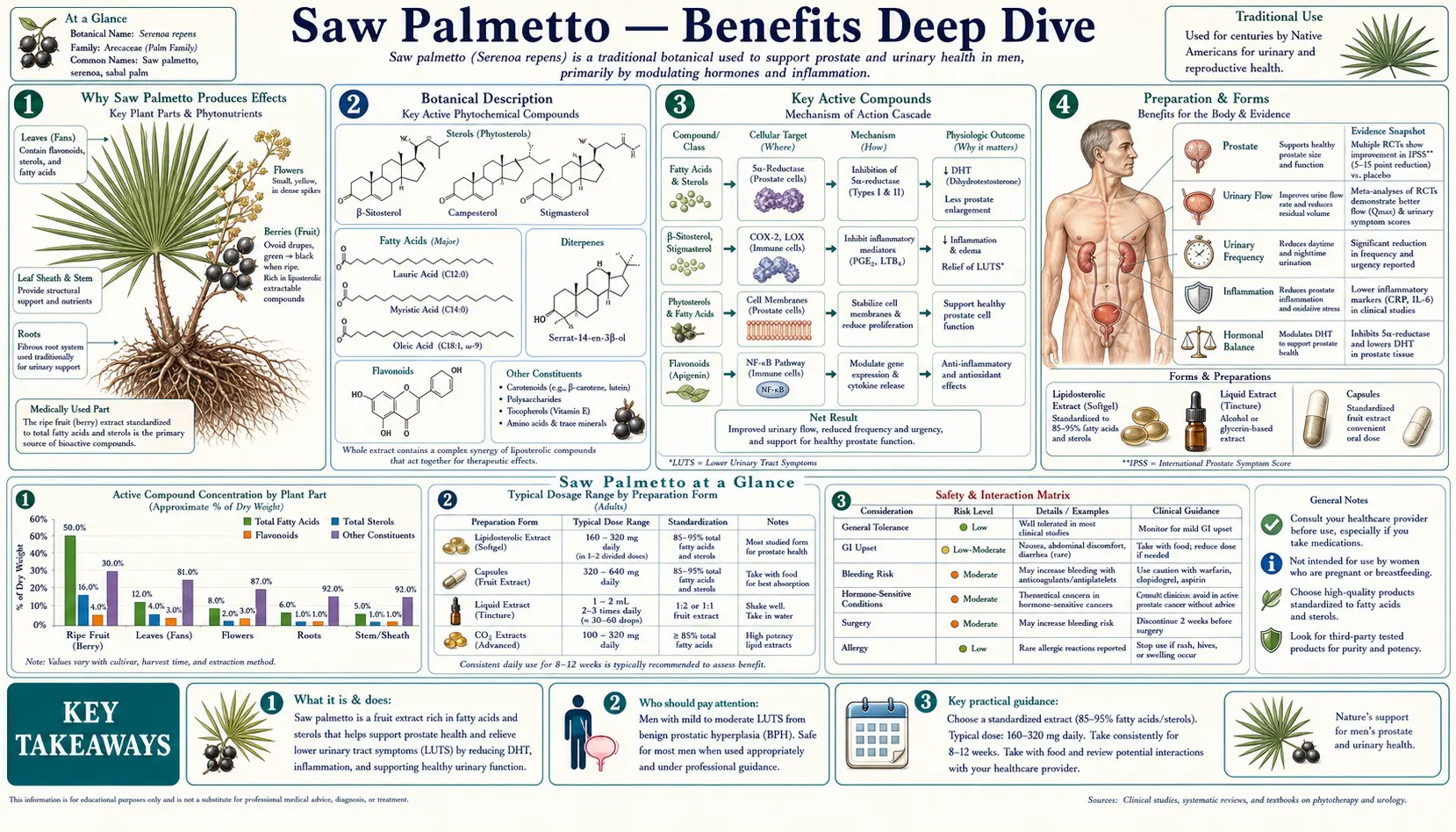
Saw palmetto (Serenoa repens) is a small fan-palm native to the southeastern United States whose ripe black berries have been used since pre-Columbian times by the indigenous Seminole and other Florida tribes for genitourinary complaints. It became the single most-popular men's herbal supplement in the West, driven by a wave of strongly positive 1990s-2000s European trials of the standardized liposterolic extract for benign prostatic hyperplasia (BPH). The therapeutically interesting fraction is roughly 85% free fatty acids (oleic, lauric, myristic, palmitic), plus 0.2-0.5% phytosterols (beta-sitosterol, campesterol, stigmasterol) and flavonoids. The mechanistic story is multi-pronged — non-competitive 5-alpha-reductase inhibition, alpha-1 adrenergic receptor blockade, anti-inflammatory COX/LOX modulation, and anti-edematous and pro-apoptotic effects in prostatic tissue. The clinical story is genuinely mixed and requires honest framing: the Wilt 1998 Cochrane meta-analysis (18 trials, 2,939 men) reported symptom improvements roughly comparable to finasteride with fewer sexual side effects, but the two methodologically rigorous American confirmatory trials — STEP (Bent 2006, NEJM) and CAMUS (Barry 2011, JAMA) — both found no difference from placebo, even at triple-dose. The reconciliation may lie partly in extract quality (the European hexane liposterolic extract used in many of the positive trials differs chemically from many generic U.S. extracts) and patient selection, although the 2023 Cochrane review, which pooled 27 randomized trials, found that saw palmetto alone made little to no difference to urinary symptoms. The four pages below walk through the benign prostatic hyperplasia evidence honestly, the androgenetic-alopecia hair-loss story (Prager 2002, plus DHT-blocking mechanism), urinary-function effects beyond benign prostatic hyperplasia (overactive bladder, post-prostatectomy nocturia), and the hormonal and safety profile including the surprisingly good tolerability versus finasteride.
Deep-Dive Articles
Prostate Health & Benign Prostatic Hyperplasia
The most-studied and most-debated herb for benign prostatic hyperplasia. Wilt's 1998 Cochrane meta-analysis (18 trials, 2,939 men) reported nocturia and peak-flow improvements comparable to finasteride; the rigorous American STEP (NEJM 2006) and CAMUS (JAMA 2011) confirmatory randomized controlled trials (RCTs) both found no difference from placebo. Triple mechanism — 5-alpha-reductase inhibition (both type I and II isoforms), alpha-1 adrenergic blockade, anti-inflammatory and anti-edematous effects. The quality gap between the European hexane liposterolic extract and many generic extracts may explain the trans-Atlantic results split.
Read the deep dive →Hair Loss (Androgenetic Alopecia)
The DHT-blocking mechanism shared with finasteride applied to the scalp follicle. The Prager 2002 small pilot randomized controlled trial (RCT) tested saw palmetto extract combined with beta-sitosterol: blinded staff rated 6 of the 10 men on the active formula (60%) as improved. A 2020 systematic review found 5 randomized trials and 2 prospective cohort studies of oral and topical products containing saw palmetto (100-320 mg), reporting 60% improvement in overall hair quality and 27% improvement in total hair count with no serious side effects; its authors note that high-quality data are lacking and call for larger trials of saw palmetto's own contribution. Subsequent open-label data and head-to-head comparisons against finasteride and minoxidil. Topical vs oral formulations, realistic effect-size expectations, and why this is a 6-12 month commitment, not a quick fix.
Read the deep dive →Urinary Function
Beyond benign prostatic hyperplasia per se — overactive bladder pilot data, frequency and urgency reduction, nocturia improvement mechanisms, and the emerging post-prostatectomy use for residual urinary symptoms. How the alpha-1 adrenergic effect on bladder neck and prostatic urethra smooth muscle complements the anti-androgen mechanism, and why some patients with mild lower urinary tract symptoms (LUTS) respond even when their prostate-specific antigen-driven prostate volume reduction is modest.
Read the deep dive →Hormonal Effects & Cautions
The 5-alpha-reductase inhibition makes saw palmetto theoretically an anti-androgen — relevant for women with polycystic ovary syndrome (PCOS), hirsutism, and acne, where small uncontrolled series suggest benefit. Critically, unlike finasteride, saw palmetto has not been associated with persistent post-finasteride syndrome, gynecomastia, or measurable systemic feminizing effects in controlled trials. Also covered: the theoretical antiplatelet (anti-clotting) effect behind the 2-week pre-surgery stop listed in herbal references, the listed pregnancy contraindication, and the reported interaction with anticoagulant (blood-thinning) drugs.
Read the deep dive →Table of Contents
Why Saw Palmetto Produces Effects
Most plant medicines acting on the prostate work through a single dominant mechanism. Saw palmetto is unusual in that the standardized liposterolic extract has been shown in cell-culture, animal, and tissue-biopsy work to act through at least five distinct mechanisms simultaneously, each one independently modest in effect size but collectively additive on the diseased prostatic and follicular tissue. Understanding why the multi-mechanism profile matters helps explain both the herb's clinical utility and the heterogeneous trial results.
- 5-alpha-reductase inhibition — the liposterolic extract non-competitively inhibits both type I (skin, scalp, sebaceous gland) and type II (prostate, hair follicle) isoforms of 5-alpha-reductase, the enzyme that converts testosterone to the more potent androgen dihydrotestosterone (DHT). The inhibition is partial and dose-dependent, far weaker than finasteride or dutasteride: in a 24-week trial of 399 men with benign prostatic hyperplasia, finasteride 5 mg lowered blood DHT by about 71% (70.8%) and dutasteride 0.5 mg by about 95% (94.7%) (Clark 2004). In a 6-month randomized biopsy trial of 40 men, a saw palmetto herbal blend lowered prostate-tissue DHT by 32% (from 6.49 to 4.40 ng/g), with no significant change on placebo — a fall the authors called "modest but significant" (Marks 2001). Saw palmetto has not been linked to the large systemic DHT drop that drives finasteride's sexual side effects.
- Alpha-1 adrenergic receptor blockade — the same fatty acid fraction has been shown to antagonize alpha-1 adrenergic receptors in the bladder neck and prostatic urethra smooth muscle. This is the same mechanism by which prescription drugs tamsulosin and alfuzosin work, providing immediate symptomatic relief of obstructive urinary symptoms while the slower anti-androgen mechanism reduces prostate volume.
- Anti-inflammatory COX and LOX modulation — saw palmetto fatty acids inhibit both cyclooxygenase (COX, prostaglandin synthesis) and 5-lipoxygenase (5-LOX, leukotriene synthesis) in prostatic tissue. Histologic studies of benign prostatic hyperplasia have established that chronic prostatic inflammation contributes to symptom severity independently of prostate volume, and reducing prostaglandin/leukotriene burden plausibly reduces irritative urinary symptoms (urgency, frequency, dysuria).
- Anti-edematous effects — both clinical observation and ultrasound studies suggest saw palmetto reduces prostatic tissue edema. The mechanism is incompletely understood but may relate to the COX/LOX inhibition (reducing inflammatory exudate) and to a direct effect on prostatic capillary permeability. The clinical correlate is the often-reported subjective sense of "decompression" within days of starting treatment, well before any measurable prostate-volume change.
- Pro-apoptotic effects on prostatic epithelium — in vitro work has shown saw palmetto extract induces apoptosis in cultured prostatic epithelial cells and modulates expression of Bcl-2 family proteins. This mechanism is more theoretical than clinically established but could contribute to the modest prostate-volume reductions seen in some long-term trials.
The catch is that none of these mechanisms is strong on its own. Finasteride is a far more potent 5-alpha-reductase inhibitor; tamsulosin is a far more selective alpha-1 antagonist; ibuprofen is a stronger COX inhibitor. The therapeutic logic for saw palmetto, when it works, is that partial action across all five pathways in the same patient produces an effect roughly comparable to full action on any single pathway via a prescription drug — with a dramatically better tolerability profile because no single pathway is being fully suppressed.
This logic also explains the mixed trial results. Patients whose benign prostatic hyperplasia is driven primarily by tissue inflammation or smooth-muscle tone may respond robustly to saw palmetto. Patients whose benign prostatic hyperplasia is driven primarily by large prostate volume and severe DHT-mediated hyperplasia probably need full-dose finasteride or dutasteride and will perceive saw palmetto as ineffective. The two American confirmatory trials (STEP, CAMUS) enrolled patients with moderate-to-severe symptoms and likely overrepresented the latter group; the European trials of the hexane liposterolic extract enrolled patients earlier in the disease course and likely captured more of the former. Herbal practitioners use saw palmetto for early benign prostatic hyperplasia and for men who cannot tolerate finasteride's side effects; the pooled trial evidence, summarised in the next section, found little to no difference from placebo for saw palmetto alone.
What the 2023 Cochrane Review and the STEP Trial Found
The 2023 update of the Cochrane review of saw palmetto (Serenoa repens) for urinary symptoms of an enlarged prostate pooled 27 randomized trials with 4,656 men: 19 compared saw palmetto with placebo and 8 tested combination products containing saw palmetto. Most men were over 50 with moderate symptoms. Its findings, based on the trials at low risk of bias:
- Urinary symptoms — saw palmetto alone made little to no difference at 3-6 months (0.90 points better on the 0-35 International Prostate Symptom Score, IPSS; 9 trials, 1,681 men) or at 12-17 months (3 trials, 898 men). The review rates this as high-certainty evidence.
- Quality of life — little to no difference at 3-6 months or at 12-17 months (high-certainty evidence).
- Side effects — about as common as on placebo (12 trials, 2,399 men; moderate-certainty evidence).
- Combination products — products containing saw palmetto plus other plant extracts may make little to no difference to symptoms (low-certainty evidence); the authors say their role is more uncertain.
The authors conclude that saw palmetto alone "provides little to no benefits" for men with these symptoms. The largest single American trial points the same way: in the STEP trial (Bent 2006), 225 men over 49 with moderate-to-severe symptoms took saw palmetto extract 160 mg twice a day or placebo for one year, and symptom scores, urine flow, prostate size and quality of life did not differ between the groups (symptom-score difference 0.04 points); side effects were similar in both groups. The 2023 review replaces the 2012 Cochrane version; both are linked under External Authoritative Resources.
Key Research Papers
- Wilt TJ et al. (1998). Saw palmetto extracts for treatment of benign prostatic hyperplasia: a systematic review. JAMA. — PubMed PMID: 9820264
- Bent S, Kane C, Shinohara K, Neuhaus J, Hudes ES, Goldberg H, Avins AL (2006). Saw palmetto for benign prostatic hyperplasia (STEP trial). N Engl J Med 354(6):557-66. — PubMed PMID: 16467543
- Barry MJ et al. (2011). Effect of increasing doses of saw palmetto extract on lower urinary tract symptoms (CAMUS trial). JAMA. — PubMed PMID: 21954478
- Marks LS, Hess DL, Dorey FJ, Luz Macairan M, Cruz Santos PB, Tyler VE (2001). Tissue effects of saw palmetto and finasteride: use of biopsy cores for in situ quantification of prostatic androgens. Urology 57(5):999-1005. — PubMed PMID: 11337315
- Marks LS, Partin AW, Epstein JI, Tyler VE, Simon I, Macairan ML, Chan TL, Dorey FJ, Garris JB, Veltri RW, Santos PB, Stonebrook KA, deKernion JB (2000). Effects of a saw palmetto herbal blend in men with symptomatic benign prostatic hyperplasia. J Urol 163(5):1451-6. — PubMed PMID: 10751856
- Prager N et al. (2002). A randomized, double-blind, placebo-controlled trial to determine the effectiveness of botanically derived inhibitors of 5-alpha-reductase in the treatment of androgenetic alopecia. Journal of Alternative and Complementary Medicine. — PubMed PMID: 12006122
- Clark RV, Hermann DJ, Cunningham GR, Wilson TH, Morrill BB, Hobbs S (2004). Marked suppression of dihydrotestosterone in men with benign prostatic hyperplasia by dutasteride, a dual 5alpha-reductase inhibitor. J Clin Endocrinol Metab 89(5):2179-84. — PubMed PMID: 15126539
- Evron E, Juhasz M, Babadjouni A, Mesinkovska NA (2020). Natural Hair Supplement: Friend or Foe? Saw Palmetto, a Systematic Review in Alopecia. Skin Appendage Disord 6(6):329-337. — PubMed PMID: 33313047
- Franco JV, Trivisonno L, Sgarbossa NJ, Alvez GA, Fieiras C, Escobar Liquitay CM, Jung JH (2023). Serenoa repens for the treatment of lower urinary tract symptoms due to benign prostatic enlargement. Cochrane Database Syst Rev 6(6):CD001423. — PubMed PMID: 37345871
External Authoritative Resources
- U.S. National Center for Complementary and Integrative Health (NCCIH) — Saw Palmetto — the U.S. National Center for Complementary and Integrative Health summary
- U.S. National Institutes of Health (NIH) Office of Dietary Supplements — Botanical and Dietary Supplement Fact Sheets
- LiverTox (U.S. National Institutes of Health) — Saw Palmetto (drug interactions, dose, evidence ratings)
- Cochrane Database — Serenoa repens for the treatment of lower urinary tract symptoms due to benign prostatic enlargement (Franco 2023 update) — the current version: saw palmetto alone gives little to no benefit
- Cochrane Database — Serenoa repens for benign prostatic hyperplasia (Tacklind 2012 update) — earlier version, replaced by the 2023 update
- PubMed — All research on Serenoa repens / saw palmetto (~2,000+ papers)
Connections
- All Herbs
- Saw Palmetto (Main Page)
- Saw Palmetto for Prostate Health & Benign Prostatic Hyperplasia
- Saw Palmetto for Hair Loss
- Saw Palmetto for Urinary Function
- Hormonal Effects & Cautions
- Benign Prostatic Hyperplasia (BPH)
- Prostate Conditions
- Erectile Dysfunction
- Low Testosterone & TRT
- Polycystic Ovary Syndrome (PCOS)
- Alopecia (Hair Loss)
- Hair Loss
- Prostate-Specific Antigen Test
- Testosterone Test
- Hormone Panel
- Zinc
- History