⚠ Evidence warning: Clinical trials or other evidence do not support the claims that saw palmetto improves urinary flow by 1-3 mL/sec and is safe for indefinite daily use. This page keeps it as a report of what people, websites or other media say.
Saw Palmetto (Serenoa repens)
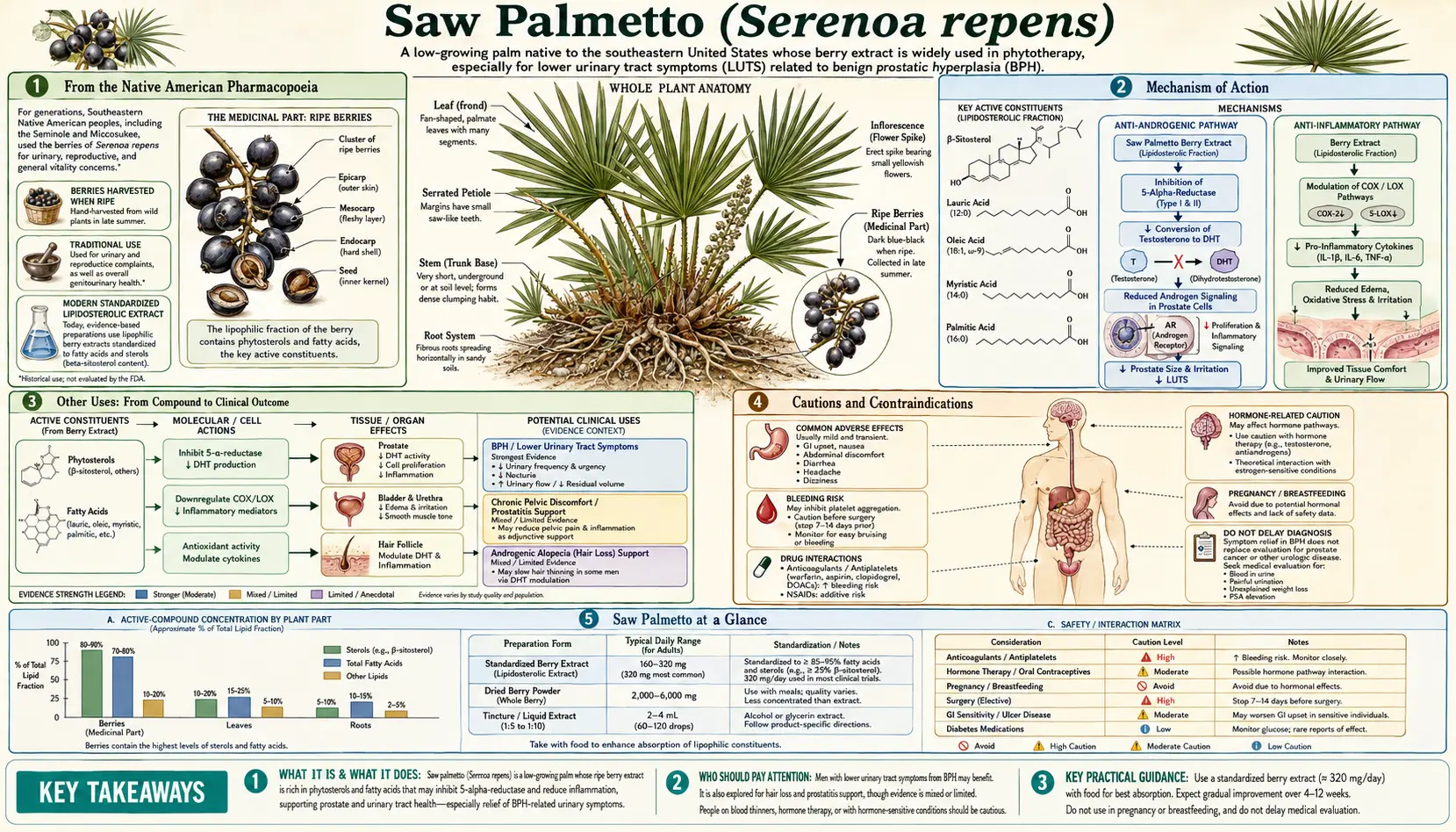
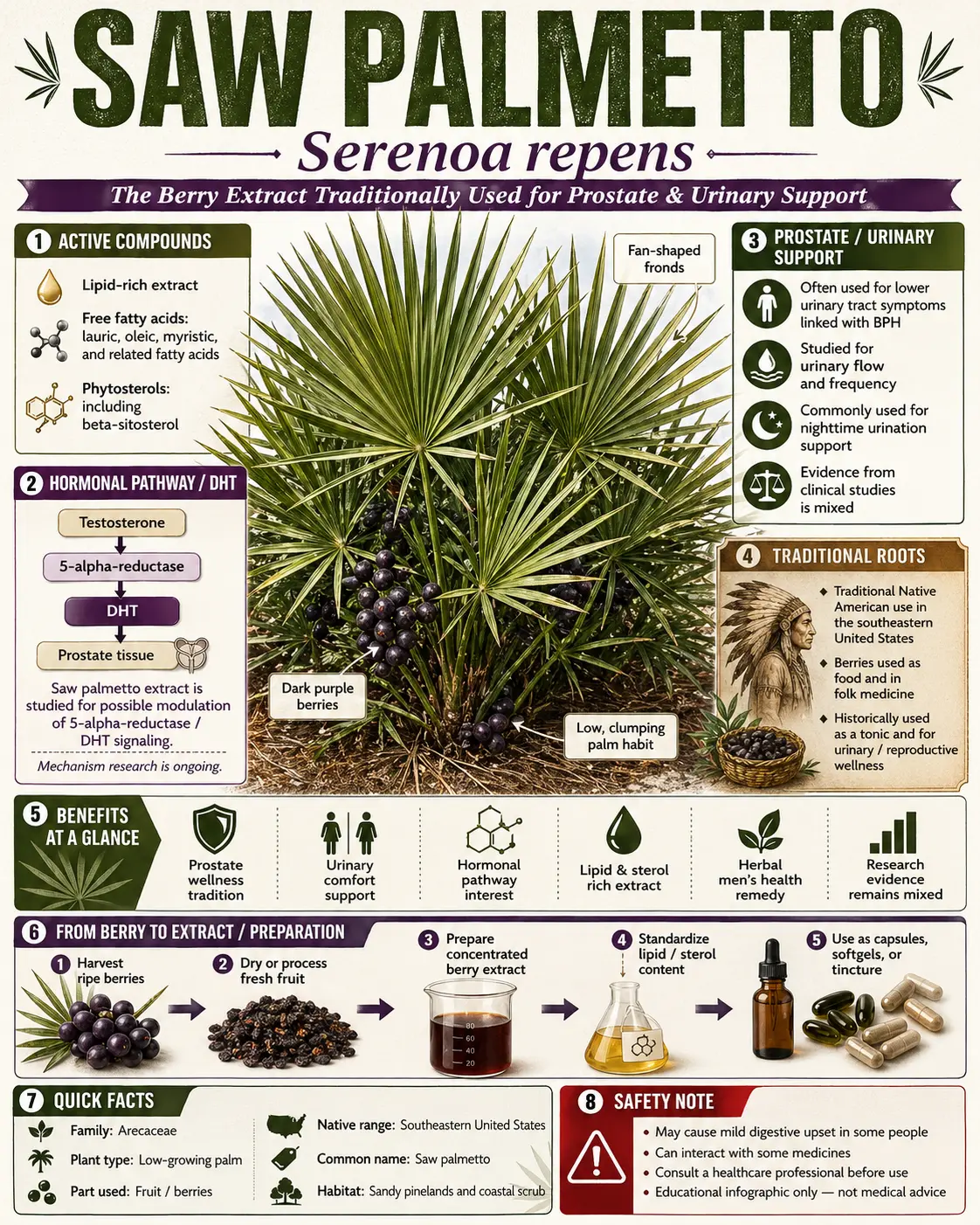
Table of Contents
From the Native American Pharmacopoeia
Saw palmetto is a small, ground-level palm native to the southeastern coastal United States, whose dark purple-black ripe berries were long used as food and medicine by the indigenous peoples of the region — most enduringly to support the ageing male urinary tract. Carried into print by a Savannah physician in 1879, it became an officially listed American drug, was revived in Europe as the standardized lipidosterolic extract, and is now one of the most studied of all botanical medicines — the fuller story is told in the dedicated History & Traditional Use article.
Active Compounds
Saw palmetto's active fraction is a complex mixture of fatty acids and sterols extracted from the dried, ripe berry by hexane, ethanol, or supercritical CO2:
- Free fatty acids — predominantly lauric, oleic, myristic, and palmitic acids; the largest fraction of the lipidosterolic extract
- Phytosterols — including beta-sitosterol, campesterol, stigmasterol, and lupeol
- Polyphenols — including epicatechin and procyanidins
- Flavonoids — in the whole berry, with antioxidant activity
The extract type matters. The lipidosterolic extract (typically 85-95% free fatty acids, 0.2-0.4% sterols) is the form used in clinical trials. Whole-berry powder, dried berry capsules, and aqueous extracts have not been shown to produce equivalent clinical effects and are not interchangeable with it. A hexane lipidosterolic extract is the most-studied preparation; the extract the European Medicines Agency’s 2015 monograph accepts for well-established use is a hexane extract containing 92% fatty acids.
Benign Prostatic Hyperplasia
Saw palmetto's primary use is for the lower urinary tract symptoms of benign prostatic hyperplasia (BPH). The EMA’s 2015 monograph accepts a hexane extract at 320 mg a day as a herbal medicine for the symptomatic treatment of BPH (well-established use). The large placebo-controlled trials and their reviews report:
- International Prostate Symptom Score (IPSS) — the 2023 Cochrane review (Franco and colleagues; 27 studies, 4,656 men) found little to no difference from placebo at 3 to 6 months (mean difference −0.90 points on the 35-point scale, high-certainty evidence) and at 12 to 17 months (0.07 points); in the 72-week CAMUS trial (Barry and colleagues, 2011; 369 men), up to three times the standard dose did not reduce symptoms more than placebo
- Maximum urinary flow rate — the 2012 Cochrane review (Tacklind and colleagues) found peak urine flow was not improved compared with placebo in three high-quality trials (mean difference 0.40 mL/s)
- Maximum urinary flow rate — modest improvements of 1-3 mL/sec
- Nocturia (nighttime urination) — in the 72-week CAMUS trial, nightly urination did not fall significantly compared with placebo
- Post-void residual urine volume — the one-year STEP trial (Bent and colleagues, 2006; 225 men) found no difference from placebo
- Quality of life — no difference from placebo in the STEP trial, and little to no difference at short- or long-term follow-up in the 2023 Cochrane review
Effects are smaller than alpha-blockers (tamsulosin, alfuzosin) for symptom relief and smaller than 5-alpha-reductase inhibitors (finasteride, dutasteride) for prostate volume reduction, but in the 2023 Cochrane review adverse events were about as common as on placebo, and saw palmetto avoids the sexual side effects (erectile dysfunction, decreased libido, retrograde ejaculation) that are common with pharmaceutical agents.
Its traditional and practitioner use is in men with mild to moderate benign prostatic hyperplasia who want fewer pharmaceutical side effects, often alongside lifestyle changes (caffeine reduction, evening fluid restriction, weight loss) before pharmaceutical therapy.
Mechanism of Action
Saw palmetto's effect on prostate symptoms appears to involve multiple mechanisms:
- 5-alpha-reductase inhibition — partial inhibition of the enzyme that converts testosterone to dihydrotestosterone (DHT), the more potent androgen that drives prostate growth; effect is weaker than pharmaceutical 5-ARIs
- Anti-inflammatory activity — reduces inflammatory cytokines (interleukin-6, IL-8) and inflammatory infiltrate in prostate tissue
- Anti-androgenic activity at the receptor level — inhibits binding of DHT to androgen receptors in prostate cells
- Smooth muscle relaxation — mild alpha-1 adrenergic blocking activity, contributing to symptom relief
- Apoptosis of prostate cells — promotes programmed cell death in hyperplastic prostate tissue at therapeutic concentrations
Importantly, saw palmetto does not significantly affect serum prostate-specific antigen (PSA) levels (the STEP trial found no change compared with placebo over one year; pharmaceutical 5-ARIs lower prostate-specific antigen by approximately 50%). This is clinically relevant because prostate-specific antigen monitoring for prostate cancer screening remains accurate during saw palmetto use.
Androgenic Alopecia (Hair Loss)
Because saw palmetto inhibits 5-alpha-reductase — the same enzyme target as pharmaceutical finasteride for male pattern hair loss — there has been interest in using it for androgenic alopecia. Small clinical trials have shown modest improvements in hair count and patient satisfaction with topical or oral saw palmetto, though effects are smaller than pharmaceutical 5-ARIs.
Men seeking a milder, lower-side-effect alternative to finasteride are the main users of saw palmetto for hair loss. Topical preparations may produce local effects with even less systemic exposure.
Other Uses
Beyond prostate symptoms and hair loss, saw palmetto has been studied for:
- Chronic prostatitis / chronic pelvic pain syndrome — modest evidence; often combined with stinging nettle and pygeum
- Female androgenic alopecia, polycystic ovary syndrome, and hirsutism — limited evidence; rationale based on 5-alpha-reductase inhibition
- Sexual function — a 2026 meta-analysis of six randomized trials in men with BPH (Dong and colleagues) found no significant effect on sexual function compared with placebo; not a reliable libido or erectile dysfunction (ED) treatment
Forms and Preparations
- Lipidosterolic extract (LSESr) — the form used in clinical trials; standardized to 85-95% fatty acids; the form the EMA monograph covers (a hexane extract for well-established use, an ethanol extract for traditional use)
- Standardized softgel capsules — 320 mg of LSESr in a single softgel; convenient daily dosing
- Whole dried berry capsules — traditional form; less reliable clinical effect
- Tea — minimal clinical relevance; the active compounds are lipid-soluble and poorly extracted by water
- Topical preparations for hair loss — typically 1-2% saw palmetto extract in a topical base
Dosage
- For benign prostatic hyperplasia symptoms — 320 mg of lipidosterolic extract daily, as a single dose or split as 160 mg twice daily (the EMA monograph’s dose); usually taken with food, which practitioners say improves absorption of the fat-soluble extract
- Onset — practitioners describe 8-12 weeks before symptoms change
- Duration — the EMA monograph states that long-term use is possible; the 2023 Cochrane review found no data on long-term adverse events, with trials lasting up to 17 months
- Duration — safe for indefinite daily use; long-term safety established to at least 3-5 years
- Combination protocols — practitioners often combine it with stinging nettle root, pumpkin seed extract, beta-sitosterol, and rye pollen for prostate support
Cautions and Contraindications
- Prostate cancer — the urinary symptoms of benign prostatic hyperplasia overlap with those of prostate cancer; a prostate-specific antigen (PSA) blood test and a digital rectal examination are the checks used to look for cancer. The EMA monograph’s traditional-use indication applies only after serious conditions have been excluded by a doctor, and it names fever, spasms or blood in the urine, painful urination, or being unable to pass urine (urinary retention) as warning signs
- Anticoagulants and antiplatelets — saw palmetto is reported to have mild antiplatelet activity; the EMA monograph notes a few cases of suspected interaction with warfarin, with raised INR values (a measure of how slowly blood clots)
- Anticoagulants and antiplatelets — saw palmetto has mild antiplatelet activity; case reports of increased bleeding with warfarin, aspirin, and clopidogrel
- Surgery — a 2001 case report (Cheema and colleagues) described severe bleeding during surgery in a man taking saw palmetto; his prolonged bleeding time returned to normal a few days after he stopped the herb
- Surgery — a stop at least two weeks before scheduled surgery is described, because of bleeding risk
- Women, pregnancy and breastfeeding — the EMA monograph lists pregnancy and breastfeeding as not relevant and states that there is no relevant indication for women, children and adolescents; its only contraindication is allergy (hypersensitivity) to the extract, and tests on reproductive toxicity have not been performed. Its anti-androgenic activity is the theoretical concern for a developing fetus
- Hormone-sensitive conditions — its effect on androgens (male hormones) matters in any condition where androgen modulation could be problematic
- Gastrointestinal (GI) side effects — mild nausea, abdominal discomfort, or diarrhea; the EMA monograph lists abdominal pain as common and nausea as uncommon, and notes such complaints especially when it is taken on an empty stomach
- Headache, dizziness — the EMA monograph lists headache as a common side effect
- Liver enzymes, rash, breast enlargement — the EMA monograph lists raised liver enzymes (transaminases or gamma-glutamyltransferase), skin rash, and reversible breast enlargement in men (gynecomastia) as uncommon side effects
Key Research Papers
- Franco JV, Trivisonno L, Sgarbossa NJ, et al. Serenoa repens for the treatment of lower urinary tract symptoms due to benign prostatic enlargement. Cochrane Database of Systematic Reviews. 2023;6(6):CD001423. — PubMed PMID: 37345871
- Tacklind J, Macdonald R, Rutks I, et al. Serenoa repens for benign prostatic hyperplasia. Cochrane Database of Systematic Reviews. 2012;12(12):CD001423. — PubMed PMID: 23235581
- Bent S, Kane C, Shinohara K, et al. Saw palmetto for benign prostatic hyperplasia. New England Journal of Medicine. 2006;354(6):557–566. — PubMed PMID: 16467543
- Barry MJ, Meleth S, Lee JY, et al. Effect of increasing doses of saw palmetto extract on lower urinary tract symptoms: a randomized trial. JAMA. 2011;306(12):1344–1351. — PubMed PMID: 21954478
- Dong C, Zheng J, Jiang Y. Effects of Serenoa repens extract on sexual function in patients with benign prostatic hyperplasia: a systematic review and meta-analysis. Sexual Medicine. 2026;14(6):qfag088. — PubMed PMID: 42751554
- Cheema P, El-Mefty O, Jazieh AR. Intraoperative haemorrhage associated with the use of extract of Saw Palmetto herb: a case report and review of literature. Journal of Internal Medicine. 2001;250(2):167–169. — PubMed PMID: 11489067
PubMed Topic Searches
The following PubMed search links provide curated entry points into the published clinical and mechanistic literature on Saw Palmetto (Serenoa repens). Each link opens directly in PubMed at the National Library of Medicine.
- Saw palmetto and 5-alpha reductase inhibition — PubMed: saw palmetto 5-alpha reductase
- Saw palmetto IPSS symptom improvement — PubMed: saw palmetto IPSS
- Hexane lipidosterolic extract clinical trials — PubMed: Serenoa repens hexane extract prostate
- Saw palmetto and androgenic alopecia hair loss — PubMed: saw palmetto alopecia
- Saw palmetto safety and PSA — PubMed: saw palmetto PSA safety
- Saw palmetto polyphenol fatty acid composition — PubMed: saw palmetto fatty acid composition