Neem (Azadirachta indica): History and Traditional Use
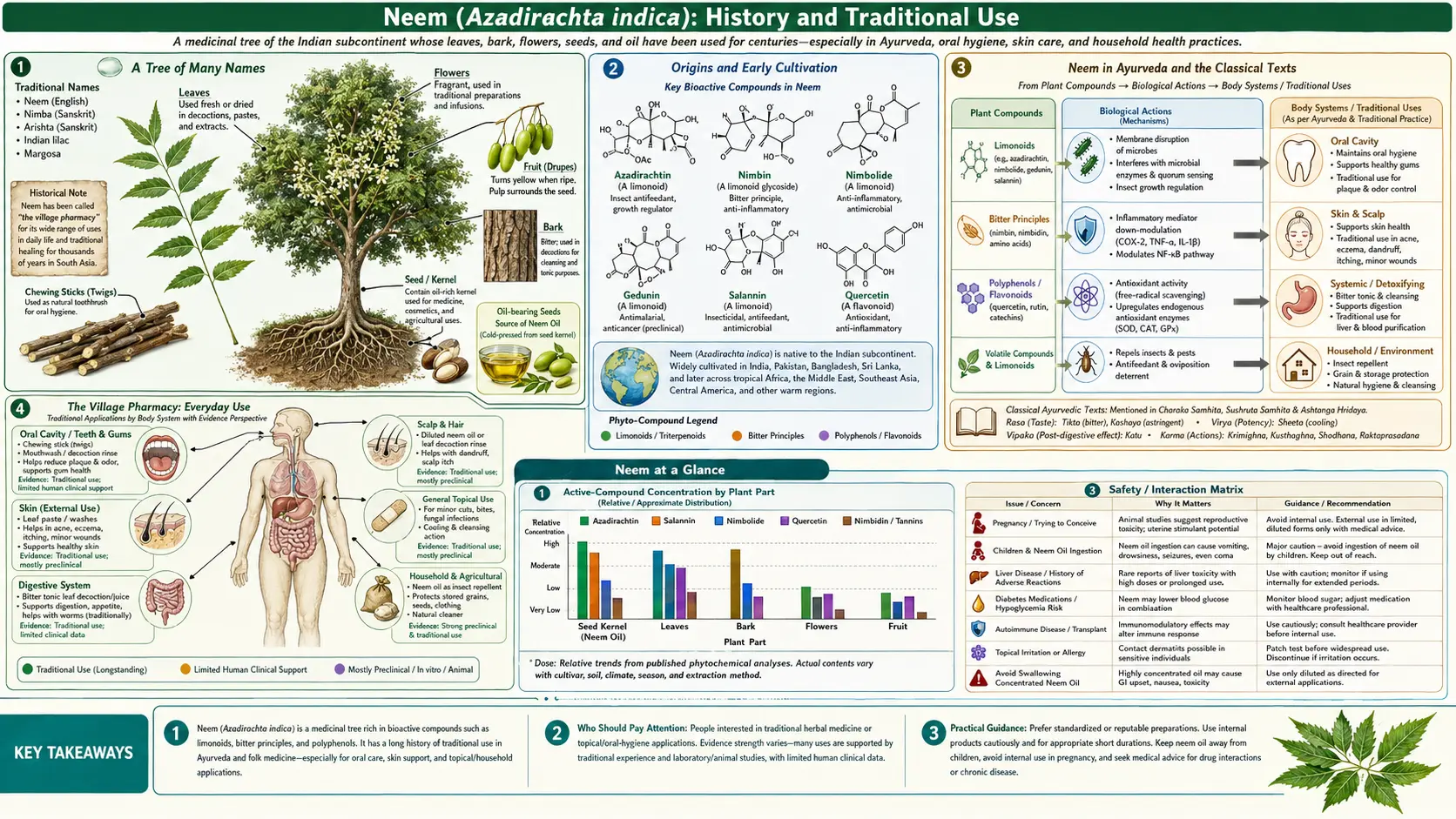
Few trees are as deeply woven into the daily life of a whole civilization as neem — the hardy evergreen Azadirachta indica of the Indian subcontinent. For thousands of years its leaves, bark, twigs, seeds, oil, and flowers have been used across India for fever, skin trouble, dental care, and pest control, earning it the affectionate nickname "the village pharmacy." This article traces that long story honestly — separating what the classical texts and the archaeological record actually support from the layers of tradition and folklore that have gathered around this remarkable tree, and ending with the genuinely documented modern moment, in 1968, when chemists first isolated the molecule that made neem world-famous.
Table of Contents
- A Tree of Many Names
- Origins and Early Cultivation
- Neem in Ayurveda and the Classical Texts
- The Village Pharmacy: Everyday Use
- Unani Medicine and Spread Beyond India
- Folklore, the Goddess, and Protective Custom
- From Folk Tree to the Laboratory: Azadirachtin
- The Neem Patent and a Landmark Ruling
- From Tradition to Modern Research
- Research Papers and References
- Connections
- Featured Videos
A Tree of Many Names
The tree we are tracing is Azadirachta indica A. Juss., a fast-growing evergreen of the mahogany family (Meliaceae), native to the Indian subcontinent and now planted across the dry tropics of Asia, Africa, and the Americas. Its botanical genus name, Azadirachta, descends through Latin from the Persian azad-dirakht, meaning roughly "free tree" or "noble tree" — a small reminder that the plant was prized far beyond India long before modern science took an interest in it.
In the languages of its homeland the names are even more telling. The common English word neem comes from the Hindi nīm, which in turn derives from the Sanskrit nimba. Sanskrit sources also call the tree arishta (also written arishtha), a word usually glossed as "reliever of sickness" or "the imperishable." Traditional accounts hold that more than fifty Sanskrit names were attached to neem over the centuries, each pointing to some quality or use of a part of the tree — a dense cloud of naming that is itself a kind of evidence, telling us the plant was familiar, valued, and worth describing in great detail across an enormous span of Indian history. (The often-repeated folk etymology that breaks nimba into a phrase meaning "that which gives good health" is best treated as traditional word-lore rather than settled linguistics.)
Origins and Early Cultivation
Neem is native to the Indian subcontinent — most likely the dry forests of India, Myanmar (Burma), and the surrounding region — and is extraordinarily well adapted to hot, arid, poor-soil conditions. It tolerates drought, grows quickly, and casts dense shade, qualities that made it one of the most commonly planted trees of Indian villages, temple grounds, and roadsides, and that later recommended it for planting across the semi-arid tropics worldwide.
Popular accounts frequently state that neem was already cultivated and used medicinally in the Indus Valley Civilization some 4,000 to 4,500 years ago. This claim appears widely, including in peer-reviewed reviews of the plant, and it is plausible given neem's range and usefulness; readers should know, however, that it is usually presented as a broad statement about the plant's antiquity rather than tied to a single, securely dated excavated find, so it is fairest to call it a strongly held traditional dating rather than a precisely pinned archaeological fact. What is not in doubt is that by the time of the classical Sanskrit medical compendia — well over two thousand years ago — neem was already a thoroughly established and carefully described medicinal tree, which is itself evidence of a long prior history of use.
Neem in Ayurveda and the Classical Texts
Neem holds a position of exceptional importance in Ayurveda, the classical medical tradition of the Indian subcontinent. It appears in the foundational Sanskrit compendia — the Charaka Samhita and the Sushruta Samhita, the great texts of internal medicine and of surgery respectively, whose core material is generally dated to the centuries around the start of the common era. These works describe neem in detail and recommend its leaves, bark, and oil for fevers, skin diseases, wounds, and inflammatory conditions, and within Ayurvedic theory the intensely bitter herb is classed as cooling and cleansing, a remedy to "purify" the blood and pacify conditions of heat and excess. The Charaka Samhita and Sushruta Samhita are named here as historical primary sources rather than as modern clinical citations.
The surgical tradition of the Sushruta Samhita is especially striking in hindsight. It recommends neem preparations for cleansing and dressing wounds and for care after surgery — an application that aligns closely with what modern laboratory work would much later describe as neem's antibacterial activity, though it would be anachronistic to claim the ancient authors understood it in those terms. Across the classical and later medieval Ayurvedic literature, including the medicinal lexicons known as nighantus, neem is one of the most frequently cited single plants, drawn on for an unusually wide range of complaints.
It is worth a careful word here, because accuracy matters on a health page: neem's prominence in Ayurveda is genuinely ancient and well documented, but Ayurveda is a traditional system of medicine, and the indications recorded in these texts describe historical practice and theory, not the results of modern clinical trials. The value of this record is that it tells us, with great consistency, how neem was used for two millennia — and it is precisely that consistency that later drew scientists to investigate the tree.
The Village Pharmacy: Everyday Use
Beyond the formal medical texts, neem became part of the texture of ordinary life across India, and it is this everyday, household use that earned it its best-loved description: "the village pharmacy." The phrase captures a real and well-attested pattern — a single abundant tree that supplied a poor rural household with a great many of its everyday remedies and necessities, free for the gathering. Almost every part had a customary use.
The most widespread of all was dental care. For generations, hundreds of millions of people across South Asia have cleaned their teeth with a fresh neem twig — the datun — chewing one end until it frays into soft bristles and then brushing with it, a daily ritual that delivers neem's bitter compounds straight to the gums. Neem leaves were boiled for a bitter wash or bath to soothe itchy, irritated, or eruptive skin; a leaf paste was applied to sores and wounds; and leaf decoctions were drunk for fevers. Branches were hung over doorways and stored among grain and woollen clothes to keep insects away, and dried leaves were tucked into books and bedding for the same reason. During outbreaks of smallpox and chickenpox, neem leaves were spread on and around the bed of the sick person and used to fan and bathe them — a custom that sat at the meeting point of practical care and religious observance, discussed in the folklore section below.
None of this required a physician or a text; it was carried forward by households, healers, and habit. That combination — cheap, abundant, multipurpose, and close at hand — is the quiet reason neem was never forgotten and never had to be deliberately revived: it was always already there, growing in the courtyard.
Unani Medicine and Spread Beyond India
Neem also entered Unani medicine, the Greco-Arabic medical system (its name from the Arabic word for "Greek") that carried the classical inheritance through the Islamic world and into South Asia. Unani physicians, working within their own framework of bodily "temperaments," adopted neem for its purifying and antimicrobial-style qualities and used it for skin conditions, fevers, and infections — a parallel professional tradition that reinforced, in a different medical language, the same broad cluster of uses found in Ayurveda.
From its homeland neem travelled widely. Carried by migration, trade, and later by deliberate forestry programmes that valued its drought-hardiness, the tree was established across South and Southeast Asia, the Middle East, much of sub-Saharan Africa, and eventually the Caribbean, Central America, and Australia. In several parts of Africa in particular, neem was taken up into local healing practice after its introduction and became a valued household remedy — commonly reported uses include leaf preparations taken for fever and malaria and applied for skin complaints. As with the Indian material, these are records of traditional and cultural practice rather than modern clinical recommendations, but the pattern is consistent: wherever neem was planted, people seem to have arrived independently at a strikingly similar set of uses, centred on the skin, on fevers, and on keeping insects and infection at bay.
Folklore, the Goddess, and Protective Custom
Alongside its medicine, neem gathered a thick layer of religious and protective lore, especially in connection with disease. In parts of Hindu tradition, particularly across North India, neem is closely associated with Shitala (also written Sheetala or Sitala), a goddess whose name means "the cool one" and who is venerated as presiding over smallpox, chickenpox, and other fevers — both able to send such illnesses and to protect against and cool them. In her iconography the goddess is commonly shown holding a sprig of neem leaves, and in the south a comparable role is held by the goddess Mariamman. During smallpox and chickenpox, the practice of laying neem leaves on the patient's bed and bathing or fanning them with neem was understood at once as soothing care and as honouring the goddess. Folk legend even speaks of the goddess (or, in some tellings, a group of sister-deities) dwelling in the neem tree itself. These beliefs are religious folklore and are recounted here as cultural history, not as medical guidance.
More broadly, neem branches, leaves, and the smoke of burning leaves were widely used as a protective charm — hung at doorways, carried, or burned to ward off evil spirits, the "evil eye," and ill fortune, and especially to guard a mother and newborn in the vulnerable days just after childbirth. The tree's evergreen vigour, its bitterness (a quality traditionally linked to purification), and its real, observable power to repel insects all fed naturally into this symbolic role. Neem leaves also feature in seasonal custom: in several regions a few bitter neem leaves are eaten at the spring new-year festivals (such as Ugadi and Gudi Padwa), often paired with something sweet, as a small ritual reminder that life holds both the bitter and the sweet. Taken together, this body of lore shows that neem was never merely a drug or a useful timber — it was bound into the symbolic and religious life of the communities that lived beneath it, a status reserved for only the most familiar and valued of plants.
From Folk Tree to the Laboratory: Azadirachtin
For most of its long history neem's reputation rested entirely on tradition and everyday experience. That began to change in the twentieth century, when chemists set out to ask what was actually in the tree that made it so effective against insects. The pivotal documented milestone came in 1968, when J. H. Butterworth and E. D. Morgan, working at the University of Keele in England, first isolated a pure compound from neem seeds that powerfully deterred feeding by the desert locust (Schistocerca gregaria). They named it azadirachtin, after the tree. Their report in the journal Chemical Communications is the moment neem's folk reputation as an insect-repelling tree acquired a specific chemical identity.
Azadirachtin turned out to be a fearsomely complex molecule — a highly oxygenated limonoid — and working out its full chemical structure took chemists into the 1980s. Its difficulty made it a celebrated target for chemical synthesis; the total synthesis of azadirachtin was finally completed in 2007 by the group of Steven V. Ley at the University of Cambridge, after more than two decades of effort. The full arc of this work — the isolation, the structure, and the synthesis — is told in the authoritative review pointedly titled The Azadirachtin Story by Veitch, Boyer, and Ley (2008), listed below.
Naming Butterworth, Morgan, and Ley here reflects genuinely documented scientific milestones — the kind of specific, verifiable, dated claims that distinguish the modern chapter of neem's history. It is worth being clear about what they did and did not do: they isolated, characterized, and synthesized a single compound. No one person discovered, founded, or invented neem itself. Like every great medicinal plant, neem emerged into human use gradually and anonymously, across many cultures and many centuries, long before anyone could name a molecule in it.
The Neem Patent and a Landmark Ruling
The modern scientific interest in neem also produced one of the most famous episodes in the history of traditional knowledge and intellectual property. In 1995 the European Patent Office granted a patent — held by the United States Department of Agriculture and the chemical company W. R. Grace — on a method of using oil extracted from neem seeds to control fungus on plants. To many in India, the idea of patenting a use of neem was indefensible, because neem's pest- and disease-controlling properties had been common knowledge and common practice across the subcontinent for centuries.
A legal challenge was mounted by a coalition that included the Indian scientist and activist Vandana Shiva, the International Federation of Organic Agriculture Movements (IFOAM), and the European politician Magda Aelvoet. They argued that the patented use was not genuinely new — that it merely described knowledge neem-using communities had held for generations. The European Patent Office agreed: it revoked the patent in 2000, and after an appeal it upheld that revocation on 8 March 2005. The case is widely cited as the first time the European Patent Office struck down a patent on grounds connected to "biopiracy" — the appropriation of traditional knowledge — and it remains a landmark in debates over who owns the uses of a plant that an entire civilization helped discover.
From Tradition to Modern Research
The shape of neem's history is the classic shape of how a folk medicine becomes a research subject. For thousands of years — from the dry forests of its origin, through the pages of the Charaka and Sushruta Samhitas, the courtyards and grain stores of countless villages, and the rituals around a goddess of fevers — people across India and, later, much of the tropical world used neem in remarkably consistent ways: for the skin, for fevers, for the teeth, for wounds, and to drive off insects and infection. In the modern era, science has begun to test that inheritance. The isolation of azadirachtin gave neem's reputation a chemical address, and a large body of laboratory and clinical work now examines extracts of the leaf, bark, seed, and oil and the many compounds within them.
That the United States National Research Council devoted an entire 1992 report to the tree — Neem: A Tree for Solving Global Problems — is a measure of how seriously this once-local plant came to be taken on the world stage, particularly for low-cost pest control and forestry in the developing world. The traditional record raised the questions; modern research is now testing the answers.
A closing note of honesty is owed to anyone reading this for health reasons. Neem's history is genuinely impressive and its traditional reputation is being investigated seriously — but a long tradition is a reason to study a remedy, not a proof that it works, and some of neem's preparations (particularly the concentrated seed oil) carry real safety cautions, including in pregnancy and in young children. Neem is best thought of as a fascinating traditional plant and a companion to good medical care, never a substitute for it. The detailed modern evidence — what the studies actually show for the skin, the teeth, blood sugar, and infection — is taken up in the companion Neem Benefits articles and on the main Neem page.
Research Papers and References
The list below combines key peer-reviewed reviews of Azadirachta indica with curated PubMed topic-search links into the historical, ethnobotanical, and pharmacological literature. Historical primary texts (the Charaka Samhita and the Sushruta Samhita) and the religious folklore around the goddess Shitala are named in the article as historical and cultural sources rather than as modern citations. Reference links open in a new tab.
- Veitch GE, Boyer A, Ley SV. The azadirachtin story. Angewandte Chemie International Edition. 2008;47(49):9402-9429. — doi:10.1002/anie.200802675
- Biswas K, Chattopadhyay I, Banerjee RK, Bandyopadhyay U. Biological activities and medicinal properties of neem (Azadirachta indica). Current Science. 2002;82(11):1336-1345. — Current Science (full-text PDF)
- Subapriya R, Nagini S. Medicinal properties of neem leaves: a review. Current Medicinal Chemistry — Anti-Cancer Agents. 2005;5(2):149-156. — doi:10.2174/1568011053174828
- National Research Council. Neem: A Tree for Solving Global Problems. Washington, DC: National Academy Press; 1992. — doi:10.17226/1924 (also NCBI Bookshelf NBK234646)
- European Patent Office revokes the neem fungicide patent on grounds of prior traditional use (2000; upheld on appeal 8 March 2005) — European Commission (CORDIS): EPO revokes neem patent
- Azadirachta indica ethnobotany, history, and traditional use — PubMed: Azadirachta indica ethnobotany and traditional use
- Neem in Ayurveda and traditional Indian medicine — PubMed: neem in Ayurveda and traditional medicine
External Authoritative Resources
- NCCIH — Herbs at a Glance
- MedlinePlus — Herbs and Supplements
- PubMed — All research on Azadirachta indica
Connections
- All Herbs
- Neem (Azadirachta indica)
- Neem Benefits
- Turmeric
- Holy Basil
- Ashwagandha
- Tea Tree
- Bitter Melon