Moringa
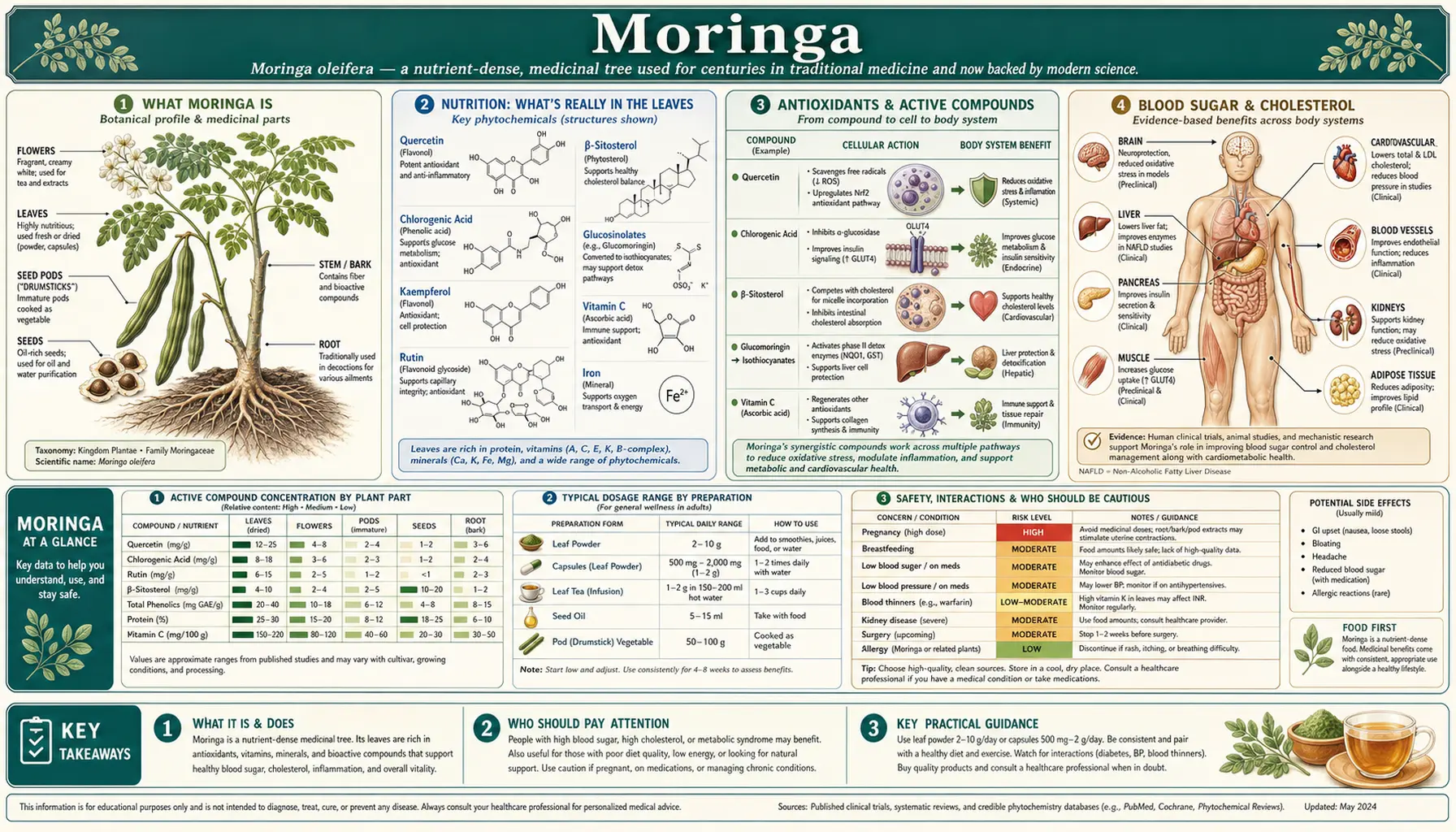
Moringa (Moringa oleifera) is a fast-growing tree native to the foothills of the Himalayas in northwest India and now grown across South Asia, Africa, and other tropical regions. It goes by many names — the drumstick tree (after its long, slender seed pods), the horseradish tree (after the sharp taste of its roots), and, in marketing circles, the "miracle tree." Almost every part is used: the leaves are eaten as a green vegetable and dried into a powder, the immature pods are cooked like beans, and the seeds are pressed for oil or used to help clarify water. Moringa is genuinely valuable — it is drought-tolerant, nutrient-dense, and an important food crop for nutrition security in parts of the world where fresh vegetables are scarce. But it is also wrapped in exaggerated claims. This page separates what Moringa really offers from the viral numbers that oversell it, looks honestly at the human research, and explains which parts of the plant are safe food and which parts you should leave alone.
Table of Contents
- What Moringa Is
- Nutrition: What's Really in the Leaves
- Antioxidants & Active Compounds
- Blood Sugar & Cholesterol
- Inflammation & Blood Pressure
- Food & Culinary Uses
- Safety: The Leaf vs. the Root
- Medication Interactions
- Research Papers
- Connections
- Featured Videos
What Moringa Is
Moringa oleifera is the most widely cultivated species in a small family of trees (Moringaceae) built for tough conditions. It grows remarkably fast — several meters in a single year — tolerates drought and poor soil, and produces edible leaves almost year-round in warm climates. Those traits are the real reason it matters: a household in a dry region can grow a tree that reliably yields fresh green leaves when little else will grow. Aid organizations and nutrition programs have promoted it for exactly this reason, as a locally grown, low-cost source of vitamins, minerals, and protein.
Different parts of the tree are used differently, and the distinctions matter a great deal for both nutrition and safety:
- Leaves — the part most people mean by "moringa." Eaten fresh as a cooked green or dried and milled into a fine green powder. This is the well-studied, food-safe part.
- Pods ("drumsticks") — the long immature seed pods, cooked as a vegetable in South Asian and other cuisines. The tree's common name comes from them.
- Seeds — found inside mature pods. Roasted and eaten in small amounts, pressed for ben oil (also called behen oil), or crushed and used traditionally to help settle particles out of murky water.
- Flowers — edible when cooked.
- Roots and root bark — sometimes scraped for a pungent, horseradish-like condiment, but they carry concentrated alkaloids and are the part to be cautious about (see Safety).
When you buy "moringa" as a supplement, you are almost always buying dried leaf powder in a bag or in capsules. Keeping the leaf clearly separate from the root is one of the most practical safety points on this whole page.
Nutrition: What's Really in the Leaves
Moringa leaves are a legitimately good leafy green. The problem is not the plant — it is the marketing, which stacks a specific set of exaggerated comparisons on top of a genuinely useful food. Let's do both halves honestly.
What the leaves actually provide
Fresh Moringa leaves (about 100 grams, roughly a generous cup once chopped) supply, in approximate ranges reported across composition reviews:
- Protein — about 6–9 g, high for a leafy green, and containing all nine essential amino acids (though in modest total amounts per realistic serving).
- Provitamin A (beta-carotene) — a substantial source; the deep green color reflects real carotenoid content that the body can convert toward vitamin A.
- Vitamin C — roughly on the order of a citrus fruit in the fresh leaf, but much of it is destroyed by drying and heat (an important caveat below).
- Calcium — a genuinely good plant source, on the order of a couple hundred milligrams per 100 g of fresh leaf.
- Iron and potassium — present in useful amounts, with the caveat that the iron is the plant (non-heme) form, which the body absorbs less efficiently than iron from meat.
- Antioxidant compounds — flavonoids and phenolic acids, discussed in the next section.
Dried leaf powder concentrates these numbers because the water is removed — fresh leaves are roughly three-quarters water, so drying multiplies the per-100-gram figures by about seven to nine times. That is why powder charts show such dramatic per-100-gram values for protein, calcium, and iron. It is a real concentration effect, but it is also the source of the confusion, because nobody eats 100 grams of powder.
The "X times the vitamin C of oranges" problem
You have probably seen the chart: "7× the vitamin C of oranges, 4× the calcium of milk, 4× the vitamin A of carrots, 3× the potassium of bananas, 2× the protein of yogurt." These lines trace back to a widely reproduced promotional table, and they are misleading for two specific reasons:
- They compare dried powder to fresh foods. The moringa figure is per 100 g of dehydrated leaf powder; the orange, milk, carrot, and banana figures are per 100 g of the whole, water-rich food. Remove the water from anything and its per-weight nutrients soar. Comparing dried moringa to a fresh orange is like comparing raisins to grapes and being amazed the raisins are "sweeter per gram."
- They ignore serving size. A realistic serving of moringa powder is 1–2 teaspoons (about 2–6 grams), not 100 grams. Scale the claims down to a real serving and they shrink dramatically. A rounded tablespoon of powder (roughly 6 g) delivers on the order of 100–140 mg of calcium (about a third of a small glass of milk, not four glasses), a milligram or two of non-heme iron, well under 100 mg of potassium (a banana has around 400 mg), and roughly 1.5–2 g of protein. Useful additions to a meal — but a long way from the headline multiples.
Vitamin C deserves its own note, because it is where the marketing is most backwards. Vitamin C is fragile: it degrades with heat, light, and time. The fresh leaf can hold a respectable amount, but the drying and storage that produce the powder most people buy destroy a large fraction of it. So the very "7× the orange" claim is applied to the exact form — dried powder — in which vitamin C is least reliable.
The honest bottom line on nutrition
Moringa leaf powder is a nutrient-dense green worth adding to a diet, not a multivitamin in a spoon. Its real, defensible value is greatest exactly where it is most needed: as an inexpensive, home-grown, shelf-stable green that can meaningfully improve diets in regions where fresh produce, protein, and micronutrients are hard to come by. For someone already eating a varied diet with fruits, vegetables, and protein, a spoonful of moringa is a modest, healthy extra — not a transformation. Both of those statements are true at the same time, and the honest version of moringa lives in holding them together.
Antioxidants & Active Compounds
Beyond basic nutrition, Moringa leaves contain a mix of plant compounds that account for most of the biological interest in the plant. The best-characterized groups are:
- Flavonoids — chiefly quercetin and kaempferol (and their sugar-bound forms). These are common plant antioxidants also found in onions, apples, and tea.
- Phenolic acids — especially chlorogenic acid, the same compound abundant in coffee, which influences how sugar is handled after a meal in laboratory studies.
- Glucosinolates and isothiocyanates — Moringa's more distinctive chemistry. The leaves contain unusual, stable glucosinolates (notably glucomoringin) that convert into isothiocyanates such as moringin. These sulfur-containing compounds are chemically related to the pungent molecules in mustard, horseradish, and broccoli sprouts, and they are the compounds most implicated in Moringa's anti-inflammatory and metabolic effects in the laboratory.
- Carotenoids and tocopherols — beta-carotene and vitamin E forms that add to the leaf's antioxidant capacity.
In test-tube and cell studies, extracts rich in these compounds mop up reactive oxygen species and dampen inflammatory signaling. This is genuine and reproducible chemistry, and it is the reasonable basis for studying Moringa in metabolic and inflammatory conditions. The important caution is one that applies to almost every plant: strong antioxidant activity in a test tube does not automatically translate into a measurable health benefit in a person, because how much of a compound is absorbed, converted, and delivered to tissues is a separate question. The distinctive isothiocyanate chemistry is a good reason for interest, not proof of a cure.
Blood Sugar & Cholesterol
The two most-studied health claims for Moringa leaf are that it helps control blood sugar and improves cholesterol. Here the evidence is genuinely promising but still preliminary — a mix of encouraging animal studies and small, often short human trials, not the large, long, high-quality trials that would settle the matter.
Blood sugar
The blood-sugar story rests on three tiers of evidence. In animal studies, Moringa leaf extracts have repeatedly lowered blood glucose in diabetic rats and mice, an effect consistent enough that reviewers treat it as a real biological signal. Mechanistically, the chlorogenic acid and isothiocyanate content plausibly slow the absorption of sugar and improve how cells respond to insulin. In humans, the data are thinner but pointed in the same direction: one classic study found that adding Moringa leaf to a meal reduced the rise in blood sugar and insulin afterward in people with diabetes, and several small trials since have reported modest reductions in fasting or after-meal glucose. Review articles that gather this literature describe Moringa as a promising candidate for supporting glucose control, while being explicit that the human trials are small, short, and varied in quality.
The honest takeaway: Moringa is a reasonable, food-based addition for someone managing blood sugar, but it is not a treatment for diabetes and not a substitute for medication. Because the effect is real enough to matter, anyone on diabetes medication who adds a meaningful amount of Moringa should monitor their blood sugar and talk to their clinician, precisely because the effects can stack (see Medication Interactions).
Cholesterol and blood lipids
Moringa's effect on cholesterol follows a similar shape. In animal models — rabbits and rodents fed high-fat diets — water extracts of Moringa leaf have lowered total and LDL ("bad") cholesterol and reduced early markers of artery plaque. A frequently cited study in cholesterol-fed rabbits reported both lipid-lowering and anti-atherosclerotic effects from the leaf extract. Human confirmation is limited to a handful of small trials with mixed and modest results. So the fair summary is: consistent and encouraging in animals, only lightly tested in people. Promising, not proven.
Inflammation & Blood Pressure
Anti-inflammatory activity is where Moringa's distinctive isothiocyanate chemistry is most interesting. Purified, water-extractable isothiocyanates from the leaf have been shown to reduce inflammatory signaling in cell and animal models, quieting some of the same pathways targeted by conventional anti-inflammatory approaches. This is mechanistically meaningful preclinical work. What it is not yet is a body of human trials showing that eating Moringa reduces inflammation-driven disease — that step has largely not been taken, so the anti-inflammatory reputation is built on laboratory and animal evidence rather than clinical proof.
Blood pressure has been studied less. Certain Moringa compounds — including some of its isothiocyanate and thiocarbamate glycosides — have relaxed blood vessels and lowered blood pressure in animal experiments, and a few small human observations hint in the same direction. The evidence base here is genuinely thin, so blood-pressure benefits should be treated as an early hypothesis, not an established effect. As with blood sugar, the practical point is caution about stacking: if Moringa does nudge blood pressure downward and you are already on blood-pressure medication, the combination could lower it more than intended.
Food & Culinary Uses
Long before it was a supplement, Moringa was simply food — and the culinary tradition is the safest and most time-tested way to use it. Different parts feature in cuisines across South Asia, Southeast Asia, and Africa:
- Leaves — cooked much like spinach: wilted into soups, stews, curries, dals, and stir-fries, or added to eggs and rice. In the Philippines the leaves ("malunggay") are a classic addition to the chicken soup tinola; in South India, East Africa, and West Africa the leaves go into a wide range of everyday dishes. Light cooking preserves more of the vitamin C and carotenoids than long boiling.
- Dried leaf powder — the modern convenience form. Stirred into smoothies, juices, yogurt, soups, and sauces, or steeped as a mild, grassy tea. A spoonful is the usual serving; more is not better, and large amounts can taste bitter and sit heavily.
- Pods (drumsticks) — the immature green pods are a beloved vegetable, cooked like green beans and famous in South Indian sambar and many curries. The tender inner flesh and seeds are scraped out and eaten.
- Seeds — mature seeds can be roasted and eaten in small quantities like a nut, or boiled. Pressed, they yield ben oil, a stable, mild cooking and cosmetic oil. Crushed raw seeds are also used traditionally to help clarify muddy water, because a protein in them makes suspended particles clump and settle.
- Flowers — edible when cooked, sometimes battered and fried or added to dishes.
Used as food — leaves, pods, a spoon of powder — Moringa has a long, safe track record. The cautions on this page are almost entirely about concentrated extracts and the root, not about cooking with the leaves and pods.
Safety: The Leaf vs. the Root
The single most important safety message about Moringa is that the plant is not uniformly safe part-for-part. The leaves are food; the root is not.
Leaves and pods are well tolerated. Populations have eaten them for generations, and human studies of leaf and leaf powder generally report good tolerability at food-level and typical supplement doses, with only mild, occasional digestive complaints (loose stools, an upset stomach) — more likely at large powder doses. As a food, the leaf has an excellent safety record.
Root, root bark, and bark are a different story. These parts concentrate alkaloids — including a compound often described as spirochin and a group of benzylamine alkaloids — that can affect the nervous system and, in concentration, be toxic. Traditional medicine has long used the root as an abortifacient and to bring on menstruation, which is exactly why it is dangerous in pregnancy. The pungent "horseradish tree" condiment made from the root should be regarded as a folk use to avoid, not a safe seasoning.
Pregnancy: the clear, cautious rule is to avoid the root, root bark, and bark entirely during pregnancy, given their traditional abortifacient use and alkaloid content. Concentrated leaf extracts and high-dose supplements also lack good safety data in pregnancy and are best avoided in favor of ordinary food amounts of the leaf. (Moringa leaf is traditionally used in some cultures to support breast-milk production after birth, and small studies have looked at this, but that is a separate, post-pregnancy question.)
Seeds and seed extracts: a few roasted seeds as food are one thing; concentrated seed extracts are another. High doses of seed extract have shown signs of toxicity, including effects on cells and organs, in some laboratory studies. Treat seed extracts and any very concentrated moringa product with the same caution you would give any potent botanical extract, and stick to leaf-based products from the food tradition unless a knowledgeable clinician advises otherwise.
In short: cook with the leaves and pods freely; use leaf powder in sensible spoonfuls; and leave the root, bark, and concentrated seed extracts alone — especially if you are or might be pregnant.
Medication Interactions
Because Moringa leaf has real, if modest, biological activity, it can interact with several kinds of medication. These interactions are precisely the flip side of its potential benefits — the same blood-sugar-lowering that looks helpful can become a problem if it adds to a drug doing the same job. Talk to a doctor or pharmacist before combining meaningful amounts of Moringa with:
- Diabetes medications — insulin, metformin, sulfonylureas, and others. Moringa's own glucose-lowering effect can add to theirs and push blood sugar too low (hypoglycemia). Monitor your levels and adjust only with medical guidance.
- Blood-pressure medications — because Moringa may modestly lower blood pressure, combining it with antihypertensive drugs could cause blood pressure to drop further than intended, with dizziness or lightheadedness.
- Thyroid medications / thyroid conditions — animal studies suggest Moringa leaf can alter thyroid hormone levels. For anyone taking thyroid hormone (such as levothyroxine) or being treated for a thyroid disorder, this raises the possibility of interference, so use is worth discussing with the prescribing clinician and, if used, monitoring.
More generally, if you take prescription medication, are pregnant or breastfeeding, or have a chronic condition, mention Moringa supplements to your healthcare provider — not because the leaf is dangerous as food, but because concentrated daily supplementation is a different exposure than an occasional cooked green, and a two-minute conversation avoids the avoidable problems.
Research Papers
- Anwar F, Latif S, Ashraf M, Gilani AH. Moringa oleifera: a food plant with multiple medicinal uses. Phytotherapy Research. 2007;21(1):17–25. doi:10.1002/ptr.2023 — A foundational review of the plant's food and traditional-medicine uses across its leaves, pods, seeds, and other parts.
- Leone A, Spada A, Battezzati A, Schiraldi A, Aristil J, Bertoli S. Cultivation, genetic, ethnopharmacology, phytochemistry and pharmacology of Moringa oleifera leaves: an overview. International Journal of Molecular Sciences. 2015;16(6):12791–12835. doi:10.3390/ijms160612791 — A comprehensive review of leaf composition and pharmacology; a good anchor for realistic nutrient figures.
- Leone A, Spada A, Battezzati A, Schiraldi A, Aristil J, Bertoli S. Moringa oleifera seeds and oil: characteristics and uses for human health. International Journal of Molecular Sciences. 2016;17(12):2141. doi:10.3390/ijms17122141 — Reviews the composition and uses of the seeds and ben oil, relevant to their culinary and safety profile.
- Gopalakrishnan L, Doriya K, Kumar DS. Moringa oleifera: a review on nutritive importance and its medicinal application. Food Science and Human Wellness. 2016;5(2):49–56. doi:10.1016/j.fshw.2016.04.001 — Summarizes the nutrient and phytochemical content of the leaves, pods, and seeds.
- Saini RK, Sivanesan I, Keum YS. Phytochemicals of Moringa oleifera: a review of their nutritional, therapeutic and industrial significance. 3 Biotech. 2016;6(2):203. doi:10.1007/s13205-016-0526-3 — Details the flavonoids, phenolic acids, and glucosinolate-derived isothiocyanates behind Moringa's biological activity.
- Vergara-Jimenez M, Almatrafi MM, Fernandez ML. Bioactive components in Moringa oleifera leaves protect against chronic disease. Antioxidants. 2017;6(4):91. doi:10.3390/antiox6040091 — Reviews the antioxidant and anti-inflammatory constituents of the leaf and their proposed roles in metabolic disease.
- Mbikay M. Therapeutic potential of Moringa oleifera leaves in chronic hyperglycemia and dyslipidemia: a review. Frontiers in Pharmacology. 2012;3:24. doi:10.3389/fphar.2012.00024 — Focused review of the blood-sugar and blood-lipid evidence, candid about the preliminary nature of the human data.
- William F, Lakshminarayanan S, Chegu H. Effect of some Indian vegetables on the glucose and insulin response in diabetic subjects. International Journal of Food Sciences and Nutrition. 1993;44(3):191–195. doi:10.3109/09637489309017439 — An early human study finding that Moringa leaf reduced the glucose and insulin rise after a meal in people with diabetes.
- Chumark P, Khunawat P, Sanvarinda Y, et al. The in vitro and ex vivo antioxidant properties, hypolipidaemic and antiatherosclerotic activities of water extract of Moringa oleifera Lam. leaves. Journal of Ethnopharmacology. 2008;116(3):439–446. doi:10.1016/j.jep.2007.12.010 — A cholesterol-fed rabbit study reporting lipid-lowering and anti-atherosclerotic effects of the leaf extract.
- Waterman C, Cheng DM, Rojas-Silva P, et al. Stable, water extractable isothiocyanates from Moringa oleifera leaves attenuate inflammation in vitro. Phytochemistry. 2014;103:114–122. doi:10.1016/j.phytochem.2014.03.028 — Characterizes the leaf's distinctive isothiocyanates and shows anti-inflammatory activity in cell models.
- Stohs SJ, Hartman MJ. Review of the safety and efficacy of Moringa oleifera. Phytotherapy Research. 2015;29(6):796–804. doi:10.1002/ptr.5325 — A safety-focused review concluding leaves and seeds are well tolerated while flagging cautions around other plant parts and high-dose extracts.
- Kou X, Li B, Olayanju JB, Drake JM, Chen N. Nutraceutical or pharmacological potential of Moringa oleifera Lam. Nutrients. 2018;10(3):343. doi:10.3390/nu10030343 — A balanced overview weighing Moringa's nutritional value against the strength of the health-claim evidence.
Connections
- Fluoride Chelation — mineral replacement during a fluoride flush
- All Herbs
- Turmeric
- Fenugreek
- Bitter Melon
- Gymnema
- Vitamin A
- Vitamin C
- Iron
- Calcium