Moringa Benefits
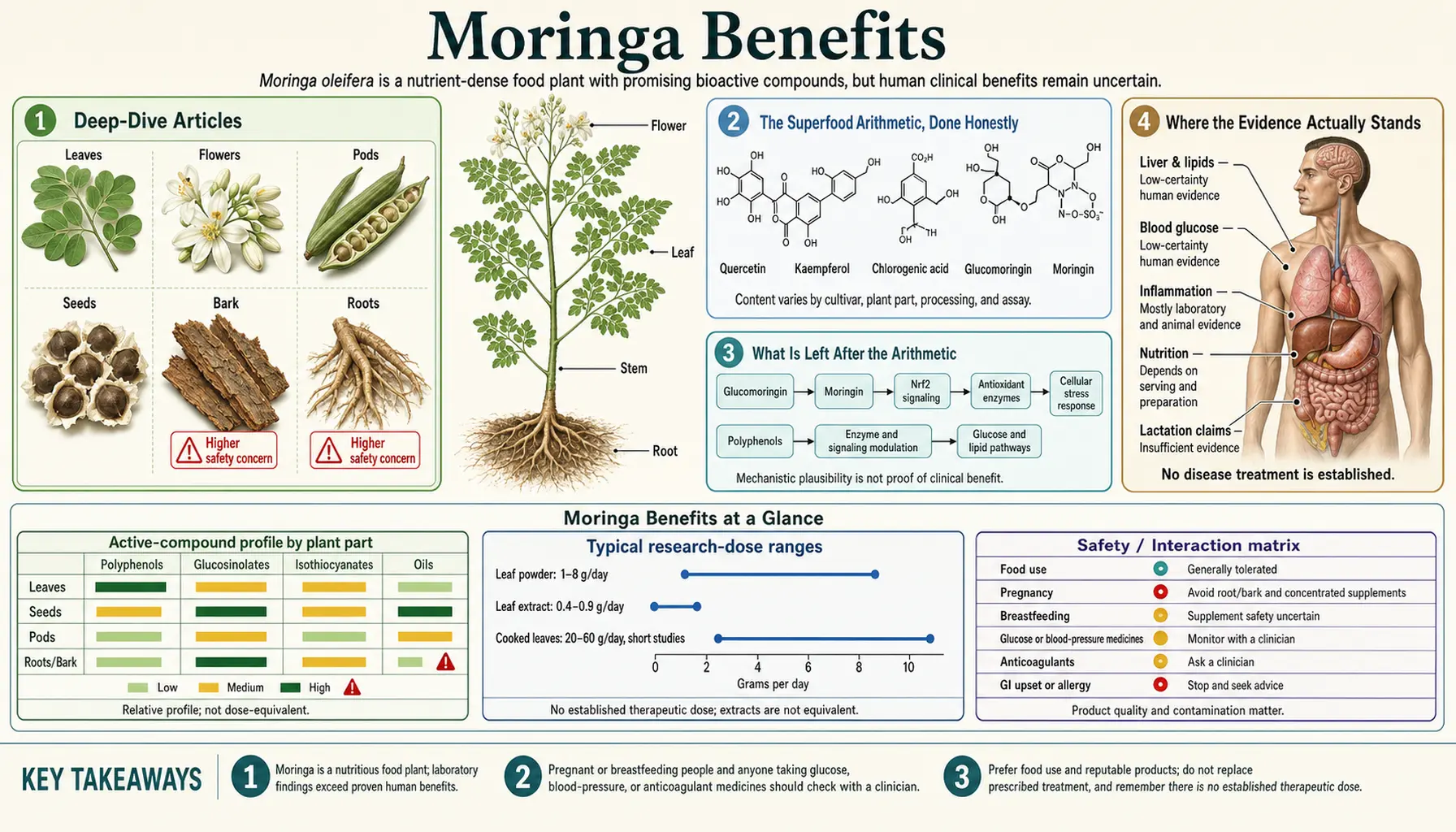
Moringa (Moringa oleifera, family Moringaceae) is a fast-growing tree from the Himalayan foothills of northwest India, now planted across the tropics. It is called the drumstick tree for its long, slender seed pods and the horseradish tree for the sharp bite of its roots. The leaves are cooked as a green vegetable or dried into a fine powder; the immature pods are a staple vegetable in South Indian cooking; the seeds are pressed for ben oil or crushed to help clear muddy water.
Moringa is also the most oversold plant in the supplement aisle. Almost every bag of powder carries some version of the same table: 7× the vitamin C of oranges, 4× the calcium of milk, 4× the vitamin A of carrots, 3× the potassium of bananas, 2× the protein of yogurt. Those numbers are not invented, but they are constructed in a way that makes them meaningless: they compare dried leaf powder, gram for gram, against fresh, water-rich whole foods, at a weight nobody eats. Remove three-quarters of the water from any leaf and its per-gram numbers soar. That is not nutrition; it is dehydration.
So the most useful thing this page can do is not add another benefit claim. It is to do the arithmetic properly — what a real teaspoon of powder actually puts into your body against a real daily requirement — and then look honestly at what is left. Some of what is left is genuinely good. The leaf is a real source of protein, provitamin A, calcium and iron in places where the underlying problem is food security, and that use case deserves respect rather than dismissal. The seed protein really does clarify turbid water. The isothiocyanate chemistry really is mechanistically interesting. What is thin is the human clinical evidence, and one of the better-designed trials on this page found nothing at all.
Table of Contents
- Deep-Dive Articles
- The Superfood Arithmetic, Done Honestly
- What Is Left After the Arithmetic
- Where the Evidence Actually Stands
- The Root Is Not the Leaf
- Buying and Using Moringa
- Key Research Papers
- External Resources
- Connections
Deep-Dive Articles
Four articles go deeper. Start with the nutrition one — correcting the superfood arithmetic changes how you read everything else on this page.
Nutrition and the Superfood Claims
The multiplier claims taken apart line by line, then rebuilt: what a 2 g teaspoon and a 6 g tablespoon of powder actually deliver against an adult RDA, why the vitamin C claim is printed on the exact form that has the least vitamin C, and what oxalate and phytate do to the calcium and iron numbers on the label.
Blood Sugar and Cholesterol
The human trials, with their sample sizes on the table: a 32-person randomised placebo-controlled trial that found nothing, a 10-person dose study that raised insulin without moving glucose, and a meta-analysis routinely cited as proof that turns out to pool 699 rodents.
Isothiocyanates and Inflammation
Glucomoringin, moringin and the sulfur chemistry that makes this plant genuinely unusual — moringa’s answer to sulforaphane in broccoli. Strong mechanism, real preclinical data, zero clinical endpoints, and a practical problem: most powder on the shelf probably contains almost none of it.
Water Purification and Food Security
The two uses where moringa earns its reputation. A cationic seed protein that flocculates turbidity and cuts bacterial counts — precisely how far that goes and why it does not make unsafe water safe — and the leaf’s serious role in undernutrition, where the comparison is not a multivitamin but an empty plate.
The Superfood Arithmetic, Done Honestly
Here is the whole trick in one sentence. The famous multipliers come from the dried-powder column of a nutrient table, compared against 100 g of fresh orange, milk, carrot, banana and yogurt. Fresh moringa leaf is roughly three-quarters water. Dry it and every per-100-gram figure multiplies by about four- to eight-fold, purely because you removed water. Then set that against foods you eat whole, at a weight — 100 g of powder — that would be about seventeen heaped tablespoons in one sitting. Nobody does that. Nobody should.
The honest comparison uses a real serving of powder against a real serving of the comparison food. A level teaspoon of moringa leaf powder weighs roughly 2 g; a level tablespoon roughly 6 g. Most labels put the serving somewhere in that range, and most published human studies used between 4 and 8 g a day. Using mid-range values from published composition reviews, here is what a tablespoon actually contains:
| Nutrient | In 1 tbsp (6 g) powder | Share of adult daily need | The marketing claim | Honest comparison |
|---|---|---|---|---|
| Vitamin C | ~1–7 mg | 1–9% | “7× oranges” | A tenth to a fiftieth of one orange |
| Calcium | ~110 mg | ~11% | “4× milk” | About a third of one glass of milk |
| Potassium | ~85 mg | ~3% | “3× bananas” | About a fifth of one banana |
| Protein | ~1.6 g | ~3% | “2× yogurt” | About a sixth of a cup of yogurt |
| Iron | ~1.7 mg | 9–21% before absorption | “25× spinach” | Non-heme iron; a fraction is absorbed |
| Beta-carotene | ~1 mg | ~10–12% as vitamin A | “4× carrots” | About a fifth of one medium carrot |
Read the last two columns together. Every single multiplier inverts once you compare like with like. A claim of “seven times the vitamin C of oranges” becomes, at a real serving, roughly a fiftieth of one orange — a swing of two orders of magnitude, in the opposite direction from the one advertised.
Vitamin C is the sharpest case, because drying does not merely fail to help it — it destroys it. Fresh moringa leaf really does carry a respectable amount of vitamin C, in the neighbourhood of a citrus fruit per 100 g and sometimes well above it. Vitamin C is also heat-, light- and time-sensitive, and the most widely reproduced dried-powder value in the literature is lower per 100 g than an orange. So the “7× the orange” line is printed on precisely the form of moringa in which vitamin C is least reliable. The full breakdown is in Nutrition and the Superfood Claims.
What Is Left After the Arithmetic
Quite a lot, actually — just not what the label says.
- Calcium and provitamin A are the two respectable numbers. Around 11% of a day’s calcium and 10–12% of a day’s vitamin A activity from one tablespoon is a real contribution for a plant food, and better than most leafy greens deliver at that weight.
- It is a green vegetable, and it behaves like one. A spoon of moringa is a reasonable, healthy addition to a meal, in the same category as adding parsley, kale or spinach. That is a modest, honest, entirely defensible claim.
- Where food security is the actual problem, it is not modest at all. A drought-tolerant tree that yields protein-, calcium- and carotenoid-rich leaves nearly year-round, on poor soil, next to the house, is a serious nutritional asset. In a rural Bangladeshi school study, adding moringa to a daily meal for six months measurably raised haemoglobin and serum retinol in adolescent girls. That is the real use case, and the honest comparison there is not a multivitamin — it is nothing.
- The chemistry is genuinely distinctive. Moringa makes rhamnose-substituted glucosinolates found almost nowhere else, which release moringin, a stable isothiocyanate in the same family as broccoli’s sulforaphane. This is real, reproducible, mechanistically interesting work — and so far entirely preclinical.
- The seed clarifies water. A small cationic protein in the crushed seed flocculates suspended clay, algae and bacteria out of turbid water. This is well documented and used in the field. It is a clarification step, not a disinfection step.
Where the Evidence Actually Stands
| Use | Best available evidence | Honest verdict |
|---|---|---|
| Micronutrient contribution to a diet | Composition analyses; controlled feeding studies in undernourished populations | Real — modest in a well-fed diet, meaningful in a deficient one |
| Undernutrition, food-insecure settings | Quasi-experimental school feeding study (n=226, 6 months) and programme experience | Promising and important; few randomised trials |
| Water clarification (seed) | Decades of water-engineering studies; protein isolated and characterised | Established for turbidity; partial for bacteria; not a disinfectant |
| Blood glucose control | 44-study meta-analysis in rodents; small human trials, the best of which was negative | Not established in people |
| Cholesterol and lipids | Consistent rabbit and rodent data; sparse, inconsistent human data | Preclinical |
| Blood pressure | Postprandial human study (n=41); vasorelaxant compounds isolated; animal models | Early signal, enough to matter for drug interactions |
| Anti-inflammatory (isothiocyanates) | Cell culture and mouse models with defined isothiocyanate doses | Mechanistically strong, clinically untested |
| Milk supply (galactagogue) | Small trials, mostly Philippine and Indonesian; systematic reviews rate them weak | Traditional use with weak supporting trials |
| Root preparations for anything | Alkaloid content; traditional abortifacient use | Avoid |
The Root Is Not the Leaf
This is the single most important safety point about moringa, and it is not a generic herbal disclaimer. The plant is not uniformly safe part for part.
Leaves and pods are food, with a long track record and good tolerability in the human studies that exist. The worst commonly reported effect of leaf powder is loose stools at large doses.
Root and root bark are not. They concentrate alkaloids — including the compound described in the mid-twentieth-century Indian literature as spirochin, along with benzylamine alkaloids — and analytical work has documented markedly higher anti-nutritional and alkaloid loads in the root than the leaf. Root bark has been used traditionally as an abortifacient and to bring on menstruation, which is exactly why it is dangerous in pregnancy. The pungent “horseradish” condiment scraped from the root is a folk use to leave alone, not a safe seasoning.
Practical rule: buy leaf. A label should say leaf or leaf powder explicitly. If it just says “moringa,” or lists bark or root, put it back.
Beyond that, four interactions are worth a conversation with a prescriber, and each is covered in detail on the relevant sub-article:
- Glucose-lowering drugs — a single 4 g dose measurably increased insulin secretion in healthy volunteers. Additive hypoglycaemia is plausible even though the best glycaemic trial was negative.
- Blood-pressure drugs — moringa contains isolated hypotensive thiocarbamate and isothiocyanate glycosides, and eating cooked leaves lowered two-hour postprandial blood pressure in a 41-person study.
- Thyroid medication — leaf extract shifted thyroid hormone levels in rats, and thiocyanate released from glucosinolates competes with iodide uptake. Monitor if you take levothyroxine.
- Pregnancy — avoid root, bark and concentrated extracts outright. Ordinary culinary amounts of leaf are traditional; high-dose supplements have no adequate safety data.
Buying and Using Moringa
- Cook with it before you supplement with it. Leaves wilted into soup, dal, eggs or stew are the oldest and best-tested form, and they preserve more vitamin C and carotenoids than long boiling or long storage.
- Treat powder as a vegetable, not a multivitamin. One to two teaspoons stirred into food is a sensible serving. More is not better; large doses mainly buy bitterness and loose stools.
- Fat helps. Beta-carotene is fat-soluble, so moringa in a dish with some oil, coconut milk or eggs delivers more usable vitamin A than moringa stirred into water.
- Check the label for the plant part, the origin, a lot number and third-party heavy-metal testing. Leafy crops accumulate lead and cadmium from soil, and much moringa powder is sun-dried in open air — a dried raw agricultural product, not a sterile one. For infants, pregnancy or a compromised immune system, cook it into hot food rather than sprinkling raw powder.
- Ignore any product claiming an isothiocyanate benefit without quantifying it. The active enzyme that makes moringin is heat-labile and glucosinolate content varies enormously with cultivar, tissue and processing. Standardised preparations exist in research settings; almost nothing on a retail shelf is one.
Key Research Papers
Every identifier below was checked live against NCBI E-utilities — first author, title, journal and year all had to match before a PMID was printed. Where a source could not be confirmed that way it is represented by a PubMed topic search, which cannot resolve to the wrong paper.
Composition, phytochemistry and general reviews
- Leone A, Spada A, Battezzati A, Schiraldi A, Aristil J, Bertoli S. Cultivation, genetic, ethnopharmacology, phytochemistry and pharmacology of Moringa oleifera leaves: an overview. International Journal of Molecular Sciences. 2015;16(6):12791–12835.
- Saini RK, Sivanesan I, Keum YS. Phytochemicals of Moringa oleifera: a review of their nutritional, therapeutic and industrial significance. 3 Biotech. 2016;6(2):203.
- Anwar F, Latif S, Ashraf M, Gilani AH. Moringa oleifera: a food plant with multiple medicinal uses. Phytotherapy Research. 2007;21(1):17–25.
- Liu R, Liu J, Huang Q, et al. Moringa oleifera: a systematic review of its botany, traditional uses, phytochemistry, pharmacology and toxicity. Journal of Pharmacy and Pharmacology. 2022;74(3):296–320.
- Kou X, Li B, Olayanju JB, Drake JM, Chen N. Nutraceutical or pharmacological potential of Moringa oleifera Lam. Nutrients. 2018;10(3):343.
Nutrition in practice — absorption and food security
- Khanam M, Sanin KI, Ara G, et al. Effects of Moringa oleifera leaves on hemoglobin and serum retinol levels and underweight status among adolescent girls in rural Bangladesh. Frontiers in Nutrition. 2022;9:959890. Quasi-experimental, 226 girls, 6 months; haemoglobin and serum retinol both improved.
- Thurber MD, Fahey JW. Adoption of Moringa oleifera to combat under-nutrition viewed through the lens of the “Diffusion of innovations” theory. Ecology of Food and Nutrition. 2009;48(3):212–225.
- Pullakhandam R, Failla ML. Micellarization and intestinal cell uptake of beta-carotene and lutein from drumstick (Moringa oleifera) leaves. Journal of Medicinal Food. 2007;10(2):252–257.
- Dai J, Tao L, Shi C, et al. Fermentation improves calcium bioavailability in Moringa oleifera leaves and prevents bone loss in calcium-deficient rats. Food Science & Nutrition. 2020;8(7):3692–3703.
- Walia K, Argüello H, Lai M, et al. Qualitative microbiological risk assessment of Moringa oleifera leaf powder to be used to treat undernutrition in infants and children in Cambodia and India. Journal of Food Protection. 2019;82(3):513–521.
Glycaemia and lipids — including the negative trials
- Taweerutchana R, Lumlerdkij N, Vannasaeng S, Akarasereenont P, Sriwijitkamol A. Effect of Moringa oleifera leaf capsules on glycemic control in therapy-naïve type 2 diabetes patients: a randomized placebo controlled study. Evidence-Based Complementary and Alternative Medicine. 2017;2017:6581390. Negative: 32 patients, 8 g/day, 4 weeks, no effect on fasting glucose or HbA1c.
- Anthanont P, Lumlerdkij N, Akarasereenont P, Vannasaeng S, Sriwijitkamol A. Moringa oleifera leaf increases insulin secretion after single dose administration: a preliminary study in healthy subjects. Journal of the Medical Association of Thailand. 2016;99(3):308–313. Ten volunteers; insulin rose 74% at 4 g with no change in glucose.
- Watanabe S, Okoshi H, Yamabe S, Shimada M. Moringa oleifera Lam. in diabetes mellitus: a systematic review and meta-analysis. Molecules. 2021;26(12):3513. Frequently cited as human proof; it pools 44 rodent studies.
- C Afiaenyi I, K Ngwu E, M Okafor A, Ayogu RN. Effects of Moringa oleifera leaves on the blood glucose, blood pressure, and lipid profile of type 2 diabetic subjects: a parallel group randomized clinical trial of efficacy. Nutrition and Health. 2025;31(1):281–291. Forty adults, 20/40/60 g leaves for 14 days; no significant difference after adjustment.
- Chumark P, Khunawat P, Sanvarinda Y, et al. The in vitro and ex vivo antioxidant properties, hypolipidaemic and antiatherosclerotic activities of water extract of Moringa oleifera Lam. leaves. Journal of Ethnopharmacology. 2008;116(3):439–446. Cholesterol-fed rabbits.
Isothiocyanates and inflammation
- Waterman C, Cheng DM, Rojas-Silva P, et al. Stable, water extractable isothiocyanates from Moringa oleifera leaves attenuate inflammation in vitro. Phytochemistry. 2014;103:114–122.
- Waterman C, Rojas-Silva P, Tumer TB, et al. Isothiocyanate-rich Moringa oleifera extract reduces weight gain, insulin resistance, and hepatic gluconeogenesis in mice. Molecular Nutrition & Food Research. 2015;59(6):1013–1024.
- Jaja-Chimedza A, Graf BL, Simmler C, et al. Biochemical characterization and anti-inflammatory properties of an isothiocyanate-enriched moringa (Moringa oleifera) seed extract. PLoS One. 2017;12(8):e0182658.
- Fahey JW, Olson ME, Stephenson KK, et al. The diversity of chemoprotective glucosinolates in Moringaceae (Moringa spp.). Scientific Reports. 2018;8(1):7994.
- Fahey JW, Wade KL, Stephenson KK, et al. A strategy to deliver precise oral doses of the glucosinolates or isothiocyanates from Moringa oleifera leaves for use in clinical studies. Nutrients. 2019;11(7):1547.
Water treatment, safety and interactions
- Ghebremichael KA, Gunaratna KR, Henriksson H, Brumer H, Dalhammar G. A simple purification and activity assay of the coagulant protein from Moringa oleifera seed. Water Research. 2005;39(11):2338–2344.
- Nkurunziza T, Nduwayezu JB, Banadda EN, Nhapi I. The effect of turbidity levels and Moringa oleifera concentration on the effectiveness of coagulation in water treatment. Water Science and Technology. 2009;59(8):1551–1558. Every measured parameter met WHO drinking-water guidelines except E. coli.
- Jerri HA, Adolfsen KJ, McCullough LR, Velegol D, Velegol SB. Antimicrobial sand via adsorption of cationic Moringa oleifera protein. Langmuir. 2012;28(4):2262–2268. States the regrowth problem plainly: crushed seed adds organic matter that feeds surviving bacteria.
- Stohs SJ, Hartman MJ. Review of the safety and efficacy of Moringa oleifera. Phytotherapy Research. 2015;29(6):796–804.
- Monera TG, Wolfe AR, Maponga CC, Benet LZ, Guglielmo J. Moringa oleifera leaf extracts inhibit 6beta-hydroxylation of testosterone by CYP3A4. Journal of Infection in Developing Countries. 2008;2(5):379–383. Paired with the human follow-up: Monera-Penduka TG, Jani ZT, Nhachi CFB, et al. Effect of Moringa oleifera Lam. leaf powder on the pharmacokinetics of nevirapine in HIV-infected adults. AIDS Research and Therapy. 2017;14:12, which found no clinically significant interaction.
- Tahiliani P, Kar A. Role of Moringa oleifera leaf extract in the regulation of thyroid hormone status in adult male and female rats. Pharmacological Research. 2000;41(3):319–323.
Live PubMed Searches
- Moringa oleifera — all literature
- Leaf nutrient composition
- Randomised controlled trials
- Glucomoringin and moringin
- Seed coagulant and water treatment
- Toxicity and safety
- Root and bark alkaloids
- Moringa and childhood undernutrition
External Resources
- PubMed — Moringa oleifera literature
- USDA FoodData Central — check the comparison foods yourself
- NCCIH — Herbs at a Glance
- LactMed — NIH drugs and lactation database
- WHO — household water treatment and safe storage
- PubChem — glucomoringin compound record
- World Flora Online — Moringa oleifera Lam. taxonomy
- ClinicalTrials.gov — registered moringa trials
Connections
- All Herbs
- Moringa — the main article
- Nutrition and the Superfood Claims
- Blood Sugar and Cholesterol
- Isothiocyanates and Inflammation
- Water Purification and Food Security
- Neem — another Indian tree with a large gap between claim and evidence
- Curry Leaf — a South Indian culinary leaf with overlapping claims
- Endocrinology — diabetes and thyroid conditions