Manuka Honey: History and Traditional Use
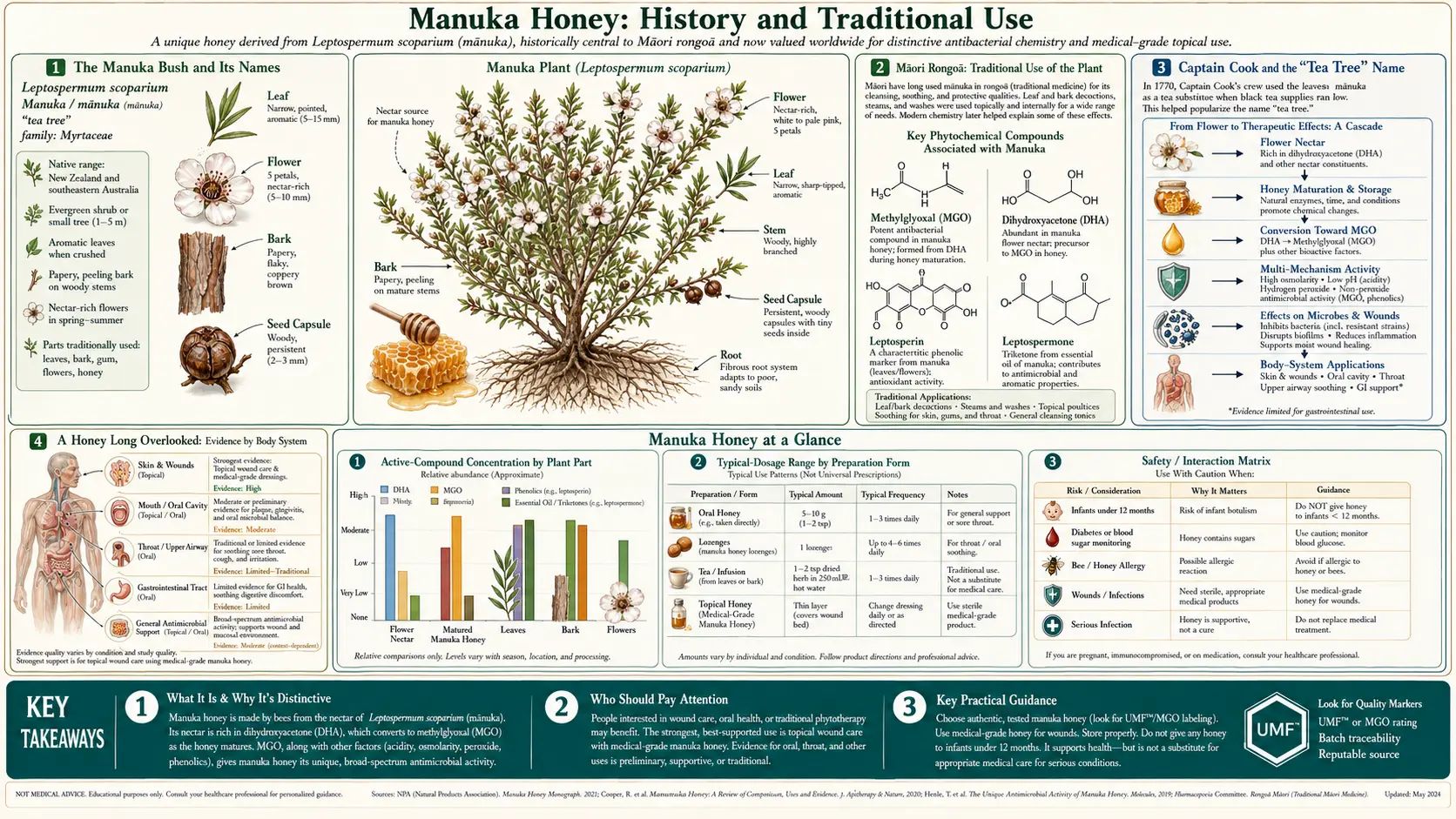
Manuka honey has two histories woven together. The older one belongs to the manuka bush itself (Leptospermum scoparium), a hardy New Zealand shrub whose leaves, bark, gum, and sap were used as medicine by Māori for centuries before Europeans arrived. The newer one belongs to the honey made from its flowers — a substance that sat in New Zealand kitchens as an ordinary table honey until, in 1981, a Waikato University biochemist began asking why it killed bacteria that other honeys could not. This article traces both stories honestly, marking tradition as tradition and naming real people only for milestones that the published record actually documents.
Table of Contents
- The Manuka Bush and Its Names
- Māori Rongoā: Traditional Use of the Plant
- Captain Cook and the “Tea Tree” Name
- A Honey Long Overlooked
- Peter Molan and the 1981 Discovery
- Finding the Active Ingredient: MGO (2008)
- Grading, Authenticity, and a Legal Definition
- From Folk Honey to the Hospital Ward
- From Tradition to Modern Research
- Research Papers and References
- Connections
- Featured Videos
The Manuka Bush and Its Names
Before there was manuka honey, there was the manuka bush. Leptospermum scoparium is an evergreen shrub of the myrtle family (Myrtaceae), native to New Zealand and parts of southeastern Australia, that grows readily on disturbed ground, coastal slopes, forest margins, and regenerating land. In New Zealand its Māori names are mānuka and kahikātoa; in Australia the same and closely related Leptospermum shrubs are often called tea tree or, in the case of the jelly bush, given their own regional names. Its small white-to-pink flowers open for only a few weeks in the southern-hemisphere summer, which is why the honey made from them has always been a seasonal, limited crop.
It helps to clear up a long-standing tangle of names at the outset, because the word “tea tree” attaches to more than one plant. The manuka of manuka honey is Leptospermum scoparium. The tea tree oil sold for skin and antiseptic use is a different Australian plant entirely, Melaleuca alternifolia, also in the myrtle family but not the source of any honey. The two are frequently confused precisely because early English-speaking settlers applied the loose label “tea tree” to several aromatic Myrtaceae shrubs they brewed as a tea substitute. For honey, only Leptospermum matters.
Māori Rongoā: Traditional Use of the Plant
The documented medicinal history of manuka begins with Māori, who settled New Zealand several centuries ago and incorporated the plant into rongoā Māori, the traditional system of healing. Ethnobotanical records held by New Zealand institutions, including Landcare Research's database of Māori plant use and the collections described by Te Papa (the national museum), document that nearly every part of the manuka bush — leaves, bark, gum, sap, seed capsules, and flowers — was put to use, both internally and externally. It is important to be clear that this tradition centres on the plant; the therapeutic use of the honey in particular is a much more recent and largely modern development.
The traditional uses that the ethnobotanical record describes include the following. An infusion or decoction of the leaves was taken for colds and as a febrifuge (to bring down fever), and the leaves were boiled so the hot vapour could be inhaled to relieve head colds and congestion. Leaves and bark were boiled together and the warm liquid rubbed on stiff backs, aching muscles, and rheumatic joints. Preparations of the bark were used as a sedative and to settle the stomach and bowels, and bark decoctions were applied as a wash for skin complaints, with ash from the burnt bark also rubbed on the skin. Oils and poultices made from the bark were laid on wounds, while the white gum (called pai Māori) was, by tradition, given to nursing infants and applied to scalds and burns. The plant is also recorded as having been used as a diuretic, an analgesic, and in the care of inflamed breasts and fractures.
These uses describe past cultural practice as preserved in the ethnobotanical literature; they are recorded here as tradition and history, not as modern medical recommendations, and they concern the bark, leaves, and gum of the shrub rather than the honey. What matters historically is the picture they paint: long before any laboratory looked at it, the manuka bush was understood by the people who lived among it to be antiseptic, soothing, and broadly useful for wounds, skin, fevers, and the chest — the same broad territory in which the honey would later be studied.
Captain Cook and the “Tea Tree” Name
The first sustained European contact with New Zealand came with the voyages of Captain James Cook beginning in 1769. It is commonly recounted — and reflected in the plant's enduring colloquial name — that Cook and the early settlers brewed the aromatic green leaves of manuka and the related kānuka into a tea-like drink, which is how the shrubs came to be called “tea tree” in New Zealand. Accounts from the era also describe leaves being used to flavour a rough beer. These details belong to the early-contact and settler record and are repeated in New Zealand botanical and conservation sources today; they are presented here as the traditionally received account of how the “tea tree” name arose.
The episode is worth noting for one reason in particular: it is the origin of a naming confusion that still misleads shoppers two and a half centuries later. Because Cook-era English speakers used “tea tree” for manuka, and because Australians later used the very same phrase for the unrelated Melaleuca whose oil became a popular antiseptic, the two plants are perpetually muddled. Manuka honey comes from the New Zealand “tea tree” (Leptospermum scoparium); tea tree oil comes from a different plant and has nothing to do with honey.
A Honey Long Overlooked
For most of the period that Europeans kept bees in New Zealand, manuka honey was not prized at all. Honeybees (Apis mellifera) are not native to New Zealand; they were introduced by European settlers in the nineteenth century, and only then did a honey made from manuka nectar begin to be produced in quantity. Manuka honey is dark, strongly flavoured, and notoriously thixotropic — it sets into a gel that is awkward to extract from the comb — and for generations many beekeepers regarded it as a low-value or even nuisance crop compared with lighter, milder clover honey. The idea that this particular honey was something special, let alone medicine, is not part of the deep traditional record; it is a discovery of the late twentieth century.
That said, honey in general has an ancient reputation as a wound dressing that long predates anything specific to manuka. Honey's use on wounds and burns is recorded in Egyptian, Greek, and other early medical traditions, and the practice never entirely disappeared from folk medicine. What the modern manuka story adds is not the idea that honey can help a wound — that is genuinely old — but the discovery that this one honey possesses an unusual, heat-stable antibacterial activity that ordinary honeys lack. Establishing that fact, and explaining it, is the work of the scientists in the sections that follow.
Peter Molan and the 1981 Discovery
The turning point in manuka honey's history has a date and a name. Professor Peter Charles Molan (1943–2015) was a biochemist who moved to New Zealand in 1973 to take up a lectureship at the University of Waikato in Hamilton, where he established the institution's first biochemistry course. In 1981, encouraged by a member of the local beekeeping community, he began investigating the antibacterial properties of New Zealand honeys — and found that manuka honey behaved unlike the rest. This early work, carried out with collaborators including Kerry Simpson, is widely credited as the start of the scientific study of manuka honey's medicinal activity.
To understand why his finding mattered, it helps to know that all raw honey has some antibacterial power, mostly because an enzyme the bees add (glucose oxidase) slowly generates small amounts of hydrogen peroxide. But that “peroxide activity” is fragile: heat, light, and an enzyme called catalase — present in blood and body tissue — quickly destroy it. Molan's key observation was that manuka honey kept much of its antibacterial activity even after the hydrogen peroxide was deliberately neutralised. Something else in the honey, a stable non-peroxide factor, was doing the work. A landmark 1991 survey of New Zealand honeys that Molan published with K. L. Allen and G. M. Reid placed manuka's unusual activity on a firm comparative footing against hundreds of other samples, measured against a phenol (carbolic acid) standard.
Molan named this distinctive property the Unique Manuka Factor (UMF), a term that became the basis of the honey's later grading system, and in 1995 he established the Honey Research Unit at Waikato. Over roughly three decades he authored a large body of peer-reviewed work and campaigned, against considerable initial scepticism, for honey to be taken seriously as a wound-care agent. He was appointed a Member of the Order of the British Empire (MBE) in the 1995 Queen's Birthday Honours for his services to honey research, and died in 2015. It is fair to say that without Molan's persistence, manuka honey would very likely still be regarded as an ordinary, if strong-tasting, table honey.
Finding the Active Ingredient: MGO (2008)
Molan had shown that manuka honey carried a stable, non-peroxide antibacterial factor, but for years no one knew exactly what the chemical was. The answer came in 2008 from Germany. A team at the Institute of Food Chemistry, Technische Universität Dresden — Elvira Mavric, Silvia Wittmann, Gerold Barth, and Professor Thomas Henle — published a study identifying and quantifying methylglyoxal (MGO) as the dominant antibacterial constituent of New Zealand manuka honey. They found MGO in manuka honey at concentrations dramatically higher than in ordinary honeys, and the amount of MGO tracked closely with the honey's antibacterial strength. This finally gave the “Unique Manuka Factor” a concrete chemical identity that could be measured in a laboratory.
The following year, in 2009, a New Zealand group — C. J. Adams, M. Manley-Harris, and Peter Molan — explained where that MGO comes from. They showed that the manuka flower's nectar is unusually rich in a compound called dihydroxyacetone (DHA), and that as the honey matures, DHA is slowly converted (by a non-enzymatic chemical reaction) into MGO. Freshly harvested manuka honey is high in DHA and low in MGO; over the following weeks and months, the DHA turns into MGO and the honey's antibacterial potency rises. This is why the same batch of manuka honey can test stronger after some months of storage, and it explains the whole chain — flower to nectar to DHA to MGO — in plain chemical terms.
Grading, Authenticity, and a Legal Definition
Once it was clear that manuka honey could be genuinely potent — and command a high price — two practical problems followed: how to tell a strong jar from a weak one, and how to tell real manuka honey from cheaper honey fraudulently labelled as manuka. Both problems shaped the next chapter of the story.
On potency, two grading systems came into common use. The older, UMF (Unique Manuka Factor), grew out of Molan's phenol-comparison method and is administered by the industry's UMF Honey Association; a higher UMF number means stronger antibacterial activity. The newer, MGO, simply states the measured concentration of methylglyoxal in milligrams per kilogram, following directly from the Dresden team's 2008 work. The two scales are related but not identical, because UMF also takes account of additional markers. Notably, Molan himself withdrew his support from the UMF trademark around 2008–2009 and set up a separate “Molan Gold Standard” mark, a reminder that the grading landscape has been contested as well as commercial.
On authenticity, chemistry again supplied the tools. In 2012, a Japanese group led by Yoji Kato (University of Hyogo) identified a distinctive glycoside in manuka honey, which they named leptosin (the compound is also known as leptosperin). Because it is found abundantly in Leptospermum honeys and is comparatively heat-stable, it serves as a useful chemical fingerprint of genuine manuka honey. Most decisively, the New Zealand Ministry for Primary Industries (MPI) introduced a legal scientific definition of manuka honey for export, which came into effect on 5 February 2018. To be sold as monofloral manuka honey, a product must pass a test combining a DNA marker for Leptospermum scoparium pollen with four specific chemical markers (3-phenyllactic acid, 2-methoxyacetophenone, 2-methoxybenzoic acid, and 4-hydroxyphenyllactic acid). This government standard, rather than any single industry trademark, is now the formal benchmark for what may legally be called New Zealand manuka honey.
From Folk Honey to the Hospital Ward
The most striking turn in manuka honey's history is its passage from a folk remedy into approved clinical use — the rare case of a traditional substance being adopted, rather than merely tolerated, by mainstream medicine. The decisive regulatory step came in the United States in July 2007, when the Food and Drug Administration cleared the first manuka-honey-based wound and burn dressings (marketed under the Medihoney brand, originally developed by Derma Sciences and now part of Integra LifeSciences) for medical use. Medical-grade products of this kind are made from honey that is filtered, standardised for activity, and sterilised by gamma irradiation, so that clinicians get a consistent, contaminant-free dressing rather than a jar of table honey.
Alongside formal clearance, manuka honey dressings were taken up in wound-care practice in New Zealand, the United Kingdom (including within parts of the National Health Service), and elsewhere, chiefly for chronic and infected wounds — leg ulcers, pressure sores, diabetic foot ulcers, burns, and surgical wounds — and especially where antibiotic-resistant organisms were involved. The honey's appeal in this setting is the combination of a broad antibacterial action that bacteria seem unable to grow resistant to, a moist healing environment, and the control of wound odour.
A note of honesty belongs here, because real patients read pages like this one. Manuka honey's strongest evidence is topical — on the skin and on wounds — and even there, clinical trial results have been mixed and reviewers continue to call for larger, better studies. The historical fact that a honey earned a place in the modern wound clinic is genuinely remarkable, but it does not make manuka honey a cure-all, and it is not a substitute for proper medical care of a serious wound or infection. The detailed clinical evidence, dosing, and grading guidance are covered in the companion Benefits articles, including Wound Healing and the Antimicrobial Spectrum.
From Tradition to Modern Research
Manuka honey's history is unusual among herbal remedies in how cleanly it splits into a long traditional phase and a short, well-documented scientific one. The traditional phase belongs to the plant: for centuries, Māori used the leaves, bark, and gum of the manuka bush as an antiseptic, soothing, broadly useful medicine for wounds, skin, fevers, and the chest. The scientific phase belongs to the honey, and it can be dated almost to the year — from Molan's 1981 observation of a stable non-peroxide factor, through the 1991 survey that benchmarked it, to the 2008 identification of methylglyoxal, the 2009 explanation of its origin in nectar DHA, the 2012 authenticity marker, and the 2018 legal definition.
The thread that links the two phases is the honest one: people noticed, long before they could explain it, that the manuka plant helped wounds and infections, and modern chemistry has since supplied a concrete reason why its honey, in particular, is antibacterial. That continuity — from a Māori bark poultice to an FDA-cleared wound dressing — is what makes manuka honey's history worth telling. It is also a useful caution: tradition raised a real question, and research answered part of it, but the answer is specific (a measurable topical antibacterial effect), not a licence to treat the honey as a remedy for everything.
Research Papers and References
The references below pair the key peer-reviewed milestones in manuka honey's scientific history with curated PubMed topic-search links into the ethnobotanical and clinical literature. Author names, titles, and journals are given as plain text; only the DOI or PMID is hyperlinked, and each opens in a new tab. New Zealand ethnobotanical and government sources (Landcare Research's Māori plant-use database, Te Papa, and the Ministry for Primary Industries) are named in the article as institutional sources of the traditional and regulatory record.
- Allen KL, Molan PC, Reid GM. A survey of the antibacterial activity of some New Zealand honeys. Journal of Pharmacy and Pharmacology. 1991;43(12):817-822. — doi:10.1111/j.2042-7158.1991.tb03186.x (PMID 1687577)
- Mavric E, Wittmann S, Barth G, Henle T. Identification and quantification of methylglyoxal as the dominant antibacterial constituent of Manuka (Leptospermum scoparium) honeys from New Zealand. Molecular Nutrition & Food Research. 2008;52(4):483-489. — doi:10.1002/mnfr.200700282 (PMID 18210383)
- Adams CJ, Manley-Harris M, Molan PC. The origin of methylglyoxal in New Zealand manuka (Leptospermum scoparium) honey. Carbohydrate Research. 2009;344(8):1050-1053. — doi:10.1016/j.carres.2009.03.020 (PMID 19368902)
- Kato Y, Umeda N, Maeda A, Matsumoto D, Kitamoto N, Kikuzaki H. Identification of a novel glycoside, leptosin, as a chemical marker of manuka honey. Journal of Agricultural and Food Chemistry. 2012;60(13):3418-3423. — doi:10.1021/jf300068w (PMID 22409307)
- Ministry for Primary Industries (New Zealand) — ensuring mānuka honey is authentic (scientific definition; in effect 5 February 2018). — mpi.govt.nz: mānuka honey testing
- Landcare Research — Ngā Tipu Whakaoranga (Māori plant-use database): Leptospermum scoparium (mānuka / kahikātoa) — maoriplantuse.landcareresearch.co.nz
- Manuka honey antibacterial activity and methylglyoxal — PubMed: manuka honey methylglyoxal antibacterial
- Manuka honey wound healing clinical evidence — PubMed: manuka honey wound healing clinical trial
- Leptospermum scoparium traditional and ethnobotanical use — PubMed: Leptospermum scoparium ethnobotany
External Authoritative Resources
Connections
- All Herbs
- Manuka Honey Hub
- Manuka Honey Benefits
- Manuka Honey for Wound Healing
- Manuka Honey Antimicrobial Spectrum
- Tea Tree
- Echinacea
- Garlic
- Myrrh
- Goldenseal